
bout de papier, Vol. 20, No. 2 (2003) — Fall/Winter 2003 // Automne/Hiver 2003, pp. 15–21
In mid-November, the Prime Minister of Canada — a former Secretary of State for External Affairs, who had first been elected to the House of Commons nearly forty years earlier, who had led the Liberal Party of Canada to three consecutive electoral majorities and who had kept his successor (and current leader of the party) waiting for more than three months while he continued to head the government — finally stepped aside. The man kept waiting in the wings was sixty-five years old. Does this sound familiar?
Whatever the similarity in circumstances, the transition in 1948 differed considerably from the one underway now. Perhaps the best evidence of that fact is the account of the formal hand-over of authority which was recorded by William Lyon Mackenzie King in his voluminous diary. Although the entry has been edited for length, the extracts below convey the obvious relief of King at his departure and the apparent reluctance of Louis St. Laurent to take over the responsibilities of the office.
For those who want to learn what else happened on that day — or any other — the diary of our dearly departed former prime minister is available as inspirational reading on-line via the Library and Archives of Canada at http://king archives ca/
Laurier House, Monday, Nov. 15, 1948.
At the time of waking this morning, my thoughts were mostly of my sister Isabel [King, 1873-1915], the anniversary of whose birthday is today. A most lovely character. One who I believe has been watching over and helping to direct my life. I also thought of this being the day of my retirement from public office. This thought brought no regrets with it — only a sense of joy and peace at seeing before me an absence of pressure and a promise of a larger freedom.
I read the papers for a time appreciating very much an editorial in the Citizen.
After reading I began immediately a letter by hand to the Governor General [Viscount Alexander of Tunis] … As I looked out of the window, I saw the first flurries of snow. Having had to re-write the letter to the Governor General, I had just time to leave Laurier House at about fifteen to eleven a.m. to arrive at Government House a little before eleven.
I had asked [J. Edouard] Handy [King’s confidential secretary] to accompany me and we also took with us little Pat [King’s third Irish terrier of that name] whom Handy held on the way down. This being an historic occasion, I was anxious that it should have associations with Handy and was glad also to have Pat in the car.
When I went out of the front door, a reporter and a photographer were nearby — see press accounts in the Citizen of today.
Before leaving Laurier House, I said Good-Bye as Prime Minister to members of the staff. Went into the kitchen to shake hands with Mrs. Gooch.
On reaching the car, I noticed two little boys who were standing on the sidewalk near the car. I shook hands with them as I got into the car.
As we reached the Government House grounds, I pointed out to Handy that the hands of the clock were together at five to eleven. We noticed that the grounds were covered with snow. Snow was falling quite freely. It was a beautiful sight – the first of the change of the season.
At Government House door, photographers were there in numbers. I was met according to plans by [Maj. Desmond] Chichester [Aide-de-Camp] and General [H.F.G.] Letson [Secretary to the Governor General]. I went immediately to the Governor General’s apartment — to the circular room where His Excellency was waiting. When announced, Lord Alexander came forward and shook hands very warmly. He lead me over to near the fireplace and asked me to take a seat and to be comfortable.
I thought it well not to sit down but to begin at once to speak of the purpose of the visit. In conversation I said pretty much what I had written in the letter — that as His Excellency knew I had for some time been anxious to retire, that I had come this morning to tender my resignation as Prime Minister and hoped it might be accepted
I added that I shall miss very much the official and personal relations I had been privileged to share with him in the time he had been in Canada. But apart from that and some natural regret at breaking other old associations, I really would feel a great relief once I was out of office. I thought this was the right time to have a successor appointed. His Excellency said something to this effect: “Well! Mr. King, I need not tell you how sorry I am that you feel it necessary to tender your resignation, but knowing what the circumstances are, I shall as the King’s representative be prepared, as it is your wish, to accept it. Who would you advise me to send for to form a new administration?” I replied without question, Mr. [Louis| St. Laurent [Minister of Justice and Attorney General]. He, as Your Excellency knows, was chosen Leader of the Liberal Party by a very large majority at the Convention [in August 1948]. He, I believe, is able to command the majority in the House of Commons, and will be able to do so more effectively than any other Member of the House. Mr. St. Laurent, as you know, has exceptional qualifications for the position of Leader, and I would feel that Your Excellency could have no better Advisor in the position of Prime Minister. His Excellency then said: “I shall act on your advice and send for Mr. St. Laurent and see if he is prepared to form a Ministry. I would like however to ask you to continue in office until I have ascertained from Mr. St. Laurent what he is prepared to do. I shall send for him at once. He may wish to consult others before giving me a final word. If so, I would let you know the time at which I will be able to inform you officially that Mr. St. Laurent is prepared to assume the responsibilities of office. I will hold your resignation meanwhile. Later when Mr. St. Laurent is here and prepared to take office, I will formally accept your resignation.” His Excellency went on to say: “I did not say to you how much I regret that you have found it necessary to retire. Our relations have been exceptionally pleasant nor do I forget at this moment that it is to you that I owe my appointment as Governor General. I shall hope we may continue to see much of each other. You will always have friends here at Government House and much more to the same effect. I said: “I thank Your Excellency very much for what you have just said. There is only one thing you have said, if I may be allowed to say so, that I must take exception to and that is that you owe your appointment to myself. I added, you owe your appointment to the fact that you are Lord Alexander of Tunis. My colleagues and I felt our country would be honoured if you would accept the appointment, that it would meet with the approval of the people of Canada, generally.” Alexander replied: “You pay me a very high honour in what you have just said. I thank you very warmly.? I did not wait to sit down but said I thought I should withdraw. When Lord Alexander went to press the bell for Letson, we had a word about the arrival of the young Prince [the birth of Prince Charles] yesterday. … His Excellency then said he would like to accompany me to the front door.
He had sent word earlier to the photographers that he would appear there.
When we reached the stairs which lead to the outer door, the photographers were lined up at the foot of the stairs, taking some snap-shots. I was asked to shake hands with His Excellency.
I should add that before coming away when our formal conversation had ended, I withdrew from my pocket the letter I had written and handed it to His Excellency. I said I had written a short note this morning which I would like to hand to him and I handed it to him unsealed
At the door I was asked to shake hands with His Excellency. We then shook hands. We were asked later to do so again at which the Governor replied I cannot shake hands too often with Mr. King.”
After the photographing was over, I put on my coat and rubbers. As I went out of the doors, the photographers asked a question or two. I told them that I had tendered my resignation but that His Excellency had asked me to continue on in office until sometime in the afternoon, until Mr. St. Laurent was prepared to take over.
One reporter remarked you are still Prime Minister to which I acquiesced. He asked me what my future plans were. I said that remained to be seen, but intimated that I was very happy and already felt the joy of the new freedom. It was quite apparent I am sure from my manner that this was no affectation. I did feel a tremendous relief.
Photographs were then taken anew of Handy and myself in the car, and then we drove off with Pat back to Laurier House.
On coming into Laurier House, hands of the clock were in a straight line at 11:25.
After coming to the library, I phone Joan Patteson, King’s close friend] to let her know how relieved and happy I felt. D.W.] Pickersgill [Principal Secretary to the Prime Minister had mentioned that the Canadian Broadcasting Corporation were anxious to have a short broadcast, and he submitted a draft which had been prepared. It has been prepared as if the broadcast was being made at night. I told Pickersgill I would like to read it while I was still Prime Minister. He thought there might be some constitutional difficulties in telling anything that had passed between the Governor and myself. I said I thought I could so word the message that any difficulty on that score would be avoided. What I wanted to do was to send a message to the People of Canada, to let them know that my last thoughts were related to the confidence that they had expressed in myself and colleagues over so long period of time.
I was at work on this when Stuart Garson arrived. He had asked to see me while I was still Prime Minister and before he was sworn in [as Minister of Justice and Attorney General]. He came at twelve and we talked together in my library before the fire. I told him how pleased I was at his having agreed to enter the Ministry. That I believed that he had taken the right step. That it was necessary to have experienced men in Government at Ottawa. That I thought the Government would be greatly strengthened by his presence and that of [Lester B.J Pearson [Secretary of State for External Affairs]. Garson said he was much concerned about the situation as he left it [when he resigned as Premier] in the Province [of Manitoba]. That he did not know how the coalition would keep together. He had witnessed one of the roughest scrapes between some of them after he had left which he felt he could have settled in a moment if he had been still at the head of affairs. I told him that was inevitable where men were seeking position that they would soon get together. I also told him of my talk with [Victor] Sifton in London that the Winnipeg Free Press would have to help to keep the Party together:
I spoke of the address he had given on Communism. He said I hoped he would use that to explain the position in an intelligent way. I also spoke about the wisdom of avoiding too much in the way of commitments. I felt that was one of the dangers that our Government was being drawn into world affairs to the extent that I questioned the wisdom of. He said to me that he had in all the years he had been Prime Minister, never made a commitment in advance. He had always watched against that carefully. He agreed there were real dangers along the idea that I had indicated. I also spoke about watching expenditures and extravagance in administration — not trying to do more than we could do in the right way. He said to me that he would have liked to have made the severance he had earlier – would liked to have been a member of my government but that he held back through fear of the consequences of his leaving the Government of Manitoba. He emphasized that two or three times he really would have liked to have come in and to have been a member of my administration first.
This was doubly interesting in view of something that appeared in Saturday Night news items that he had not entered the Government sooner as he may not have wished to come in with me. What mischief makers men are!
He then spoke about hoping he might come and talk over matters with me from time to time. I told him I should be delighted to see him at any time. While we were talking, a typewritten note was handed to me to the effect that an announcement had come over the Press that a scholarship of a $1,000 for Research and External Affairs Dept had been established by friends of mine at the University of Toronto who wished the scholarship to be known as the “Mackenzie King Scholarship” etc.; this was really a delightful surprise.
I showed the communication to Garson.
I had arranged to see [Gordon] Fogo the President of the National Liberal Federation at half past twelve. He arrived at that time and we talked for some little while.
I thanked Fogo anew for his part at the Convention and the assistance the Federation had given me.
He spoke of the present political situation and of my feeling that the Government had been much strengthened and should with effective organization be able to carry the next election. The conversation was more or less general. The visit was indeed a complimentary one on this day. It was particularly nice having a chance on the last day of office to thank Fogo for what the Federation had done.
Later in the afternoon a box of three dozen roses was left at Laurier House with greetings from the Federation signed by Fogo.
During the morning a large box of chrysanthemums and other flowers came from [Baron] Silvercruys [Ambassador of Belgium to the United States] in Washington. Still later, there was another lot of chrysanthemums delivered at Laurier House.
I continued a draft of the broadcast until about a quarter past one when I had luncheon in the dining-room. I was glad to have this period in that room with its associations and paintings.
After lunch I dictated the broadcast to Handy and at 3 o’clock I delivered it in the dining-room. Meanwhile, I also sent a telegram to the President and Secretary of the Glengarry Constituency [which King had represented since a by-election in 1945] to let them know they were in my thoughts in the last hours as Prime Minister.
I also sent a telegram to Violet Markham whose interest in my political career has been longer than that of any other friend.
I phoned to Sir Lyman Duff [Chief Justice of the Supreme Court of Canada] to thank him for an exceptionally fine letter which came from him yesterday.
I then dictated a letter to President [Harry S] Truman.
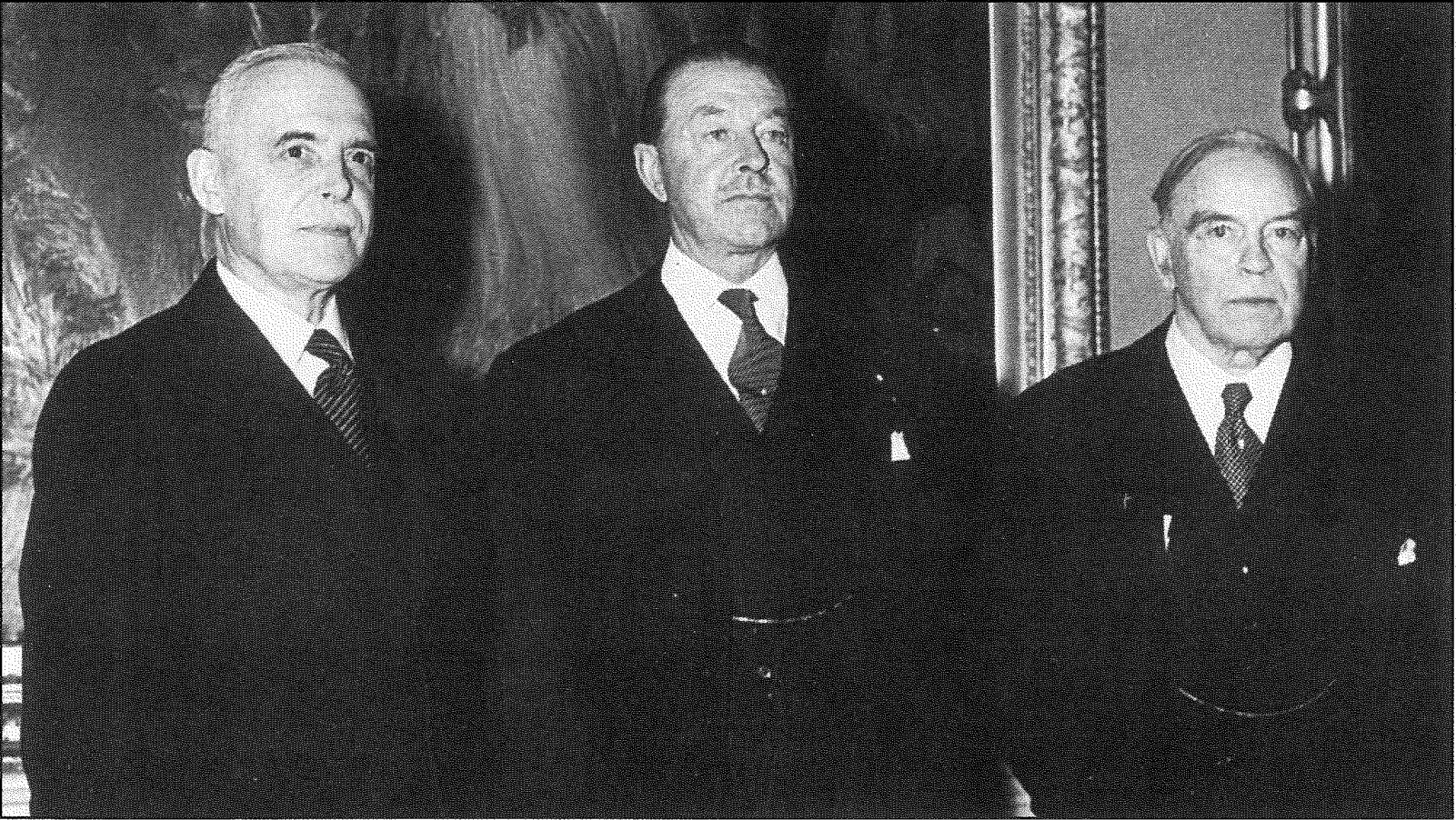
Louis St. Laurent is sworn in as Prime Minister at Government House on General Lord Alexander, W.L.M. King.
Pickersgill had arrived in time for me to go over the broadcast with him and Handy in the dining-room
They were present when I delivered it. Little Pat was also lying under the table. I was glad to see the little fellow there. The other Pat was in the same place on a previous occasion.
While we were arranging the broadcast equipment, something was said about it being an interesting time — the birth of a baby etc., and I added the passing of a Prime Minister. Altogether, all of us felt very happy.
In broadcasting I had the picture of Sir Wilfrid [Laurier] behind me. The broadcaster had arranged it and I was able to enjoy the other paintings from where I sat. I said Good-Bye as Prime Minister to Pickersgill as I was just about to go up in the elevator and thanked him for his help over the years. I only had time for about 7 minutes’ rest before leaving to go to Government House.
I went down alone and was met at the door again by a barrage of photographers. I was met by General Letson who took me to the Governor General’s room.
When I entered the Governor General and St. Laurent who had been seated near the Governor’s desk, both rose and came over and shook hands with me.
His Excellency said something about Mr. St. Laurent being prepared to take over the Government but before he said anything further, St. Laurent said himself that it was with great misgivings. He began to speak to the Governor and myself of what it would mean to others not to have me continue in office. He spoke of my experience, etc.
I replied that I had no misgivings. That I knew the Government was very fortunate to have him at its head. His Excellency then said that as Mr. St. Laurent was prepared to form a Ministry and had submitted his slate, he would as the King’s Representative accept my resignation, but he spoke again of my long service to the Country and also brought in a reference to the Commonwealth and of our happy relations.
When my resignation had been accepted, I looked toward His Excellency to see if he was not about to shake hands with Mr. St. Laurent. This he did. I then shook hands with St. Laurent myself and wished him all that was best. I thanked him for relieving me of the responsibilities of office and said to His Excellency that I would like to congratulate him on his first Minister.
The three of us had a very pleasant talk together. [Arnold D.P.J Heeney [Clerk of the Privy Council and Secretary to the Cabinet] was then brought in to arrange the books for the Ministers signatures. While this was being done, something was said about a residence for the Prime Minister, that I hoped that would be arranged at once. … His Excellency seemed quite concerned about the situation and much in earnest. I should not be surprised if he would inspire something. He then said: “Will you still obey orders?” I said yes, if they came from him. He said: “Well, there is a seat for you. I would like you to sit down and not to remain standing.” He had an armchair placed at the side of his desk from where I would be facing Mr. St. Laurent and the Ministers as they were being sworn and also to be near the rest of the Cabinet as they came in.
Members of the Cabinet were then brought in. They all came over and shook hands with me. Afterwards, I remained seated through the swearing-in ceremonies. The Governor then asked me if I would sign as a witness the swearing-in of St. Laurent as Prime Minister and of the two new Ministers. He gave me a particular pen to sign with.
Later when the signing was all over, he handed me the pen in a case, saying he would like me to have this as a souvenir of the occasion. I thanked him saying he had always been so kind and saying this was the last of his kindnesses. T really meant the latest. Someone there said there would be a good many more. He mentioned that he had had the pen engraved. I later thanked him personally very warmly.
His Excellency then asked me if I would join Mr. St. Laurent and himself to go and have a photograph taken. The three of us were to have been photographed together. All the other Ministers then followed. The first photograph was taken in the nature of the three — the Governor, Mr. St. Laurent and myself being seated. Then other photographs were taken with the other Ministers standing, some partly seated. A photo was taken in front of the large painting of Queen Victoria. There were several pictures taken. Finally, one with the Governor General, St. Laurent and myself again. Later on, one with St. Laurent and myself. His Excellency then took me over to the drawing-room where the Members of the Cabinet were being photographed. In the drawing-room, I met Madame [Jeanne (Renault)] St. Laurent and extended warmest congratulations to her, the new Lady-in- Waiting [Miss Anstice Gibbs] — a very pleasant young lady – was also present. I had a few moments’ talk with her. I was also delighted to meet St. Laurent’s three daughters.
Her Excellency [The Viscountess Alexander of Tunis] and Madame St. Laurent sat on a sofa and talked until the Cabinet began to come in and their wives. The table was arranged in a corner of the room with refreshments, sandwiches, Champagne, etc. After all were assembled, His Excellency said he had two toasts to propose. He then proposed a toast to myself in which he spoke of the regret felt at my relinquishing office, of the years of service and referred in the nicest possible way to the latter. He then proposed a toast to the new Prime Minister Mr. St. Laurent in which he spoke in an equally felicitous manner of his taking on the responsibilities of office. A little later in the afternoon some of the representatives of the nations of the Commonwealth and their wives came. There were only three I think, Lady Clutterbuck and her husband [Sir Alexander], Mr. and Mrs. [John J.] Hearne and the Australian Ambassador [sic: High Commissioner Francis Michael Forde] and his wife. His Excellency then proposed another toast which was to Princess Elizabeth and the Royal Prince to wish them health and happiness, etc.
Shortly after, Mr. St. Laurent and the Ministers withdrew to attend the Cabinet meeting. I remained for a short time having a pleasant conversation with the wives of my former colleagues. I then said Good-Bye to Their Excellencies. I felt remarkably happy having had this little reunion with my Colleagues and their wives, and with friends at Government House.
It was about 5:25 p.m. when I reached Laurier House – both hands together.
As the power was to go off at 5:30 I took a chance in getting up to the library in time. I phoned to Joan to let her know I was now a free man. While talking to her on the phone, the lights went out. I had previously had King bring candles. He brought two silver candles and placed them on either side of flowers which were in the centre of the table. As I looked across, I could see my grandfather’s picture, also my mother’s picture very distinctly. It gave the whole room the appearance of a Chapel and with the lights at the end like an altar.
I often thank God for having watched over me and directed my ways — for having saved me from many pitfalls in the way of life thus far, and prayed very earnestly for power to make my life of service to my fellow-men for the remainder of my days.
The table had become literally heaped with telegrams. I gathered up some of these and took them downstairs, carrying a lighted candle with me. I went to bed shortly after six and slept until 7:45 p.m. I had just wakened when Arnold Heeney and Pickersgill called to have a few words at the close of the day. We had a nice talk together. … I then had dinner in bed about eight.
After dinner opened the telegrams until the news came at 10 o’clock…
I listened to the news with great interest. And later to the roundup of news. There was a special reference to the day’s proceedings concluding the broadcast.
After this when it was completed, I was glad to turn out the lights and to enjoy the quiet and the rest of my bed as I have not enjoyed it for a long time past.
View the original scanned pages →
Originally published in bout de papier, Vol. 20, No. 2 (2003) — Fall/Winter 2003 // Automne/Hiver 2003, pp. 15–21. Read the rest of this issue →



