
bout de papier, Vol. 20, No. 4 (2004) — Spring/Summer 2004 // Printemps/Été 2004, pp. 44–47
I sat on the veranda of a small temple in a quiet Chinatown garden surrounded by low buildings. Bright flowers edged winding paths and a stream trickled among weathered stones. Three black and white birds swooped among the temple eaves, the mid-afternoon sun glinting off their iridescent tail-feathers. I pointed them out to the man beside me, who looked up from a lapful of legal papers, muttered, “Corvids. Pica pica, or perhaps pica nuttall,” and dived back into his work. D Essex Mackinaw isn’t exactly a founding father of the Sons of Fun. Most people’s PDA is a Blackberry, he carries a Prune. But he was a paying client, so I was prepared to cut him some slack.
We had been waiting half an hour for my guy Friday to show up. Effie had taken a long lunch
– he’d been gone since Thursday, It was for a good cause — he helped a literacy project fronted by a band called Rock Bottom Remainders (motto: Learn to Read or We’ll Come Back and Sing “MacArthur Park” Again). But enough was enough. Making small talk with Mackinaw was like gargling with sand. So I asked him what he wanted. He replaced the stylus in the PDA and said, “We were on opposite sides of the Zabaglione case, but I admired your work. When another client got into difficulty, I thought of you. As you know, a man called Louie Lee was recently killed on this veranda.” I’d read about the case. And I knew Loquat Louie, from growing up nearby. Louie was a fruit-seller who saved me more than once from the street gangs. He taught me a lot, and I felt bad I hadn’t seen him for years. Mackinaw went on. “After retirement, Mr. Lee lived in this temple and tended the garden, an inheritance from his father. The rest of the block is owned by his brother-in-law, motorcycle magnate C Harley Chan. Ten days ago, Mr. Lee’s teenage son, Hai, brought dinner to the panda living behind the temple. Then he entered the temple to pick up three of his Uncle Harley’s hardwood statues for repair. Thereby becoming the proverbial bear-food boy.”
“…with teaks of Chan,” finished Effie, coming up behind him. Neither cracked a smile. Uncanny. Mackinaw said, “Hai Lee stumbled over his father’s body at the foot of the steps. The old man’s cane is still leaning against the railing there. Atter talking to witnesses, the police arrested Hai Lee for the murder. The evidence against him is as follows. First, he and Mr. Lee had a loud argument earlier that day in this garden. Several small thefts had taken place around the block, and Mr. Lee concluded his son was responsible. He threatened to call the police unless Hai Lee confessed on his own. Hai Lee denied the accusation in the most violent terms. Second, the blow that killed Mr. Lee was delivered by one of the statues that Hai Lee had been sent to obtain. He told the police that there were only two in the temple and he found the third beside his father’s body. Finally, Hai Lee’s cellphone was beneath Mr. Lee’s body. Hai Lee says he had given the phone to his father the previous day, when Mr. Lee expressed fear that he was being followed. The police are scornful.”
“Tough breaks for the kid,” I said to Mackinaw. “Who else had the chance and a reason to cosh poor Louie?” Mackinaw replied, “The street gates to the garden were locked, but the tenants of five buildings have direct access to the garden, so it could have been any of them or their henchmen. No-one has an alibi. As to motive, all five were pressing Mr. Lee desperately to sell the garden, but he refused. Hai Lee is his father’s heir and shared his views on preserving the garden, but a murderer cannot inherit from his victim. If Hai Lee is convicted, the property will go to Mr. Chan. I believe that my client is innocent of both murder and theft, however. So who was following Mr. Lee? And who is the thiet? Either could be the murderer as well.” I said, “Good questions. If we want the police to release Hai Lee, we’ll have to give them the real crooks. First, we’ll need more on the other suspects. Will they see us?” Mackinaw nodded. “I’ve already taken the liberty of contacting them. As executor of the Lee estate, I told them that had hired you to look into the thefts. I am confident that you will be able to work other questions into the conversation.” We set out.
Harley Chan greeted us in his apartment above the motorcycle showroom. His head wrapped in bandages, he looked like Claude Rains playing the invisible man. “It’s tough to talk about this,” he began, “but my medical condition is important to understanding the theft. The men in my family have this genetic disorder. As we reach 50, we start looking like Warner Oland, the actor who played Charlie Chan in some really bad movies. Our name is also Chan, so you can see the problem. But plastic surgery gives me the chance to reverse the process. The first step is to laser-scan my face. The resulting 3D image can be used to rebulld it as I age. But someone might use the laser file to create a double of me. That would be trouble. So i hold onto the only copy, on a mini-CD like this one.” He showed us a small, bright disk with an oily play of surface colour. “ took the real one from my safe for a consultation with the surgeon, and lett it on my desk when I took him to his car. When I came back, it was gone. I know I locked the study door, because I had to unlock it when I got back. There are no other keys and the only window is that one overlooking the garden, too small for a grown man.” I noticed it was probably big enough for Hai Lee. So had Louie, apparently. I asked Harley about garden. “Louie and i always disagreed on that. He wanted to keep it in memory of his father. I think that progress and money are more important than sentiment. If I get my hands on that land, it’ll be sold inside a week.”
Melba Mouse-Over, our second cali, was a sweet-looking old lady who offered us tea and cookies. “You want to know about the theft of my pendant. It is a crystal carving of a deer, a male deer, that I got in a box of rice flakes. I know it was sent by my dear Senator, since it arrived the day after he split up with that awful Donna Rice.” Effie observed, “A cereal monogamist.” Melba went on, “Naturally, I keep the charm close by. A few weeks ago, I was just outside the garden door doing my yoga, when I fell asleep. In my dream, I felt something tug at my throat. When I woke up, the pendant was gone and its chain was lying on the ground.” Her butler, a tough-looking Polish punk named Palin Romanski, added, “That’s a strange thing. Although Ms. Mouse-Over’s pendant is not worth a lot ot money, the chain is solid gold.” Melba was also ready to tell us why she wanted the garden. “Two months ago, I got a mysterious phone call from John Huston, the producer.” Effie interrupted, “But Huston has been dead since 1987.” She nodded. “That’s what made it so mysterious. But he and I used to be…. close. While he was working around here on the movie Chinatown, he told me, he hid the treasure of Sierra Madre in that very garden. Now he wants me to have it. Isn’t that sweet?” This one was clearly several bullets short of a bandolier. Since I couldn’t think of anything sensible, I asked, “How will you find the treasure?” Her face went hard, “With a back-hoe and dynamite if necessary!” She took a sip of tea and the veil slipped back into place. “Another biscuit, Mr. Dikk?”
Next up was Aylmer Phudd. He was directing a gang tearing out the inner walls of his building to create a long room from the street to the garden. A short, round man in a bad toupee and elevator shoes, he cheerfully admitted he wanted the garden as an annex to his new Nirvana Take-out. “At first, I tried a rabbit restaurant, but couldn’t work out the bugs. Now I’m trying a Buddhist hamburger joint.” Mackinaw protested, “Buddhists are vegetarian.” “I know,” replied Phudd. “And no-one has ever worked up a veggie burger that didn’t taste like a burnt alfalfa hockey puck. But mine are 100% processed lousewort, with a special ingredient that makes them taste like steak. I’m so upset about the theft — the thief took a small chrome phial of the secret formula. If it gets into the wrong hands, it could be copied.” I pressed him on the details. “I was in the temple, trying to get Lee to sell. I took out the phial and foolishly left it on the veranda railing when we went in for tea. I remembered it no more than a minute later, but when I rushed out, it was gone.” As we left, his assistant, his name-badge reading Beauregard T Corncrake, handed us flyers on a contest for a slogan to introduce Phudd’s top new burger, the Big Buddha. I tossed mine pronto, but Effie pocketed his.
As we crossed the garden, Mackinaw predicted we wouldn’t get much from Lord Elgin. “Overdose of stiff upper lip?” I asked. Mackinaw explained that Elgin was neither British nor an aristocrat. “Lord is his legal first name. His parents were either deeply Christian or a pair of far-sighted scam artists who saw the potential of such a name and were not worried about divine vengence.” I replied, “Why doesn’t anyone ask them the reason?” “They were struck by a thunderbolt as they left the birth registry, so most people incline to the second theory.” “Could be a coincidence,” I said. He replied, “They were still inside City Hall at the time. Anyway, young Elgin grew up in their tootsteps. He says that he will convert the garden to a motocross track. He could do it, as Harley Chan had the whole block re-zoned when he built his showroom. No-one believes that Elgin would really build the track, but the threat to property values would allow him to demand a truly exorbitant pay-off. By the way, Elgin is also a collector of rare children’s toys.” Mackinaw was right on Elgin’s reluctance to discuss real estate. But he did demand that something be done about the thief. “I was playing a quick game of ringer on one of the garden pathways, when my assistant called me to the phone.” He gestured to a thin, dark man earlier introduced as Lunasombra Mondschatten. When we got back, two of my best shooters – star sapphires — were gone. The only other person in the garden was that young greaser Lee, but he claimed he saw nothing.”
We moved on to Bertha de Kuhl, free-lance assassin and pyjama maker. “I didn’t know you were in town,” I greeted her. “Hope you don’t get arrested again.” She replied with a careful smile, “I wouldn’t have been arrested the last time, if you hadn’t been working the case. But I’ve gone straight. I need the garden to set up a martial arts school. That temple is from the Shaolin Academy, brought over in pieces by Lee’s grandtather. It’s falling down but priceless as a symbol. It’a put my school on the map.” I asked about the theft. She replied. “You need an edge. My edge has always been cool — maximum cool, as delivered by father’s Kuhl Ray. It’s been improved. The new martial arts version lets students do those slow-motion stunts you see in The Matrix. We’d make a fortune. I was in this room, stripping the ray at the table, when the fire bell went off. By the time I found it was a false alarm, the diamond from the beam mechanism was missing. Since I never left the corridor outside the door, the only way to get out was through the open French doors to the balcony. But we’re on the third floor and the walls of the building are like glass.” Her security chief added,, “I was standing in the garden right under the balcony when the alarm went off. I would have seen anyone leaving that way.” He was another old acquaintance, 22 Tony McTeague.
It was dusk when the three of us headed back to the temple. Effie mused, “So Bertha’s lost her cool, Harley’s lost face, Phudd’s lost his appetite, Melba’s lost hart and Lord Elgin’s lost his marbles. Some of the thefts seem impossible, others make no sense. And everone had a reason — greed — to kill Loquat Louie, personally or through a henchman. Where do we go from here?”
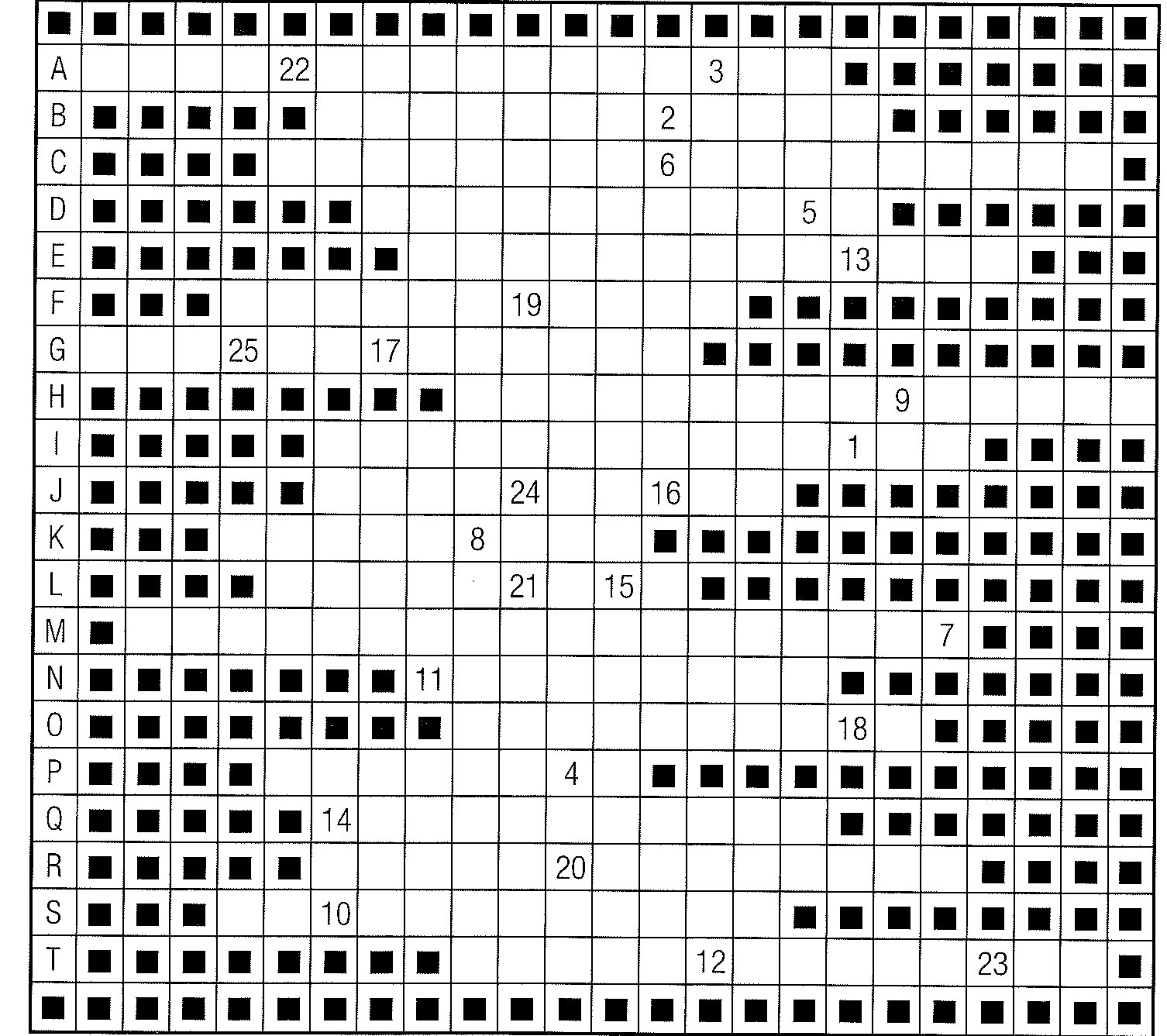
Then he shouted, “There’s a ninja on the veranda. And he’s stealing Louie’s cane!” Mackinaw tutted, “Wrong cultural stereotype. Ninjas are Japanese.” Effie dashed up the steps, while I vaulted the railing. The railing won. Effie grabbed the cane by its handle, but the ninja wouldn’t let go. Linked by the bamboo stick, they staggered down the steps. As they reached bottom, Mackinaw stuck out a foot from his hiding place in a bush and the ninja tripped. But so did Effie, who landed on Mackinaw. When the dust had settled, the ninja was speeding out the street gate with part of the cane. Effie was brandishing the other end, and some rolled-up papers slipped out. Taking them over to the temple lantern, I found a last message from Louie. “He knew he was being followed, and was afraid of being killed before he could pass on what he knew. So he wrote it all down, disguised it as a puzzle — a chart with instructions on filling it out.”
The chart can be filled in with 20 phrases, each one referring to loss in some way, based on the following clues:
(a) Commander Cody’s band;
(c) what Clementine was;
(d) 60s CBS sci-fi TV show and 1998 William
Hurt film;
(e) what an accountant calculates as the
bottom line;
(7) James Hilton novel and Frank Capra film;
(g) Atlantis, after the event;
(7) Shakespeare’s comedy hit of 1590;
(i) Hemingway, Fitzgerald (et al) in Paris in the
20s, according to Gertrude Stein;
() be forced to retreat;
(k) Conan Doyle adventure story with
Professor Challenger;
what the Moody Blues were searching for
in ’68;
(m) Reuben, Simeon, Issachar and Dan,
among others;
(n) someone who takes failure badly;
(0) ce que Monsieur Proust cherchait;
(p) Peter Pan’s troop;
(9) Ray Milland film of 1945;
(r) I got disoriented;
(s) Milton’s epic poem of 1667;
(t) the method used to cast small objects
in metal.
Reading down the column between the diamonds gives you a line from a song, also mentioning loss. Writing down the letters in the boxes marked I to 20, in order, gives you the next line of the same song. What is the first line of the song’s refrain?
The two lines of song meant nothing to me. Effie remembered them, though. “Cat Stevens, around ’71. The Remainders sing it really badly.” “Big surprise,’ ,” I said, and Effie flounced,” “If you don’t believe me, just punch the lines into a net search.” But as soon as he gave me the first line of the chorus, it was clear who had murdered Loquat Louie. What’s in a name, after all, as long as it doesn’t get lost in translation?
Mackinaw asked, “Why does the chart contain the numbers I to 25, when only 20 are used in solving it?” I replied, “Louie also solved the thefts.” I turned the chart over to show a faint line of numbers written in soy sauce: [3-12-24-22-1- 231-11 25-21-1-23-2 11-23-12-19-5-21 25- 23-3-22-7-23 17-23-11-25] “ A simple number-letter substitution, but the letters used for the second line of the song did not include all the letters Louie needed, so he had to add 5 more.” Mackinaw looked impressed. Effie had fallen asleep. It took only a few seconds to work out Louie’s last message. We stared at the results. “A well-known thief with a weakness for glitter,” I said. “Well, at least Louie died knowing his son was innocent.” I shook my head as Mackinaw contacted Sergeant Tennant on his Prune.
In the end, it all worked out. We proved that Hai Lee was not a murderer or a thief, so Mackinaw paid our fee — in cash, from a clutch purse, one bill at a time. Effie won the contest for the Big Buddha Burger slogan — ’Make me one with everything.’ He was puzzled when everyone laughed. And Hai Lee lets me visit the temple whenever I want. I sit on the steps and remember Loquat Louie. Soaking up the garden’s peace and fragrance is the best defence against the city’s hustle and jive.
Can you duplicate Shamus and Effie’s feat by identifying (a) the person who followed and killed Loquat Louie; (b) the thief; and (c) the location of the stolen goods? bout de papier will decide the winner by drawing from a box containing all correct answers received by September 30, 2004. The winner will receive a book autographed by A Aalto. Not necessary for the answer, but can you work out the 20 “lost” references in the chart, the two song lines hidden there, the first line of the refrain and the words enciphered in the number sequence? And is it true you can tell that the Godfather has been reading semiotics, when he makes you an offer you can’t understand?
View the original scanned pages →
Originally published in bout de papier, Vol. 20, No. 4 (2004) — Spring/Summer 2004 // Printemps/Été 2004, pp. 44–47. Read the rest of this issue →



