
bout de papier, Vol. 22, No. 1 (2006) — Spring 2006 // Printemps 2006, pp. 26–28
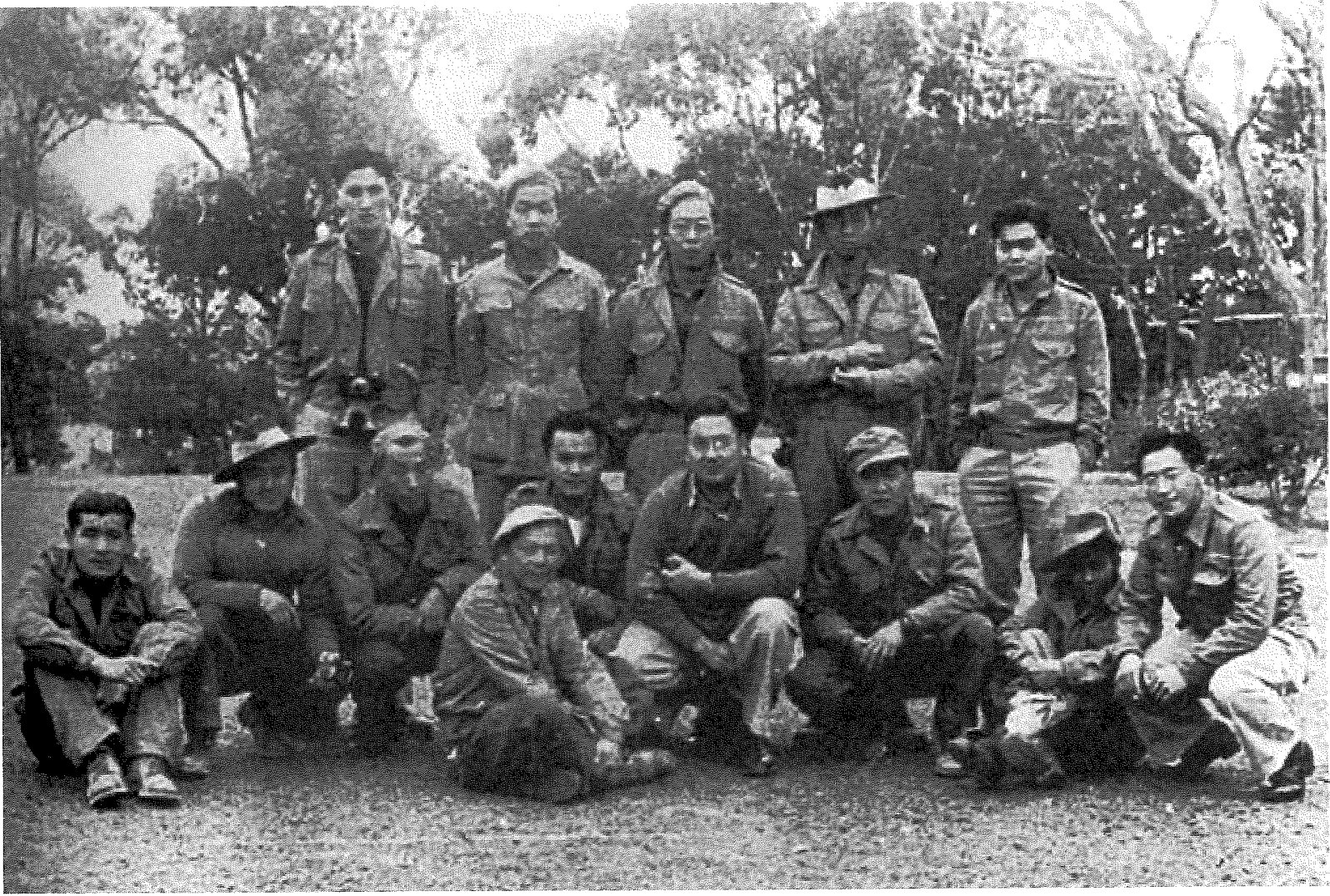
In mid-1944, thirteen Chinese-Canadians were spending the summer at a remote camp on the shores of beautiful Okanagan Lake in British Columbia. This, however, was no ordinary summer camp®
The thirteen were learning skills to equip them for one of the most dangerous aspects of warfare — special operations behind enemy lines in Japanese-occupied Southeast Asia. The skills included wireless operation, small arms, demolition, unarmed combat, silent killing, sabotage and boat work. The Chinese- Canadians had been recruited for the legendary Force 136 by “Mike” Kendall, a Canadian major in the British army. Before the war Kendall had worked in south China where he himself had been recruited by British intelligence before escaping from Hong Kong as the colony fell to the Japanese on Christmas Day, 1941.
In early August 1945, five of the thirteen Chinese- Canadians, led by McGill University engineering graduate Roger Cheng, landed from an RAAF Catalina flying boat on a stretch of the Rejang River some 50 kilometres from Sibu, Sarawak. Their job was to help gather intelligence in preparation for landings by Allied forces.
Roger Cheng and his party were not the only Canadians to serve in Force 136. And they were not the only Chinese-Canadians to do so. As many as 143 Chinese-Canadians were trained in special camps in India and Australia in response to a request to Canada from Britain’s Special Operations Executive (SOE), the clandestine intelligence organization known in Asia as Force 136.
The first contact between Force 136 and the communist-led guerrillas of the Malayan People’s Anti-Japanese Army (MPAJA) was in May 1943, when former Malayan police officer John Davis returned to Malaya by submarine. Davis negotiated an agreement with Chin Peng, a young man later to become secretary general of the Malayan Communist Party (MCP) and leader of the 1948-60 communist insurrection. The agreement signed with Davis in December 1943 placed the MPAJA under the operational orders of Mountbatten’s Southeast Asia Command in return for training, weapons, explosives and supplies. Britain wanted the MPAJA to be ready to strike the enemy from behind when British troops landed to liberate Malaya. The mission of Force 136 was to train and supply the MPAJA.
Communications difficulties delayed news of the agreement reaching Mountbatten’s headquarters until February 1945 and it was not until the middle of the year that significant numbers of Force 136 agents arrived in Malaya to prepare for Operation Zipper, the amphibious invasion planned for September. Among those dropped into Malaya were three French Canadians, who had worked with the French resistance behind enemy lines in France, and ten Chinese-Canadian sergeants. Their task was to train the MPAJA in sabotage, ambush tactics and intelligence collection.
Nineteen-year-old Henry Fung of Vancouver parachuted into the area north of Kuala Lumpur in June, accompanying his Force 136 unit to a camp near Kajang from where they helped blow up a railway bridge. Two other Chinese-Canadians from Vancouver operated with Force 136 in Selangor. Ted Wong and Bing Lee helped attack truck convoys and trains after parachuting into the area in July. Bob Lew from Nipissing in northern Ontario and George Chin were also members of Force 136 units operating with the MPAJA in Selangor in July. An all-Canadian Force 136 unit operated in northern Johore in early August. It was led by Joseph Benoit, a veteran of SOE operations in France and Burma, and included the group’s interpreter, Chinese-Canadian Ernie Louie. Meanwhile, two more Chinese-Canadians, Charley Chung and Harry Ho, parachuted with French Canadian Pierre Chassé in mid-July near Alor Star in Kedah from where they trekked north to Perlis, ambushing Japanese convoys and sabotaging bridges along the way.
Plans for the Force 136 teams unexpectedly changed, however, with Japan’s surrender after the atom bombs were dropped on Hiroshima and Nagasaki. Isolated Force 136 units suddenly found themselves the sole representatives of victorious Allied forces that were still weeks away from landing in Malaya and re-establishing Britain’s pre-war authority. Attached to MPAJA units that were eager to assert their strength in the power vacuum, Force 136 officers were required to take the surrender of Japanese forces and prevent the MPAJA from exacting revenge not only on the Japanese but on those in
bout de papier Vol. the local population they considered “running dogs” (traitors or collaborators).
Chassé negotiated the surrender of Japanese troops in the Perlis capital Kangar and stayed on to arrange the return from exile of the Raja of Perlis and his restoration to the throne of his state. In Selangor, Henry Fung’s unit, led by a British pre-war planter, took control of Kajang from the Japanese while Bing Lee accompanied his British commander to Kuala Lumpur where, from a villa near the racetrack (now the site of the KLCC Twin Towers), they maintained an uneasy truce with the Japanese and the MPAJA until the arrival of British forces in mid-September.
Chinese-Canadians were sought and recruited as SOE agents in Malaya, Sarawak and elsewhere in Southeast Asia because of their ability to speak a local language and to move inconspicuously among the local population. Those who undertook these dangerous assignments did so with “uncommon courage” (to quote the title of a 1985 Canadian Veterans Affairs Department publication) and made a special contribution to the Allied war effort; of the five who landed in Sarawak, four were awarded the Military Medal for bravery. Perhaps more important, however, was the fact that they volunteered for the dangers of clandestine warfare at a time when Chinese-Canadians were still denied full citizenship rights. It was not until after the war that Canada’s federal and provincial governments dismantled the country’s discriminatory legislation, beginning with the British Columbia government’s decision in 1945 to give voting rights to all those, including Chinese and Japanese, who had served in Canada’s armed forces. Thus, the part played by Chinese- Canadians in liberating Malaya and other occupied countries helped win their compatriots full citizenship in Canada.
Editor’s note: Reproduced with permission of The Expat magazine, Kuala Lumpur, Volume 88, January, 2005.
View the original scanned pages →
Originally published in bout de papier, Vol. 22, No. 1 (2006) — Spring 2006 // Printemps 2006, pp. 26–28. Read the rest of this issue →



