
bout de papier, Vol. 22, No. 2 (2006) — Summer 2006 // Été 2006, pp. 29–35
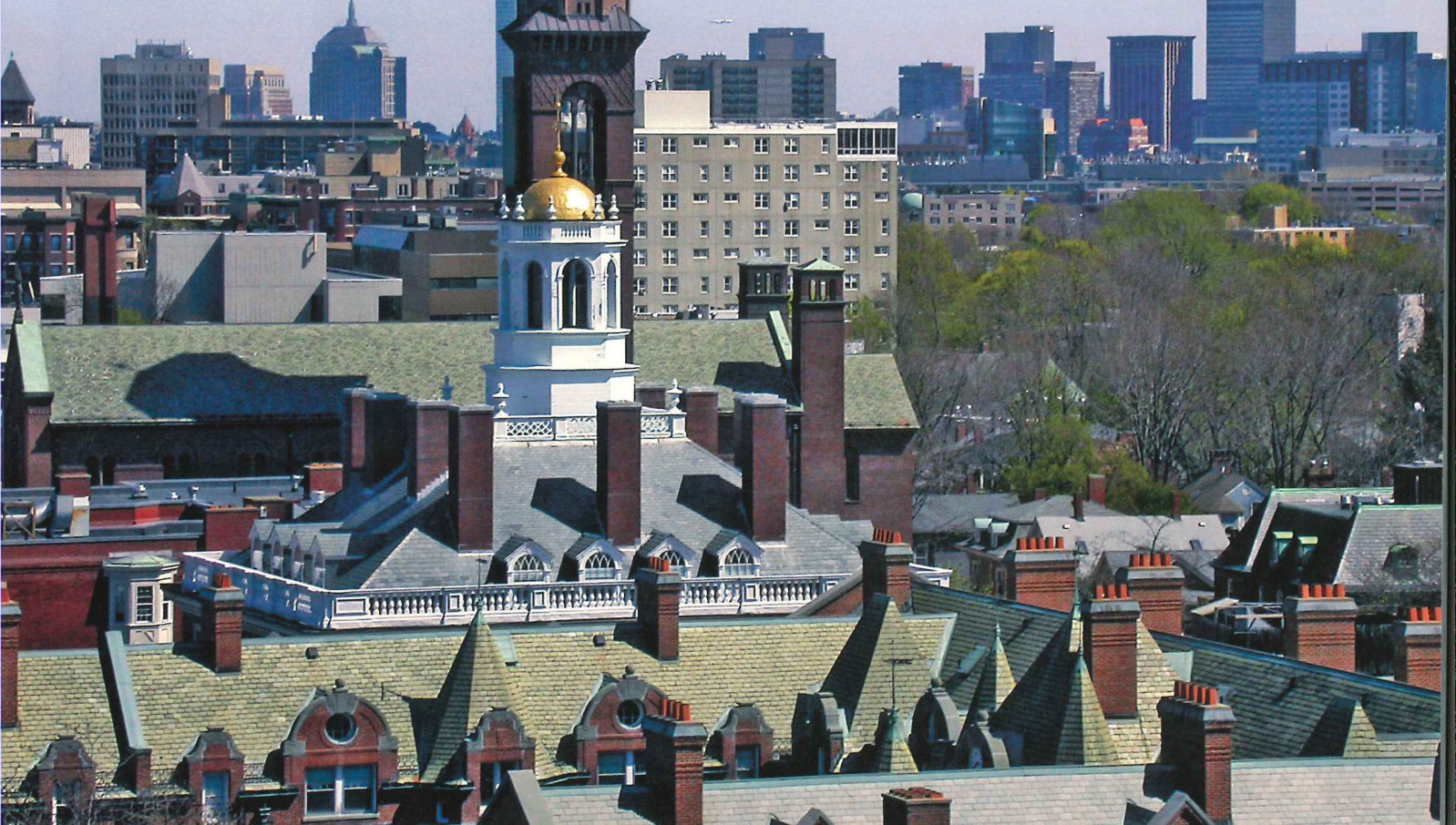
In the spring of 2003, I was offered the opportunity to spend the next year on one of the foreign service’s more unusual postings, as a Fellow at the Weatherhead Center for International Affairs at Harvard University. The contrast with what I had been doing could not have been more striking. I had just spent three years leading a rather exalted but intellectually isolated existence as Canada’s Ambassador to Cuba. It was not a difficult choice to retire my diplomatic uniform and go back to school for a year. So, in mid-August, my wife and I dispatched almost all our possessions by sea back to Canada and arrived with a few suitcases and our two cats to spend a year in Cambridge, Massachusetts.
“The People’s Republic of Cambridge” is what the hard-bitten inhabitants of Boston call the small, self-governing city on the north bank of the Charles River, which is home to both Harvard University and the Massachusetts Institute of Technology. After living in a true socialist republic for three years, I took this to be a typical mainstream American put-down of a liberal campus town. But after strolling past the Che Guevara poster in the window of Revolutionary Times Books, just down the block from Tibetan Meditation Center; actually bumping into the Dalai Lama on his way out of the Harvard Faculty Club; trying to decide which one of 26 kinds of granola to buy at my local outlet of “Whole Foods”; finding Maoist literature on the lunch-counter next door to MIT; and witnessing the massed TV crews around the Cambridge City Hall one Sunday night, poised to record at midnight the first ever legal same-sex marriages in America – I began to realize that this epithet in fact captures something true about this very old and yet very worldly corner of the United States.
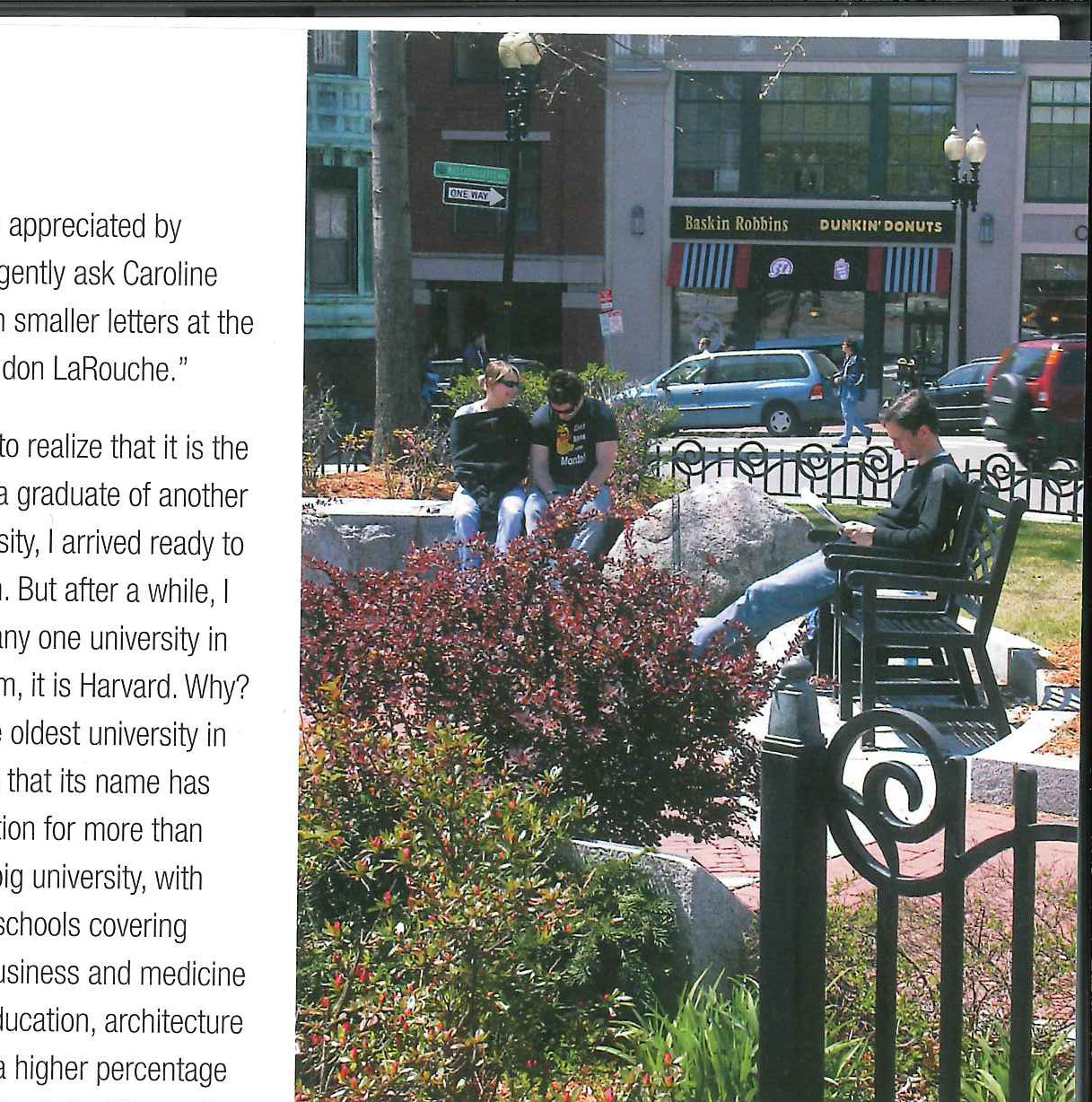
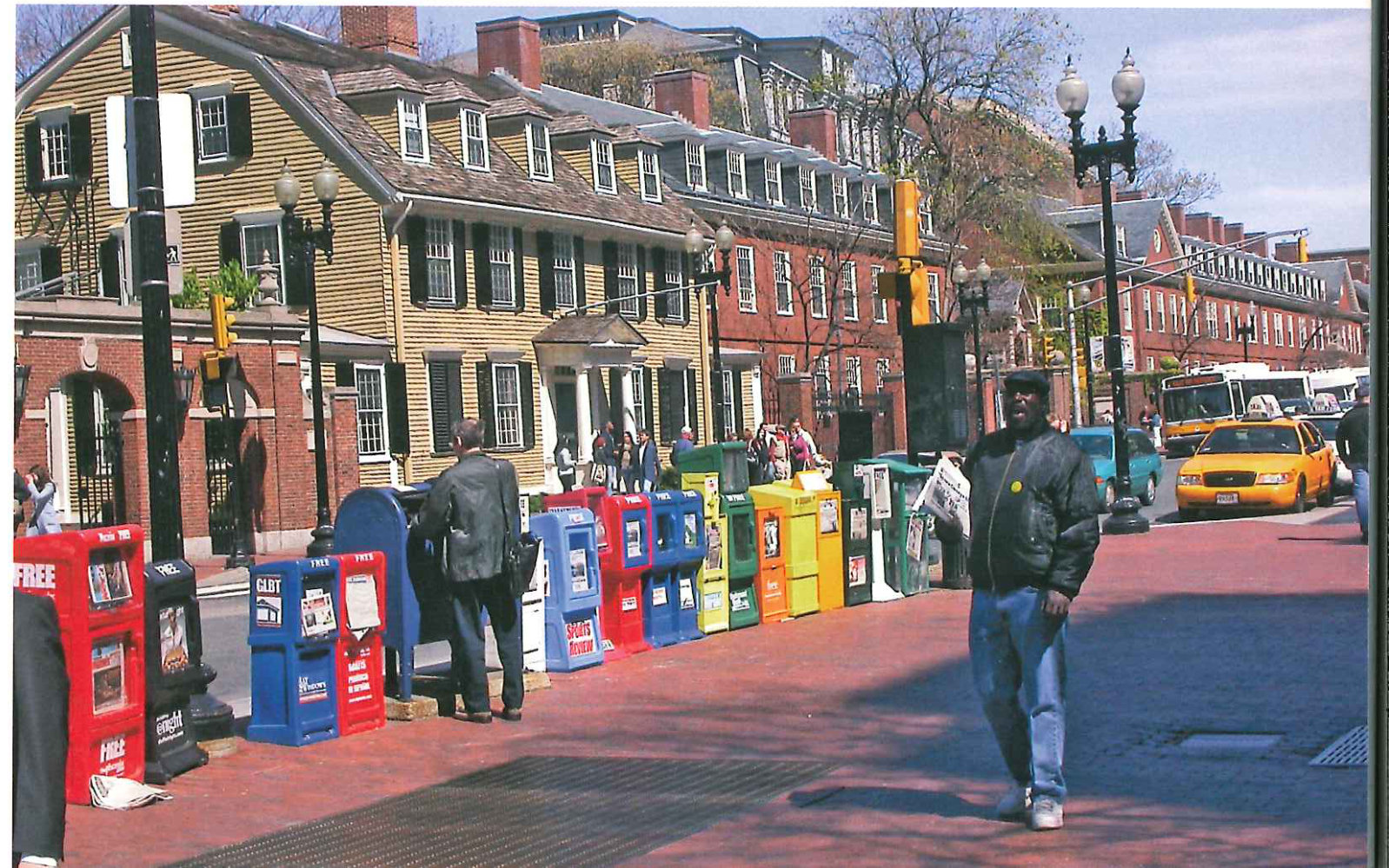
The heart of the “People’s Republic” is Harvard Square. First, one has to learn that Harvard Square is not actually part of Harvard: it is a public intersection, outside the gates of the university. More confusingly it is not square: it is a Y-shaped junction between John F. Kennedy Street and Massachusetts Avenue – the wandering 17th century cattle path that now serves as the main artery of Cambridge. Nevertheless, Harvard Square is the people’s Harvard. It is the place to shop for learned tomes by Harvard professors at the Co-op, or crimson “H” sweatshirts for your kid brother. It is the place to watch break-dancing contests by local youths. It is where old men gather to test their wits at chess on the public chess tables on the pavement outside the Holyoke Center. If you think you are smart enough, you can challenge a number of these masters at $2.00 a game. It has a newsstand that sells daily papers and magazines from two dozen countries. Want to catch up on Colombian football scores? You can find them here.
Harvard Square is inhabited by its own resident collection of the flamboyant and the bewildered. For example, there were the two large, almost identical, cheery black men, whom I finally realized were in fact two different people, who accosted all passersby with such greetings as “Hello there young lady!” in their persistent efforts to sell a newspaper to help the homeless. There was also the sad, self-absorbed man who would sit for hours in his windbreaker outside the Co-op, tunelessly sawing away on the one string of his Chinese violin. My favourite denizens of Harvard Yard were the two political activists who sat for several weeks in the fall of 2003 outside the entrance to the subway stop at the heart of the Square, beside a large homemade sign which declared “France was Right!” “You see,” said my earnest French officemate from the Quai d’Orsay, “perhaps our position on Iraq is appreciated by the American people!” I had to gently ask Caroline whether she had also noticed in smaller letters at the bottom of the sign “Vote for Lyndon LaRouche.” Harvard simply expects people to realize that it is the best university in the world. As a graduate of another distinguished Ivy League university, I arrived ready to contest this galling presumption. But after a while, I grudgingly had to admit that if any one university in the world can make such a claim, it is Harvard. Why? For many reasons. First, it is the oldest university in North America – which means that its name has been a synonym for elite education for more than three centuries. Second, it is a big university, with 18,000 students and graduate schools covering every major subject from law, business and medicine to public policy, public health, education, architecture and divinity. Harvard graduates a higher percentage of the people who go on to run the United States than any other single university in the country. And while its undergraduate college is 92 percent American, its graduate schools are not. Fifty percent of the masters students at the Kennedy School come from all over the world. Eminent Canadians — from Mackenzie King, to Pierre Trudeau, to Robert Stanfield, to Margaret Atwood – have been coming to Harvard for generations. Thus the university truly has a global reach.
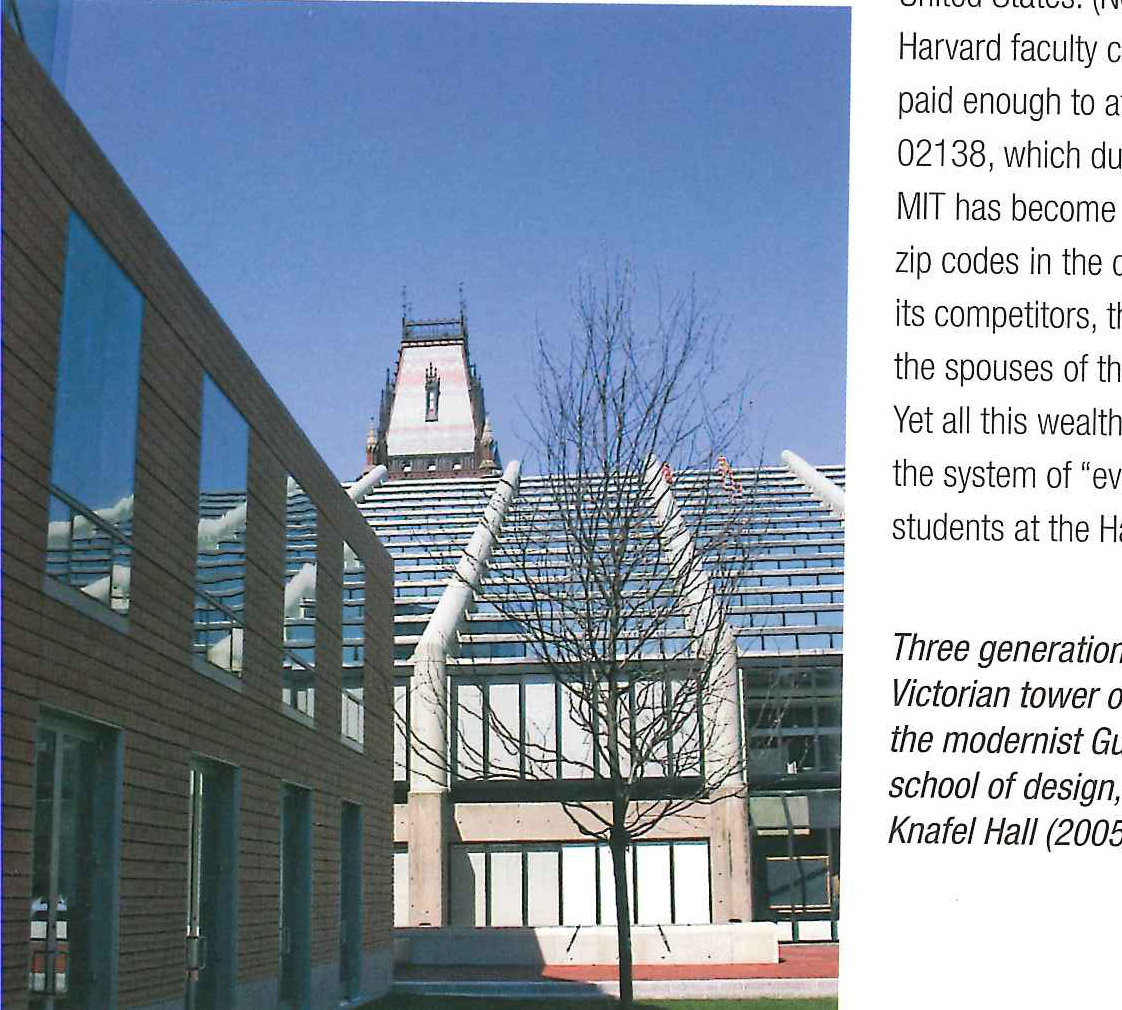
Above all, it is the richest university in the world, with a current endowment of over $23 billion. The man who managed Harvard’s portfolio in 2004 earned $53 million and claimed without irony that his services were worth every penny to the Board of Governors. All that money means that Harvard can run the most impressive central library system of any university in the world and pay its faculty members better than any other university in the United States. (Nevertheless, recently recruited Harvard faculty complain that they are no longer paid enough to afford decent housing in Cambridge 02138, which due to the high tech spin-offs around MIT has become one of the two most expensive zip codes in the country. Worse, unlike many of its competitors, the university refuses to assist the spouses of the faculty it recruits to find jobs.) Yet all this wealth is unequally distributed: under the system of “every boat on its own bottom,” students at the Harvard Business School work out at a $100 million endowed gymnasium while contemplating their six figure job offers, while their counterparts struggling to get a master’s in public policy found the interest-free period on their massive student loans suddenly eliminated half way through the school year in order to help defray the Kennedy School’s ballooning deficit.
I had heard of the “Socratic method” of teaching, fixed in my imagination by the actor John Houseman in the 1973 film, set at Harvard Law School, The Paper Chase. They may still teach first-year students that way at the Law School, but the method I saw various Harvard professors use in classes ranging from 30-150 students was something less inquisitorial but equally compelling. For example, Jorge Dominguez, the Clarence Dillon Professor of International Affairs, would open his popular undergraduate course on the Cuban Revolution by simply asking the class: “What makes a revolution?” Without putting anyone on the spot, he would elicit an initial answer from one of the braver students, work with it and shape it a bit, and then throw it back to the class in the form of another question. By the end of the hour, he had teased out four or five competing theories of revolution, identified key variables in each of them and then had the class apply those theories to the case at hand. All of this business gets done in a seemingly unscripted form of “question and response” between professor and class that can accommodate original and competing insights from the students and still allow the prepared professor to get across his or her key points without appearing to lecture. This method of teaching, if well done, enables the professor to manage a large class like a collective conversation which runs through every student’s head, even if only 10 or 15 open their mouths during the course of the hour. The method seems effortless; in fact it requires a true mastery of one’s material. What it does is build a sense of collective intelligence, and makes the entire class feel much smarter about what they already knew than before the came through the door.
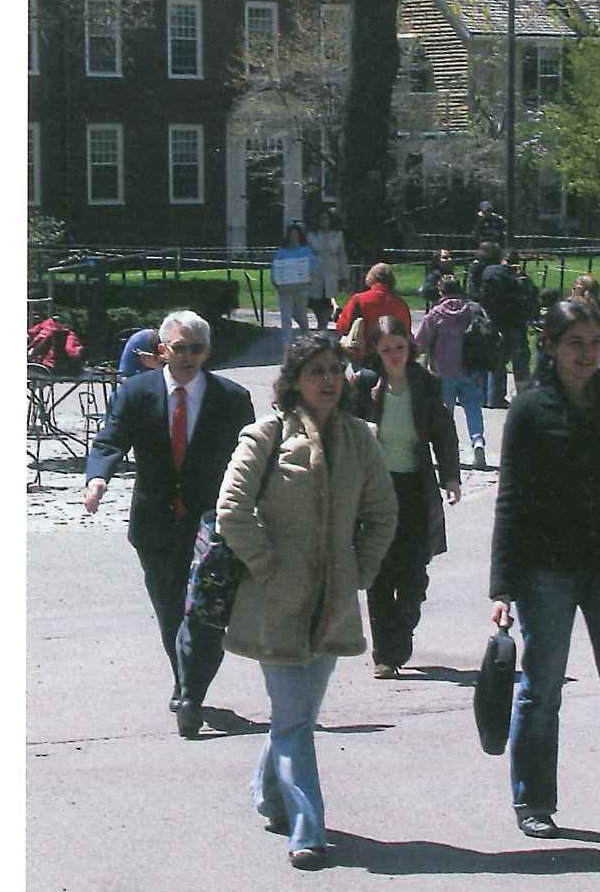
The depth of academic talent on display among the Harvard faculty is undeniably impressive. In international relations alone, it currently includes Amartya Sen, 1998 Nobel laureate for his work on development economics; Joseph Nye, originator of the concept of “soft power”; Samuel Huntington, author of “the clash of civilizations”; Stanley Hoffman, the best known interpreter of France to the United States and the United States to France; and Niall Ferguson, the enfant terrible of modern British historiography and sympathetic student of imperialism. But what gives the place the feeling of a global crossroads is the truly incredible number of intellectual and political celebrities who pass through Cambridge during the course of the year to give public seminars and talks. Between the resident faculty and the visiting talent, I must have heard more than 40 authors speak whose work I had read for years in either the New Yorker or the New York Review of Books. When courses would end around 4 p.m. on a typical weekday, you could then tune into the specialized seminars in one of the Arts and Sciences faculties from 4-6; then a public address at the Forum at the Kennedy School from 6-7; and if you still felt like more, you could move on to catch an evening reading sponsored by one of Harvard’s two outstanding bookstores, or the community sponsored Cambridge Forum, where non-academic audiences get to question distinguished writers. Since I was at Harvard in the year immediately after the Iraq War, I went to every talk I could hear that had a bearing on the subject. Robert McNamara, aged 86, was interviewed at the Kennedy School just after the release of the film biography The Fog of War and gave his own interpretation of the lessons he learned from World War Il and then Vietnam. Richard Clarke, the former White House counter-terrorism czar and the only senior official to apologize personally to the families of the 9/11 victims, offered the wry comment on the readiness of the Bush Administration to deal with the attacks: “Never try to deny the obvious.” David Kay, a career intelligence professional and the head of the first US weapons inspection team that went into post-war Iraq explained why “we were all wrong” about Saddam’s WMD capabilities. General Eric Shinseki, the highly decorated Japanese-American soldier who became Chief of the US Army, continues to speak eloquently about the values that define military leadership, despite having been ordered to take early retirement after giving a truthful reply to Congress about the level of troops he reckoned were required to maintain the peace in post-war Iraq. On the first anniversary of the war, Ken Roth, the Executive Director of Human Rights Watch, and Michael Ignatieff, then Harvard’s Professor of Human Rights Practice, held a packed public debate explaining how each of them had used just war theories to take opposing views on the justifiability of the invasion. A common thread through all of these talks was public morality and where that comes into tension with professional ethics. I found it compelling to listen to these eminent speakers talk less about what they had done right in their careers than about where and when they had been wrong and what they had personally learned from the experience. I also enjoyed expanding my horizons by listening to eminent scientists explain their work to lay audiences, such as Freeman Dyson, the British physicist now well into his eighties, who described the five years he spent in a California think tank in the late 1950s, trying to develop the crazy and dangerous idea of an inter-planetary spacecraft propelled by continuous nuclear explosions; David Attenborough, who spoke to a packed house in the beautifully carved Memorial Hall, on trekking up into the highlands of Irian Jaya to film for the first time the mating dances of birds of paradise; and iconoclastic Canadian geologist, Paul Hoffman, about his “Snowball Earth” hypothesis, which posits that twice in the last one billion years the planet has been covered from the poles to the equator in ice.
Not all the pleasures of the year were cerebral – many of them were aesthetic or antiquarian. Given the eccentricities of giving by Harvard’s alumni, there are such hidden jewels in Harvard’s museums and libraries as the Woodberry Poetry Room, designed in bent wood and lit in high modernist style by Finnish architect Alvar Aalto; or the Theatre Arts collection, with an unparalleled collection of early 20th-century Russian ballet sets; or the Semitic Museum, whose dusty dioramas of digs from the 1930s looked straight out of the opening scene of Indiana Jones. The Peabody Museum of Ethnography had a yearlong exhibit and lecture series to commemorate the bi-centenary of Lewis and Clarke, whose journey up the Missouri, over the Rockies and to the Pacific has become one America’s founding myths. After the show had opened, there was great excitement when an original Lakota bear-claw necklace given to Lewis and Clark turned up in a trunk in the Peabody’s basement. It proved to be only the eighth native American artifact that has survived from the material brought back to Thomas Jefferson by his “Corps of Discovery.” Perhaps my favourite Harvard museum was the Museum of Comparative Zoology – home for many years to such greats of evolutionary biology as Stephen Jay Gould and Edward O. Wilson. I loved trolling through the dusty drawers of the Museum’s Department of Malacology, looking for unique specimens of deep-water shells trawled off Cuba by Harvard expeditions 60 years ago and never found since. One curiosity on public display includes a New Guinea bird-wing butterfly, whose German collector was eaten by Papuan natives, shortly after he captured the specimen.
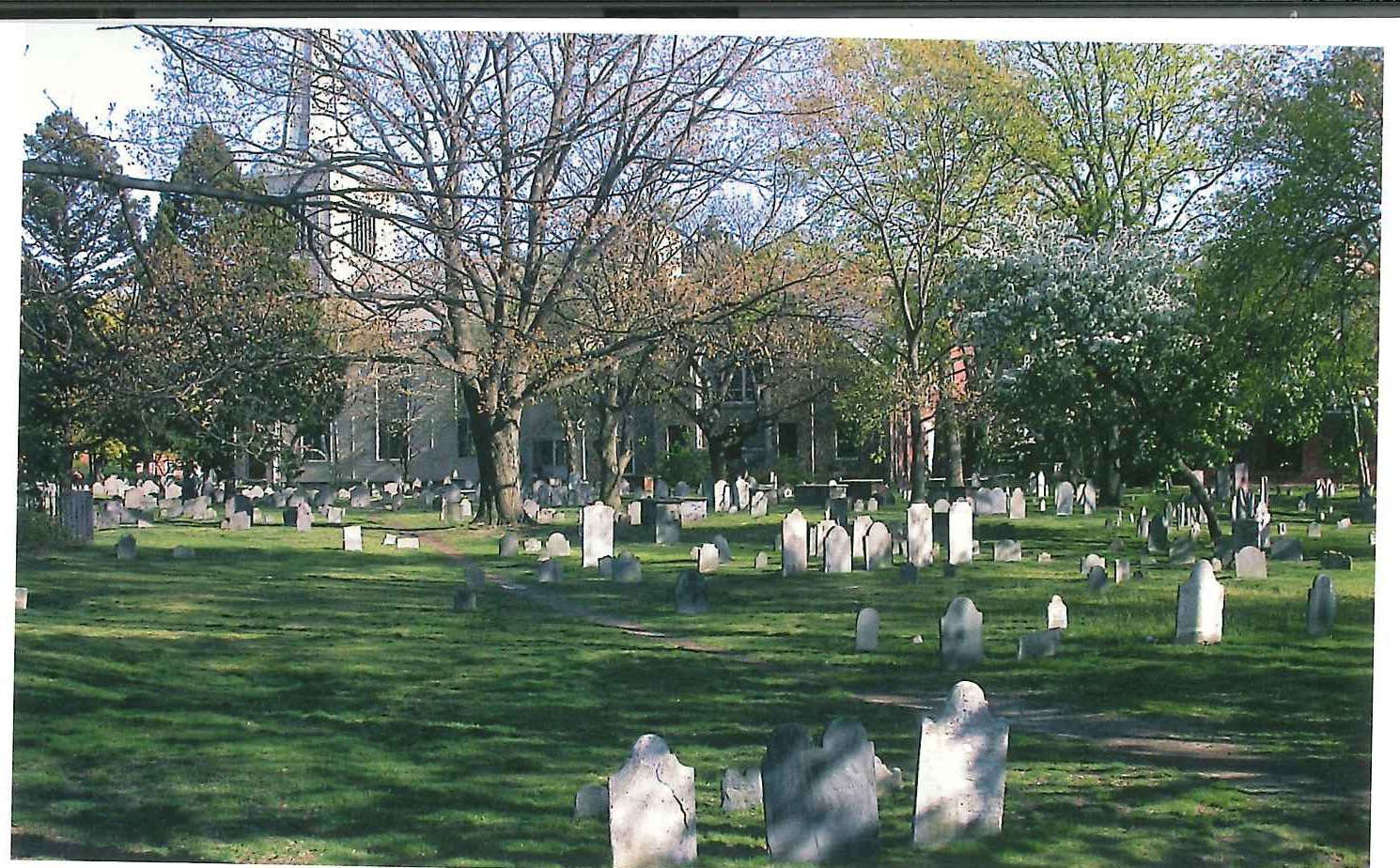
It can be hard to find a focus for one’s year as a Fellow. The time streams by incredibly rapidly through two 12-week terms, so that by the time you have finally figured out how the place actually works, it is time to depart. Without the discipline of having to write papers and earn marks, the temptation is to give in completely to the infinite opportunities for intellectual dilettantism. Contrary to the advice given by the management of the Weatherhead Center, I decided to try to seriously follow a number of courses — doing the reading, contributing in class, and even in one case, writing weekly short essays. As an auditor, you were regarded somewhat ambivalently: by the more hard-nosed faculty as the unwanted occupant of a seat which could be filled by a fee-paying student and by other students as some kind of living fossil – until they realized that you could offer them free advice, based on real experience, without any threat that you would be marking them. A few of the more astute faculty figured out that Fellows could be enlisted as unpaid, informal teaching assistants. I wound up counselling various graduate students on their papers relating to Cuba, and even gave a guest lecture on “human security” in a development theory course, after I pointed out to the professor that I had helped to write much of the reading he had assigned that week. I finally realized that to truly feel something more than a bystander, you had to do something related to the core business of the university – namely research. The Fellows program encourages participants to write a Fellows paper. After a couple of false starts trying to pick a topic that might be relevant to my future work in the Department, I concluded that it was pointless to try to pitch something from afar to ever-shifting, contemporary policy interests inside the Pearson Building. Instead, the great virtue of a university environment is the degree of detachment it offers, so I went the other way, deep into diplomatic history, and decided to see what I could find about a completely forgotten chapter of Canadian diplomatic history — the Peace Conference convened between the United States and Mexico, held in Niagara Falls, Ontario, in May 1914. Using Harvard’s unbelievable library resources, I was able to survey the complete series of contemporary newspapers on microfilm, read the original British, American and Mexican diplomatic papers, and consult a huge array of secondary sources. In all my research, I found that there was not one reference to a book or monograph that touched on the subject of this obscure peace conference, whether it was published in South America, Mexico or the United States at any point since 1914, that I could not find in the Harvard library system. Usually, I could check out these obscure sources, by searching from home at night via the on-line library database and then request the book from Harvard’s off-site book depository; invariably, it would be ready for pick-up at the reference desk by 15:00 the next day. like working with perfect information. Once classes had ended, I spent 15 hours a day researching this topic for six weeks in the early summer and the resulting monograph – however obscure to most other readers — was one of the most satisfying pieces of work I have ever done. It was the kind of writing you could only ever pursue in a richly endowed academic setting.
The culmination of the year, at least for the students, is graduation, or as it is known in the United States, “Commencement.” Harvard’s Commencement for 2004 had the usual share of luminaries, ranging from the faculty’s choices for honorary doctorates, e.g., Kofi Annan, to the students’ choice for their class-day speaker, the faux white-rapper, Ali G. Reclining on the grass waiting for the speeches to start, I looked up to see Margaret Atwood striding down the walkway in a purple gown as a newly minted Doctor of Letters. Harvard’s much unloved (and subsequently deposed) President, Larry Summers, in fact gave an excellent speech on the responsibilities of a university to address the inequalities of educational opportunity in America Then the President of the Harvard Alumni Association gave an upbeat talk on the millions raised that year to ensure the continued quality of education – at Harvard. At the end of the ceremonies, I decided to see if I could catch up with Margaret Atwood, whom had met the year before. She disappeared from the stage, but reckoning there might be a post-commencement ceremony for the honorary doctorates, I trailed Larry Summers as he strolled out of the grounds, dictating memos to his underlings. He headed out of the grounds, down a street past the First Unitarian Church, and then jumped into his parked presidential limousine. As Larry sped off, I noticed his car carried a vanity plate on the back, “1636”, the year that Harvard College was founded. Membership indeed has its privileges.
View the original scanned pages →
Originally published in bout de papier, Vol. 22, No. 2 (2006) — Summer 2006 // Été 2006, pp. 29–35. Read the rest of this issue →



