
bout de papier, Vol. 23, No. 2 (2007) — Fall 2007 // Automne 2007, pp. 40–43
The shaman rested a paddle across the front of his kayak, watching a small whale hauling itself onto the beach. “Chaos roils the sea and the land, the people and our fellow creatures,” he said to the man in the outboard beside him.
The younger man nodded. “The days are warmer and the ice is clearing earlier every year. The shoreline is eroding and the permafrost is melting deeper. The caribou must find new trails and it is harder for the polar bears to hunt because the floes are disappearing.” They watched as the whale crawled arduously up the slippery hillside above the beach, only to slide down again and again.
“And because the water is opening between the islands,” the young inuit continued, “the qallunaat are back in force, fighting among themselves for ownership of the sea. I fear their coming will bring us trouble.” The whale had pulled ice axes from a fold in its flanks and was using them to pull himself up the hill.
The shaman replied, “When the qallunaat fight, we are often injured. We must not let them exile us again to hostile country. Your grandmother still cries out in her sleep.” The young man watched the struggling whale and said, “And we must we protect the animals. Look at that poor one, driven mad by change.” The shaman shook his head. “Yes we must. But the one on the hill is not a whale but a very fat man in a beluga suit.” The beluga had almost reached the top, by a hut with a Canadian flag, when it lost its grip. Crying “Caramba!!”, it sped back down the slope, ricocheted off three inukshuk trail markers and an abandoned DEW Line station, skidded under a surprised-looking bear, launched into the air over the lip of a cliff, just missed being pronged by the horn of a narwhal surfacing in the bay and landed on a sleeping walrus, which used its tail to volley him back to the beach. Three seals on a rocky islet held up boards bearing the numbers 8.9, 9.3 and 9.5 in large print.
Some time later, the hut door crashed open and Don Gordo staggered in, swathed in shreds of grey and white neoprene. Liebnitz glanced around the table and said, “Now we can start. First, a situation report on our competitors in this Arctic sovereignty fight. What are the Americans doing?”
Felix Africa replied, “They’re taking an indirect approach, fronted by a movie crew filming a new Hollywood feature — Mordecai Richler meets Bullwinkle — called The Apprenticeship of Dudley Do-right. The mission, personally created by the president, is called Operation Eminent Poltroon.
People in black suits, narrow ties, snap-brim fedoras and wingtips are scurrying all over, trying to look cool and cinematic. Backed by an aircraft carrier. Inconspicuously, of course.”
Don Gordo jumped in. “The Chinese also deployed one of their navy vessels, which I scouted in this disguise. Embarrassingly, it turns out to have been built under the joint Sino-Canadian Revolutionary Armament Program — the SCRAP-class frigate Joe Hu. You may recall that the Russians sank first one, the Sir John A McDeng, after a surprise naval visit and fireworks display in Vladivostok. The newer ones run on a mixture of screech and maotai, which makes it impossible to sneak up on the ship from downwind without getting stoned. On a personal note, I advise — strongly — staying away from drunken female belugas.” “Sage advice, no doubt,” said Liebnitz dryly. “What have you found out, Esmeralda?” Don Gordo’s sultry daughter smiled. “I had quite a good time with one of the cuter — and stupider — officers from the EU cruiser. The captain of the ship, the Quelques Arpents de Neige, is Gaston LeLâche, the famous ’chicken of the sea’. He keeps surrendering
– so tar to two icebergs, the aurora borealis and a soapstone carving of Oscar Wilde. With great élan, of course. But they haven’t got very far.” “Finally, the Japanese,” said Inspector Wu. “They arrived in the cruise ship Hello Kitty, crammed with couples — well-armed couples – hoping to be married under the northern lights. The ship is a former Russian vessel, Yeltsin’s Revenge, with an Australian crew — which explains why it is always downwind of the Hu. Rialto Sleazewagon is also on board. The Japanese plan to establish sovereignty by starting a colony, attracted by the freshest sashimi in the world, but we don’t know what Sleazewagon is up to.”
“Which takes us to the next agenda item,” said Liebnitz. “None of you has been briefed on the real reason we are here. It’s not just to establish a presence — us and the navy and the bases and the Canadian Rangers — but to guard the real basis of Canadian sovereignty in the north. Called the Mapleheart, it’s the physical incarnation of all that makes Canada what it is. No-one knows its source, although experts guess it includes rare political elements — Trudeau’s humility, King’s charisma, Harper’s laissez-taire media approach, Diefenbaker’s coherence, Sir Mackenzie Bowell’s real last name.”
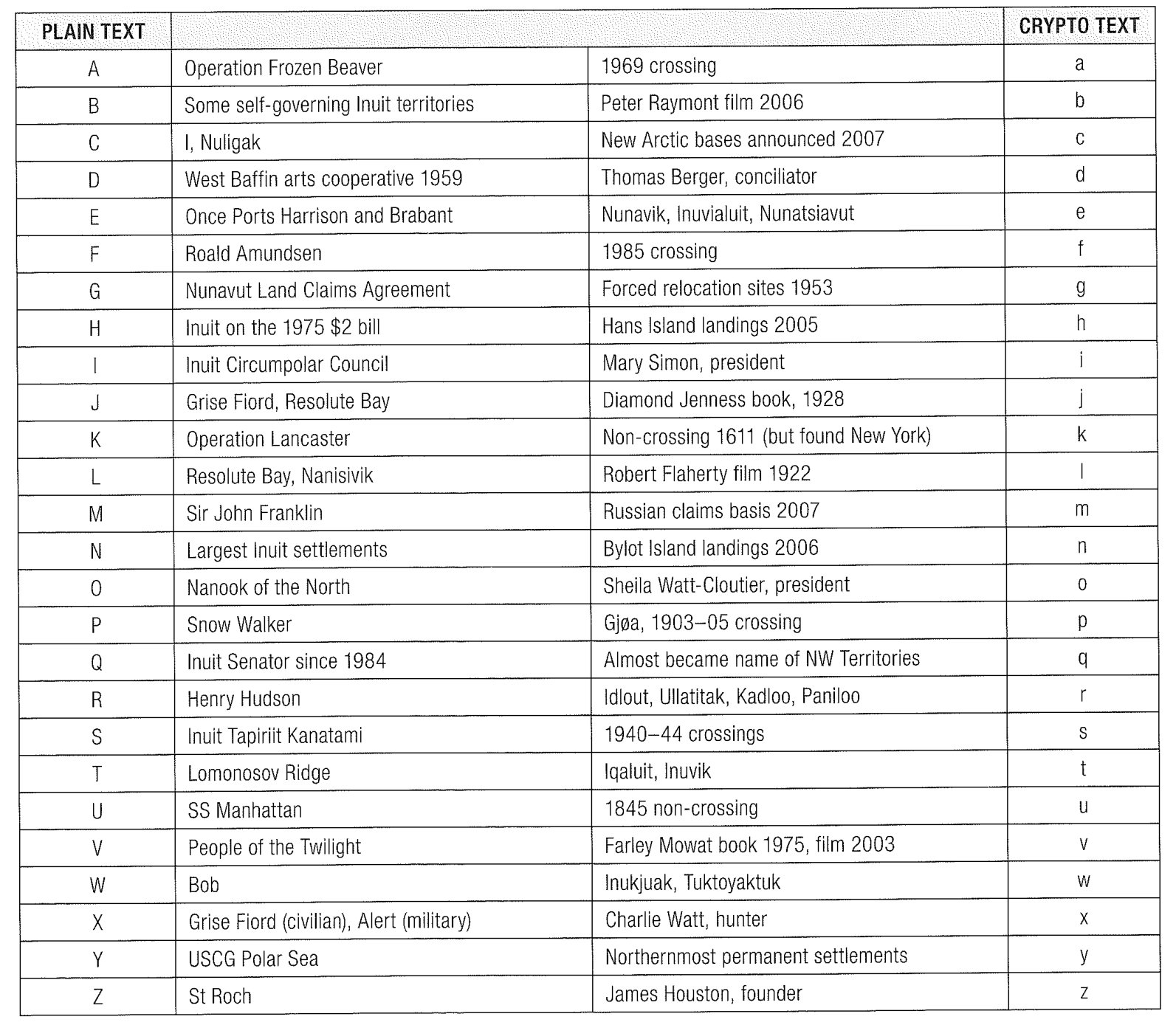
“Whatever it is, it has kept the Arctic ours, safely locked up here in the ice. But now we have problems. First, with the Northwest Passage open, it is easier for challengers to get here and look for it. Secondly, we no longer know where it is. The only map was lost during a particularly rowdy food fight in the parliamentary restaurant. And although there is a GPS transmitter tracking the Mapleheart, it connects only rarely and faintly. And the location seems to be moving. So that’s what all five groups are seeking — the Mapleheart, key to the North. But where to look?” Bugbyte O’Nanotek unfolded herself from a chair and slotted a memory stick into the projection system, saying, “I think I can help on that.” She tapped her mirror-shades. “Our silicon-based friend GEODE contacted me through these. He sees ice as an allied crystal and thinks we should focus more on climate change and less on “distractions.” So he released six copies of a puzzle whose answer reveals the Mapleheart’s location. Here it is.” The screen flicked on.
“Interesting,” said Liebnitz. “A straightforward association enigma. Each entry in the second column has a corresponding entry in the third column. If you match them up, you create a link between the letter to the left of each entry in the second column and the letter to the right of the corresponding entry in the third column, a pattern of linkages you can use to decipher the encrypted paragraph that comes with the table:
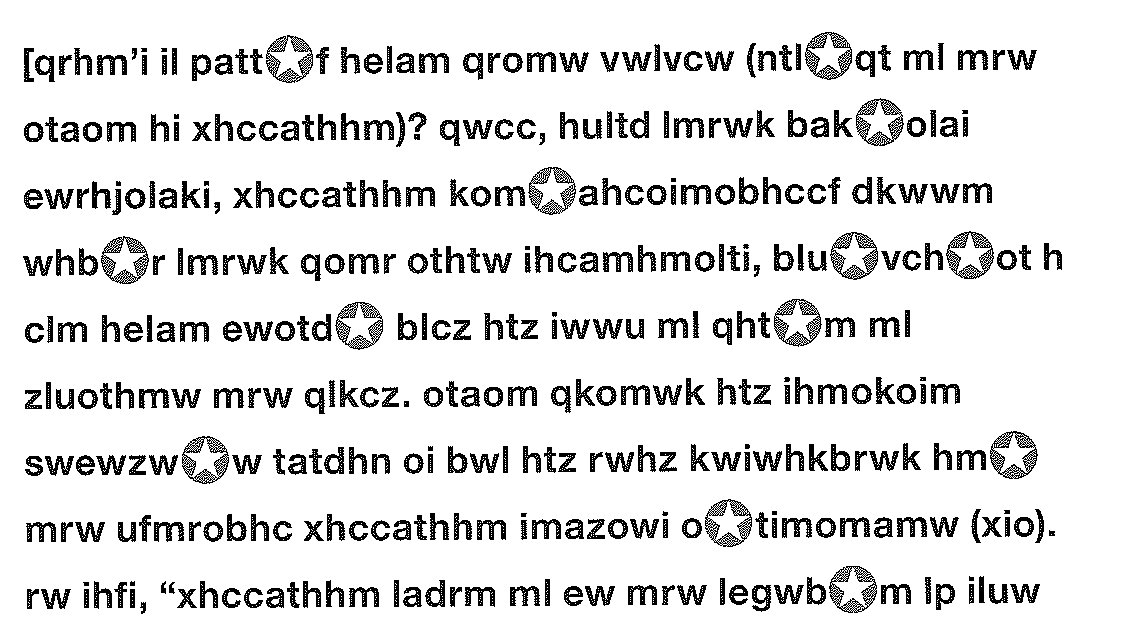
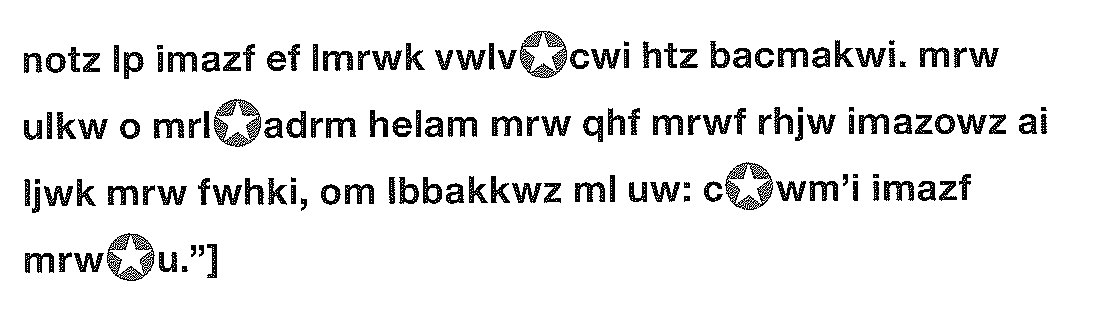
The letters just before each star should then spell out the location of the Mapleheart.”
Esmeralda looked over the puzzle. “I agree that the structure is standard, but some of the references in the table are obscure. What’s Inuit Tapirit Kanatami, for example?” “No idea,” admitted the ace logician. “But that’s what the Internet is for. Besides, you can attack the puzzle simultaneously by doing a letter-frequency count on the encrypted paragraph. E and T are usually the most common letters, for example, with A, S, O and N also among other frequent ones. From that we can deduce some letter equivalences and cross-reference between the paragraph and the chart.”
Esmeralda nodded and soon had the puzzle solved. “Well, that explains the motion, assuming it is contained by the field lines,” admitted Liebnitz. The team was soon in a large skiplane, heading north over the increasingly icy terrain. Watching behind, they saw the opposition gaining on the same course, so they created diversions. A chaff of business cards grounded the Japanese while they sought consensus on how low to bow, Rialto Sleazewagon impatiently seething. A Derrida missile deconstructed the EU plane and the 10 passengers immediately formed I political parties to decide on repairs. Confronted with giant holograms of Chairman Mao and a US Treasury bill side-by-side in the sky, the Chinese fell into prolonged self-criticism and circled randomly. And the Americans were distracted by an offer of the lowdown linking Angelina Jolie to Elvis’s alien-abduction love child with the creature from the black lagoon. But somehow nobody was delayed for long.
All five teams arrived simultaneously. But someone else was there first — the shaman and his grandson, standing between the qallunaat and an opalescent sphere just above the ice, drifting slowly away from them. “How did you get here so fast?” demanded Don Gordo. “Inuit quajimajatugangit, the oral wisdom of my people,” said the shaman. “And a little help from a stone spirit,” said his grandson, tipping his argillite snow-goggles at Bugbyte. “That’s right,” mused Liebnitz. “GEODE did say he’d given out six copies.”
Rialto Sleazewagon snarled, “All very well, my frozen mystic, but where’s the Mapleheart?” “Right here,” replied the shaman, reaching through the opalescent ball and pulling out a large brown object. “Mon Dieu,” breathed Don Gordo, “that’s the biggest maple sugar crystal I’ve ever seen.” “Someone tie him up,” ordered Liebnitz sotto voce. The shaman went on, “What forms it up is not the passing emanations of the famous, but the enduring goodness of the many – peacetulness and generosity and reverence before the beauty of nature, the things that make a people worthy of the land the gods lend them. It is too important to become a scrap fought over by huskies. I am glad we got here first.”
There was a moment of tension as guns were unholstered. Then Esmeralda began to laugh. “It’s perfect. No wonder our attempts to delay you just meant we all got here at the same time! GEODE had it all planned. None of us is going to allow another to take the Mapleheart, so it will go to the Inuit by default.” The five commanders looked variously angry, bemused and embarrassed. Then LeLâche surrendered to an Ookpik and the rest glanced at each other, nodded and herded their groups back to the planes.
“Not so fast,” howled Sleazewagon, pulling out a heavy pistol and advancing on the shaman. “You haven’t heard from me. You all want to capture the crystal, but I want to see it destroyed. If no-one has sovereignty, I can claim title to all the seafront land in the Arctic. Once climate change has done its work, this will be the only place left on earth where you can grow tropical fruit. Just ask Gore. I’ll corner the market!” He stopped, confused, as the shaman’s grandson walked calmly up to him. Drawing what looked like a polished bone from his pocket, he flicked a switch. A brilliant ray of light emerged, which he used to cut a circle around Sleazewagon’s feet. The loop closed, the ice within it suddenly dropping the villain two metres into a column of water. Soon, the Japanese were loading a giant Sleazewagon popsicle onto their snow-cat. “Quajimajatuqangit and laser tech,” said the shaman’s grandson. “Unbeatable.”
Of the qallunaat, only Liebnitz was left. The shaman walked up to him and said, “We have a saying — nunalivut. It means the land is ours. We know what is right for it.” He logician nodded and the shaman continued. “But meanwhile, you should do something about global warming. Or that man will turn out to be right and we should all be buying Canadian banana futures.” Tucking the Mapleheart into a caribou-skin pouch, he blinked once and walked slowly into the white-out.
Can you duplicate Esmeralda’s feat by providing the location hidden in the puzzle paragraph? bout de papier will decide the winner by drawing from a box containing all correct entries received by February 15, 2008. The winner will receive a subscription to WALRUS magazine. Not necessary to win the contest, but can you also make the 26 match-ups? And can you say why the Mapleheart was moving?
View the original scanned pages →
Originally published in bout de papier, Vol. 23, No. 2 (2007) — Fall 2007 // Automne 2007, pp. 40–43. Read the rest of this issue →



