
bout de papier, Vol. 24, No. 4 (2009) — Winter 2009 // Hiver 2009, pp. 44–47
he walls of the vast hall glistened
with ochre slime dripping down green and purple velvet. Overhead, mirror-balls randomly reflected laser beams through a drifting fog, reeking of stale Saturday nights and old gym socks. Underfoot, flaccid creatures scurried on too many scaly legs through decaying food and the gnawed bones of creatures you’d hope never to meet, while in the corner an enormous blob of used chewing gum groped toward sentience.
A raucous crowd circled an enclosure in mid-room, where stood a five-metre cube, a hazy hologram punctuated by brighter drifts and pinpoints of light. Around the cube lounged three gigantic creatures. One had the fore-quarters of a warthog, the back end of a slug and the twin heads of Bob and Doug McKenzie, a beer held to each ear. The second was a gorilla with the head of a manta ray, dressed in a rhinestone-studded gold lamé Jumpsuit, a granite baseball cap and Styrofoam wedgies. Wrapping up was a vast open tub of guacamole with eyestalks, mounted on REO Speedwagon firetruck with multiple speakers blasting out Billy Ray sings Liberace.
The ape reached into the cube to place a spark and complete a crooked line of light. “The full Arc of Gr’mlax,” he rasped. “That means the Andromeda Sector is mine.” “Cute, hoser,” sneered the wartslug heads in unison, “But you forget the sentient planet rule. That sector remains open while there’s still life on Gaia.” “Which won’t be for long,” his opponent replied. The guacamole gurgled and quietly set a fiery spiral spinning in the far corner of the cube.
The hall flickered and winked out. From a chair in the bridge of the spaceship Heart of Glod, a black-clad Bugbyte O’Nanotek gazed at the elegant golden robot, eyebrows lifting. “I have to say, GEODE, that I was expecting the future to be more like Star Wars and less like Tripping the Rift. Who are those clowns?” The robot shrugged. “What you are seeing is not really the future, but a simulacrum of the 11-dimensional space-time continuum in which our 3-D world is embedded. Even your fine mind couldn’t grasp the reality of that meta-space, so the ship’s computers created an analogy that reflected the inwardness of what was going on, expressed in terms of the Earth culture of your time. Unfortunately, being an 11th-dimensional demigod doesn’t necessarily mean you have class.”
“Those are gods?” she sputtered. GEODE replied, “They might as well be, given the power they wield. The important thing, however, is the game they are playing. It is a kind of Intergalactic Go, at tournament level. The playing pieces, those points of light, are the stars and galaxies of our own universe. Fortunately, the play of the game, even victory or defeat, won’t directly affect us. But the reference to the sentient planet rule could. A planet like Earth, which harbours a certain level of life, has a will of its own
and an independent role in the game. It does not count as a piece for any of the
players. Gorilla Ray’s strategy won’t work unless he controls all the pieces in the Arc. So he needs to wipe out humanity to win.”
Bugbyte recoiled in shock. “He’d eliminate us all — to win a game? Doesn’t that bother anyone?” GEODE replied impassively, “Do those people look like they care? For that matter, do you mourn the germs you kill every time you use mouthwash?” Bugbyte thought frantically, “So how will he do it? And how can we stop him?” GEODE’s metal face somehow showed a wry smile. “Oh, he’s already started. Time isn’t one-to-one between dimensions. Where do you think we got the Black Plague? Nuclear arms? Global warming? Fortunately, we have allies — higher beings on this 3-D island, like me and my silicon-based friends, and people from eleven-space who don’t want that ape to win.”
“So what’s the crisis?” asked Bugbyte. “Why call me here?” GEODE replied, “The latest try at destroying Gaia involves teleporting a major chunk of the sun into the core of the Earth. The resulting explosion will vaporize the solar system as far as Saturn. I have parked this spaceship in orbit close to the inter-brane relay that will carry out this task in about half an earth-standard hour from now. Unfortunately, it is heavily defended and I have nothing strong enough to destroy it, or even get close to it.”
“There is a way to abort the program, a fail-safe self-destruct command. If we can activate it, Earth will be protected for millennia, since the rules allow only a certain number of tries at destroying a sentient blockade. But only a few people know the self-destruct command and none of them are allowed into this dimensional space. Fortunately, the Speedwagon under the guacamole is a fellow silicon avatar and has agreed to help — he can’t stand Billy Ray Cyrus. By the rules, he can’t just tell us the command, but he found a loophole — this puzzle gives us the answer. If we can solve it.”
“This is the kind of thing that we are Just not programmed to solve, but I know you have had some experience. Can you help?” Bugbyte frowned. “I wouldn’t think it’s all that tough. The last four columns can be filled using logic, and then the second column can be completed using the Internet if nothing else. But I’m not the expert, Liebnitz is. Can you get him here pronto?” The robot sighed. “Negative. I had to move us into the future to make contact with the relay at the one moment it is vulnerable. Given quantum uncertainties, I am not sure that we would be safe, doing the time warp again.”
Bugbyte thought a minute. “You once told me that a full recording of Liebnitz’s brain-patterns was made before his death and sealed in a tesseract.” “That’s right,” said the robot. “It was retained by the MacBannock family for generations and used to help them out of one scrape after another.” “Where is it now?” “No-one knows. Hashish MacBannock VII left it in an open airlock during the evacuation of the Spaceship Titanic, which the family had just purchased from inter-galactic cyber-dwarves, along with the latest charts. No-one ever saw the tesseract (or the Titanic) again.”
“Hmm. What would be the odds of that tesseract suddenly bumping into this ship out here in the farthest reaches of space, just at the moment we most need it?” GEODE cocked a quirky metal eyebrow, paused infinitesimally and said, “About I in 10 to the 73 trillionth power. Plus 3.” “And if this really is the ship that Zaphod Beeblebrox stole, do you ever use the Infinite Improbability Drive?” “As a last resort, yes.” “So plug in the number. What have we got to lose?”
Meanwhile, in near space, a small faceted object of diamond-like brilliance hurtled ever closer, force-fields at maximum. Within, a tiny imago in comfortable-looking cords wildly conducting an invisible orchestra in an enthusiastic version of The Ride of the Valkyries — totally wasted on any outside observers, since sound does not travel in the vacuum of space — and screaming, “I love the smell of neutrons in the morning!”
Disappearing nanoseconds before crashing into the bow of the Heart of Glod, the tesseract reappeared in the bridge, tumbling wildly, and bounced to a stop in the captain’s chair. Liebnitz appeared before them as a life-sized hologram. “Good call, Bugbyte,” he cried warmly. “Now, GEODE, let’s see that puzzle.” The ace logician had the puzzle solved in minutes. “Interesting,” he said. “The fail-safe code is in fact a highly traditional one, used before by expats like Rennie and Reeves. It never did mean anything, but lets’s see if it works.” GEODE punched the command into an all-wavelengths format and narrow-cast it to the relay station. At first nothing happened, then the station turned abruptly into an incandescent turquoise and cerulean rutabaga before erupting into fireworks spelling out “Oh fuddle-duddle.”
In an eye-wateringly ugly hall somewhere in the 11th dimension, a patch of lights in the hypercube winked from carmine to puce. The crowd bayed. Millions of ululating clams changed hands as bets were paid off. A gorilla cursed in fluent Esperanto as his grinning two-headed opponent doused him in brew. A plastic tub of guacamole quietly changed the flash-stick ported into his sound system, as the firetruck beneath him sighed in relief. Avocados always play the long game.
Can you duplicate Bugbyte’s and Liebnitz’s feat by providing the three-word (6-6-5 letters) fail-safe command? bout de papier will choose the winner by drawing one entry from all those with correct answers submitted by March 31, 2010. The prize will be a book autographed by A Aalto. Not necessary to solve the puzzle, but can you also fill in the chart, including the names of the movies/shows? Also, where does the command phrase come from?
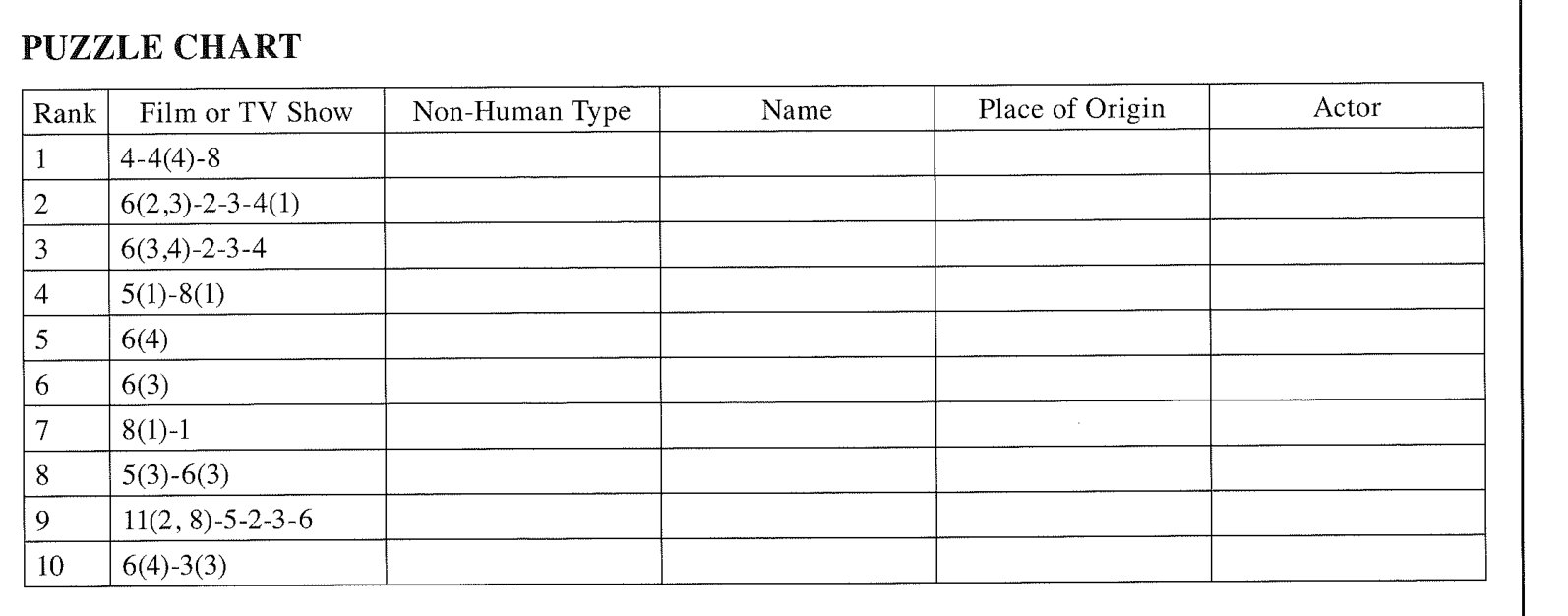
In the chart below, each row gives the name of a science fiction movie or TV show from the late 20th or early 21st centuries, the species of a non-human character in that movie or show, the name of the character, his/her/its place of origin and the actor who played him/her/it. No entry appears more than once. The 12 clues (A to L) will enable you to fill in the third, fourth, fifth and sixth columns in the chart relating to these non-human characters. From there, you should be able to work out the names of the movie or show, to be placed in the corresponding squares of the second column.
Each of these second-column squares currently contains a series of numbers. The numbers outside the parentheses give the number of letters in each word of the name (dropping any “The” at the beginning). The numbers inside the parentheses indicate the location within that word of the key letters making up the command code. For example, if the notation 3-2-3(2)-8(5) turned out to be “DAY OF THE TRIFFIDS”, then the key letters would be H (the second letter in THE) and F (the fifth letter in TRIFFIDS). The command code is made up of the letters in order from column 2, box I to box 10.
Cornelius the gorilla (type) from Earth falls on the list
directly below the Borg (type) and directly above the
character played by Warwick Davis.
God (name) in line 4 is played by Morgan Freeman.
The character named Christopher Johnson, from an
unknown planet, is three lines up from the Time Lord
(type) and four down from the Ewok (type).
The character played by Roddy McDowall, the one
named Smith and the Prawn (type) are on different lines
with prime numbers, in that numerical order.
The Jatravartid (type) named Humma Kavula, from
Viltvogel 6, is found on line 9.
The character named 7 of 9, the character of Na’vi type
and the character played by John Malkovich are in
different lines. The numbers of those lines are not
adjacent but do ascend in that order, and they total 16.
The replicant (type) named Pris, from the outer planets
is found one line below the character played by Jason
Cope and two lines below the character from Pandora.
The character from Heaven, the Agent (type) from
cyberspace and the character named Neytiri are on
three adjacent lines in that numerical order.
The character played by Jeri Ryan, from Delta Quadrar
is found on line 1.
The character played (as of this year) by Matt Smith is
on a line whose number is twice that of the line of the
character played by Hugo Weaving.
The character Wicket W Warrick from Endor is on a
line whose number is seven less than that of the line
of the character Dr Who from Gallifrey.
The character played by Zoe Saldana is on a line exact
half-way between the lines of the deity (type) and the
character played by Daryl Hannah.
View the original scanned pages →
Originally published in bout de papier, Vol. 24, No. 4 (2009) — Winter 2009 // Hiver 2009, pp. 44–47. Read the rest of this issue →



