
bout de papier, Vol. 25, No. 4 (2011) — Winter/Spring 2011 // Hiver/Printemps 2011, pp. 36–39
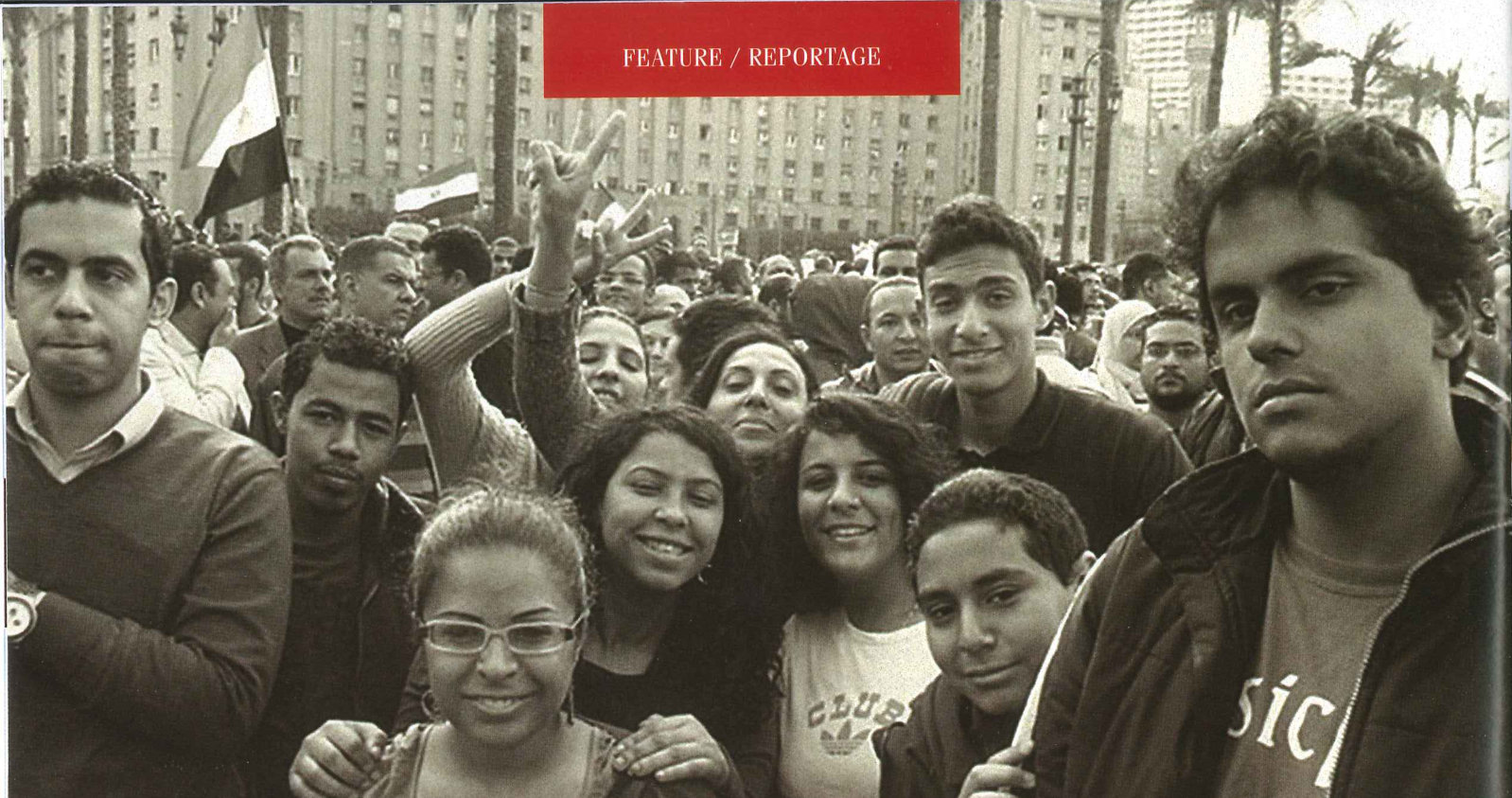
Editor’s Note: Our former Ambassador to Egypt (Iran and Jordan), Michel de Salaberry, was an eyewitness to Egypt’s “revolution”. Now working with a modest NGO in Cairo, he long ago sensed the rising frustration of ordinary Egyptians alienated by a succession of authoritarian governments that treated them as subjects, not citizens. The thirst for democracy was palpable, but he didn’t think he would see fundamental change so soon. On February 2 he wrote his impressions as if he were once again at his desk preparing another notable diplomatic report. On February 6 he added a Prologue and a Postscript putting rapidly evolving events in context. bout is very pleased to bring you Michel’s perspective, written from the edge of Tahrir Square itself.
February 6, 2011
Prologue
What was I doing in Cairo amidst the turmoil? Like others, I have spent most of my professional life observing, mixing with and indeed trying to assist (on Canada’s behalf), those who strive to bring some justice and peace to the fascinating, beautiful, and frustrating Middle East. Before retiring in 2004 I concluded that there would be no broad political solution to the various dramatic issues dividing it. Others would take up that policy challenge, and God’s grace be with them. Nonetheless, I wanted to remain involved with the people and cultures I love. I decided to focus on the micro, on individuals and help with situations like those of working kids and of students in neglected government schools, or at least a handful of them.
After a last posting in Cairo it was easy to blend into life there for a few months every year (except in 2009 which I spent in Tehran). My pretext was to re-join a small NGO that had received modest funding from the Embassy’s local initiatives fund in 2002 and to which I had devoted a lot of free time. My Egyptian stays happen to coincide with Ottawa winters.
Friends loaned me the use of a nice small apartment on top of what had been the tallest building in Egypt. It was built by Mussolini, right downtown, to house Italian Consulate services when “Mare Nostrum” was at the centre Italian foreign policy. The common areas are almost derelict but the elevator to the eighth floor normally functions, and there are only two other floors to walk up. From that perch, there is a bedroom view of the faraway Citadel in the East. Through a kitchen window and recently erected billboards to the West lies a view of the Nile. Stepping onto the roof there is a partial view of Tahrir square 350 metres away (the heart of the Arab world), and of the October 6th bridge (where the key battles of the January 25 uprising would take place).
Twice a week I enjoy the liveliness of subway and microbus trips to reach the NGO on outskirts of the city. Opening an Arab language textbook inevitably launches a conversation with the passenger in the next seat. And for years now, on another evening of week, closer to the city centre, I attend discussions with 15-30 youngsters. They want to know what’s going on and what one can do about it (in Arabic with the help of a volunteer interpreter).
I have had a privileged seat to witness and participate in the developing movement of Egyptian youth and their voluntary organizations. The movement does not have a political agenda, only ideals, shared objectives and determination in pursuing them. Organizationally, it is a step behind the non-religious political parties that have a convoluted history of agendas despite their weakness. It is much smaller and weaker than the Muslim Brotherhood, especially in scattered provincial cities. It is a third force.
Almost everyone I know was engaged in the conquest of Tahrir square on January 25. Outside my building state security forces and demonstrators took and lost ground, erected and dismantled barriers, and suffered as teargas wafted up to the roof. Before the media reported it, I heard the thunderous cheer of the hundreds below greeting and surrounding the first military vehicle to appear on the scene. The diplomat who never expected to see real change watched as demonstrators stood their ground and took control of Tahrir Square.
Cairo, February 2, 2011
Just back from a stroll on the Square. These are moments that only occur once or twice in a lifetime. I have been privileged to see another resurrection of a people believed dead, the first was in witnessing the huge demonstrations in Tehran a year and a half ago. It seems the outcome here will be different, but Tehran may not yet be over…
What is the mood, what do we see?
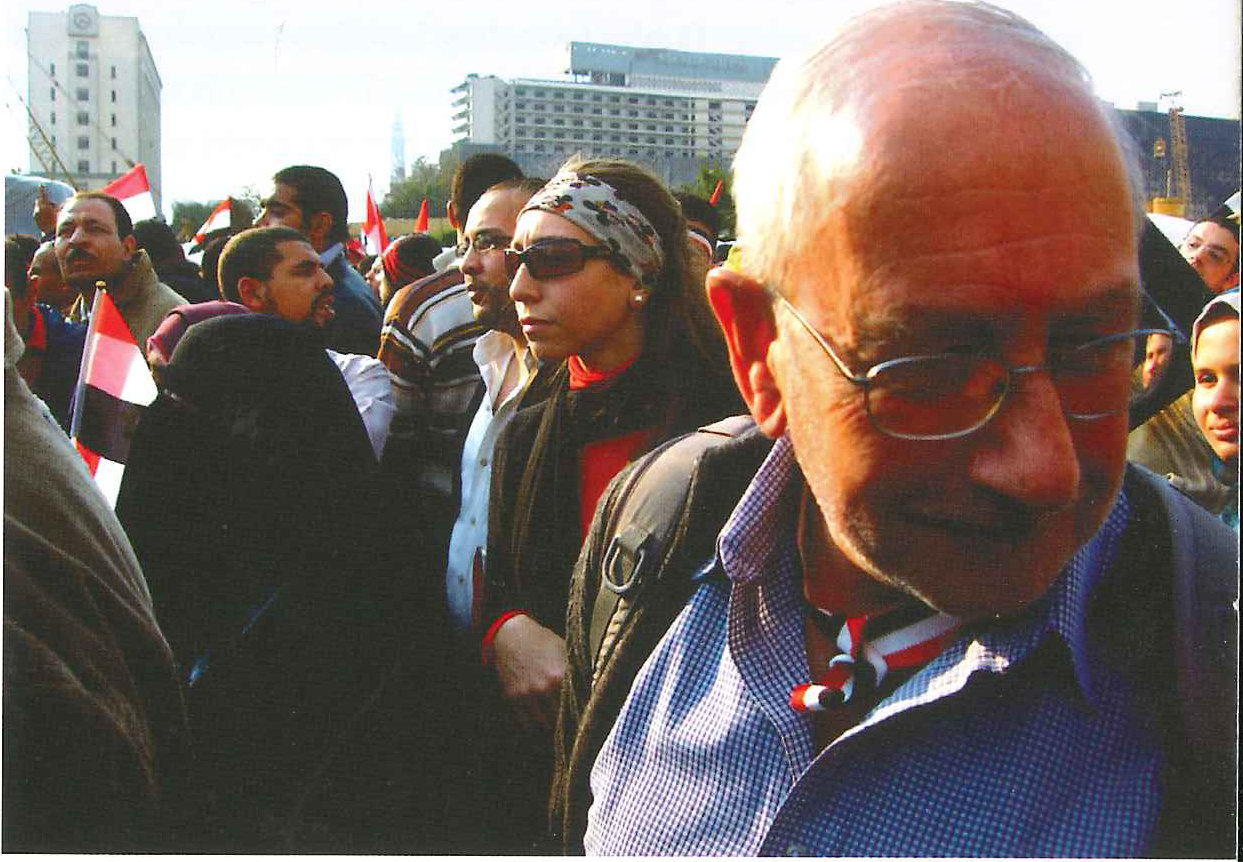
& It’s a moment of grace, the memory of which will need to last through the tough challenges ahead. The vicious street battles are apparently over, confidence is now pervasive, but there is still enough tension and uncertainty to keep the huge crowds together. & The moment is to be savoured: in the square there were all varieties of veiled women and bare-headed ones, from 7—77 years old; bearded brotherhood types with prayer marks on the foreheads and official, state-employed imams with their red and white tarboushes; probably no more youths than in the country as a whole at this stage of the movement; and probably more of the really poor than in the modest middle-class make up of demonstrations last Friday. There were the pervasive smells of the unwashed, but some elegantly, casually dressed people too. Many carried small handwritten signs ( “Mubarak f..off”, “We are Egyptians, not politicians”), often in mostly poor English, French, even German. Many had national colours painted on their faces, or carried flags… there was a tangible sense of community, of oneness.
% It is organized: convivially, as the crowds moved in, there were the good natured twin identity checks of soldiers first, often smiling, and then of the organizers. The latter patted one down for weapons. Seeing a foreigner, they said “welcome”. The square is much cleaner than the surrounding streets; organizers were picking up rubbish and carrying bags of it outside. In the evenings they provided tents to ward off the cold. Secular NGO contacts seemed to have registered in their cell phones the numbers of key vigilantes protecting many city neighbourhoods from the pillaging thugs of security police and criminal origin; these vigilante committees emerged only hours after the initial looting, area by area. In the several areas I went through (from the city centre to Heliopolis) they are of secular, not religious appearance. They had the same appearance in Nasser City; maybe not in poorer areas.
It’s about dignity
& A student said it best as he stood with me on the roof of our building. We watched the nervous assembly on the square below, it was curfew time on Saturday afternoon. Half in Arabic and in English he said: “there is only one Egypt now, not the powerful and the weak, not the rich and the poor, not the religious and the non-religious: we are all one now”. He lives in one of those modest constructions on top of city-centre buildings. He is not blind to inequality. This is not about economic or social grievances, it is about citizenship. And this is why, for now, the hundred thousand people in the square are together, as Egyptians not politicians, as the sign said.
& He also articulated what seems to be a shared understanding of the more secular sections of the population. “When we are free, we will become richer and we will build our country”.
And this is today’s generation’s single chance at citizenship.
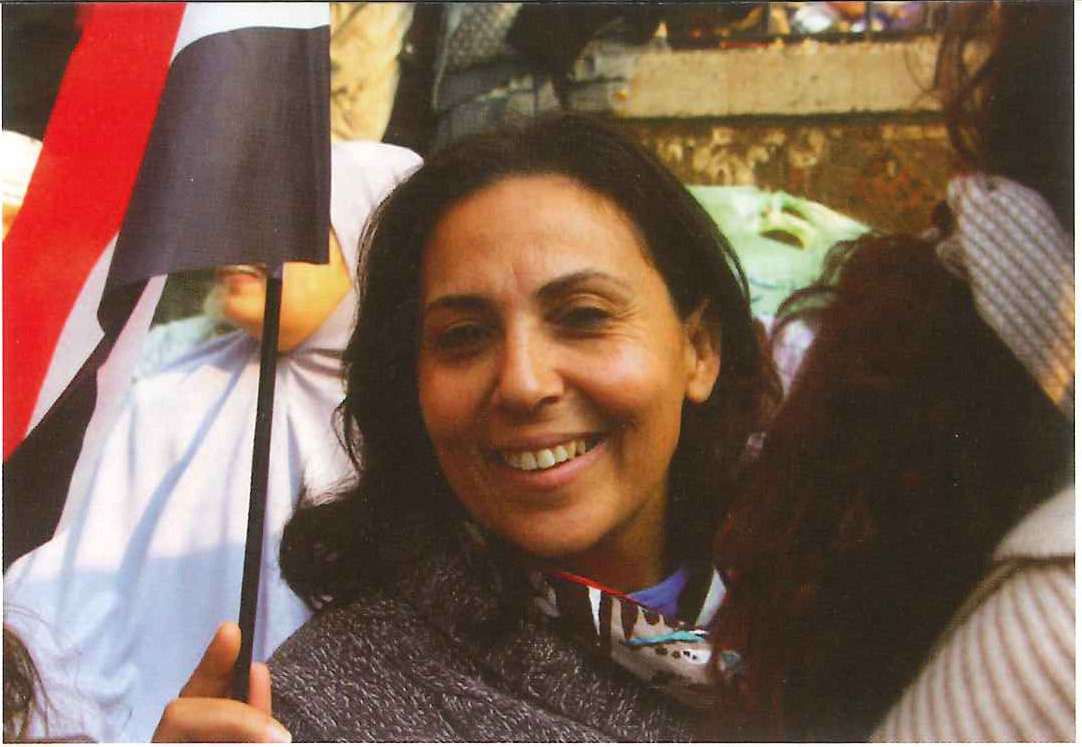
A long, tenacious education on rights via NGOs and the internet takes to the streets
& The NGO I know best is the Shehab Community Centre, in a concrete shantytown close to the airport. The embassy partnered with it 10 years ago through a small Canada Fund grant to support kids’ learning. Public schooling here is so bad that private tuition expenses are the single biggest item in family budgets; the Centre attempted to help out kids whose parents could not afford it. It was then made up of half a dozen volunteers.
S Through the shoals of government control and the versatility of foreign donors’ funding, it managed to stay on course with assistance and development based on rights. On women’s issues it has gone from income-providing embroidery (belly dancers’ costumes, a lucrative product!) to a rights campaign that now enrolls 600 char ladies from the community who work in richer Nasser City next door and who are at considerable risk of abuse. It has a staff of 59 people involved in everything from the right to water and garbage removal and other government services, to the struggle to obtain birth certificates for women who were never registered. In education, it now has a partnership with the only local government school and reaches out to the teachers, parents and some 4,000 students. The theme of rights runs through all programmes. & Shehab is one of tens of similar organizations that gradually linked up for mutual support and reinforcement. Twenty or more NGOs regularly come to the Centre when its turn comes to host seminars. The energy and creativity are Egyptian, but a substantial share of resources come from foreign donors. Canada can take a bow.
& The Centre is the only secular NGO in a township of at least 150,000 where all others cater to their respective Muslim and Christian clienteles. It carefully stays away from overtly political stands but was originally rooted in the tiny Tagamo (Labour) Party. Shehab also hosts a discussion group where 20-30 young NGO workers from across Cairo look at topical issues that they select. A striking feature is the level of internet literacy of these young Egyptians, stimulated by the scarcity of alternative resources and the heaviness of social and governmental controls. They know what is happening abroad and they have mastered the communication skills required to access and share information.
Recently some of the women have chosen to take off their veils; at the same time the view that the country has overinvested in religion is no longer scandalous. Discussions and opinions once closeted in NGOs and the internet are now moving to the street.
Secular networks seize the day and set the agenda – thus far
The secular networks emerging from the NGO movement in the last six days are significant, though not on a scale that could compare with the Muslim Brotherhood. I saw parts of phone banks in operation in Tahrir Square to keep a minimal presence during the night, draw a maximum in the afternoon and ration resources. An organizer who came for a break was in telephone contact with the activists on the street below.
& More than once this network put together welcoming crowds of several hundreds or thousands for the Nobel Peace Prize winning head of the International Atomic Energy Agency, Mohamed El Baradei. He came home to spearhead a campaign for constitutional reform. Egyptians were proud of him. It was thought his international status would make him safe from the lightning destruction of previous significant challengers. Though he is about as charismatic as Stéphane Dion speaking in English or Robert Stanfield in French, he got opposition political forces to cooperate, perhaps because he wasn’t a threat to any. Something in the present state of Egyptian culture drew more than respectable turnouts wherever Baradei appeared throughout the country, for Friday prayers at mosques and among the diaspora abroad. & The 2005 parliamentary elections had two features: the fraud perpetrated against the Brotherhood in later tranches of constituency contests, and the recruitment by a consortium of NGOs of some 5,000 young observers covering close to the whole of the country. One felt their rage back then at what they were witnessing. Two self-evident observations can be made about the state of human rights in Egypt since then: that we continued to see no real progress throughout the political system as a whole (and perhaps even some regression as the government contemplated a new more restrictive law on NGOs), and that computer literate youth were increasingly restless and looking for something different. Youth involved in the secular NGO movement were not that interested in partisan politics, especially not the traditional issues of pan-Arab nationalism (though they shared deep shame over Egyptian cooperation in the Gaza blockade) and were increasingly disappointed by the lack of return on the investment in religion. They were outraged by acts of terrorism against the Copts, around Christmas 2010, as well as last month. On many of their Facebook pages this year a cross and a crescent appeared instead of a photograph.
& The most significant opening of recent years has been the emergence of free dailies, themselves a kind of outgrowth of the NGO movement. The first, the brilliantly successful AJ Masri Al Yom, achieved the largest circulation of any in the country.
It was created by the co-president of the Egyptian Organization for Human Rights, Hisham Kassem. It was financed by the Coptic Sawiris family, anchoring its interest in the rights of minorities. It was joined by the almost as successful Al Dustour. In tandem with the denizens of the internet, their readers were learning a new secular rights oriented language.
& Tunisia proved to be the determining factor. The internet call on January 25 to go down to the street met with much more success than NGO contacts themselves expected. They were prepared to call it a success if they mobilized a few hundred more than they had been able to rally on similar occasions; in hindsight the chemistry was ready for real reaction.
& It seems the internet call very successfully tapped into the memberships of the city’s two largest sports clubs, Ahli and Zamalek.
& Precisely because the initial turnout was beyond NGO expectations, the ability to seize the opportunity once it presented itself was proof of their organizational growth.
The secular and religious factions in the opposition, and what we may expect of them
S Despite one or two strong figures such as Ayman Noor or the morally authoritative Osama Ghazali Harb, the leaders of traditional secular political parties, new and old, failed to impress Egypt’s citizenry. It was partly because citizens have lost confidence in the system. It is also because the middle-class secular audience (their most likely initial target) is fundamentally ambivalent: they turn back to the comfort of authoritarianism whenever the Islamists seemed to be gaining control.
à By far the largest and best-organized Islamist group is the Muslim Brotherhood (MB). It is now nested in most labour and professional unions. It has a network of medical doctors and welfare centres attending the needy. Although devoted to a somewhat rigid and unsophisticated practice of popular Islam, the MB is not a monolithic ideological block. It has its modernizers and its traditionalists; many seem interested in democratic competition and cooperation, and many others seem to live in a largely separate world. On the religious right the MB has to compete against the more recent, small but growing attraction of Salafism which advocates exclusive dedication to Islam and rejects the appeal of social or political involvement. To its left, the MB faces growing boredom with religious commitment that, after having won over most social institutions, no longer excites or offers anything new to many Egyptians.
& Not so much as a considered political judgment but rather as a way of relating to society, the younger NGO constellation seems vaccinated against the attraction of the traditional secular or Islamist camps. If they considered voting in the past, they might support one of them but the formal rigidity of a political framework and a hierarchy repels them. In this, their values are not unlike those held by youth in the West: they value association and action as long as they are free to choose their specific form of commitment, from helping street children to advocating privacy rights. & Baradei is attempting to federate three social and political universes — secular, Islamist and post-traditional. They came together with impressive effectiveness during the last week but are unlikely to be amenable to permanent fusion. The traditional parties are factional and demographically light; the MB is big but heavy to move; the NGO movement has broad but shifting appeal among youth in this nation with its very young population. Their common success is a down payment on future cooperation, although they seem temperamentally unsuited to maintaining such cooperation for very long. It will be critical that they remain convinced of their achievement and they have take ownership of their freedom, not as some temporary concession from a Pharaoh or his army.
The great achievement of the NGO constellation is that it has defined the agenda, to which the traditional political parties and the MB have rallied. It will have difficulty maintaining its lead over the more traditional secular and religious parties, but then these others had pretty well exhausted their own creativity.
February 6, 2011
Postscript
Three friends of friends were killed last Wednesday night (among the 25-30 deaths and 5,000 wounded around Tahrir) as armed regime thugs attempted a massacre. Exhausted secularists had been succeeded or replaced to a great extent by the MB, who had been late in joining. Because of the heavy MB presence at this decisive moment, the high price the Brotherhood paid in deaths and casualties, and its contribution to the critical maintenance of the square in democrats’ control, secular friends now speak of the Brothers as heroes.
Am I as confident as I was, and hopeful for the secular NGO movement? Was what I saw an Egyptian political Woodstock? NO! But my political studies master John Meisel would say that political parties are essential and perhaps it is inevitable that they will come to occupy the political space opened by the NGOs if the NGOs don’t occupy the space themselves. Secular friends respond that only their being scattered allowed them to escape repression, that the clarity of their demands and their determination insure some kind of supervision of the coming process, and that they never intended to “become politicians”.
It is too early to tell how this revolution will turn out, but it is very clear that without the NGO movement the regime would still be in place and the revolution would not have had and will not have the vigour and vitality that will determine its success.
I also watch my beloved Iran, where the contest will not be peaceful.
View the original scanned pages →
Originally published in bout de papier, Vol. 25, No. 4 (2011) — Winter/Spring 2011 // Hiver/Printemps 2011, pp. 36–39. Read the rest of this issue →



