
bout de papier, Vol. 25, No. 4 (2011) — Winter/Spring 2011 // Hiver/Printemps 2011, pp. 18–20
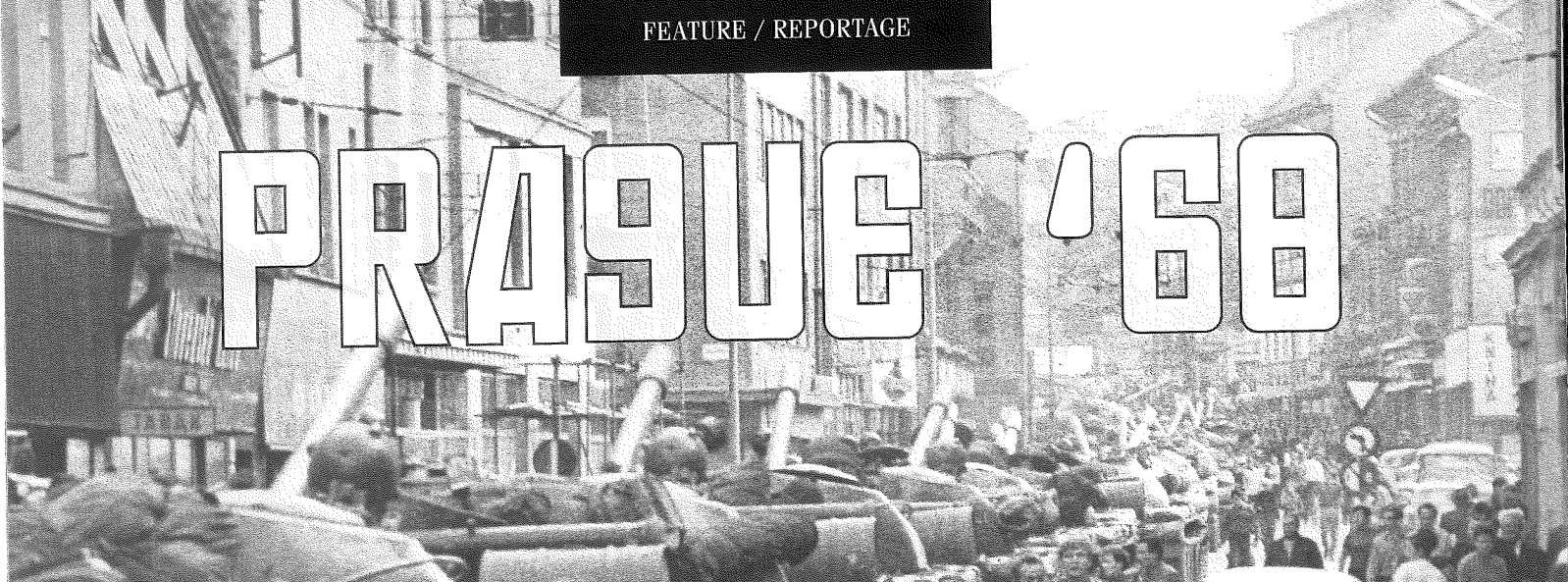
Editor’s Note: Knowing too little is always a handicap, but knowing too much can present its own dilemmas. As Charles Cole graphically recounts in his narrative of the Soviet intervention in Czechoslovakia in 1968, early warning of the Russian-led invasion presented a terrible choice: to do his duty and report the news (which he believed would have resulted in the death of his source), or remain silent and live with the consequences. The invasion also presented tough choices at the highest levels for policy makers and the bureaucracy: to depart from existing immigration policy and — somehow — welcome a wave of dissidents from Eastern Europe. At the level of individuals like Josef Jurkovic, the choice was to remain in his native Prague or take a great leap of faith into the unknown and a life in Canada (which included a stint with External Affairs). In “From the Archives” we get another perspective: the official reaction to the invasion, primarily crafted — it seems — for domestic consumption.
While attending the Tehran Conference on Human Rights in the spring of 1968, I received a telegram from External Affairs asking if I would be interested in a posting to Czechoslovakia. I consulted my wife Jean and she was thrilled with the prospect so I quickly agreed. I arrived in Prague on July 9 and Jean and my 14-year-old son Frank arrived a few days after the USSR-Czechoslosvak summit meeting held in early August in Cierna Nad Tisou.
Prior to my family’s arrival, ambassador Mac Bow had left for Ottawa on July 22, appointing me Chargé d’affaires. They arrived a few days after my meeting with the Czechoslovak Deputy Minister of Foreign Affairs, Vaclav Pleskot. I had requested that meeting as I wanted to ascertain from the Czechoslovak authorities their views on the outcome of Cierna. The meeting turned out to be private, with only the Deputy Minister present. At the time, worldwide analyses were divided on the question of an imminent invasion so I wanted to ascertain how the Czechs themselves viewed the outcome.
Canada’s Ambassador in Moscow, Robert Ford, concluded that there would be no invasion. My own analysis led me to the opinion that an invasion was probable based on my reading of the agreements reached at Cierna, the subsequent reluctance of reformist Czechoslovak Premier Alexander Dubcek to speak to the ensuing large demonstrations, and the slow movement of Russian tanks leaving Czechoslovakia following the Warsaw Pact manoeuvres.
We were just beginning our discussion when the Deputy Minister suddenly broke into an uncontrollable outburst of tears. I was embarrassed and tried to comfort him as much as I could. However, the tears continued and to my surprise he said: “Mr. Cole, the invasion is coming”.
I was certain that should this news become public, it would result in his death sentence imposed by the Russians. At the same time, I admired him for his patriotism and courage, knowing of course, of the questionable suicide of the Czechoslovak foreign minister Jan Masaryk from a foreign ministry window following a Communist Coup in 1948. Considerable doubt has always existed as to whether his death was voluntary. Moreover, there undoubtedly would be severe repercussions not only for Dubcek and his supporters, but also East-West relations.
I can only speculate as to the reasons for his disclosure. One possibility is my attendance at the Tehran Conference; he led the Czechoslovak delegation to that Conference at which I was an adviser to the Canadian delegation. I had drafted a resolution on legal aid which Professor Ronald Macdonald of the University of Toronto Law School (who was a delegate) asked me to introduce to the Third Committee. Presumably Deputy Minister Pleskot would have learned of my name at that meeting.
To report this information to Ottawa, as I was bound to do as a diplomat, was unthinkable in light of the probable consequences. It was the most difficult decision in my life but my conscience persuaded me to remain silent. I told no one, not even my own wife who manned the switchboard at the embassy during the invasion and its aftermath. The weight of that decision has haunted me for over 40 years.
A little more than two weeks after my meeting with Pleskot, on August 21 shortly after 2:00 a.m., I received a telephone call from the Ambassador’s chauffeur, Cipra. He was crying as he was telling me “Mr. Cole, Mr. Cole, they are here”. I asked who were here and he replied the Russians. I thanked him for letting me know. I asked if he could come and get me without exposing himself to danger (my own car had not arrived from Canada). I telephoned the administrative officer and asked him to telephone Canadian staff and ask them if they could safely come to the Embassy. All of them turned up. I then woke my wife Jean and my son Frank. I told them that I had to go to the Embassy and that they should come with me. I asked them to dress warmly and to wear good walking shoes as we didn’t know what we were facing. Frank turned up at the front door with his tennis gear all set to go.
Cipra arrived about a half hour later. We got into the car and drove down the hill to boulevard Leninova. No other cars were visible but every few yards was a tank which formed a column into the horizon. I thought it’s just going to take one shell from one of those tanks and the family will be wiped out as well as the driver. As far as the Coles are concerned, we’ll all go at the same time. In a way this was a bit comforting.
Ten minutes after our arrival at the Embassy, the street was completely blocked with tanks and troops. My first task was to send a telegram to Ottawa advising that all Canadians were safe and well. Not long afterwards the switchboard was jammed with calls from the 120 Canadian scientists attending the World Geological Congress and the many other Canadians visiting Czechoslovakia. The two communicators worked around the clock sending not only updates concerning the invasion but also information concerning visitors to the country. The floor of the communications centre was completely covered with incoming messages.
Our home was situated across the street from a large park with a stunning view of the city. On the morning of August 21st it was taken over completely by the invading forces. I counted more than 80 tanks and armoured vehicles. On my first visit home the embassy car, driven by Cipra, was stopped by a soldier in a small truck with a machine gun mounted on a tripod. Suddenly Cipra accelerated as though he were going to crash the car into the truck. The soldier’s finger tightened on the trigger. I said several times calmly in a soft voice, “Cipra, it’s not worth it”.
To my relief he eased his foot off the accelerator.
I was particularly concerned that I might be prevented from returning to the embassy during the early stages of the occupation when there was so much to be done. An immediate priority was providing assistance to the many Canadians (including scientists and family members) attending the World Geological Congress in Prague who were stranded by the cancellation of air flights, trains and buses. There was much relief when surface transportation resumed within a few days. We were able to assist the Canadian scientists in leaving the country.
During long days and some nights, I remained at the embassy with a few staff members. Shortly after the occupation an 8:00 p.m. curfew had been announced, which resulted in empty streets and risky travel. Although there were plenty of worries, was somewhat reassured that Frank was at home with his mother. However, on returning home one evening from the embassy, I noticed someone hiding behind a bush on the lawn about 75 feet from the invaders camp. It turned out to be Frank holding an air rifle which I quickly took away and hid in the house. He said that he was concerned about his mother’s safety.
During the early hours of 21st of August, a large number of individuals of various nationalities, but mostly Czechoslovak, sought and were given shelter at the Canadian Embassy in Prague. The hard-pressed Canadian staff was unable to give its full attention to these refugees, other than to isolate them under supervision from the operational part of the Embassy. Their fears were assumed to be genuine, given the overwhelming concentration of foreign armed forces with streets and squares jammed with tanks and troops. The collapse of the Dubcek government made for a period of uncertainty, compounded by the arrest of Czechoslovak leaders and widespread intimidation by the invaders, including sporadic weapons fire and the positioning of numerous tanks and armoured vehicles on the hill near my home. It was an anxious time too for more than 150 Canadian visitors whom the Embassy advised to remain at their hotels until assistance could be given in leaving the country. Within a day or two fears for personal safety diminished and refugees at the Embassy gradually departed.
The situation in Prague presented an expansion of the circumstances envisaged under the usual definition of temporary diplomatic refuge or asylum. Serious concerns were generated not by local political disturbances or riots, but by the invasion of the armed forces of five communist allies which brought about the virtual, if brief, collapse of government authority. While the concept is sufficiently flexible to cover such a situation, difficult questions would undoubtedly arise if the invaders should, in fact, supplant the legitimate government or even effectively control its policies for an extended period of time.
During the first day of the invasion a few Czechs were killed resisting the tanks. Later that day, a Canadian visited the embassy to inform us he had seen a group of soldiers shooting at a group of civilians but had seen no blood or heard any cries. We reported this to Ottawa.
Tension increased when the Czechs removed street signs and cars were stopped and searched (including diplomatic vehicles). I was concerned about the lack of immunity. I telephoned the Czech Foreign Ministry to seek assistance but they explained that they were unable to do so as they were virtual prisoners. I asked Ottawa for authority to protest to the Russian Ambassador but Ottawa refused. A few days later after the Dutch Ambassador’s car had been fired on for not stopping, the Dean of the diplomatic corps called a meeting of heads of mission who protested to the Russian Ambassador.
It was to be expected that serious demonstrations would take place on the first anniversary of the invasion and it was announced that there would be a blackout in Prague. Central areas were declared off limits and would be patrolled by police and the People’s Militia. The obvious reason was to demonstrate that Czechoslovakia had accepted the invasion.
I considered it important to have an eyewitness report on the evening’s events and after dark drove down to the prohibited area in my small car. Within minutes, as I was descending a hill, my car was spotted by a group of police. As they were approaching I tried to escape by backing up but they caught up and placed machine guns in two open front windows. There was a bad moment until they shone flashlights on my diplomatic plates and let me go.
Later I decided to walk through the area. There seemed to be no pedestrians. Suddenly I heard my name called from across the street and recognized the voice of Hannah, the locally employed assistant to our military attaché, Colonel Bayliss. She asked if I were looking for the demonstrations and offered to take me there. A 15 minute walk brought us to the locale which was a disaster. Streetcars were on fire with their windows smashed and the rails torn up. Emergency lighting had been provided. No civilians could be seen. A tank guarded the entrance to the area. Fire engines were present and it was obvious that water canons had been in use.
After taking a closer look we noticed a long line of People’s Militia coming in our direction. We tried to hide in a doorway but they spotted us and motioned us to come out to the street. They carried guns and heavy clubs. In spite of Hannah’s frantic efforts to explain my diplomatic status it appeared that I was going to be severely beaten. In desperation I took out my diplomatic identity card and showed it to them. It listed me as First Secretary. They snapped to attention, saluted me and let us go. I had become a witness to history.
View the original scanned pages →
Originally published in bout de papier, Vol. 25, No. 4 (2011) — Winter/Spring 2011 // Hiver/Printemps 2011, pp. 18–20. Read the rest of this issue →



