
bout de papier, Vol. 25, No. 4 (2011) — Winter/Spring 2011 // Hiver/Printemps 2011, pp. 7–9
Editor’s Note: PAFSO Canadian Foreign Service Officer Award recipient Sanjeev Chowdhury, now Director General, Summits, spoke to a PAFSO Professional Committee breakfast gathering in October 2010. It was an often humorous take on some serious issues, on Staging back-to-back summits successfully, and on dealing with the treacherous waters of Fake Lake. Public diplomacy, it seems, is not for the faint hearted.
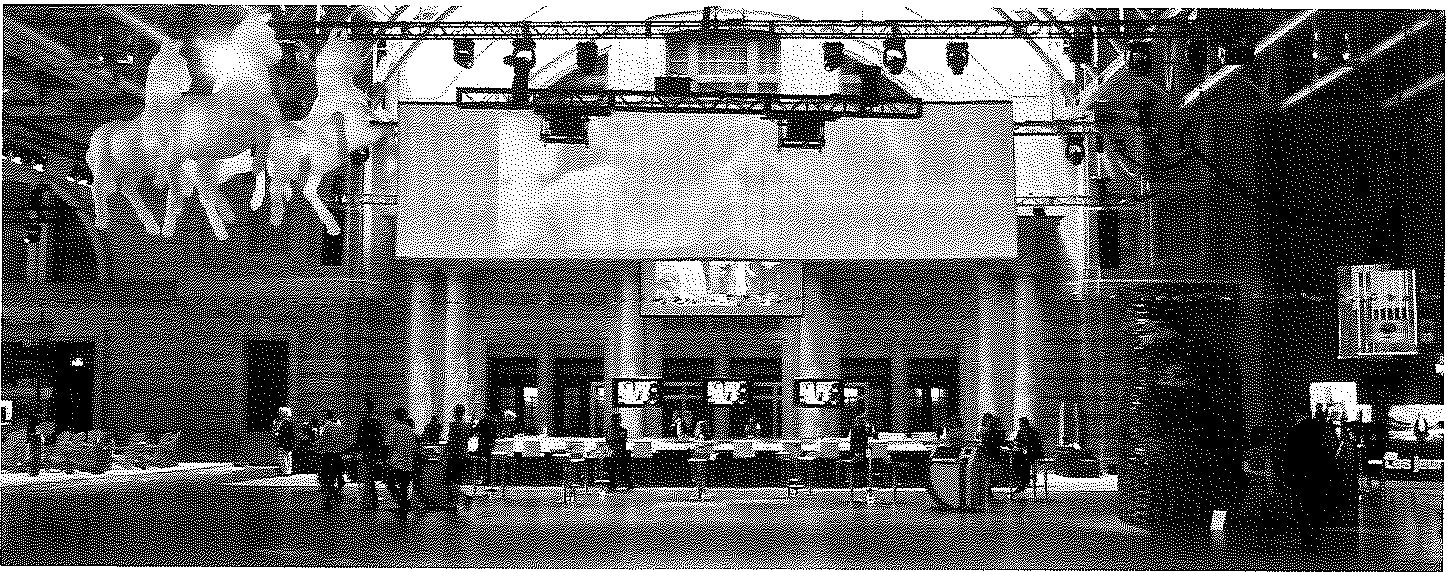
When the Prime Minister announced in June 2008 that the 2010 G8 Summit was to be held at Huntsville, Ontario, he noted that the Muskoka region would benefit from the significant economic activity associated with the Summit. He also pointed out that millions of potential travellers would be introduced, through international media coverage, to the many attractions of Ontario’s cottage country.
In response to this announcement, an Investment/Branding Advisory Committee (made up of local Chambers of Commerce, tourism associations and federal and provincial representatives) was created with DFAIT as Chair. Its aim was to develop a branding strategy to leverage the media attention afforded by hosting the G8 Summit to showcase Muskoka, Parry Sound, Northern Ontario, and, more broadly, Ontario itself, to international and domestic markets as a premier investment and tourism destination. One idea surfaced immediately: to create a “Muskoka Alley” at the G8 Summit site or in the International Media Centre (IMC) to highlight the best of Muskoka to the delegates and press.
In September 2009, the Prime Minister announced that Canada would also host a G20 Summit during the same June weekend as the G8 Summit, but in Toronto. A site in downtown Toronto was chosen for the IMC to house and feed the more than 3,000 media now expected to cover both Summits. Given the fact that there was not enough accommodation in Muskoka for both delegates and media, media pools would have to be transported from Toronto to Muskoka daily to cover the G8 Summit and return back that evening to Toronto. The result: the Investment/Branding Advisory Committee decided that if the media could not all stay in Muskoka and see the sights, why not bring the original “Muskoka Alley” idea to the media in Toronto?
Summits Management Office (SMO) Assistant Deputy Minister Peter McGovern (now Canada’s Chief Trade Commissioner), together with Danielle Thibault, Director General of the Invest in Canada bureau, saw an even greater opportunity. Based on the government’s decision to host back-to-back Summits, they proposed to take the Muskoka Alley idea one step further and promote all of Canada through an innovative investment pavilion. It would be renamed “Experience Canada” to highlight the best of our country to the international media; part of that pavilion, spanning 20,000 square feet, was to be devoted solely to Muskoka, the region that originally inspired the idea.
The SMO managed the project under the direction of Jane Powers (Investment/ Branding Manager) and Carmen Altamirano (Marketing Manager). To administer the initiative they worked with the Invest in Canada division, namely Marcel Gaumond, Director, and Ghislain Robichaud, Deputy Director. Lord Cultural Resources of Toronto was contracted on April 12, 2010, to design, build and operate the Experience Canada Pavilion at the IMC; they are famous for designing and implementing Ontario House at the February 2010 Vancouver Winter Olympics.
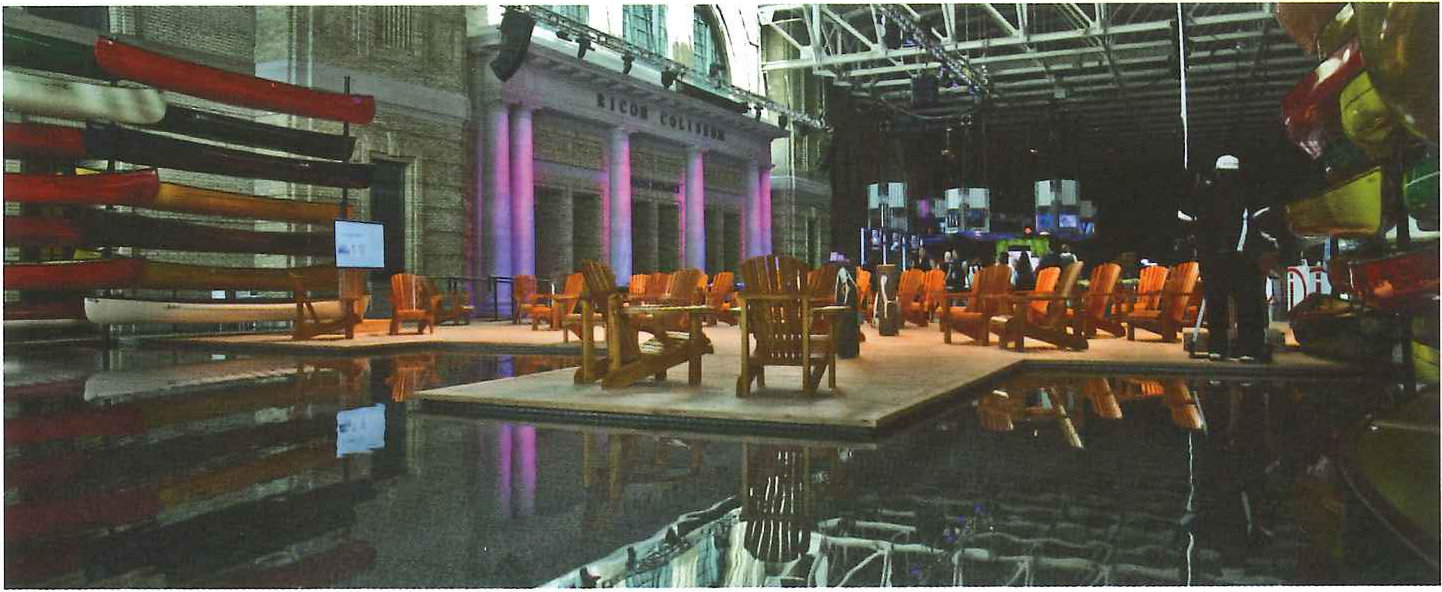
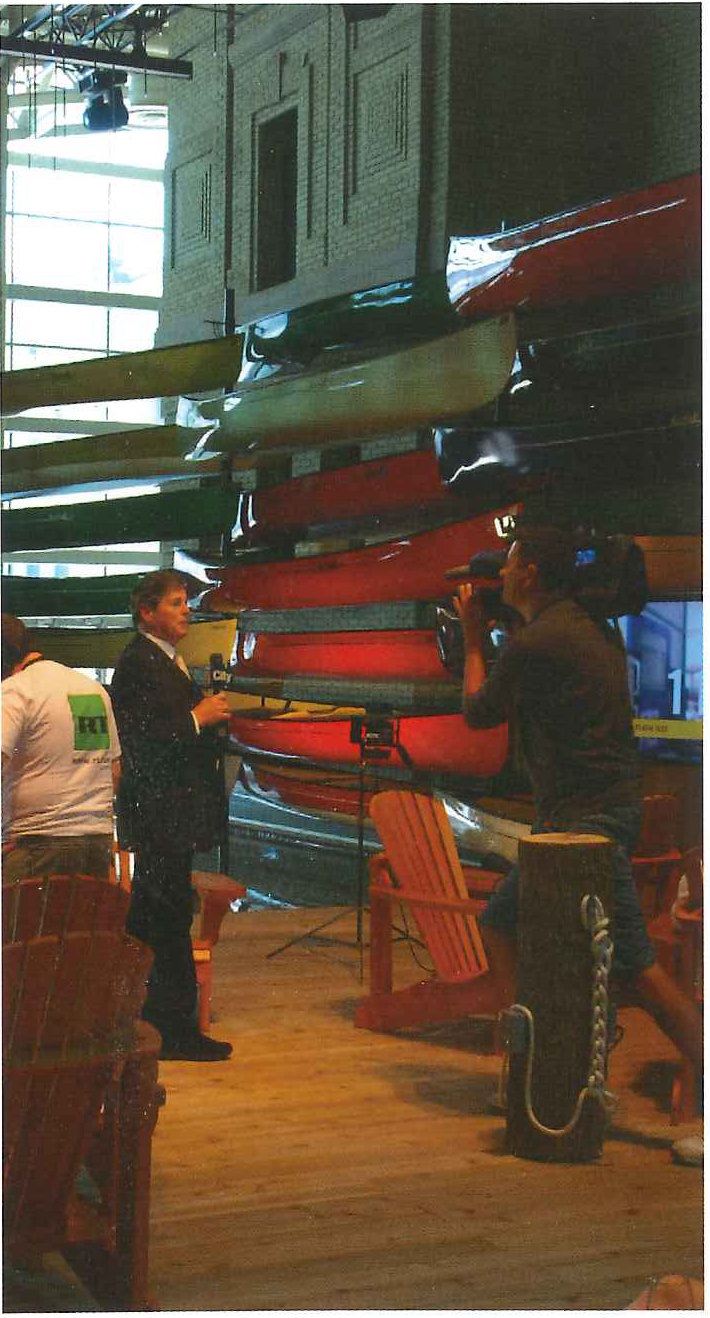
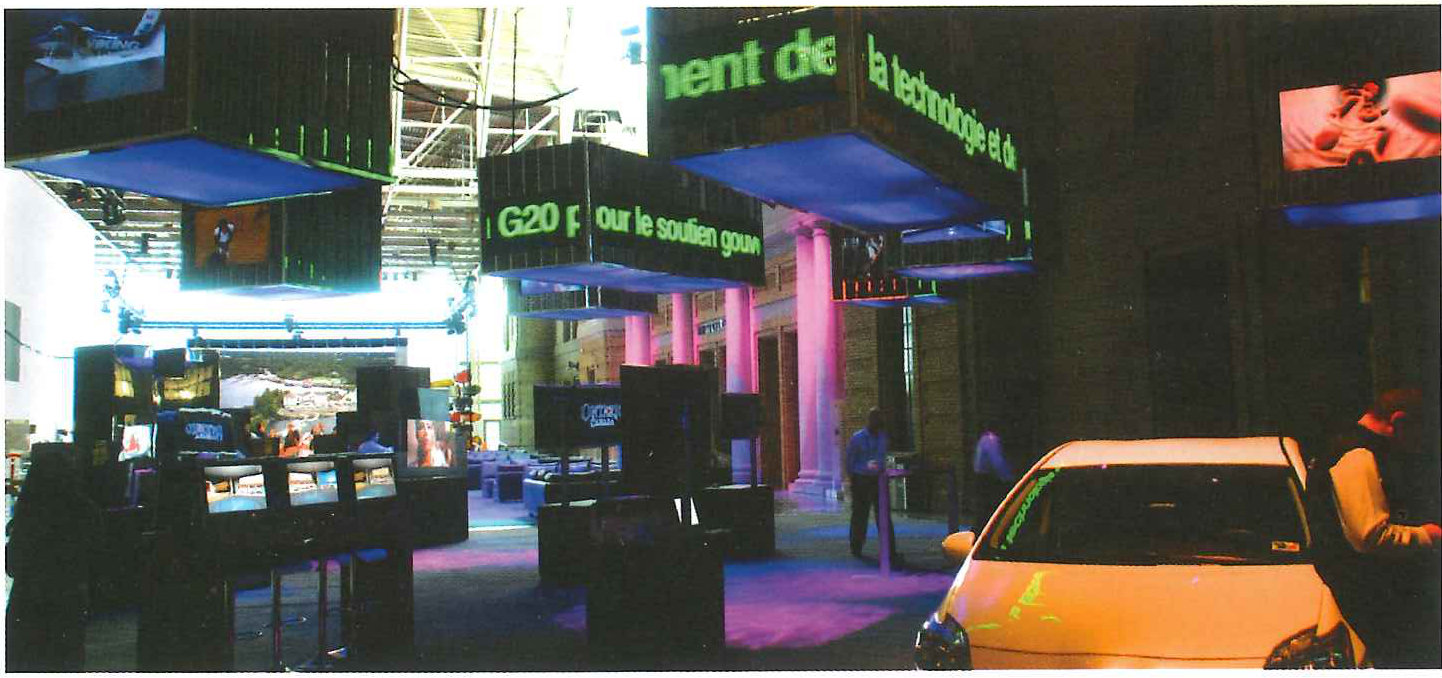
Experience Canada’s design took shape in three parts using a highly consultative process with the people of Muskoka, the provinces, the Ontario Ministry of Economic Development and Trade, Ontario Tourism and Marketing Promotion Corporation, the city of Toronto, and DFAIT officials. First, a Northern Ontario Oasis was included, with a small reflecting pool and dock with a canoe sculpture wall and a large screen broadcasting high definition images; second, a Cityscape to highlight Canadian investment opportunities and tourism highlights; and, finally a central welcoming bridge featuring Savour Muskoka and Savour Ontario food tastings.
The Investment/Branding Advisory Committee wracked its brains to figure out a way to get the media to visit the pavilion. How could we pull the thousands of media away from their work stations and draw them to the site at the back of the IMC? Little did we know that what would happen next would “solve” that problem for us!
Three weeks before the Summits, a local tourism official in Muskoka conducted an interview with The Sun’s Greg Weston — he mentioned that the Northern Ontario oasis would house a “very large water feature” (confusing it with what was really the small reflecting pool). Mr. Weston then wrote a story where he mentioned the cost of the entire pavilion ($1.9 million) but left the impression that this was the cost for what he termed a “fake lake”. In fact, the cost of the reflecting pool and dock re-creation was only $57,000 of the $1.9 million. However, this number was lost in the outrage that erupted after the story broke. The media had a field day with this expenditure, and the story even made it to CNN. The Follies took off: “fake lake” became the brunt of jokes all across the nation and dominated Question Period.
The intense negative public reaction was linked directly to the news the week before that both Summits would cost $1 billion. While this elicited a negative reaction country-wide, our “fake lake” was an actual item people could envision and relate to, unlike the large $1 billion overall price tag for the events. So, the public latched on to the story and wouldn’t let go.
The SMO undertook 20 national interviews by phone and radio to try to correct the story. Those officers with public diplomacy experience were called on to handle the media deluge. The controversy raged on for a week. We believed in this project and the SMO and Invest in Canada team didn’t waiver. Then, seven days after the story broke, the SMO appeared on CTV’s “Question Period” with Craig Oliver to set the record straight about the “fake lake”. The interview, although intense and with an aggressive host, helped dull the impact of the inaccurate story. Nonetheless, “fake lake” continued to dominate headlines, albeit with the corrected costs now included.
On the day of the opening of the IMC, hundreds of reporters literally ran to the pavilion to see the so-called “fake lake” and take photographs. Local mayors from Muskoka were on-site at the opening to tour the facility and were shown live on national television praising the project. The exhibit was a super hit! When an earthquake happened across Ontario two days before the Summits, media playfully twittered that a tsunami warning had been issued for the “fake lake”. Two Canadian female journalists caused a stir when they appeared in bikinis on the dock. In all, more than 2,570 separate visits to the Northern Ontario Oasis were recorded, many by reporters who came back time and again.
Television stations from around the world broadcast live, daily, from the dock to their viewers back home. Thanks to the “fake lake” controversy, a spillover effect was recorded in the Cityscape, where more than 6,200 separate visits were recorded. And to think we were once worried about attracting the media to the exhibit!
For five full days, the media enjoyed the “fake lake”, dock, bridge, and Cityscape sections of the Experience Canada pavilion. Reporters who once mocked the project now embraced it, including Andrew Coyne and Greg Weston. Mr. Coyne wrote, “T’ve now had the opportunity to see the fake lake. It’s a total non-story. It is, in short, a perfectly acceptable, if hardly vital, use of public funds, and should never have become a subject of controversy”.
However, the greatest vindication for Investment/Branding Advisory Committee members and Lord Cultural Resources was an unexpected — out of the blue — national editorial in The Globe and Mail on June 28, 2010. Entitled “G20/The Fake Lake: Save this faux treasure”, it appeared the day after the Summits ended. To quote: “Despite all the controversy over the so-called fake lake, the Muskoka-inspired display built for the G8-G20 Summits should be preserved…as a playful and successful exhibit that succeeded as few tourism promotion displays ever have. The Experience Canada exhibit is to be entirely dismantled within the next three days, and with it goes the…Northern Ontario Oasis. The fake lake is to be drained, the looping loons silenced, the canoes and Muskoka chairs returned to their lenders, the wood from the faux dock handed over for reuse. It’s a cruel fate to be wrought upon such an inventive installation, one that lightheartedly uses its very artificiality to celebrate Canada’s natural richness. The fake lake has become iconic. It has been seen by thousands of journalists and served as a backdrop for numerous international media broadcasts…the critics who once hounded the government over its cost and conception, then, should be concerned now to have the fake lake preserved… Preserved, it would become a featured attraction of the Canadian National Exhibition. Canadians should have an opportunity to put a toe in the fake lake.”
Discussions with the Canadian National Exhibition took place, but given that all partners were involved in other projects immediately after the Summits, the “fake lake” sadly could not be recreated there. Regardless, the entire experience from conception to implementation to dismantling, is one which will never be forgotten by those intimately involved in the initiative.
View the original scanned pages →
Originally published in bout de papier, Vol. 25, No. 4 (2011) — Winter/Spring 2011 // Hiver/Printemps 2011, pp. 7–9. Read the rest of this issue →



