
bout de papier, Vol. 25, No. 2 (2010) — Summer 2010 // Été 2010, pp. 26–29
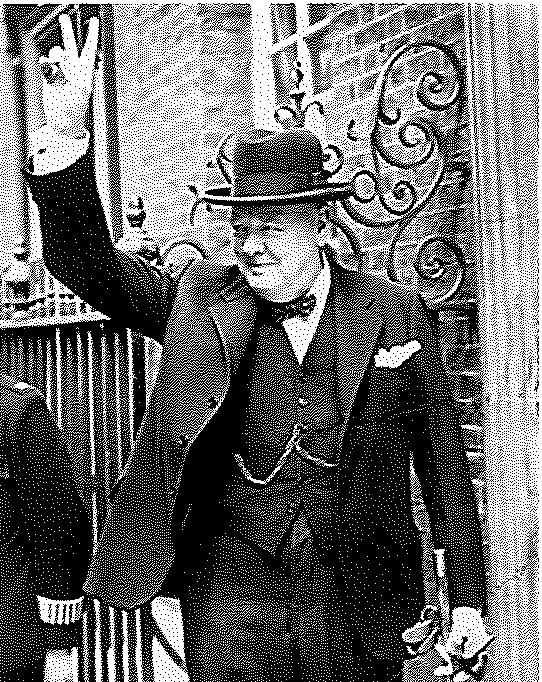
Note de la rédaction : Vous trouvez qu’on a suffisamment parlé de Winston Churchill? Pas au goût de Randolph Gherson, membre du comité supérieur de rédaction; grâce à ses bons offices, hout est heureux de publier une série de deux articles sur Churchill et le « Grand Dominion » par l’historien britannique David Dilks. Professeur émérite de relations internationales à la University of Hull (ne pas confondre avec notre Gatineau!), M. Dilks est ancien boursier à Oxford et Président fondateur du Comité d’études canadiennes à l’Université de Leeds (le premier Centre régional d’études canadiennes en Grande-Bretagne). Il est surtout renommé pour ses biographies de Lord Curzon (vice-roi de l’Inde) et de Neville Chamberlain, ainsi que pour sa remarquable publication de 2005, « The Great Dominion: Winston Churchill in Canada 1900-1954 » (Éditions Thomas Allen, 2005). Pilier de la British Association for Canadian Studies, le prof. Dilks, tout comme Churchill, a beaucoup d’affection pour le Canada; dans son article, il nous parle autant de Churchill que de nous-mêmes en explorant l’affinité particulière que Churchill avait avec le Canada et les Canadiens et Canadiennes. Le prof. Dilks a aussi été membre actif de la délégation du R.-U. au Comité culturel Canada-R.-U., où Randolph Gherson a fait sa connaissance en 1984, noué avec lui des liens d’amitié et en est venu à grandement apprécier son apport aux travaux du comité.
On December 23, 1900, the overnight train from Boston arrived at Windsor station in Montreal. From one of the sleeping cars stepped a passenger of athletic build, with sloping shoulders and sandy hair. His daughter, exercising more than a century later that freedom permissible or even salutary within families, described him as “very much a young man in a hurry — and on the make…”. Of all the young men in the world he was perhaps the most celebrated, after his escape from the Boer authorities in Pretoria, his colourful and exciting despatches, his books. To sustain a new life as a Member of Parliament, he needed to find some money; and how better to do it than by lecturing with his lantern-slides, at first all round the British Isles and then in the New World? In Boston, it transpired, there dwelt many ill-disposed people who did not relish Mr. Winston Churchill’s robust defence of Britain’s conduct in South Africa. The exchanges became refreshingly emphatic. Hence his first words on the platform at Montreal, more fervent than accurate:
Fifty-four years later, Sir Winston alighted in Canada for the ninth and last time. “I love coming to Canada”, he said. “Canada is the masterlink in Anglo-American unity, apart from all her other glories.” During that same visit, he remarked — and in French at that — that he dared to think of Canada as being almost his own country. How astonishing it seems to a later generation, identifying Churchill with the British Empire, to realize that Canada was the sole country of the Commonwealth which he knew closely. He did not return to India after 1899, though at a grave moment in 1942 he announced a desire to fly to New Delhi in an effort to resolve the constitutional crisis, and was prevented only by the fall of Singapore. He did not revisit the landscapes and battlefields of South Africa; he never set foot in Australia, New Zealand, or any of the British territories in the Pacific; he did not see Malaya or Singapore or Burma. Most of the vast expanses which the British administered in Africa were unknown to him at first hand. But Canada lay six or seven days away by comfortable travel in a liner, and conveniently adjacent to the United States. Although we think of him as quintessentially British, we should never forget that Churchill was half- American and devoted to his mother. That said, he did not conceive of “the Great Dominion” as an appendix to the United States. Nor did he regard Canadians as decaffeinated Americans.
In the summer of 1929, visiting the city of Quebec for the first time and beginning an odyssey of five weeks which carried him across the continent to Vancouver Island, he reflected upon the fate of General Wolfe, born at Westerham close by Churchill’s own home at Chartwell. During the span of nearly 30 years separating his first sojourn in Canada from his second, Churchill had entered the Cabinet while still in his 30s, held the offices of President of the Board of Trade, Home Secretary, First Lord of the Admiralty, Minister of Munitions, Secretary of State for War, Secretary of State for Air, Secretary of State for the Colonies and, most recently, Chancellor of the Exchequer. Musing, as former Chancellors will, how agreeable it was to be free of any responsibility for England’s tiresome financial affairs, he arranged for a re-enactment of the battle of the Heights of Abraham and distributed the parts among his travelling party. Rather surprisingly, he assigned to himself the role of General Montcalm and to his young son Randolph the more heroic part of Wolfe. The point soon became apparent; the stage Wolfe had to scramble in perilous style up the Heights, while the latter-day Montcalm viewed the scene with some detachment from aloft.
During that visit, Churchill spoke in almost all the great cities of Canada, from Montreal to Ottawa and Toronto, Regina to Winnipeg and Edmonton, Calgary to Vancouver and Victoria. In the Rockies he painted the landscapes now to be seen at Chartwell and until recently thought to represent the Dolomites. In Vancouver harbour he caught a fine salmon in no more than 20 minutes. He loved Canada for the grandeur of its scenery, the sturdiness of its people, the almost unlimited space, the abundant resources. When he first found himself at Winnipeg, in January, 1901, he observed that there seemed to be a large field adjoining. Enquiring about its dimensions, he received the startling reply “Nine hundred and eighty miles long and two hundred and thirty miles broad.” “We must make the prairies Great Britain’s Breadshop,” he said to his wildly enthusiastic audience that night.
In sum, Canada had everything that Britain did not, and does not, have: the capacity to grow all its own food and a great deal more, immense reserves of minerals, room for a huge increase of population. He felt a strong affinity with the people, many of whom had emigrated from Britain. Thus in a moment of agony during the Second World War he could cry to the Canadian Parliament, “We” — not “You” — “have not journeyed all this way across the centuries, across the oceans, across the mountains, across the prairies, because we are made of sugar candy.”
By the turn of the century, when Churchill made his way to North America without even waiting to take his seat in Parliament, he had already learned how to earn a handsome living by his pen. Mastery of the written word was one thing; of the spoken, something different. His skills as a speaker, to which he owed more than any other Prime Minister in our modern history, developed from a process by no means instinctive. The Ottawa Evening Journal remarked of his address there at Christmas, 1900, “He evidently does not make any pretensions to oratory.” It was then that he met another talented young man, just recruited to the public service and fresh from a sojourn at Harvard, W.L. Mackenzie King, prim, conscientious, patient, faintly scandalized to find the visitor from Britain drinking champagne in mid-morning. Canada had already sprung to the defence of the Empire during the Boer War and during that first lecture at Ottawa, which King attended, Churchill expressed admiration of her conduct.
At Winnipeg he learned of Queen Victoria’s death. Anxious to convey a lively impression of Canada’s size, her son pointed out to Lady Randolph Churchill that this city far away among the snows lay 1,400 miles from any British town of importance. He had found the people “furiously British” and his visit to them “most exhilarating.” Well he might. “Fancy,” he wrote to her, “20 years ago there were only a few mud huts — tents: and last night a magnificent audience of men in evening dress and ladies half out of it, filled a fine opera house and we took $1,150 at the doors. £230: more that is to say than in cities like Newcastle. Winnipeg has a wonderful future before it.”
Starting with no capital, Churchill had by his own estimate made £10,000 in less than two years. He confessed himself very proud of the fact that not one person in a million could have accomplished such a feat at his age. Regaining England in the middle of February 1901; he sent to his improvident mother a cheque for £300, accompanied by a note which reveals as much of the recipient as of the writer:
Canada’s heroic record during the First World War commanded the enthusiastic approval of Churchill, as of almost every politician and citizen in this country. That the same response would follow if Europe launched itself into a renewed orgy of destruction was by no means a foregone conclusion, for Canada now stood wholly independent in her foreign policy. Having long since abandoned the civil service for politics, Mackenzie King became a species of perpetual Prime Minister. Whereas we read nowadays of Permanent Under-Secretaries whose permanence seems to extend to three or four years at most, King served as Premier with only one major interval from 1921 until 1948, and as Minister for External Affairs until 1946. His capacity to win elections did not escape the favourable notice of Churchill, whose own record in that respect proved a good deal more variable. Only after Members of Parliament had been summoned to Ottawa from every part of the vast Dominion did Canada go to war in 1939, a week after other constituent countries of the Commonwealth and Empire. To his credit, Mackenzie King pointed out to Churchill in August 1941 that Canada’s ability to act with a united Cabinet resulted from the Munich agreement and the policy which Chamberlain had pursued towards Germany; only when it was clear that there was no alternative, that genuine efforts had been made to meet German grievances, was it possible for Canada to enter the fray unfractured. He had not doubted that in such circumstances Canada must fight and could have formed a government at an earlier stage by taking in members of the Opposition parties; but only at the price of losing many of his Liberal colleagues and of a profound division between the English and the French-speaking parts of Canada.
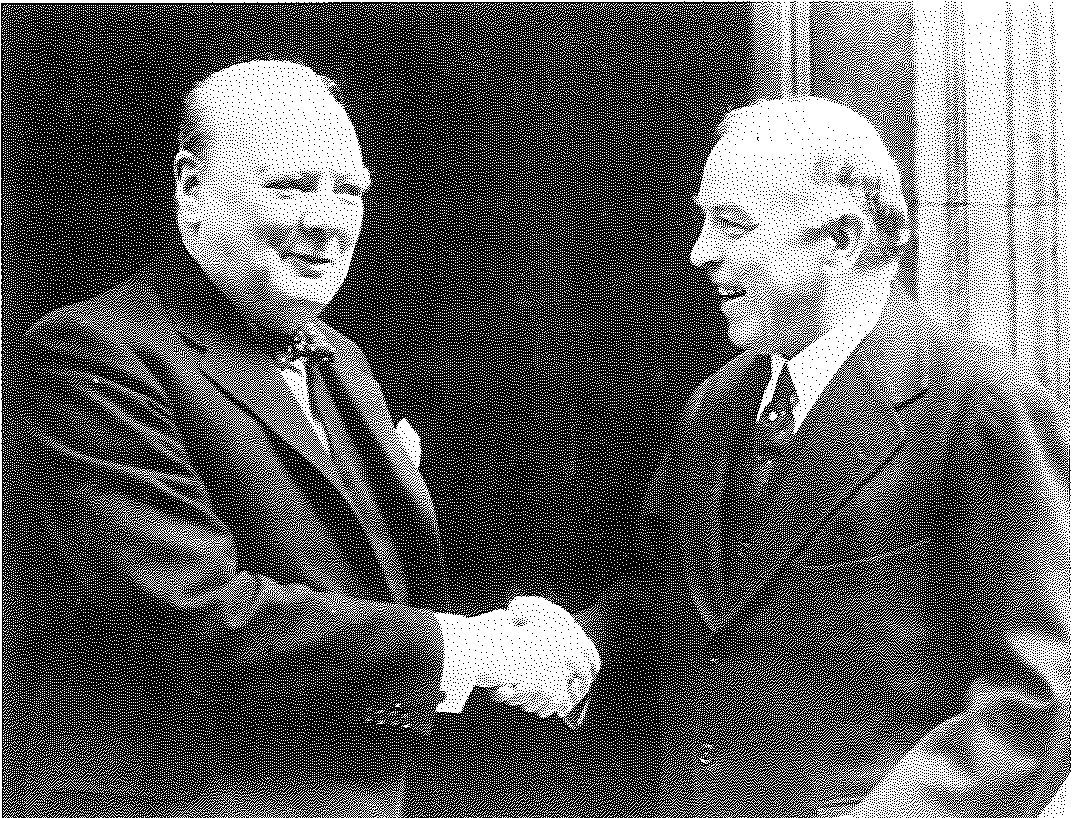
No such calculation determined Canada’s decision in September 1939, or for that matter the actions of Australia, New Zealand and South Africa. If it had been a matter merely of measuring advantage, Canada might well have followed the example of the United States and remained neutral. After all, the geography, politics and strategy of the world were broadly speaking the same for both countries. Churchill and Mackenzie King had differing mental habits, assumptions, reactions; we can almost catch the sniff of disapproval when King said to him one night, “The great thing in politics is to avoid mistakes.” Where the one was ebullient, exuberant and often unrestrained in his language, liked to drink deep, sit up all hours, did not scruple to call Hitler a bloodthirsty guttersnipe and Mussolini a jackal, the other was careful to a degree, reserved and prosaic in conversation, had resolved not to touch alcohol for the duration of the war, imagined slights where none was intended. Nonetheless, a growing warmth developed between them. King responded to Churchill’s charm, the more persuasive because ungushing and unforced. We may aver with confidence that none but Churchill could have induced the Prime Minister of Canada to dance with him in the great hall at Chequers. That no artist was at hand to record in a few strokes the spectacle of those two chubby figures in close embrace is a loss to history and King’s diary remarks Credit: National Film Board of Canada. Photothèque / Library and Archives Canada / C-047565 candidly that “All present were almost in hysterics with laughter.” Only Mrs. Churchill could have persuaded him to take a glass of champagne by way of marking the successful conclusion of the conference at Quebec in the autumn of 1944.
Before the first Christmas of the war, battalions of Canadian soldiers had reached Britain. These were people who were surrendering their careers, their businesses, their homes, their families, to set off into the unknown. Every man-jack was a volunteer. Many did not go back, or returned wounded. Some were away from Canada for five or six years.
Even now, it is hard to grasp the scale and speed of the transformation. In the spring of 1939, the armed forces of Canada amounted to scarcely more than 10,000 men all told. By the summer of 1945, well over one million had served. Canadian troops were lost at Hong Kong at Christmas 1941; indeed, their brave commanding officer was killed there. It was the Canadian forces which suffered most severely at Dieppe, which enterprise had at least the merit of demonstrating, to anyone with eyes to see, that an opposed landing across the Channel would require long planning and an overwhelming preponderance of sea and air power. Canadian divisions fought valiantly in Sicily, through Italy, France, the Low Countries and into Germany. The Royal Canadian Navy had by the middle of the war some 500 ships in service. The Commonwealth Air Training Scheme, the main effort of which was based in Canada, rendered a service beyond price. It provided more than 125,000 aircrew, without whom the war could not have been won in 1945.
Of rather less than 500 squadrons under the command of the Royal Air Force in 1944, no fewer than 100 came from the Dominions, which figure takes no account of individual citizens of those countries who had enlisted in the RAF. If we look at a microcosm, the 20 Typhoon squadrons of the Second Tactical Air Force had about 450 pilots. In the summer of 1944, with a scale of loss as great as that in the Battle of Britain, one-third of the pilots were killed and nearly another one-third crash landed or baled out. Of the 151 who lost their lives, 78 were British and 41 Canadian. Without the food imported from Canada and other parts of the Commonwealth, notably Australia and New Zealand, this country would have starved. It is right to place on the other side of the ledger a fact often neglected, what might be called a supreme act of lend-lease: without the use of the British Isles for the air campaign, the training of the armies, the launching of the armadas, no invasion of western Europe would have been possible in 1944 or at any other date.
This is by no means the extent of Canada’s service to the Allied cause; for example, the country produced armaments on a vast scale. Among her many other contributions, Canada twice provided in little more than a year the place where the war machines of the United States on the one side and the Commonwealth on the other, coordinated by the Combined Chiefs of Staff, could meet and after painful passages resolve their differences. President Roosevelt, despite occasional half-promises, always found reasons for not coming to Britain. (The same, incidentally, was true of his successor Truman. No American President in office set foot in this country, save when Woodrow Wilson passed through on his way to Paris in 1918, until President Eisenhower came at the end of the 1950s). This wounding fact, seldom mentioned even in private, had to be accepted. After all, Roosevelt’s physical disabilities did not prevent him from appearing in all manner of unlikely places from Casablanca to Cairo, Tehran to Yalta. Churchill might be pardoned for regarding such an attitude as humiliating, given the United States’ long neutrality and the sheer scale of the Commonwealth’s war-effort. In fact, he accommodated himself to this situation with an equanimity not always shown in other contexts; as he used to say with a twinkle, no lover ever studied the whims of his mistress with the care which he had devoted to the President.
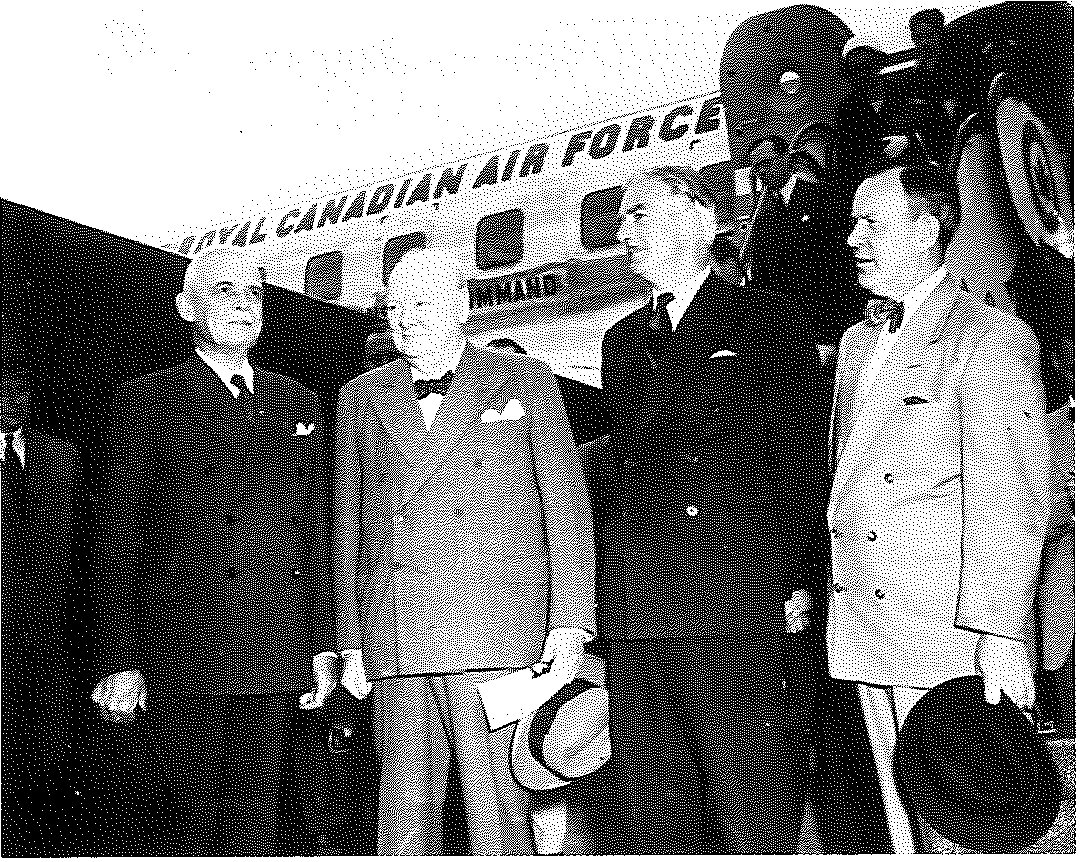
The older man, Churchill made repeated visits to the U.S. He had with some delicacy kept the Prime Minister of Canada, who in all these matters behaved towards us with extraordinary tact and goodwill, at arm’s length for his first meeting with Roosevelt off the coast of Newfoundland in 1941. Churchill and his entourage travelled thither in Prince of Wales, the Royal Navy’s newest capital ship, escorted in the later stages of the voyage by Canadian destroyers. The meeting produced the Atlantic Charter and some decidedly un-neutral decisions by the Americans. In his schoolboyish way, Churchill broke away one afternoon and insisted on going ashore in a small boat. Landing on a shingle-strewn beach, he scrambled up a little cliff and pleased himself by rolling boulders down it, as if he were General Montcalm again. Before the year was out, Prince of Wales had been sunk by the Japanese off the coast of Malaya.
When the hinge of fate had begun unmistakably to turn, and the conference was about to convene at Quebec in 1943, it became apparent that President Roosevelt would not allow any Canadian representatives to take part. That was embarrassing to Churchill. He had assumed the opposite and already said so to Mackenzie King, who accepted the awkward position with good grace. The point being put to him again, Roosevelt refused to entertain any suggestion that the Canadian Chiefs of Staff might take part in the plenary meetings with their American and British counterparts. He replied that sooner than permit anything of the kind, he would prefer not to come to Canada but to hold the conference elsewhere, perhaps in Bermuda. In the outcome, it was soon acknowledged on all sides that no more suitable place than Quebec could have been found for this momentous meeting.
Once the Allied invasion of France had taken place in the following year, and victory was in sight, another conference at the highest level was urgently needed. The impending Presidential election conveniently ruled out any question of a gathering in London. Quebec therefore suggested itself again. Once more the Canadian Prime Minister and Chiefs of Staff behaved with self-abnegation and understanding, Mackenzie King remarking afterwards that he had played a role at the two Quebec conferences somewhat akin to that of the General Manager of the Chateau Frontenac. Let us recall with gratitude that the Canadian government insisted on paying for everything, every last thing: the special trains, the hurriedly-constructed ramps for the President’s wheelchair, fleets of cars available day and night, all the communications and the princely hospitality, even down to the oranges specially flown from Florida. They disappeared from the menu at the Chateau Frontenac the moment the delegates dispersed.
View the original scanned pages →
Originally published in bout de papier, Vol. 25, No. 2 (2010) — Summer 2010 // Été 2010, pp. 26–29. Read the rest of this issue →



