
bout de papier, Vol. 26, No. 3 (2012) — Spring 2012 // Printemps 2012, p. 37
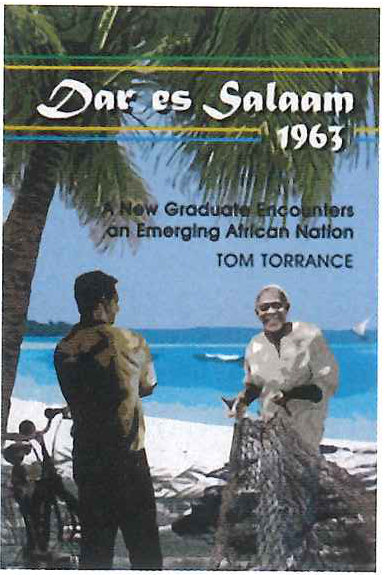
DAR ES SALAAM 1963 by Tom
Torrance, General Store Publishing
House, 2010, $19.95
DAR ES SALAAM 1963 by Tom Torrance, General Store Publishing House, 2010, $19.95
I got to know Tom Torrance in the early 1960s when we were both students at the University of Toronto, where he was working on a degree in Political science and Economics and dreaming of some day making a difference in a developing country. After graduation, he obtained a job as an economist with the government of Tanganyika (now Tanzania) in Dar Es Salaam. Unlike internationally sponsored jobs, this one was to pay purely local rates. Written almost fifty years later and based on diary notes and letters home, this book is his account of his first three months there.
Dar Es Salaam 1963 is a pleasant, informative and sometimes fun memoir. Reading it now, I am struck by the fresh idealism and innocence Tom brought to his African adventure. A lot of our generation probably shared that, but very few acted on it as he did. This 23-year-old youngster arrived in Tanganyika entirely on his own, with no backing from any aid or governmental organization and no money. He had, he tells us “come out to Africa to do some good and dabble in a bit of poverty.” For three months he lived in a primitive thatched hut in a Salvation Army camp four miles from his workplace, with no transportation except his legs and eventually, a bicycle. When his bicycle was stolen, it was a blow because he couldn’t afford to buy another one.
The thirty-six short chapters depict life in Tanganyika as it is emerging from British colonial rule into independence. In them we encounter a range of characters — some colourful and some sad — young African magistrate trainees, journalists, American Peace Corps volunteers, seedy ex-pat colonial administrators, the occasional dedicated aid worker, an African revolutionary, Tanganyikan life and culture, economics and politics, hopes and fears. We learn of the history of the independence movement, President Nyerere’s dreams of a genuine African socialism rooted in traditional African family life, the condescending elitism of the colonials, the ubiquitous poverty. We also share Tom’s “learning curve”
as he realizes the limitations of his supervisors, the frustrations caused by “neo colonialism”, and the pervasive racism of the colonial mentality. He tells us: “when I moved to Tanganyika, many of my stereotypical ideas about Africa, colonialism, and even of Canada were shattered.” On a lighter note, we also learn of the forays of our “innocent abroad” into the more exotic side of Dar Es Salaam, including inadvertent encounters with drug dens and hookers.
There are many interesting photographs and descriptions of the sights, sounds and smells of the African countryside, cityscape and coast. There is the heat and squalor, and the contrast between the African housing and the elegant colonial residences, but also the breathtaking beauty of the early mornings at the camp, the cheerful bustle of the harbour, the colour and variety in the markets. There is a vivid account of a joyous Muslim end of Ramadam festival — “a riot of colour, smell and noise”, where, he says, “we sensed the overwhelming charity, goodwill, and the chance to make a fresh start prevailing in the populace”. In hindsight, a poignant contrast with more recent darker pictures.
In light of history since that time, there is a wistful feel to this book. In many parts of Africa much of the idealism has been undermined by tribal, class and religious conflict, ruthless corporate exploitation, corruption and cynicism. As Tom points out in his Appendix, the hopes and dreams for Tanzania have not been fulfilled. Yet he also notes that Tanzania is a multi-party democratic republic with a much increased literacy rate and life expectancy. It was recently mentioned by Obama as an example of the kind of country worthy of serious aid investment. The dreams and hopes and efforts of people like Tom have not been in vain.
View the original scanned pages →
Originally published in bout de papier, Vol. 26, No. 3 (2012) — Spring 2012 // Printemps 2012, p. 37. Read the rest of this issue →



