
bout de papier, Vol. 26, No. 3 (2012) — Spring 2012 // Printemps 2012, pp. 9–11
If Canada is “top of mind” in Detroit, it is for good reason: the most important border crossing between our two countries is here; Canada’s and Ontario’s ownership position in GM and Chrysler gives us immediate standing; and, not least, commerce and investment flows between Canada and this four-state region are staggeringly high. However, transportation links have not kept pace — we badly need a new bridge. I expected that getting a new bridge across the Detroit River actually underway would not be easy. My expectations have been met! It turns out that doing the self-evidently right thing for the economic future of both sides of the border is not universally embraced in Michigan. However, with many allies in Michigan’s government and private sector (some longstanding, many newly cultivated), I believe real progress is being made. Common sense will prevail.
A little context: the transnational or “intermestic” nature of the Canada-U.S. relationship means our missions in the USA advocate on many objectives for which Foreign Affairs and International Trade does not have the policy lead. A new bridge across the Detroit River at Windsor, often described as ‘“Canada’s #1 national infrastructure priority,” is one of those. The Detroit River International Crossing (DRIC) project (now referred to in Michigan as the New International Trade Crossing or NITC), has been in development by Transport Canada for more than a decade. The need was accentuated by greater screening and the advent of trusted traveller and cargo programs in the wake of the 9/11 attacks. Customs plazas at the existing Ambassador Bridge, especially on the Canadian side, simply can’t be expanded to deal with those new security realities or with anticipated traffic growth.
The Detroit-Windsor linkage is vital to the economies, today’s and tomorrow’s, of central Canada and the U.S. industrial heartland. It is the infrastructure centrepiece of the Canadian Government’s Continental Gateway — which complements the Government’s strategic Atlantic and Asia-Pacific Gateways. Fully 25% of all Canada-US. trade crosses the 83-year-old Ambassador Bridge (making it the most important border crossing, by value, in the world).
While Canada’s overall dependency on trade with the U.S. may be declining (relative to historic highs in the 1990s), trade with the U.S. nonetheless grew more than 20% in 2010 over 2009; traffic over the Ambassador Bridge was up 11%. Today, there are no satisfactory alternatives to a new bridge: the Blue Water Bridges at Sarnia-Port Huron carry 16% of all U.S. —Canada trade (and, essentially, are at capacity), and the Peace Bridge, at Fort Erie-Buffalo, is 360 miles away from Detroit and itself is awaiting the construction of a twin span.
In my view it’s impossible to overstate the importance of the DRIC/NITC. More than a million Canadian jobs — overwhelmingly in Ontario and Quebec — depend on manufacturers’ and shippers’ ability to efficiently move goods at Windsor—Detroit. The four mid-west states for which the Consulate General in Detroit is responsible — Michigan, Ohio, Indiana, and Kentucky — themselves consume more than 15% of all Canadian exports to the world! Enduring uncertainty about the reliability of transportation options going forward could deter companies from locating (or expanding their operations) in this highly integrated cross-border economic region. The Government, and Transport Canada (the lead department),
En septembre 2010, j’ai eu la chance de devenir consul général a Détroit, à la suite de deux mandats à notre ambassade à Washington (tout récemment à titre de ministre responsable des relations avec le Congrès et des relations publiques et intergouvernementales) et deux affectations au niveau de SMA au sein du gouvernement de l’Ontario. Détroit s’est révélée une expérience enrichissante sur le plan professionnel, au point de m’inciter à partager avec les lecteurs quelques perspectives personnelles de la diplomatie dans la « vraie vie » sur le terrain.
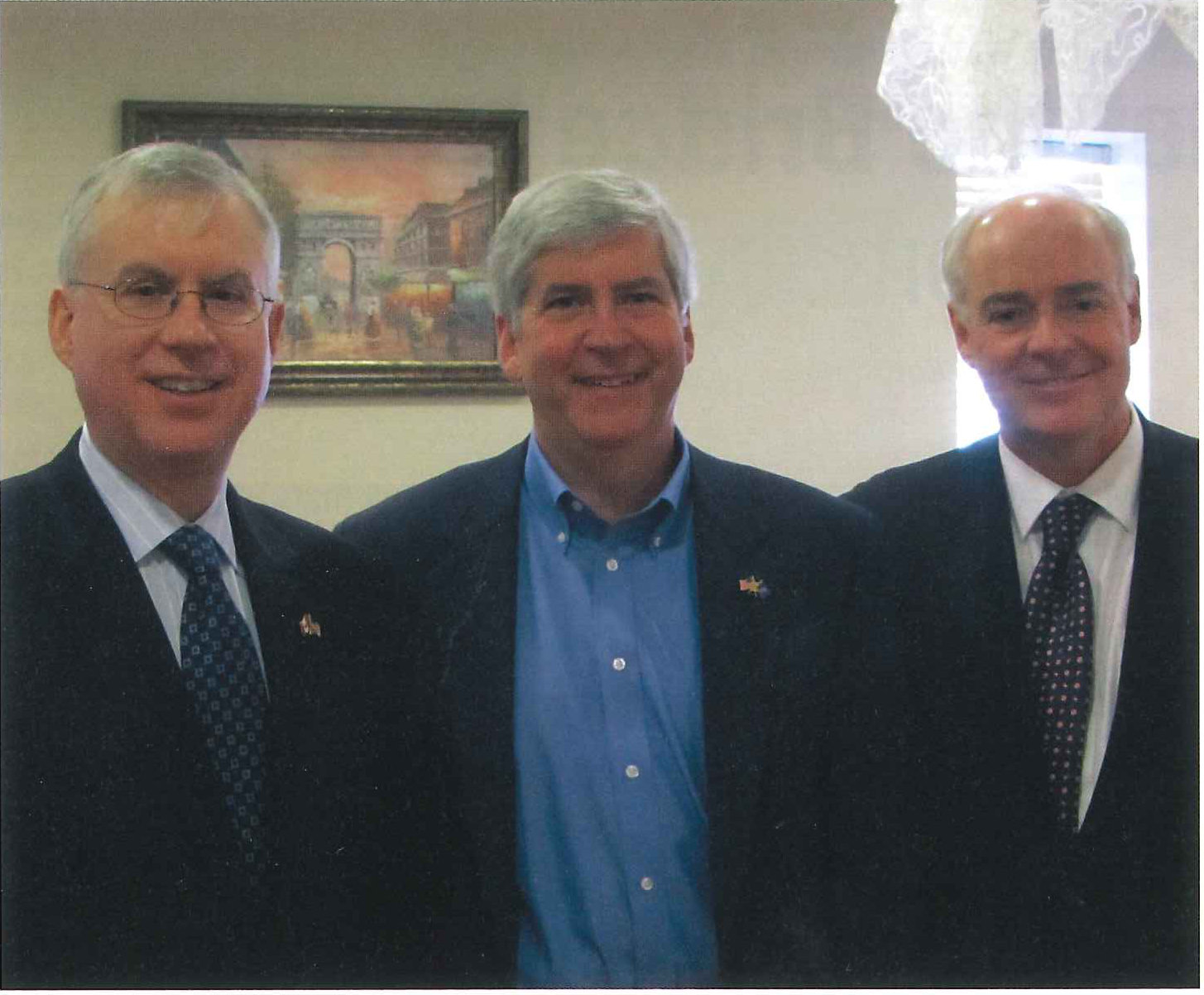
Roy Norton (left), Governor Snyder, and Perrin B Commerce, who visited in March for Bridge advo are determined that a second route be created, or “strategic redundancy” be achieved, at Windsor—Detroit. If, for any reason, the Ambassador Bridge were to become inoperative for a protracted period, the unemployment implications would be catastrophic on both sides of the border.
A little history: The Canadian environmental review of DRIC was completed during Robert Noble’s tour as Consul General (2006-2010). He ensured that promoting Michigan’s embrace of this project became a major advocacy priority for the mission. Michigan’s then-Governor (Canadian-born Democrat Jennifer Granholm, 2003-2011) supported the concept during her second term, but invested limited energy or resources in bringing it to fruition. Michigan’s support is crucial: further to legislation passed by the U.S. Congress in 1972, new border crossings have had to be agreed, in the first instance, between Canada and the “receiving” state.
In the spring of 2010, the Hon. John Baird, then Transport Minister, took two unusual steps to move the project along. In recognition of Michigan’s parlous financial situation, he secured Cabinet approval to increase our equity stake in the project by up to $550 million (equivalent to Michigan’s share of the project), an amount Canada would recover later from toll revenues. He also testified before a Committee of the Michigan House of Representatives — something Canadian elected officials generally refrain from doing. The House subsequently endorsed the project. However, the legislation was never taken up in the Senate.
Fast-forward to the November 2010 Michigan elections. Venture capitalist Rick Snyder (Republican) was elected Governor; Senate Republicans strengthened their hold on the State Senate. Control of the Michigan House (whose Democratic majority passed the DRIC-authorizing legislation in May 2010) flipped to the Republicans.
Governor-elect Snyder took no position on the new bridge during the campaign (his Democratic opponent, who accepted campaign funds from the Ambassador Bridge Co., broke with Jennifer Granholm and opposed DRIC). Chuck Strahl, John Baird’s successor as Transport Minister, travelled to Lansing to meet Snyder during the period between Election Day and Inauguration Day (January 1). In his State-of-the-State Speech on January 19 (akin to the President’s State of the Union — or a Canadian Throne Speech), Snyder made extensive reference to Canada. He stunned Michigan’s body politic, including his own Republican Party, by making completion of the NITC (as he calls it) a high priority of his Administration.
However, he had a number of other major legislative priorities for his first months in office — passing a balanced budget and reconfiguring a tax structure that he felt was killing jobs, to name two. Something of a vacuum was thus created in the winter/spring which the owners of the Ambassador Bridge filled with a multi-million dollar advertising and public relations campaign designed to poison Michiganders against the NITC and get them to press legislators to vote against it. Objective analysts note that this campaign was in no way constrained by “truth in advertising” strictures.
Advocacy 24/7: On my selection as Head of Mission, then Minister Lawrence Cannon and Deputy Minister Len Edwards could not have been clearer about my top priority: “Get the Bridge”! With that mandate, yours truly has spent 2011 in non-stop bridge advocacy. Like any Head of Mission, I relish a scenario in which my key mandate dovetails precisely with a principal policy objective of the Head of Government of a jurisdiction to which I’m accredited. That’s been the case in Michigan during my first year. Close collaboration directly with the Governor and his Administration has been the order of the day.
At the time of writing I have given more than 50 speeches to influential audiences across the state (including testimony to the Michigan Senate and the Detroit City Council). Supportive resolutions invariably emanate from the target audiences (e.g. local Chambers of Commerce) within weeks of my having had the opportunity to share the facts with them. It turns out that the need to build a new bridge is a classic “no brainer” — unless, that is, you happen to own an 83-year-old bridge and are determined never to face competition.
Apart from giving speeches and holding many individual meetings with legislators in this campaign to reach out to key communities, I’ve also given more than 100 media interviews over the course of the year. Transport Canada has done a tremendous job of quickly securing all of the necessary concurrences from the Centre to permit me virtually unrestricted contact with the media throughout 2011 (notwithstanding the Canadian election). It’s been an outstanding example of tight, whole of government cooperation between a Consulate, Foreign Affairs Headquarters, and an “Other Government Department” with the policy lead on a major file.
Apart from the owners of the Ambassador Bridge (and the Michigan Tea Party organizations that they fund), virtually the entire Michigan private sector now supports the NITC. That includes Michigan’s Chamber of Commerce, Chambers in all major municipalities, the Detroit-3 auto assemblers + Toyota and Honda, major auto parts manufacturers, major West Michigan firms, all significant organizations representing Michigan agricultural producers, all major unions, and all major newspaper editorial boards. It’s noteworthy, however, that neither individually nor collectively are these organizations spending any significant sums in support of the NITC. As is often the case, the “anti-” side is highly motivated to protect vested interests while the “pro-” side, by contrast, largely leaves it to government to get the job done.
Challenges still abound: in a procedural vote at the responsible Senate Committee in mid-October, Michigan’s Lieutenant Governor (designated by Governor Snyder to be the lead) failed to secure sufficient votes to proceed. The Governor immediately called for a “cooling off’ period. Two weeks later, speaking at a conference in Ottawa organized by the U.S. Ambassador and Canada 2020, Governor Snyder publicly committed that the NITC will be built, with authorization coming “in months, not years.”
While still preferring legislative approval, it may be that even without it the Governor could enter into an agreement with Canada to allow the bridge to be built (by a private contractor, according to a Public-Private Partnership model). That would be controversial and undoubtedly would be challenged by the Ambassador Bridge Co., whose owners are notoriously litigious. Assuming approval (whether by the Legislature or the Governor), Washington D.C. could soon become the next advocacy theatre. A presidential permit is required to proceed. The Obama Administration appears supportive, but has insisted on waiting for action in Michigan before officially embracing the project. Federal money will be required for the U.S. Customs Plaza; the Ambassador Bridge folks are already lobbying heavily in D.C. — and recently placed T.V. commercials in lowa, presumably to influence Republican presidential candidates against the NITC.
Until such time as the bridge becomes a federal matter (with the Embassy assuming carriage of this issue), we can all reflect on the extent to which stopping things from proceeding seems, increasingly, so much easier than getting things done in the U.S. system. The bridge will cost Michigan nothing. The State will assume no liability associated with it. For the 4—5 year construction period, approximately 13,000 direct (and 25,000 indirect) jobs will be created in Michigan — a state with unemployment above the national average. A massively enhanced investment climate, once the NITC is completed, will entice industry to Michigan. “Insurance” will have been taken against the ramifications of potential catastrophic failure of the Ambassador Bridge (built in 1929 to last 50 years!). After 45 years or so, on a bridge built to last 125 years, Michigan should expect an annual return from toll revenues of approximately $50 million.
Advocating a cause that is a “no-brainer” like the DRIC/NITC may not seem glamorous, but that is real life diplomacy as seen from Detroit. The stakes are high: never mind Canada’s interests, two million U.S. jobs depend on trade moving efficiently at the ageing Ambassador Bridge. The national interest of two G-8 countries can’t forever be held hostage to the self-interest of one company. I am hopeful we’ I get there soon — although probably not before this article goes to print. Getting there, though, is proving instructive — and for me, all consuming. It causes one to reflect on how challenging advocacy has become on key issues that aren’t “no-brainers”. The nature of diplomacy may be changing, but the need for professional diplomacy in pursuing the national interest seems as strong as ever.
Roy Norton is Canada’s Consul General to Michigan, Ohio, Indiana and Kentucky — based in Detroit.
View the original scanned pages →
Originally published in bout de papier, Vol. 26, No. 3 (2012) — Spring 2012 // Printemps 2012, pp. 9–11. Read the rest of this issue →



