
bout de papier, Vol. 26, No. 4 (2012) — Summer 2012 // Été 2012, pp. 33–34
CANADA AMONG NATIONS, 2011—
2012: CANADA AND MEXICO’S
UNFINISHED AGENDA, edited by
Alex Bugailiskis and Andrés Rozental,
McGill Oneen’s [Iniversitv Press 919
296 pp, $29.95
Although Sir Wilfred Laurier asserted that the 20th century belonged to Canada, the 21st could well be owned by Mexico and a few others. While Canadians have begun to focus on the importance of China to us, have we given enough thought to India, Brazil and — even closer to home — Mexico? The excellent “Canada Among Nations” series, produced by the Norman Paterson School of International Relations at Carleton University, dedicated its 2011— 2012 volume to Mexico-Canada, rather than to its normal thematic studies of Canada in the world. “Canada and Mexico’s Unfinished Agenda”, edited by Alex Bugailiskis and Andrés Rozental, undertakes to provide greater understanding of what is a key relationship for Canada that has remained too long below the radar.
Much has been written on the themes exposed in this volume, but it is scattered about. This volume offers students of international affairs and policy practitioners alike, one-stop-shopping on the complexity of a bilateral relationship that stretches from traditional areas such as trade to new fields including security and energy. It offers a variety of thought-provoking policy options for the future, which should spark rich debate. The editors, both longterm practitioners in Canada-Mexico affairs, have assembled an impressive list of contributors from governments, the private sector and academe, most of whom have studied, or nurtured, bilateral relations for many years. The volume notes that Canada-Mexico relations have reached a plateau, and seeks ways to renew growth.
This volume also should be of interest to readers of bout de papier because many of its policy prescriptions are applicable elsewhere in the hemisphere, and perhaps further afield. As the Americas strategy evolves and deepens, Mexico-Canada should serve as a blueprint for other bilateral relationships. The Americas strategy is, after all, a how-to-build-a-strategy-on-a-shoe-string approach, which only works if a wide spectrum of actors is engaged. This has occurred with Mexico.
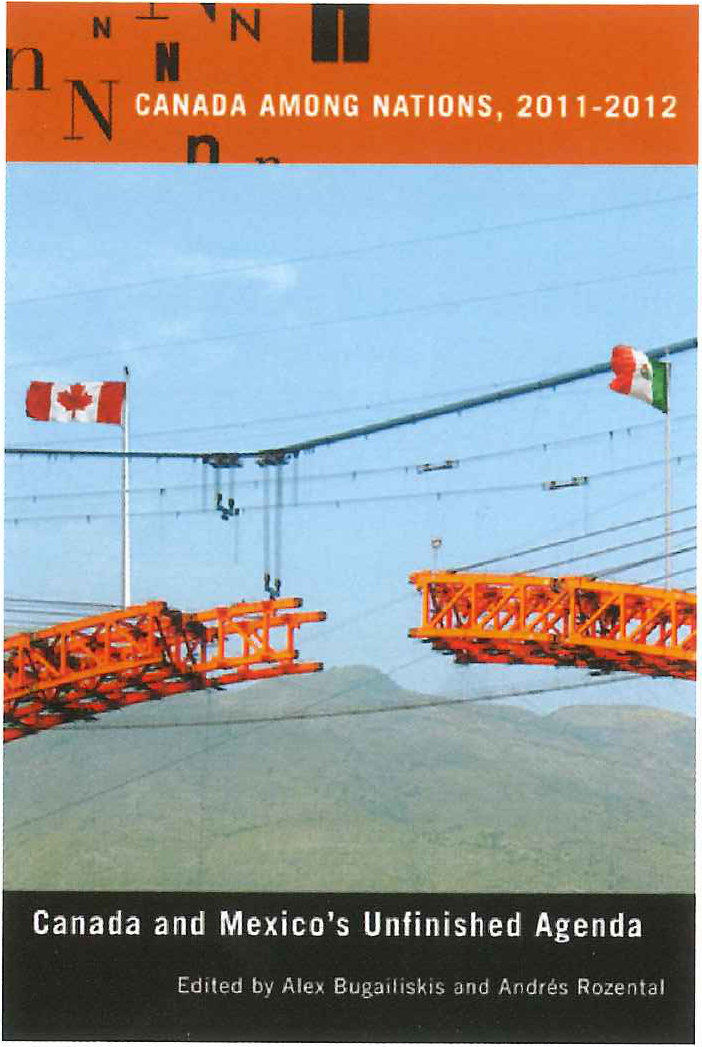
“Unfinished Agenda” amply documents how bilateral relations have burgeoned to the point that its depth and breadth are not matched in any of Canada’s other partnerships, except for that with the USA. Several contributors rightly assert that NAFTA’s entry into force in 1994 transformed the bilateral economic and political relationship. While I agree that Mexico’s political opening began in 1994 when Ernesto Zedillo became president, the election of Vicente Fox in 2000, with a peaceful transition of power after 71 years of one-party rule, placed a seal of approval on the relationship. The compressed time frame between benign indifference and strategic partner makes the achievement truly impressive.
However, the analysis could have included a look at attitudinal changes within Mexico itself over time. When I was first posted to Mexico (1975-77) society was inward looking, suspicious of outsiders — particularly Americans — with a closed economy based on the import substitution model. Canada was a distant blip on Mexico’s radar — despite several assertions in the volume that relations were substantial before 1994. For example, Prime Minister Trudeau’s visit in 1976 was the cause of much head scratching as we searched for something significant to sign. In the end we signed a cultural agreement, since that was considered innocuous and would not commit either side to anything but good intentions. When I last served there (1999— 2001) Mexico was a convinced free trader, with a well-travelled middle class almost the size of Canada’s total population, self-critical, and open to outside influences. Fast-forwarding to the current day, Mexico is the world’s 13th largest economy, with a maturing democracy, anxious to play a larger role in the world.
The asymmetry between levels of development constitutes an impediment for Canadian engagement and should have deserved closer examination in the volume. As the “developing partner”, Mexico’s definition of “cooperation” generally means cash and expertise from Canada in return for some nebulous benefit. For example, in 2000, Mexico floated a trial balloon for a North American solidarity fund to help finance development in Mexico’s poor south, but why should the Canadian taxpayer pay for this when Mexico ought to be taxing its rich to finance its own development? There has to be some short-term concrete benefit for us too.
The authors agree that bilateral and trilateral relations have stalled, not the least because NAFTA has reached its limits and needs an overhaul if North America is to compete with other major trading blocks. The authors assert that relations between Mexico, Canada and the USA require a kick-start, and they present an ambitious road map, but there is no bilateral or trilateral consensus here. Mexico’s current vision for North America is aimed at establishing a North American economic community that would even out social and economic disparities in North America. However, I doubt that most Mexican patriots would agree to common fiscal or foreign policies, to name one. Readers may recall the furor when US Congress sought oversight over the US$1.4 billion in funding allocated to Mexico for its anti-drug campaign: the Mérida Initiative. Mexico’s screams of anguish and accusations of interfering in Mexico’s domestic affairs were strident, if not xenophobic. Imagine Mexico’s response to US control over a common currency?
That Canada has not bought into Mexico’s proposal is portrayed here, and elsewhere, as timidity or a lack of vision on our part, and it has created bilateral frictions. To me, Mexico’s overall approach is top-down, legalistic, in the most part with limited public consultation, and based on signing a plethora of agreements with the expectation that some sort of action will flow. In the past, this didn’t work, and many agreements were stillborn or became moribund. Canada and the USA prefer a bottom-up approach with gentle nudges from governments to improve the enabling environment for the private sector. Finding a middle ground will remain difficult, but it is essential if progress is to be made.
If we can decide where we are going, how do we kick-start a new phase in the relationship? Many analysts suggested in 2000 that elections in all three NAFTA countries gave leaders strong mandates, which were reinforced by the close rapport that had been established among leaders. This was seen as an auspicious moment for bold new initiatives. Notwithstanding, relations continued to evolve incrementally. National goals did and will remain paramount. Partners will tend to treat issues on a bilateral, rather than a trilateral basis. Rather than bold thinking, it is more likely that the trilateral agenda will consist of small steps to improve the regulatory environment, transportation policy and infrastructure, border facilitation and alternative energy.
Where are we headed? One study suggests that by 2050 Mexico will have a population of 148 million and a GDP of US6.6 trillion, against Canada’s 45 million people and GDP of US$3.2 trillion. Even if this analysis is exaggerated, we had better get used to the fact that Mexico will become one of the big kids on the block, and it behooves us to remain on good terms. On the bilateral commercial side, however, Mexico could benefit greatly by opening its stagnant and inefficient energy sector (petroleum and electricity) to Canadian and other companies. This is an enormous problem for Mexico, which this volume understates. The Canada-Mexico commercial and political agendas need the sustained attention of cabinets at the national and subnational levels but, to achieve this, the agenda must be substantial — officials and the private sector must do their homework before engaging ministers.
At the foreign policy level, much is said in this volume about common priorities and worldview. I see a strong affinity in terms of economic policy and building a more equitable trading system that, by all means, we should cultivate. In multilateral organizations, we can certainly cooperate on issues such as institutional reform. Iam less convinced about substantive cooperation on the human rights and democracy files. Experience with Mexico in UN human rights fora and at the OAS suggests that slavishly invoking the doctrine of non-intervention in the domestic affairs of other sovereign states remains part of Mexico’s foreign policy baggage and an obstacle to substantive joint action.
It is positive that several of the Mexican contributors to this volume had once been strong defenders of the non-intervention mantra, but are now talking in more interventionist terms. The volume also suggests that Mexico has a better understanding of, and closer ties to, the region than does Canada. I would dispute this. By joining NAFTA, Mexico was seen in many countries as turning its back on the region. Its attempts to build commercial relations with the region have been mixed, and its relations with Brazil remain distant. With limited trade, and no significant aid or military relations with the region, Mexico has few tools to work with. Nonetheless, regular, formal, comprehensive, bilateral exchanges of views on hemispheric relations would be a useful starting point for official and academic Canada.
I am also sceptical about closer relations with Mexico’s military. Until Mexico’s insular and somewhat xenophobic military embraces an internationalist vocation, including participating in UN peacekeeping operations, real cooperation with Canada or the USA on security issues is unlikely to occur. However, that doesn’t mean we should give up.
At present, the key question is whether Canada remain a strategic partner of Mexico now that the PRI has regained power? President-elect Pefia Nieto may have to be convinced of the value of the relationship. In 2000, Canada hosted all key members of Vicente Fox’s shadow cabinet during the interregnum, to good long-term effect. As a starting point, we should offer the same opportunity to the new players. Pefia Nieto has suggested he will try to privatize at least parts of the state-owned oil monopoly PEMEX, and this could be a boon to Canada’s energy sector and North American energy security. On the other hand, the PRI is likely to return to the more traditional foreign policy approach that emphasizes nonintervention in the internal affairs of other states, and probably will place less priority on foreign affairs in general. This will create challenges for Canada-Mexico cooperation in the hemisphere.
Whatever the outcome, we can all agree that the tone of our discourse on Mexico’s trilateral vision needs to change. Canada should begin to talk the trilateral talk, even if it is less willing to walk the walk. We should think in the context of North America, even if our actions are eventually bilateral. At a minimum, Mexico and Canada should inform each other of what they are doing with the USA and share lessons learned. “Canada and Mexico’s Unfinished Agenda” offers some highly thought-provoking material for those committed to building a better North America.
David Bickford is a retired Foreign Service Officer and former analyst with the International Assessment Staff at PCO. He spent most of his career in Latin America with postings to Mexico, Brazil, Venezuela, Chile and Peru; never bored and rarely recalcitrant, he once shook hands with Chilean President Pinochet.
View the original scanned pages →
Originally published in bout de papier, Vol. 26, No. 4 (2012) — Summer 2012 // Été 2012, pp. 33–34. Read the rest of this issue →



