
bout de papier, Vol. 27, No. 1 (2012) — Winter 2012 // Hiver 2012, pp. 35–36
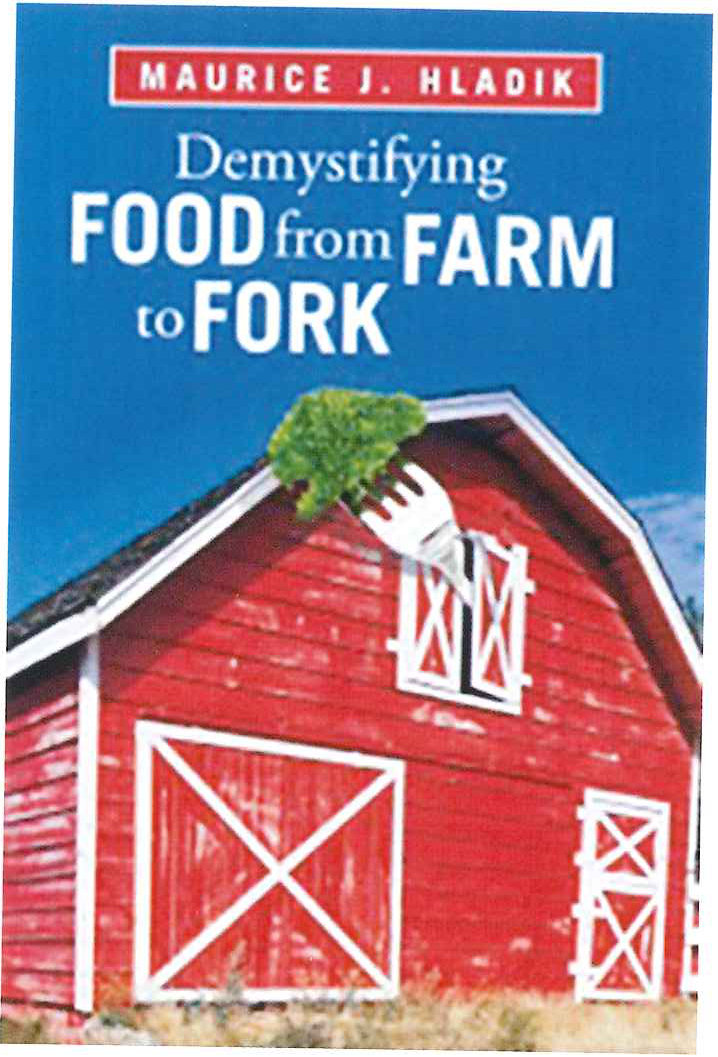
DEMYSTIFYING FOOD FROM
FARM TO FORK, by Maurice J. Hladik,
iIUniverse.com, 2012, 256 pp, $20.79
Reviewed by Richard Kohler
Despite a “prosaic” title, Maurice Hladik’s recently published book is a fun read and an iconoclastic tour de force. His guided tour through the labyrinth of truths, half-truths and worse, is an eye-opening journey that serves to debunk — or at least question — some of our most earnest assumptions about what we eat. He covers a lot of ground: food safety (Lysteria scares, lurking salmonella and creeping e-coli), joins a host of perturbing issues from alleged dangers of genetically modified foods, risks of non-organic farming and disappearance of family farms to “eating local”.
The author writes with authority. A retired DFAIT HOM who served in Germany, China, Thailand and South Korea, his early days started on an Alberta farm — by the time he was in high school, he could operate heavy farm equipment, shear sheep, deliver lambs, milk cows, repair fences and do basic welding. He ran trap lines in winter to protect sheep from coyote, skinned them and prepared the pelts for sale — becoming a registered trapper with the Hudson’s Bay Company.
With graduate degrees in agriculture, Hladik began his multifaceted Foreign Service career as an agricultural attaché and progressed to broader responsibilities (though always including agriculture and food). Post-DFAIT he held executive positions in an agriculture-based company. He attributes the impetus to writing Demystifying Food from Farm to Fork to his partner Sharon who urged him to put down on paper what had become the animated subject of so many dinner-table discussions.
Using well-documented research backed by years of experience, Hladik tackles false assumptions and disinformation without being corrosive. He urges open-mindedness and willingness to ask basic questions within the gospel of agriculture’s so-called truths and confronts received wisdom, systematically, with his own disclaimers. He also recommends readers assess objectively the accuracy of arguments against genetic modification and in favour of organic farming:
The Family Farm is a Thing of the Past. According to the 1997 U.S. census there were 1.9 million farms of which 86.9 per cent were designated “individual/family, sole proprietorship (farms)”. A census ten years later showed no substantial change.
He also recommends readers assess objectively the accuracy of arguments against genetic modification and in favour of organic farming.
Corporate Farms are Taking Over. In 1997 0.4 per cent of farms were considered non-family; in ten years, this increased to 0.5 per cent. While factory farms tend be large, they account for only 15 per cent of all food produced; family operations yield 85 per cent.
Farms are getting larger. Census data show small farms in the U.S. have actually increased over the last measured 10-year period.
‘The farm population is declining. In fact, over the most recent surveyed 10-year ( period, farm population has stayed the s same. Interesting twist: the number of women as principal farm operators, has c increased by 50 per cent — today, one in h six is a woman.
p Fertilizer use is increasing. Recent data r: confirm clear declines in fertilizer use, F 50 per cent less nitrogen used between 1980 and 2005 with similar drops in phosphorous and potassium use per bushel between 1990 and 2005.
Organic farming makes a significant difference in the overall supply of food. Only 0.6 per cent of agricultural land in the U.S. is utilized by organic farming — it remains a niche industry.
Organic foods are produced without chemicals. Organic farmers may use chemicals deemed “natural” but, misused, pyrethrins derived from chrysanthemum type flowers and can pose significant risks to humans and the environment. According to the U.S. EPA they can cause more insecticide poisoning than any other class of insecticides outside of organophosphates.
Organic Foods are nutritionally superior to their conventionally grown counterparts. A UK-based London School of Hygiene and Tropical Medicine study has determined “…that, from a nutritional point of view, organic foods are not superior to conventionally grown and raised products”. The book’s chapters on Food Safety and Animal Welfare cover in detail concerns regarding additives, processing aspects and treatment of animals that surround conventional produce.
GM Food is Bad. An official European Study is quoted: “the main conclusions from 130 research projects involving more than 500 independent research groups is that biotechnology and particularly GMOs are not, per se, more risky than e.g. conventional plant breeding”.
Food Miles Matter. Hladik shows through arithmetic and economies of scale that only food delivered by air is worthy of concern as this normally applies to up-market perishables — discerning individuals can avoid these at will.
The Food System is Broken. Not so: according to the FAO, the global percentage of undernourished has fallen from 33 per cent of all humanity in 1969 to 16 per cent in 2010, while the world’s population increased from four to seven billion.
Hladik’s book may seem U.S.-centric; about half of his statistical data are drawn from U.S. sources, but he points out differences where they matter. Also, Supply Management doesn’t get a mention but in the bigger picture this is more an exception than a rule. Some may find the topic-range too broad but Hladik prefers letting readers choose items of interest in comprehensive, “stand-alone” chapters.
Demystifying Food from Farm to Fork is best when it promotes a level playing field for both camps. Recognizing the advantages of organic farming and manifest public concern about genetic modification, Maurice Hladik suggests a science-based “best practices approach” balancing high yields with human health and environmental concerns. He says he “doesn’t trust any organic farmer with more than 30 acres” and adds: “to a hungry person, food from GM crops is immensely better than no food at all”.
He believes the world can feed itself — our main challenges are in governance and politics. The curse of obesity in the developed world lies in poor choices and the abuse of food products (as in the one third of the “goodness” of wheat that we throw away every time we supplant whole grain bread with white).
In his chapter on Weather, Climate and Food, he waxes poetic on the magic in life…the beauties of photosynthesis, the abundance of gases from the atmosphere and energy from the sun without which the “bounty and variety of food and living conditions for all creatures would not exist”.
It is available at Amazon, iUniverse, Chapter’s and Barnes & Noble.
Now retired, Richard Kohler’s 35 years in the Foreign Service included stints as Chief Information Officer; Ambassador to Brazil; Chief of Protocol of Canada and Consul General in Sydney. He later served as ADM International Relations in Ontario Premier McGuinty’s Cabinet Office and represents RHOMA on bout’s Senior Editorial Board.
View the original scanned pages →
Originally published in bout de papier, Vol. 27, No. 1 (2012) — Winter 2012 // Hiver 2012, pp. 35–36. Read the rest of this issue →



