
bout de papier, Vol. 27, No. 1 (2012) — Winter 2012 // Hiver 2012, pp. 14–16
Bien que j’adore mon poste actuel, c’est, a vrai dire, par hasard que j’ai abouti au Centre de surveillance et d’intervention d’urgence (CSIU/EWRC).
J’ai joint les rangs du MAECT il y a deux ans et demi, et ma première affectation a été à la Direction du crime et du terrorisme, en remplacement d’une employée en congé de maternité. Cette dernière devait revenir au travail en janvier suivant, ce qui signifiait que je serais alors disponible hors cycle — période où il y a habituellement peu de postes ouverts. Lorsque mon nom a été ajouté à la liste des candidats libres, CEP, la Direction des politiques, de la planification d’urgence et de la formation de la Direction générale de la gestion des urgences, a été la première à m’appeler. Une fois fixées l’heure et la date de l’entrevue, j’ai entrepris des recherches. Jusque-là, je ne savais
Various members of the emergency management Fraser. Anita Cule, Sabina Grabowiecka and Roc même pas que le ministère comptait un centre d’opérations 24/7.
As the interview progressed, I became more convinced that CEP would be an interesting place to work. I was told the person in the position would respond to emergencies whenever they arose, would liaise with divisions across the department and be right in the middle of DFAIT’s response to crises abroad. As the policy officer for communications, the individual would wear two hats. When there was no emergency, they would work on communications policy initiatives and various projects as they arose. When an emergency struck, however, the role would change.
The individual would be responsible for coordinating emergency management-related messaging and ensuring that the language used across all public DFAIT communications channels was consistent.
The main stumbling block in the interview appeared to be my lack of policy-writing experience, which resulted in numerous interview questions being skipped. Although I left the interview certain that I had been screened out, I was offered the position a week later. On January 4, 2011, I became CEP’s new Policy Officer for Communications.
Prior to joining the Emergency Management Bureau I had never written a media line, and had not handled public communications. As with most new assignments in DFAIT, I was learning as I went. I sometimes joke that my division set up a great training plan for me: several days after I began in the bureau, civil unrest broke out in Tunisia, and with it the start of the Arab Spring. There was a new emergency every week and a half, and each one was more severe and complicated than the last. Civil unrest toppled leaders in Tunisia, Egypt and Libya and an earthquake, tsunami and nuclear crisis brought Japan nearly to a standstill.
The level of activity in the Bureau skyrocketed and everyone worked flat out. During that time, I had a steep learning curve. I drafted broadcast messages requesting that communications with missions be reduced to emergency messaging only. I composed media lines pertaining to emergency management — including lines talking about evacuation flights. I provided information to update the DFAIT, Mission and Trade websites. I reviewed statements and helped draft speeches. I assembled QP notes and drafted answers for a technical media briefing. As most everything communications-related for emergency management came to me, I would find the necessary information and consult key players. It truly was trial by fire…and I wouldn’t have had it any other way. To this day, some of the emergency planning officers in the division still recognize the sound of my footsteps coming down the hall when I have questions for them.
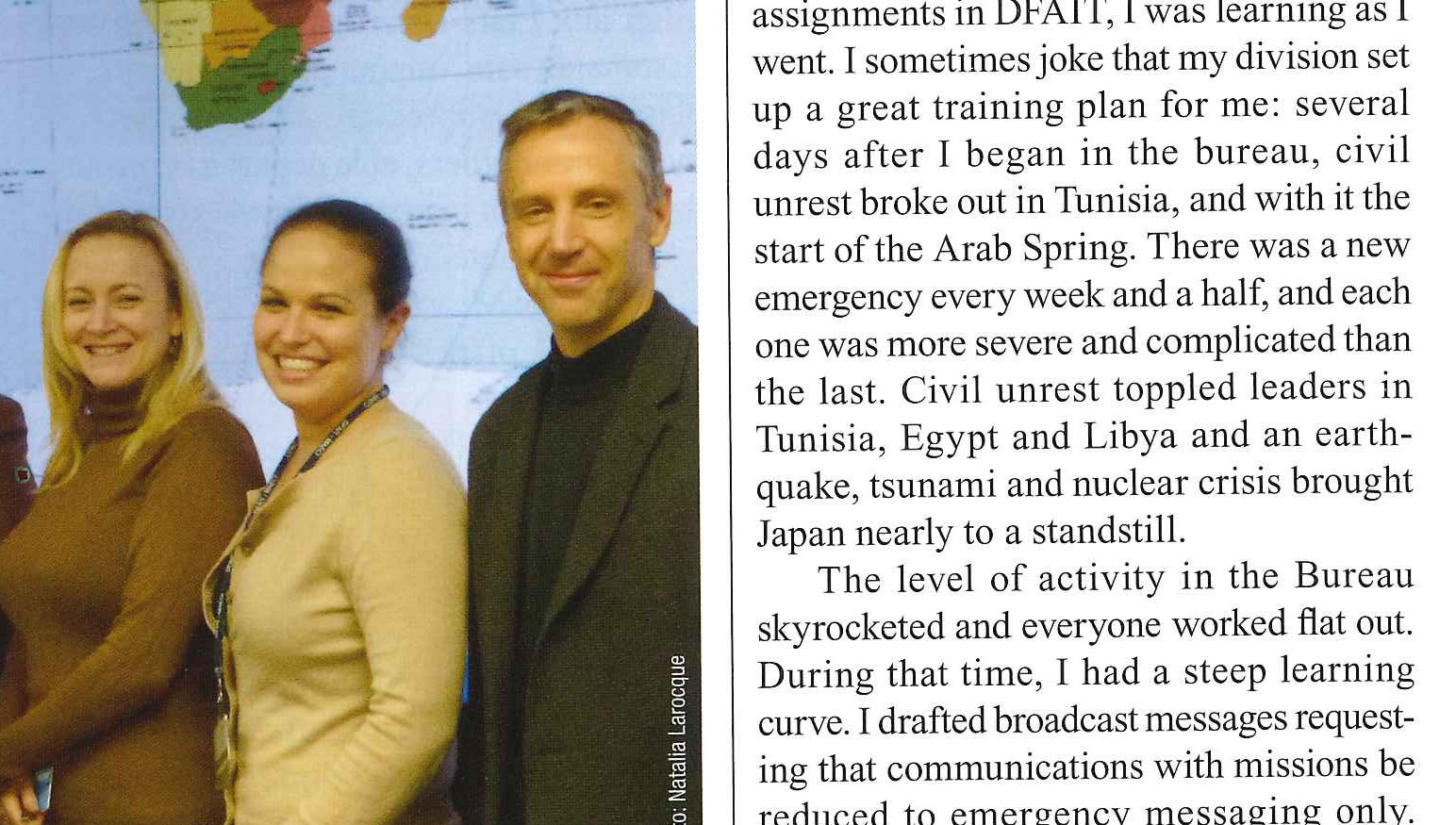
Seeing the Emergency Management Bureau in action responding to the Arab Spring and Japan earthquake of 2011 was impressive. Taskforce meetings were called any time, day or evening, and the number of people in attendance — not only from across the Department, but across the government — was formidable. Often there would not be an empty seat. The operations officers and call centres went into full swing. Members of the Emergency Response Community were brought in to provide extra capacity not only in answering calls and emails from Canadians calling the Centre directly, but also in proactively calling Canadians listed in ROCA (Register of Canadians Abroad). I recall walking into the call centre and seeing it full at 2 a.m. — everyone ready to answer calls. Call centre capacity was expanded by taking over neighbouring meeting rooms, dropping wires from the ceiling and setting up completely new stations.
To provide context, the Emergency Management Bureau (CED) was created in 2008 principally as a result of lessons learned from DFAIT’s response to the Asian tsunami in 2004/2005 and the Lebanon evacuation in 2006. The Department has worked steadily ever since to improve its emergency and consular capabilities culminating in the Emergency Watch and Response Centre (EWRC), which opened in November 2011. Members of the Emergency Management Bureau visited crisis centres around the world to find their best features and incorporate them into the design of the EWRC. The Centre provides an area for whole of government coordination in responding to emergencies abroad, and has the features necessary to allow DFAIT to respond more efficiently.
The EWRC has two dedicated call centres permanently set up and ready to be activated when needed. This allows the Centre to quickly ramp up its capacity to respond to sudden spikes in calls and emails triggered by an emergency. These rooms can be used for training during quiet times. The Centre also has boardrooms specifically allocated for use during emergencies so that taskforce meetings of key stakeholders can be held at a moment’s notice. It has a kitchen and quiet rooms for use by all staff responding to the emergency, and it has a Response Room equipped with 26 workstations and technology allowing the latest information to be displayed. How do these features aid in responding to an emergency? Let me explain.
Due to their sheer scale, not only are multiple DFAIT divisions involved in responding to an international emergency, but often numerous government departments as well. As a result, the flow of information is a key factor in determining a successful outcome. With so many people engaged, it is vital that everyone, whether involved in planning, logistics, or another role, has the latest details so that appropriate decisions and actions can be taken. One way to ensure this flow takes place quickly and efficiently is to have everyone physically work together. In the past, I was located with the policy division, away from the Operations Centre. I would often abandon my desk during emergencies to go and sit with the emergency planning officers and operations officers in the call centre, occupying whichever cubicle happened to be empty.
In order to address this need for information, the EWRC is not only large enough to house all the Emergency Management staff, but the Response Room also contains “hoteling” stations for members of other DFAIT divisions as well as partner departments and agencies. These stations permit personnel to work directly in the Centre — increasing the speed at which information can be relayed and decisions can be taken.
Another important aspect of any emergency is taking care of those working on the response — not only in the affected mission, but also at headquarters. During the Arab Spring and Japan earthquake, members of the Emergency Management team were in the office at all hours. I recall easily tracking down deputy directors for media line comments at midnight, talking to directors about statements at a.m. and catching my Director General at 4.a.m. for Q&A approvals. Sometimes the arrival of food in the evening was the only way to ensure that team members took a small break. At 7 p.m., when food arrived, you could just as easily see operations officers grabbing a bite to eat as the occasional ADM and even DM. The new kitchen and quiet room facilities of the EWRC will help ensure that staff have the facilities necessary to take care of their health, so that they can continue to assist Canadians. Personally, the quiet rooms would have served me well when I needed to obtain Q&A approvals at 4 a.m. I had to be back in the office for 6 a.m. when the revised documents would be circulated, and so I only managed to get hour sleep at home. Had the quiet rooms been available, I could have had two!
The accomplishments of the Emergency Management Bureau during the Arab Spring and Japan earthquake were striking.
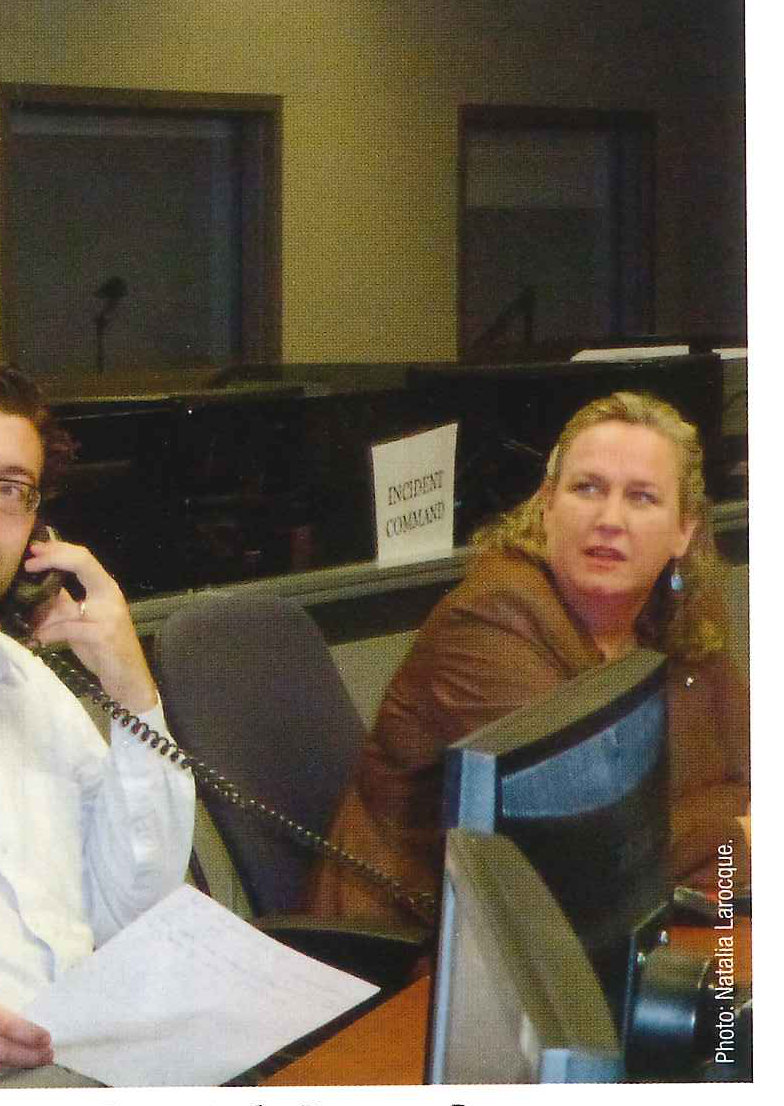
Here are just a few of the numbers: DFAIT facilitated the evacuation of 520 Canadians from Egypt and 348 from Libya. The Bureau was involved in chartering planes and coordinating with other nations. When the Japan earthquake occurred, the call centre managed approximately 12,600 calls. During the first four months of 2011, approximately 350 DFAIT employees from across the department came in and assisted the Bureau, either by manning phones in the call centres or providing back up to the Emergency Management staff. In addition, missions located in the same time zone assisted in making calls.
Looking back I now have a better appreciation for the sheer variety of people
Jade Puddington, Anita Cule, Brent Bel. I and Jess implicated in responding to an emergency abroad, be they MCOs, political officers, trade officers, IT specialists or others. The key thing however, is that at DFAIT you are never alone in dealing with an emergency. Emergencies can strike any time, anywhere and affect anyone. When they do, the first thing Canadians should do is call the EWRC!
Jade Puddington joined DFAIT in March 2010 after completing a year of French language training. She served in the International Crime and Terrorism Division (ICT) for 10 months before joining the Policy, Emergency Planning and Training Division (CEP).
View the original scanned pages / Voir les pages numérisées →
Originally published in / Publié à l’origine dans bout de papier, Vol. 27, No. 1 (2012) — Winter 2012 // Hiver 2012, pp. 14–16. Read the rest of this issue / Lire le reste de ce numéro →



