
bout de papier, Vol. 27, No. 3 (2013) — Autumn 2013 // Automne 2013, pp. 4–6
bout de papier célèbre cette année son 40° anniversaire — l’humble publication qui, au début des années 1970, a vu le jour comme outil servant à communiquer des rajustements administratifs à une collectivité du service extérieur en mission partout dans le monde est devenue aujourd’hui un magazine accompli. Cette évolution témoigne du dynamisme et de l’enthousiasme des membres de l’Association pour leur carrière de prédilection.
me,
After it was created in 1967, PAFSO communicated a record of its annual meetings in a newsletter called “Aide Memoire”. But in the early 1970’s the public service was changing and collective bargaining assumed new importance. Without the large departmental corporate branches that exist today to communicate with employees, it was much more difficult for members, particularly those serving abroad, to stay abreast of pay and benefits issues affecting them.
As a result, in 1972 the PAFSO Executive, under the presidency of Jean Touchette, took the decision to intensify communication with the membership through a “bout de papier.” Appropriating diplomatic terminology provided an apt title for a communications tool for foreign service officers by combining serious thought with more light-hearted, even wry, articles and a little self-deprecating humour reflecting a multi-talented profession.
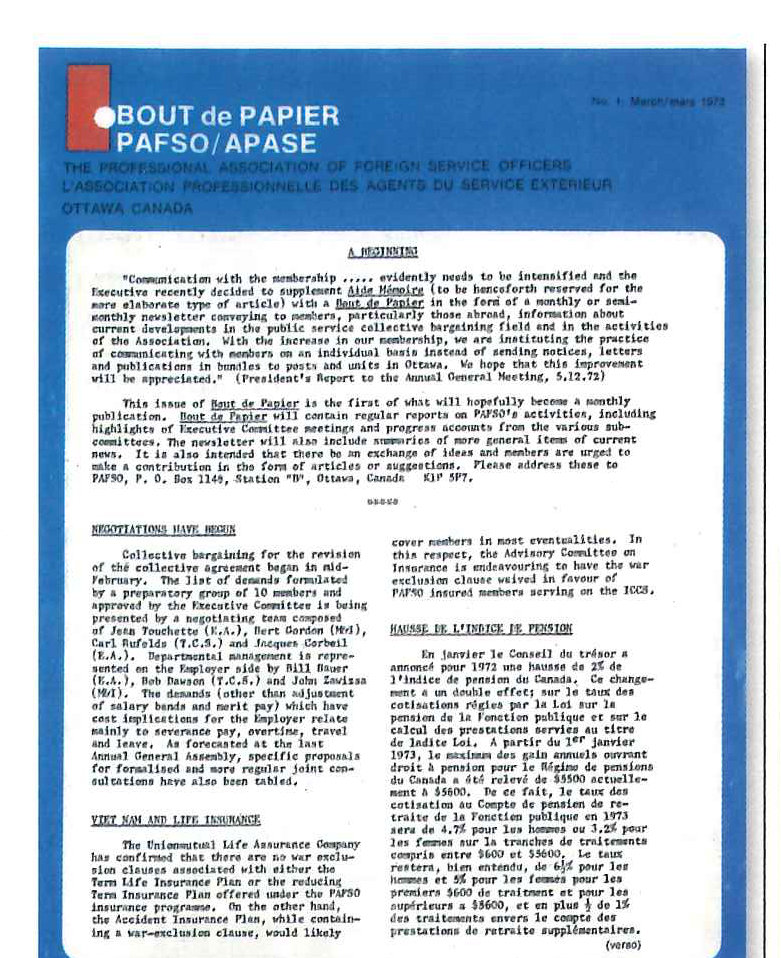
Volunteers collected items for the first edition. There were short pieces on collective bargaining negotiations, pension indexing, the “IndoChina Allowance Package” as well as a plea for compensation for representational duties entitled “The Rubber Chicken Circuit” and a humorous poem. There was no attribution. Input was provided by both English and French speaking members of PAFSO from all streams, a commitment to inclusiveness and representativity that has been a fundamental feature of bout de papier as the structure of the Foreign Service and membership in the Association have changed over the years. The bilingual nature of the publication has remained a characteristic feature. Even 1f it has at times been a challenge to get a good balance of articles n both languages, the articles have appeared as drafted and not, like in most adian bilingual translations. bout de papier Canadian D1l1INgUdl magazines, as translations. The first bout de papier appeared on a sheet of paper with a blue border and a red bar at the top left side. Design was done by brainstorming and whim. The red bar represented a bar of the Canadian flag which at the time was only six years old — the missing bar of what later became known as Canada’s word-mark. The blue border was a nod to some of those involved who had argued during the flag debate that blue bars might have
The Beginning
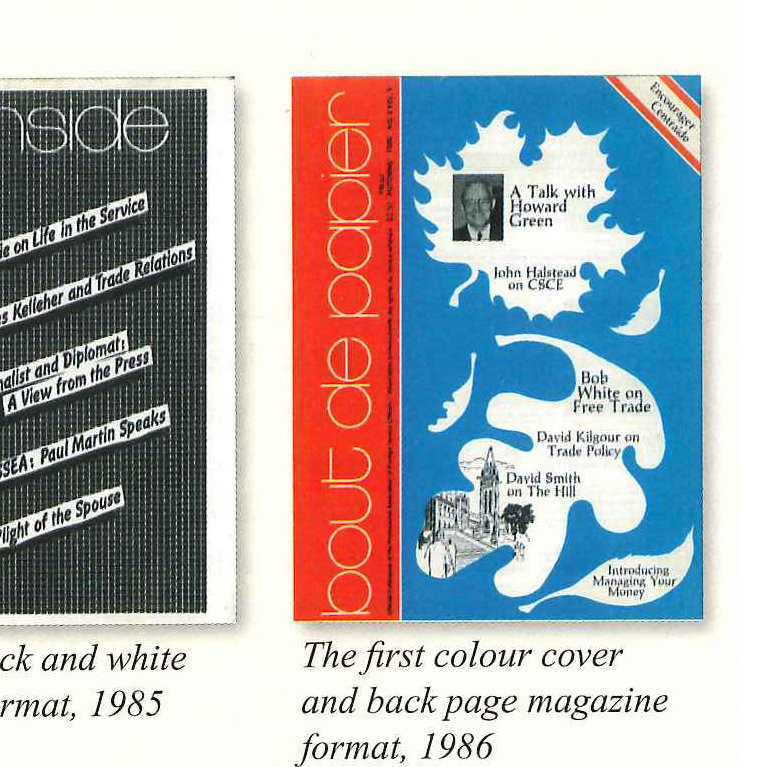
1987’s redesign with Acart Communications included former Under-Secretary Charles Ritchie, former HOMs John Halstead, Arthur Menzies, Sydney Freifeld and (recently profiled in bout de papier Vol. 27, No. 2), former UN Ambassador, Bill Barton, and former Under-Secretary, John Starnes joined by historians Don Page and John Hilliker. In advisory board member Randolph Gherson’s view, the “board has been the stimulating interchange of views between experience of older hands and fresh thinking from the new generation.. directing consideration of articles, policy and ideas for new articles”. And advisory board member Douglas Small adds, “it is a personal pleasure to join old friends and colleagues to perform what we like to think is a useful function for the magazine. While we always addressed our responsibilities seriously, our sessions were often enlivened by Arthur Menzies’ inimitable stories of foreign service life as seen from his unique standpoint.”
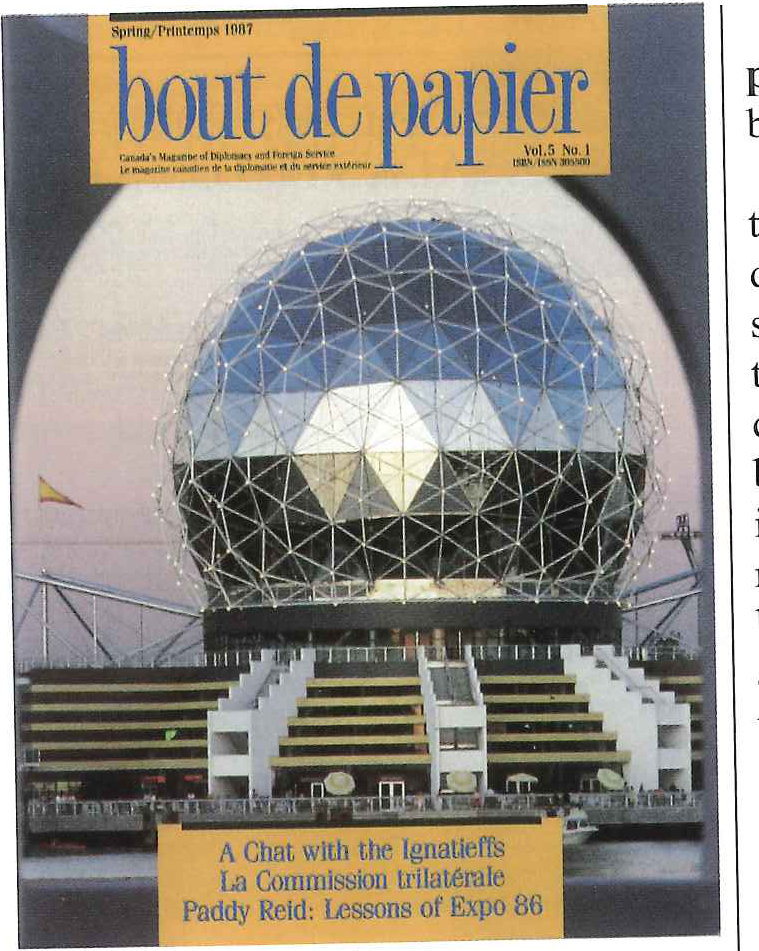
In 1987 Debra (without whom, Colin said, “bout would not be” a sentiment shared by anyone closely associated with its production) contracted the services of Acart Graphics Inc to design the production that year. Canada’s Magazine of Diplomacy and Foreign Service as we know it now was born in colour. Colin notes that “the shift from mimeograph to multi-colour, multi-page was accomplished with much hard work but a lot of belief in what we could be…that it has sustained itself says something about the While retaining its formal title, bout de papier, the magazine gradually began to be referred to affectionately as bout.
Just as PAFSO members adapted their talents to new trade, immigration, development, consular or political realities so too have the contributors and editorial team adjusted their approach to shifting demands in publishing. The constant in both has been a high level of professionalism. The quality of its design encouraged readers not only to read the articles and but also to appreciate the photography and advertising all of which related to the specific interests of the foreign service community. The calibre of the magazine’s design was underscored in 1992 when the Sixth Annual International Mercury Awards Competition for Outstanding Achievement in Professional Communications awarded Acart Graphics Inc its top prize for art direction.
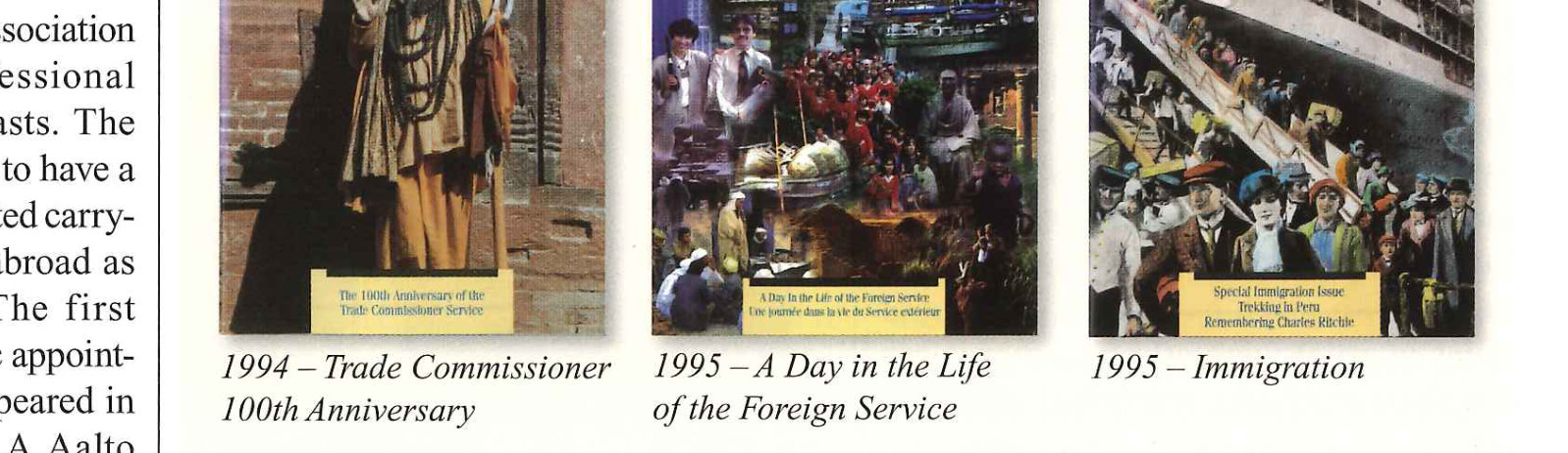
Each editor has provided new energy. Kevin O’Shea, for example, aimed in the early 1990s to enhance the “entertainment value” of bout de papier: “I wanted to make bout like Vanity Fair — FUN to read…We wanted to show Canadians that we in DFAIT were not strange cookie-pushers but ordinary Canadians working around the globe.. that the Canadian foreign service was the closest thing Canada had to the CNN — a network of bureaus spanning the globe watching events unfold and advancing Canadian interests. think that is what bout still needs to do…We would have a combination of neat in-depth pieces about international issues, lively gossip, exotic travel pieces, trenchant book reviews. We even dedicated one edition to what a day in the life of the Foreign Service looked like across the entire foreign service.”
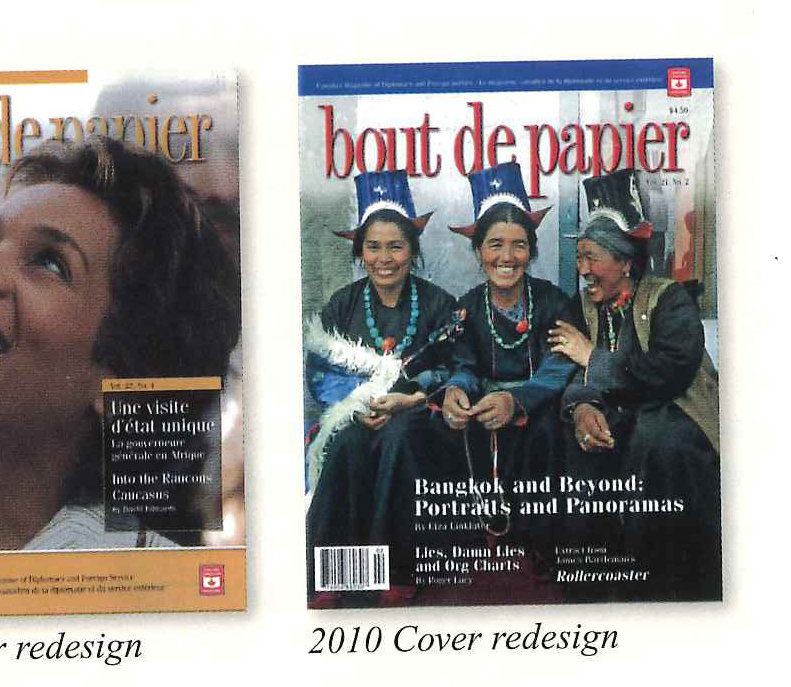
1997 Cover redesign 2007 Com PAFSO can take great pride in bout de papier. Those directly involved can look back not only on an experience many have called fun but on creating a magazine that has made a difference in perceptions about the foreign service. As always, there are challenges. Even if the goals of diplomacy have not changed over the centuries, the tools of the practice and the conditions and context in which it is practiced are always in flux. Indeed, sometimes the challenges can seem overwhelming. Mediums and platforms for communicating are evolving rapidly: the move from print to digital; the on-set of social media and cloud repositories; and the competitive need for timely delivery are challenges with which bout de papier’s management wrestles every day. Industry trends like Tweeting are being assertively tracked in order to ensure the magazine remains vibrant, up to date and viable to serve another 40 years. The key to embracing the future will be the passion, innovation and enthusiasm of today’s and tomorrow’s PAFSO members to determine the “how” and the “what” they communicate to each other and to those who support them. bout de papier, however it evolves, should be an integral part of that progress.
Richard Kohler and Michael Brock joined the foreign service in 1972 and have been friends since they met searching for the paper for bout de papier’s first edition in 1973. After completing many headquarters and overseas assignments, Michael retired as Director General Cultural Affairs while Richard served, among other things, as Ambassador to Brazil and Chief of Protocol of Canada before his retirement.
The Covers
View the original scanned pages / Voir les pages numérisées →
Originally published in / Publié à l’origine dans bout de papier, Vol. 27, No. 3 (2013) — Autumn 2013 // Automne 2013, pp. 4–6. Read the rest of this issue / Lire le reste de ce numéro →


