
bout de papier, Vol. 30, No. 2 (2017), pp. 4–7
D’une actualité indéniable, le Réseau des femmes d’Affaires mondiales Canada (AMC) puise sa
source dans la carrière de sa fondatrice, Angela Bogdan, qui depuis plus de 15 ans s’affaire à promouvoir l’entraide entre femmes, tant au Canada qu’à l’étranger. Aujourd’hui consule générale
à Sydney, Bogdan raconte le cheminement qui a mené à la création du Réseau. En parallèle, l’actuelle championne des femmes, Sarah Taylor, explique l’importance renouvelée de la cause,
articule ses objectifs ainsi que ses plans d’approfondissement et d’élargissement du Réseau.
Why a Women’s Network?
“Networks have literally been the cornerstone supporting my work, both at home and abroad, and, as such, the key to success in executing my mandate,” says Angela Bogdan.
In her long experience as a career Foreign Service officer, Bogdan has witnessed first-hand the crucial importance of networks. When serving in Canada’s Permanent mission to NATO in the early 2000s, she was one of only 20 women among the organization’s 1,400 international and diplomatic staff. The collapse of the Warsaw Pact and former Soviet Union had enlarged NATO’s membership, bringing female diplomats with little experience. These 20 women set up a sort of “secret squirrel society” offering a safe space and support on everything “from communiqué drafting, work/life balance, and how to make an intervention across the myriad of NATO committees to which they were assigned.” Hence was born the idea of “providing a community of practice for advice and support” for women, which would later become core to GAC’s Women’s Network.
Bogdan also “walked the gender talk” in the field. In Belgrade where she was Chargé, Canada led in the creation of the “Get out to Vote Campaigns and Voter Education for Women” program — partnering with like-minded missions and civil society to empower women. As a result, more than 90% of eligible women turned out to vote and Milosevic was defeated. As High Commissioner in Sri Lanka shortly after the 2006 tsunami, Bogdan joined forces with like-minded female heads of mission to advocate for human rights, women’s income generation and liveli-
“Networks have literally been the cornerstone supporting my work,
both at home and abroad, and, as such, the key to success in executing my mandate”
hoods. Together, they had a stronger, more effective voice. A few years later when serving as Canada’s Chief of Protocol, Bogdan organized a training session and an outreach tour on growing female entrepreneurship for resident heads of mission.
Back in Ottawa, Bogdan started working with Lillian Thomsen, then the Head of the Foreign Service Institute, on mentoring and coaching fellow female colleagues ahead of EX promotion boards — and beyond. In sharing the story of her career progression, Bogdan had often heard “if you could make it, maybe I can too”.
When Bogdan was appointed Champion for Women in 2010 by Susan Gregson, then the ADM for Human Resources, she was urged to take this role to a new level — leveraging the direct reporting line to the Deputy Ministers that she had as the department’s Inspector General. Bogdan’s position also allowed her to gain insights into the particular challenges that women faced abroad, whether Canada-based or locally-engaged.
In the following years, Bogdan used her informal network of senior women to exchange on how best to promote women’s leadership and inspire younger women to “put themselves out there”, to “lean in” and compete for jobs that had traditionally been held by men. The need for a culture change at the top and for new leadership models became clear to her.
And in 2013, the Women’s Network emerged as the tool to take this agenda forward.
“We began as a loose grouping of senior women with a voice at the executive table in addition to more junior women that were looking for a support group and to be heard. We then launched the Women’s Network on Agora and now have almost 800 members.”
2015 en perspective
L’élection générale de 2015 a bien entendu donné un nouvel élan à la cause féministe. « C’est très encourageant d’avoir non seulement un Premier ministre, mais aussi nos trois ministres qui sont tous féministes. On voit l’impact dans la politique étrangère, y compris bien sûr la nouvelle politique féministe d’aide au développement. C’est du jamais vu, » affirme Taylor, la championne en titre des femmes à AMC. Si cela positionne le Canada en chef de file mondial, « c’est à nous de nous assurer que nos bottines suivent nos babines, et que nous avons les mêmes bonnes pratiques au sein du ministère que celles que nous promouvons à l’étranger. Si nous demandons à nos partenaires en développement de s’assurer que tout programme ait un impact positif sur les femmes et les filles, il faudrait bien qu’on passe nos propres programmes et pratiques sous la même loupe.
Aujourd’hui à AMC, les femmes représentent 55% des employés, le plus récent concours EX-1 a promu pour la première fois un nombre égal d’hommes et de femmes et, pour la deuxième année consécutive, le Canada a déployé cet été autant de femmes que d’hommes chefs de mission.
Cependant, la sous-représentation des femmes au niveau de la haute gestion, et même de la gestion intermédiaire, demeure un problème.
Selon Taylor, en effet, il manquait en 2016 pas moins de 147 femmes gestionnaires pour atteindre la parité. Le déséquilibre homme-femme croît à mesure qu’on s’élève vers la haute gestion d’AMC. En effet, les femmes ne détiennent qu’environ 34% des postes EX-3 en montant. Malheureusement, le plus récent exercice de promotion EX-4, tenu en 2016, n’aidera pas à corriger la situation puisqu’une seule femme s’est qualifiée.
The first few years
As Bogdan highlights, the Women’s Network provides a space that is “congenial, supportive and offers access to a wider community of practice”. A place to talk about a challenge, whether professional or personal, whether a HOM (since being at the top can be a very lonely experience) or a junior woman seeking career advice.
Under the chairmanship (inter alia) of Chantal Chastenay and Natalie Dubé, shortly after its inception, the Network started organizing leadership roundtables and speed mentoring sessions, where women had the opportunity to get career advice from senior managers. This privileged access to senior managers, combined with active engagement in the Network, has helped several young women gain confidence and showcase their talent.
The Network also branched out. It organized workshops with leaders from public and private sectors. It reached out to women’s groups from other countries, to the Women’s Head of Mission Association in Ottawa, and to RHOMA, with the view to share experiences and best practices.
Since the Network’s creation, two of its members received
Deputy Awards, namely
Yasemin Heinbecker for her coaching and mentoring during the last round of EX promotions,
as well as Toby Schwartz, for
pioneering the Women’s Leadership course at CFSI. Heinbecker also received a
PAFSO Award in 2015.
The Network’s partnership with RHOMA, as well as with the Ottawa Diplomatic Association, led to the hosting of “Soup for Syrians” at Cité collégiale in 2016. A hefty 5,000 litres of soup were made, and the event, led by Laurie Peters and attended by the Governor General, provided an inspiring networking opportunity for all participants to meet and engage with current and former HOMs while coming together in a “community of spirit”.
Since the Network’s creation, two of its members received Deputy Awards, namely Yasemin Heinbecker for her coaching and mentoring during the last round of EX promotions, as well as Toby Schwartz, for pioneering the Women’s Leadership course at CFSI. Heinbecker also received a PAFSO Award in 2015.
In addition to the course Schwartz set up, more training was developed, for instance on combatting harassment in the workplace. Bogdan also briefed GAC’s Executive Committee on “How to advance women’s leadership in the department”.
It was her final act as Champion, before passing the baton to Taylor.
Objectifs actuels
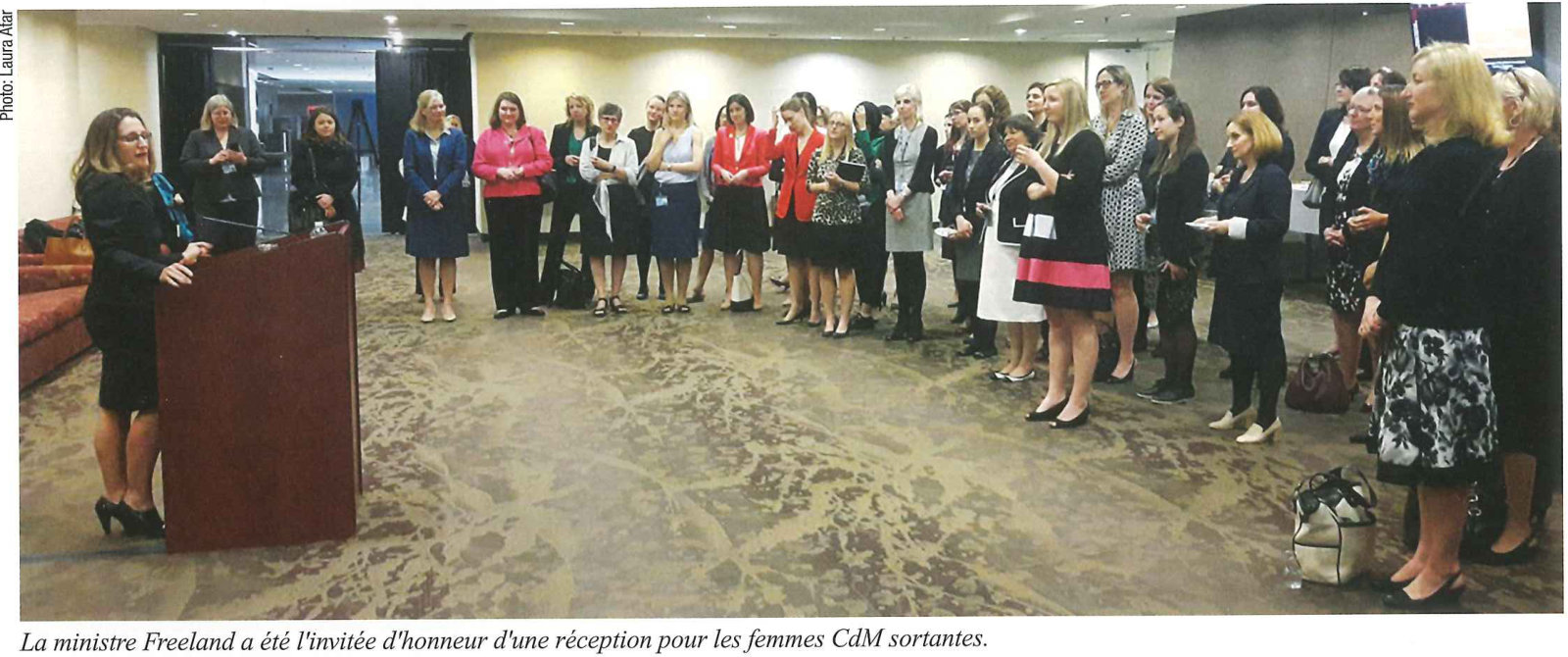
Au cours de la dernière année, sous l’égide de Sarah Taylor et d’une nouvelle cuvée de bénévoles dynamiques, le Réseau a gagné en visibilité. La ministre Freeland a été l’invitée d’honneur d’une réception pour les femmes CdM sortantes. En effet, tandis que l’ancien Premier ministre Joe Clark et la secrétaire parlementaire Caesar- Chavannes ont participé au panel de la Journée internationale des femmes.
Le Réseau a aussi organisé sa première retraite en février. De cette séance de réflexion stratégique ont émané trois objectifs principaux pour la championne des femmes en titre et pour le Réseau:
1. Poursuivre les efforts menés dès la création du Réseau pour combler le déficit de femmes dans plusieurs secteurs du ministère, et plus particulièrement au niveau de la gestion;
2. Aborder les questions qui affectent les femmes dans leur travail au quotidien ainsi que dans leur progression de carrière au sein d’AMC;
3. Élargir le Réseau, tant en nombre qu’en diversité.
Selon Taylor, l’atteinte du premier objectif requiert de revisiter les systèmes et pratiques d’AMC en matière de ressources humaines. Il faut aussi mieux comprendre pourquoi, 25 ans après avoir atteint l’équité au niveau de l’embauche, AMC affiche encore un déséquilibre homme-femme au niveau de la gestion, particulièrement de la haute gestion. Seule cette analyse permettra de s’attaquer aux causes systémiques de ce problème pérenne. S’il est facile d’identifier les symptômes du problème au moyen de statistiques, une action qui se concentrerait sur les symptômes risquerait d’être futile. « Si on se borne aux chiffres, il est possible qu’on puisse combler les manques de femmes temporairement, pour retomber dans les mêmes problèmes pas la suite — et au prix de beaucoup de mécontentement, » avance Taylor.
Mid-level managers have enormous capacity to promote diversity, says Taylor. “Every hiring or assignment decision, Dr. Sarah Taylor is the Director-General for North Asia and Oceania at Global Affairs Canada. From 2011 to 2015, she was Deputy Head of Mission at the Embassy of Canada to China, with responsibility for Political-Economic Relations and Public Diplomacy.
She worked in the Privy Council Office from 2006 to 2011, holding different leadership positions with the International Assessment Staff, including acting Executive Director and Director of its Asia Division.
A Foreign Service officer since 1990, she served in Jakarta (2000-2003), Beijing (1992-1995) and Hong Kong (1991-1992). At headquarters she was liaison officer and speech-writer for the Minister of Foreign Affairs, Deputy Director for Southeast Asia, and Director of Development Policies and Institutions.
Sarah holds a doctorate (1990) and an M.Phil. degree (1984) from Cambridge University, both in East Asian archaeology. She spent a year at Beijing University (1982-83) under the auspices of the Canada-China Scholarly Exchange programme, and has also studied in Korea and Japan. She holds an Honours B.A. from the University of Toronto.
especially acting assignments, every promotion board you sit on, every talent management plan or performance discussion presents an opportunity. That doesn’t mean you need to be picking a woman every time. Rather it means that you need to recognise your biases (which we all have) and get training on ways to counter or neutralise them; then look for opportunities to spot, nurture and reward talent.”
With that in mind, the Network collaborated with the School of the Foreign Service to deliver an “Unconscious Bias” training module to alter the organizational culture, one manager at a time. The training was tested for the first time at the 2017 course for Heads of Mission, and there are plans to further expand its reach to other key deciders in the near future.
Historiquement, de nombreuses femmes compétentes ont hésité a poser leur candidature aux postes de chef de mission ou même chef de mission adjoint. Le Réseau a donc pris l’initiative d’organiser en septembre 2017 un premier 5 à 7 intitulé « Soyez audacieuse : songez à devenir chef de mission! ». Plusieurs femmes ayant occupé de tels postes y ont partagé leur expérience.
When reflecting on the root causes of the persisting gender imbalance, Taylor observes that three issues seem to affect women differently from men:
a. Unconscious bias: the tendency for
the same work to be evaluated differently depending on who is doing it. This may be particularly acute in an environment like GAC that is competitive and prone to corridor reputation,
and where HR processes are diffuse.
b. The potentially differential impact
of rotationality: it may be harder for women to convince spouses to move and uproot their career; to take on leadership roles in missions in countries where tradition dictates against women being in such roles; or to return to work
6 months or less after giving birth.
c. The overall work environment:
whether the lack of role models — there isn’t a single room in the Pearson building named after a woman — or a culture of long hours and demanding travel schedules, which, in Taylor’s case, has meant both “taking my 6-month old with me to a regional Political Counsellor meeting and discretely excusing myself at diplomatic receptions when suddenly stuck by a bout of morning sickness”.
Flowing from the second goal are the many activities that volunteers organize for the Network. Some of these events were the result of new partnerships and ideas.
For example, in September 2016, GAC’s Aboriginal Network Chair Kimberly Phillips and GAC’s GCWCC Campaign Leader Menna Andrews invited the Women’s Network to co-host, along with the Native Women’s Association of Canada (NWAC), a Faceless Dolls Workshop in honour of Canada’s missing and murdered Indigenous women and girls. Then NWAC President Lavell-Harvard and Madame Sophie Grégoire Trudeau were keynote speakers. Our missions in Australia also held similar workshops. Christmas basket donations were also collected for an Aboriginal women’s support centre.
Par ses efforts d’élargissement du Réseau des femmes, enfin, Taylor veut refléter les divers groupes d’employés que compte AMC mais aussi l’intersectionnalité des femmes et des autres groupes-cibles en matière d’équité d’emploi, ainsi que les jeunes et les personnes LGBTQ2. Taylor souligne que les hommes sont les bienvenus au sein du Réseau, qui demeure à la recherche de champions « lui pour elle ». La diversité au sein des effectifs et de la gestion d’AMC sert les intérêts de l’ensemble des employés et pas uniquement des femmes, insiste Taylor. « Notre but est un leadership du ministère plus divers, dans tous les aspects de la diversité. Cela fera d’AMC une organisation non seulement plus équitable mais, comme le démontre des études dans le secteur privé, plus efficace ». Pour le Réseau des femmes, cette même diversité se traduit par de nouvelles idées et initiatives.
The Women’s Network has continued to broaden its reach and partnerships beyond GAC. For instance, it has partnered with the local community in collecting business clothes for Dress for Success; engaged the Ottawa diplomatic community through both the Women HOM and Women DHOM networks; and connected with foreign ministries from other countries struggling with the same issues. Taylor and her team are also looking to build bridges: with other departments to create a Government of Canada network of Champions for Women, as well as with the private sector, given the similar challenges faced by women in business.
The Network’s activities are mainly in Ottawa-Gatineau, but it is accessible to members located outside the area. Its Agora page generates a lively conversation amongst its nearly 800 members at posts and HQ. The Network meets every two weeks to plan events and discuss issues of interest, and employees at missions can join these meetings by video or conference call. To better engage with members posted across the world, Taylor has also identified volunteers that will act as “regional representatives, or convenors”. This includes Bogdan, who will lead the Asia-Pacific sub-branch of the Network, and who recently set up Sydney’s first female Heads of Mission group. Bogdan has also become an active member of Champions for Change, a group of female CEOs committed to providing grass root support for female entrepreneurs.
Taylor hopes that the series of regional sub-branches of the Network to be rolled out this fall will build on successful pilot events that already occurred over the past year — such as a speed mentoring session for staff in Europe. Taylor also hopes to broaden the scope of discussions currently taking place within the Network to include, for instance, issues of concern to locally engaged staff.
The Women’s Network continues to grow. In the words of Bogdan: “The Women’s Network is employee-driven and employee-led, and a true community of practice and kinship”. To join it, become a member of its Agora page.
Laura Atar s’est jointe à la famille FS en 2006. Elle est actuellement directrice adjointe au sein de l’équipe Haiti… et fait partie de cette nouvelle cuvée de bénévoles dynamiques que le Réseau des femmes a attirées au cours de la dernière année!
Originally published in / Publié à l’origine dans bout de papier, Vol. 30, No. 2 (2017), pp. 4–7. Read the rest of this issue / Lire le reste de ce numéro →


