
bout de papier, Vol. 30, No. 3 (2018), pp. 22–24
The Australian Security Intelligence Organisation, the country’s primary counterintelligence agency, recently announced that foreign intelligence collection and espionage threats against Australia are greater now than at any time during the Cold War. Today’s espionage landscape is in many ways more complex, featuring many unknown players, and made more complicated by the phenomenon of globalization. While we read almost daily about cyber attacks on secure data banks, espionage also involves direct efforts to gain classified information from well-placed individuals. This happens every day. The following is one such story, a sad tale, about a naive young woman who became an early victim of intelligence attacks in Canada.
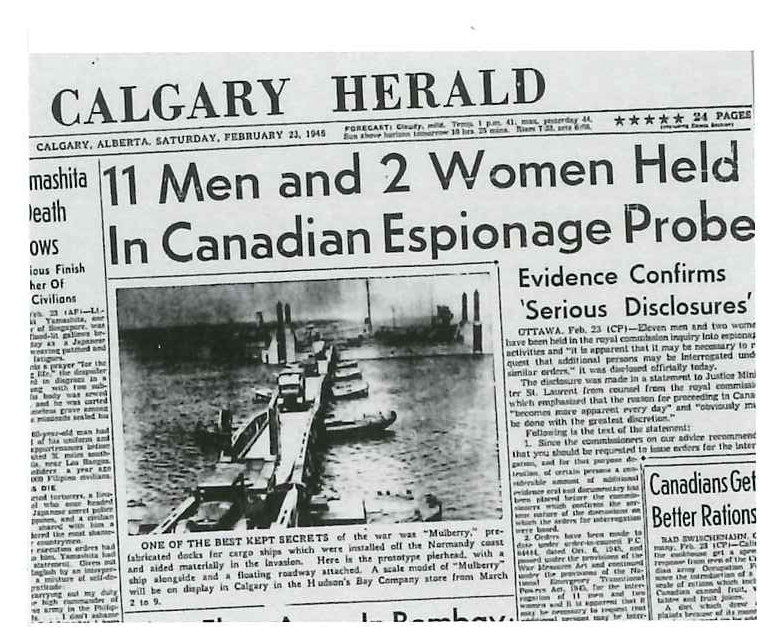
EMMA WOIKIN IS THE ONLY member of Global Affairs (then External Affairs) to have been convicted of an offence relating to espionage on behalf of a foreign power. She was one of several persons charged with espionage after the defection to Canada of Igor Gouzenko, a Russian cipher clerk, in 1945. Gouzenko brought with him evidence of extensive Soviet spying in Canada and the West, giving rise to nearly a decade of spy hunts in Canada, Great Britain, and the United States. Emma might be called the sad spy. Her life was often unhappy and repeatedly plagued with tragedies. Her only child died at birth when Emma was only 19 years old, and her husband committed suicide two years later, the result of depression.
Emma came from a simple and humble farm background, the youngest child in a close-knit family. Her family were Doukhobors, a Russian sect of religious dissenters and pacifists who settled the Canadian Prairies early in the twentieth century. A rather plain woman, she was endowed with a quick intelligence and a phenomenal
memory.
Emma’s siblings pooled their money to send her to secretarial school after the death of her husband. With few job prospects in rural Saskatchewan, she was lucky enough to gain admission to the public service. When she arrived in Ottawa, Emma was still in her early twenties. Her first job was at the passport office of the then Department of External Affairs. A hard and industrious worker, and bright, she was quickly promoted to a position in the department as a cipher clerk, decrypting messages primarily from Britain. Her quest for a better life and a career more suited to her talents also became the cause of her downfall.
As a Doukhobor from a closed family and community she found herself socially isolated in Ottawa, although she did make a few friends who remained steadfast throughout the troubles that followed. Longing for her roots, she gravitated to groups speaking Russian, her family’s original language. Before long, these social ties included members of the Soviet Embassy in Ottawa. She became particularly close to one couple, who were part of Russia’s intelligence staff.
From her relationship to Vsevolod and Lida Sokolov, Soviet intelligence agents, developed not only friendship but also pressure on her to help Russia. Her naïveté and very moderate left-wing upbringing made her easy prey, and she complied with simple requests to help the Soviet Union. She believed Soviet propaganda, particularly with respect to health care for everyone in Russia. She was convinced that the death of her infant son had been due to her lack of money for proper medical care.
Her exceptional memory enabled her to transcribe at home the texts of some classified messages from Britain which she had deciphered at External, which she passed to the Sokolovs. From the spring of 1945 to the following September, Emma assisted the Sokolovs, likely providing them with only a few messages. Four of these, which Gouzenko took with him when he defected, were of little intelligence value. Even so, they were classified, and she clearly broke the law by passing them on to the Russians.
Friendship and interpersonal relations are often utilized by intelligence operatives as means to obtain human intelligence. Of the roughly 20 persons arrested worldwide as the result of Gouzenko’s revelations, most in fact stumbled into espionage through friendship and bad luck: most were left-leaning (including some communists) in their political views and some had a Russian ethnic background.
At least two, however, were serious, committed spies. Alan Nunn May was a British physicist working on the atomic bomb in Canada who provided important information to the Soviets. He was charged and convicted in Britain. Fred Rose, who had been elected as a Member of Parliament under the Labor-Progressive Party (the wartime label for the Communist Party of Canada) banner, worked directly for Soviet interests. He was convicted and deported from Canada after serving his prison sentence.
Although Emma had given information to the Soviets, her eventual conviction was the result of an egregious abuse of power by the government of Mackenzie King. To secure convictions for Emma and the others identified by Gouzenko, the legal entitlements enshrined in, and built upon, the Magna Carta of 1215 were swept aside by a secret order-in-council passed under the authority of the War Measures Act. All were detained without access to counsel or visitors, then brought before a Royal Commission of Inquiry conducted by two justices of the Supreme Court of Canada — in a process eerily reminiscent of the Soviet show trials of the 1930s, as King admitted in his diary.
In the circumstances, none of the accused were granted habeas corpus and all were led to believe by their captors that confession was their only option. For someone as unsophisticated as Emma, that outcome seemed inevitable. As it turned out, her subsequent conviction rested almost exclusively on her confession (much of the evidence produced at the inquiry, however, could ordinarily not have been presented in a Canadian court). Emma was not innocent, but her fate was sealed by a grossly unfair process.
Emma was the first person charged and convicted for charges arising from Gouzenko’s defection. She acknowledged what she had done, quickly confessed and, having no legal representation, was sentenced in April 1946 to two and a half years in prison. The charge against her had been made under the Official Secrets Act, an archaic and poorly written piece of legislation which required that the person charged prove his or her innocence rather than that the government prove guilt. No charge of treason could be brought against Emma since the USSR was a Canadian ally at the time of the transgression.
Out of 20 persons charged (plus one in England), nine in Canada were convicted of activities relating to spying for the Soviets. Another was convicted of making a false statement and the rest were acquitted, mostly because they refused to confess under interrogation and threats. The relatively low sentences given to most of those convicted reflected the hesitancy and reservations of some within the judiciary This does not diminish the culpability of those charged, however. Intelligence work does not always deal in information of tremendous importance or strategic relevance. For the most part intelligence collected from human sources represents minor pieces of a larger puzzle, often seemingly inconsequential and of little value, but potentially important when collated and placed with other pieces.
Troubling aspects of the case linger more than half a century later. There is public familiarity with the gap in King’s diaries covering the time of the Gouzenko affair. Less well known is the fact that the relevant External Affairs and Privy Council files have also gone missing. Files and archival material do get lost and it is impossible to determine whether the missing material reflects bad luck or a conspiracy to keep secret an important dimension to the “Gouzenko Story.”
As for Emma Woikin, she completed her prison sentence at Kingston Penitentiary, with time reduced for being an exemplary prisoner. Here the story might have ended. The normal reaction to the trauma of a prison sentence by someone who is not a hardened criminal would be a scurry to anonymity and to disappear. In fact, this was Emma’s initial reaction.
She returned to her Saskatchewan community to live with her family and attempted to fade from the public eye.
For a period, she did melt away. She was an unhappy young woman who was not yet 30 years old, and had lost her child, husband and career, gained national notoriety, and spent time in prison. Emma devoted much of the early time after being released from prison trying to be helpful to her family, often in a depressed state and prone to prolonged bouts of crying.
She eventually found a job in early 1949 in a drugstore. Although he never told her, the pharmacist, Isaac Elik, was repeatedly interviewed by the RCMP Security Service seeking to have her fired. Others of the “Gouzenko group” had the same experience of the RCMP Security Service attempting to impose extralegal sentences. None of them, convicted or acquitted, ever led a fully normal life and were often pursued by a vindictive Security Service “investigating” their friends and associates.
While working at the drugstore, Emma Woikin met Louie Sawula, a Ukrainian railroad worker about 10 years her senior. It was not love at first sight for Emma, but it was protection and a means to continue her life. By all accounts, they were happily married, with Louie greatly caring for his wife. They built a life together and Emma was able to evade her past with a new last name. In 1951, she found work as a secretary in a legal firm of which John Hnatyshyn, a future Senator, was a senior partner. Emma worked closely with Hnatyshyn and then with his son Ramon, known as “Ray,” later a cabinet minister and ultimately, in 1989, Governor General of Canada.
In 1974, Emma died from acute alcoholism, something that afflicted her late in life. It was a sad ending for someone who had experienced so much grief. Emma Woikin had been a loving woman, who was deeply affectionate toward her nieces and nephews, and her wider family. In many ways, however, her life had been predominantly a succession of hardships.
Originally published in bout de papier, Vol. 30, No. 3 (2018), pp. 22–24. Read the rest of this issue →


