
bout de papier, Vol. 32, No. 3 (2023), pp. 30–33
KENNETH JOHN SUNQUIST WAS BORN to be a highly successful, top level, Canadian Trade Commissioner and diplomat— intelligent, congenial, reliable, effective, an intuitive inspirational leader who cared about people, and a nomad. He was never one to see life as a glass half full or half empty; rather, as a full glass of positivism, optimism, and opportunity.
Ken liked to say he was born in Winnipeg “at the end of mosquito season” — the fact this was the end of August said as much about the man’s abundant sense of humour as it did about the resilience of that city. His father, Ed, was a trouble shooter for the pipelines. When Ed was assigned a new task, which was often the case, he did not just set off on his own but packed up the entire family with him. Ken, his mum Diana, his slightly younger sister Susan, and brother Tim, accordingly, found themselves bouncing around Manitoba, Saskatchewan, British Columbia, Northern Ontario, as well as sharing a stint in Galveston, Texas.
Like most Prairie boys Ken was drawn to the ice; but the constant family movement precluded sticking with a hockey or curling team for anything like a ~ full season. So, he, Susan, and Tim adapted and took up the transportable sport of figure skating where they could be self-reliant. They all excelled; with Ken rising through the various stages until he found himself competing at junior levels against burgeoning stars like Toller Cranston and Ron Shaver. The demands of university study took him away from further competition but his devotion to the sport led him to become a respected gold level judge — a function he performed for decades afterwards.
At the then Regina campus of the University of Saskatchewan, Ken enrolled in administrative (business) studies. For a period, he was engaged with the Royal Canadian Navy Regular Officer Training Plan (ROTP). Unusual perhaps, as Regina is a long way from any ocean, but the lakes of the Qu’Appelle Valley, which Ken loved, are close and the northern part of the province is dotted with water. It also has been pointed out that the limitless horizons of Saskatchewan equate to what naval officers face on the high seas.
Ken soon found himself bitten not by a mosquito but by the political bug and the desire to work with and do something for others. He was elected President of the Student Council and guided it through a period of turbulence during vociferous protests against the Vietnam War and incessant demands for free university education. The love bug also struck in the charming, effervescent form of the politically aware Carolyn Darke; an education faculty student who had grown up with deep family roots in Regina. Ken was fond of squiring Carolyn to the student council offices after hours and coaxing the resident juke box into playing his favourite song by Neil Diamond — “Sweet Caroline” — as they danced across the office floor. They were engaged at graduation in June 1970; his first paycheck went toward the purchase of a ring. They were married on February 5, 1971, on one of those frigid Prairie days with the temperature touching minus 29. Carolyn was Ken’s “Sweet Caroline” then and throughout their 51 years of marriage.
Ken’s first full-time job was as assistant clerk to the Executive Council of the Government of Saskatchewan and then executive assistant to Ross Thatcher, the province’s premier. Thatcher was in his second term and was known to be combative and combustible — he apparently fired and rehired Ken in the same conversation, on multiple occasions. Ken took it in stride and enjoyed working on policy formation and the political give and take. But what caught his fancy was the interaction with citizens, reaching out, listening, and learning. Thatcher was defeated in the June 1971 election.
Ken regrouped and like many talented people from Saskatchewan, was attracted to the concept of service to the country and employment with the Public Service of Canada. He initially worked with Revenue Canada in Regina but the broader fields of Ottawa and service abroad beckoned. After successfully passing the Foreign Service exams in autumn 1972, he and Carolyn moved to the nation’s capital in June 1973 where he became a proud and devoted member of Canada’s Trade Commissioner Service (TCS). It fit him like a glove; he was on his way.
Ken cut his first diplomatic teeth, with direct exposure to other cultures in foreign lands, the following year in Jamaica, as a commercial officer under the skilled tutelage of fellow Saskatchewanian, Bob Burchill. A highlight of the Kingston assignment was the birth of son Stephen in 1975. Then it was on to Belgrade, Yugoslavia in early 1977 where he was faced with the clash of commerce with ethnic and ideological politics. There also was a disruptive merry-go-round of housing and the unexpected turnover of Canadian personnel, but throughout Ken kept his focus and shoulder to the wheel and came to appreciate the vital importance of locally engaged staff to the welfare and success of a mission abroad. As always, the challenges of life in the Foreign Service extend beyond the employee to the family. Canadian Government policy dictated that births were not to occur in communist countries and so in 1978, Carolyn set off for Regina to await the arrival of their second child. She made it as far as Toronto before son Sean unexpectedly decided to arrive on the scene. Then a third consecutive assignment abroad, this time in 1980 to San Francisco where the world of high tech, communications, and media awaited him. Once again, he was fortunate to have the wise guidance of another Trade Commissioner from Saskatchewan, Bill Clarke, and the opportunity to work with the talented, future Deputy Minister, Marie Lucie Morin. With added drive and determination out of the office, Ken acquired an M.A. in Public Administration from Golden Gate University.
The family of four returned to Ottawa in 1983, after nine years abroad. The cauldron of headquarters awaited: Deputy Director of USA economic relations followed by a year as Executive Assistant to Sylvia Ostry, the brilliant, colourful, and demanding Deputy Minister of International Trade and coordinator of International Economic Relations for the Government of Canada. Ken not only survived that experience but added enormously to his knowledge bank — as he would say later, he “learned about the strength of intellectual reasoning in what we do, the ability to provide Ministers with options and that integrity with colleagues, staff, and ministers, while difficult at times, is the only way to achieve lasting results”. Onward to Director of the Trade Development Policy Secretariat, followed by director of export information and then two years as Director General of Trade Communications and Public Affairs.
The incessant demands of headquarters and his determination to get the job done on time and well, kept the self-described workaholic in the office beyond regular hours when others had long gone home. Ken found a way, nevertheless, to share special hours and weekends with his young sons, both indoors and outside, by becoming a leader first with Beavers, followed by Cubs.
Then it was off with Carolyn and the two boys to Seoul in 1990 as Minister Counsellor (Economic and Commercial) in an increasingly important and hyper-active embassy. The mission was led at first by Ambassador Brian Schumacher who Ken would say taught him the skills of higher-level business networking and how to make Canada a player in Korea. Subsequently, Len Edwards, another future Deputy Minister, would take the Embassy reins. Ken described Edwards to be a “great leader with his focus on achieving results”. The South Korean economy was booming and there were business and governmental visits aplenty to organize, vital contacts to be made, social events to plan, sage advice to be given, and complicated and lucrative deals to help negotiate. Korean industrial names came to world attention: Samsung Electronics, Hyundai Heavy Industries and Hyundai Motors, POSCO Steel, Kia Motors, LG Electronics, among others. Ken found himself increasingly near the centre of the action; always as a consummate team player, paying as much attention to the concerns and needs of those below him as well as to those above.
The demanding pace in South Korea prepared Ken extremely well for the even more challenging assignment of Beijing; which was experiencing its own massive economic expansion and opening to the world. Every Canadian exporter dreamed of selling just one item to each of the then 1.2 billion citizens of the People’s Republic of China and each company representative came pounding on the Embassy door for assistance. Ken (with Carolyn and only Sean this round) got off to a frenetic start upon his arrival at the end of summer in 1994. Plans were developing in Ottawa for the first ever Trade Team Canada trip abroad in November with China (Beijing and Shanghai) as the destination, along with Hong Kong. The idea was to go big or go home in the face of international competition. The mega delegation, which was led by Prime Minister Jean Chrétien, included nine of 10 provincial premiers and their staffs, International Trade Minister Roy MacLaren, and approximately 400 businesspersons associated with the Canada-China Business Council. There were many egos and unlimited demands to deal with and much of the pressure fell on Ken as the Embassy number two, responsible for economics and commerce. As he always did, Ken remained calm, cool, and collected. When asked for advice by the delegation leaders, he kept it short and on target to everyone’s appreciation. The resultant press release from the Prime Minister’s Office spoke of over eight billion dollars in signed contracts and commercial opportunities. Less than a year later, Ken took on the added duties of Chargé d’affaires for a considerable time during the illness and untimely passing of Ambassador John Paynter.
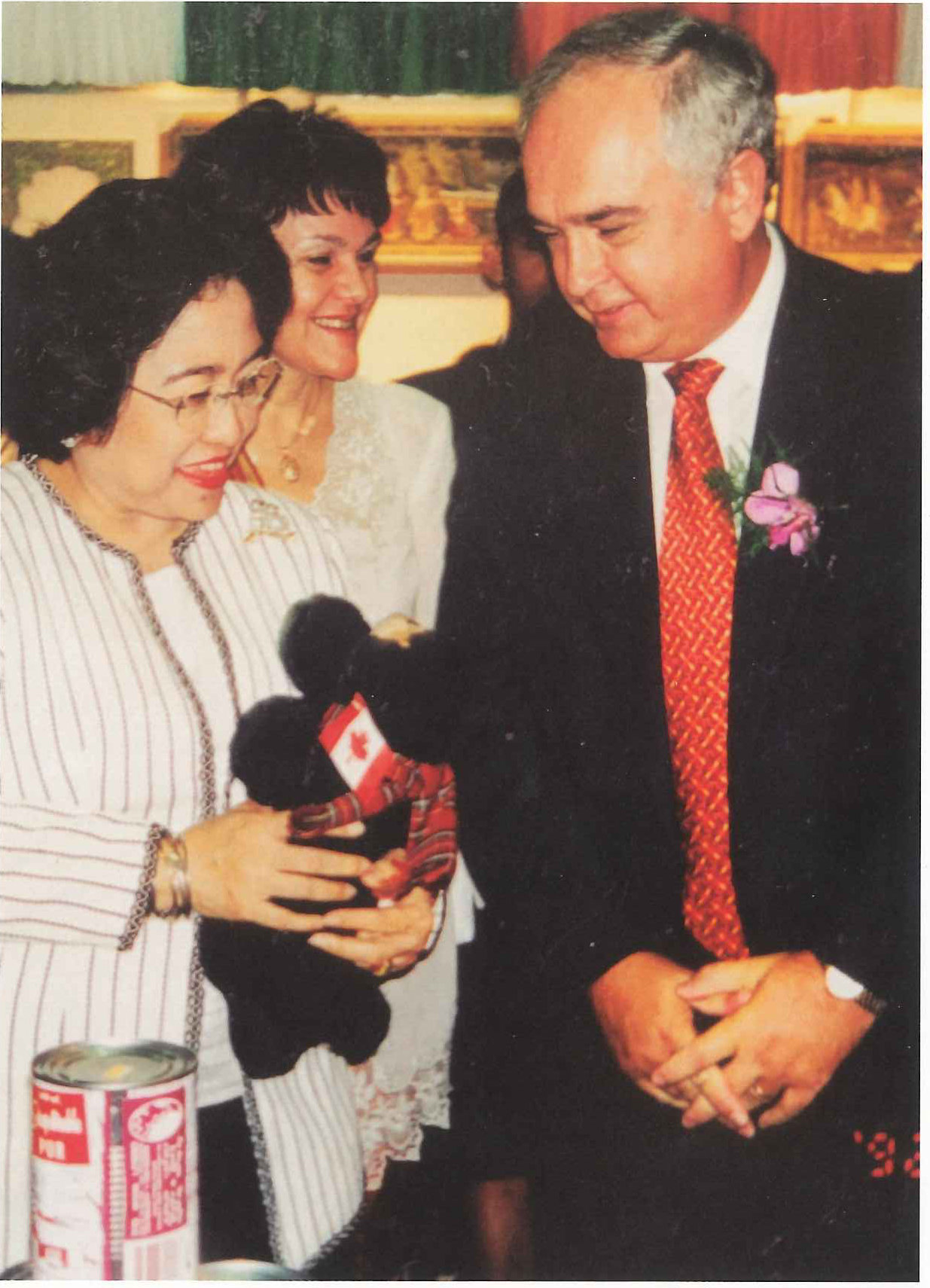
In the summer of 1997, Ken, Carolyn, and Sean returned to Ottawa. It was not a prolonged stay. Within the year the opportunity arose to be named Ambassador to Indonesia. Carolyn was delayed for several months with her ailing parents, but Ken (this time with no accompanying children) jumped into the fray in dealing with a new Indonesian government and a destabilized economy after the collapse of the 32-year authoritarian regime led by General Suharto. Canada had a large economic footprint in the country, particularly in the mining, oil and gas, and forest industry sectors, which needed attentive nurturing, as did our major development assistance program. The largest Muslim country in the world, led by three different presidents during Ken’s term, also required skilled political attention. The tumultuous and violent end of the Indonesian occupation of Timor-Leste, which was a matter of considerable international and Canadian focus, occurred during his assignment and took up much of his time.
After three action filled years in Jakarta, it was finally the moment to return once again to Ottawa and headquarters; to stay at home if one did not count the hundreds of thousands of kilometres of air travel across Canada and the globe with his new official duties. Starting in 2001, he was Director General of the Trade Commissioner Service, Assistant Deputy Minister (ADM) of World Markets and International Business, ADM of Global Operations and ADM for Asia and Africa. From 2003 until 2010, he concurrently was Chief Trade Commissioner — a job he loved and where he was known to be a staunch and determined defender of the Trade Commissioner Service in assorted bureaucratic battles. It was a blistering pace but if it was not demanding enough, he became “champion” for mid-level management, for mentoring and for Indigenous Affairs in the Department of Foreign Affairs and International Trade (DFAIT). Additionally, he held special responsibilities as alternate governor to the Asian Development Bank, to the African Development Bank, and senior official to the Association of South-East Asian Nations (ASEAN) and to the grouping of Asia- Pacific Economic Cooperation (APEC). For his multiple endeavours Ken received the Minster of Foreign Affairs Award of Excellence for Policy and the Public Service Awards for Excellence in Management and again for Policy.
Throughout it all, Ken never lost sight of the importance of his family to his own well-being. Few would have turned down an ambassadorial assignment to a major embassy, as Ken did, to keep the totality of life in some form of equilibrium.
On his retirement day, June 18, 2010, the Crush Lobby in the Pearson building was packed with well-wishers. As a measure of the man, the Deputy Minister of International Trade announced the creation of the “Kenneth J. Sunquist Award” to be awarded annually to a junior Trade Commissioner “who exemplifies the same qualities and attributes which Ken has shown over his 37-year career including:
* leadership, charisma, passion
* commitment to duty beyond normal expectations
* spirit of cooperation and teamwork
* client focus.”
There also were multiple oral and written compliments, of a personal nature, directed his way. Many referred to his: “amazing interpersonal. skills”; “love of people”, “affable nature and ever ready smile”, “human touch”, “humanity and compassionate nature”, “generosity of spirit”, “uncommon ability to balance the brain and the heart” and even “possessing a magic potion that gives you the ability to care for everyone, give wonderful guidance, mentor and just be a fun, all-round good guy”. Another wrote that during a mentoring session for middle ranking officers held over a sandwich luncheon, Ken made every person feel important and asked about their hometown, history, and career aspirations. We all left the session, the young officer said, feeling “respected, recognized, valued, and inspired”. A contemporary described Ken as a classic “servant leader”.
But it was not just his innate ability to have a good relationship with everyone and to draw the best from others to meet goals and objectives. He was seen as “wise” with “uncommon, good sense”, and as having a mind “as sharp as a tack”. He was judged by his peers and team to have renewed the fabled Trade Commissioner Service and made it ready for the 21st century by seeking new directions and opportunities; by giving its members “the tools to do our job, to serve our clients and to collaborate effectively with our partners”. Most importantly, trade commissioners spoke about a “sense of pride and accomplishment” under his leadership.
While retirement is the end of the work line for many, it was just the beginning of a new measure of public service for Ken; particularity in the world of non-governmental organizations (NGOs). He sought new avenues and became a passionate member of numerous boards: 10 years with CARE Canada (five as Chair), CARE International, CARE Indonesia, the Forum for International Trade Training (FITT), the Trade Facilitation Office (TFO), the Canadian Commercial Corporation (CCC), and the University of Alberta, Canada— China Institute. Ken was no strap hanger, along for the ride. FITT President and CEO Caroline Tompkins for one, spoke glowingly of Ken’s seven years with that organization as Vice Chair, Chair, and Past Chair. Of how Ken not only inspired everybody but led the transition from a government funded service to a self-sufficient NGO; the securing of third-party international accreditation and the formulation of the COVID-19, 2020-2021 Contingency Plan.
DFAIT reached out to him for many years afterwards to mentor first time ambassadors. The subject, “values and ethics”. No surprise here as he was a standard bearer in both domains.
Ken also became a frequent visitor to his alma mater, the University of Regina, delivering lectures and leading discussions. He received a “Lifetime Achievement Award” from the alumni association and the university recognized his outstanding success and service to the country with an honourary doctorate.
Saskatchewan, and their alternate home at B-Say-Tah near Fort Qu’Appelle, remained a beacon of joy for Ken and his family — Prairie sunsets, Sports Day, the endless boat towing of grand-kids around the lake, cigars and whiskey with his boys, books and newspapers around the house, engaging neighbours and lake friends with tales of the Foreign Service. He and Carolyn were enthusiastic supporters of the Saskatchewan Roughriders with the two of them wearing all sorts of football team paraphernalia while watching a game — apparently, they did not go as far as to put the half-cut watermelons on their heads as favoured by other local fans. When adversity set in, weather related or not, Ken was among the first to assist — such as filling and deploying sandbags and staffing pumps in the neighbourhood during spring flooding.
It is said that the true measure of a person is not how they handle life during the good times, but rather through times of personal adversity. Here Ken stood tall as well. Despite dealing with the debilitating impact of cancer in his last few months, he continued to reach out and to remain positive. He never made conversation about himself. He wanted to know how you were doing and to share in any success you might have. He drew his cherished family close: Carolyn, Steve and his partner Sue and their daughter Kira, Sean and his wife Kate and their two sons Elliot and Trevlyn. And when time began to run out in Ottawa, he longed for one more trip to Saskatchewan.
The day of his funeral service, June 15, 2022, the University of Regina lowered its flag to half-mast in tribute to Ken. The main hall at Beechwood Cemetery in Ottawa was full to overflowing with well over 250 young and old colleagues, friends, neighbours, and family members. There were constant refrains, as there had been during the gathering for his departmental retirement. Ken was “a man of integrity”, “a man of trust”, “someone who would listen to you and cared about you regardless of your rank”.
In sum, it was said “he personified the best DFAIT had to offer”.
Originally published in bout de papier, Vol. 32, No. 3 (2023), pp. 30–33. Read the rest of this issue →


