
bout de papier, Vol. 31, No. 3 (2021), pp. 36–37
PASTA. One of my favourite unexpected discoveries here in Brussels is that it’s full of … Italians.
there was a large post-WWII migration for coal mining, though cultural ties go back much further. I mentally divide Italian restaurants here into two groups: one where the staff converses among themselves in Italian (which are always good) and those where they don’t (which often aren’t).
Not only are there endless great Italian restaurants here, but there are also lots of tremendous grocery stores carrying products from the home country. In every single one, there is an inevitable wall of dried pasta. And it is good stuff. Since starting research for this article, I’ve brought home a huge number of Italian pastas to try and the differences between brands have been really surprising.
The history of pasta is unclear and contested. It was likely developed either in China or the Middle East nearly 2,000 years ago and migrated over time to the south of Italy. There, what started as a handmade food only for the rich became a poor man’s food when mechanized production was developed in the 17th century. Naples and Sicily become “pasta powerhouses.”
That quick meal you pull out of the pantry on days when you are lacking time or inspiration is big business. Pasta is a US$12 billion business, globally. Twelve. Billion. Dollars. And the top sellers (at least the Italian brands) are surprisingly diverse in terms of quality. Among the top is (I’m sorry to say) Barilla. You are sure to have seen the ubiquitous blue box at the grocery store, but I recommend you give it a pass, as it makes a mushy, uninspiring meal. De Cecco and Rummo are also high on the sales list. Now there, you will find happiness. De Cecco gives you a much more robust bite and Rummo is, at this point in my pasta testing, the best commercial pasta I have come across.
One of the big differences between the great and the passable products are how they are extruded; when the pasta dough is forced through a die (a disc with holes) into its finished shape. A lot of commercial producers use a Teflon die, which leaves a smooth surface. But for those who use a bronze die, the consumer is rewarded with a roughened surface, a bit like that of a cat’s tongue. This makes for a much more interesting mouthfeel and also makes it easier for sauce to cling to. Most artisanal pasta, as well as the better commercial ones, are extruded through bronze dies. Artisanal long pastas — like spaghetti — often also are folded in half, leaving a loop at one end; this is how it hangs during the drying process. Commercial producers cut this part off, but small producers leave it on. It makes for a nice, long Lady and the Tramp-style spaghetti eating experience. It is also an indicator your pasta is a bit fancy and worth bragging about.
So what do you need to know to make your own (you know I was going to go there, right)? Many think that making homemade pasta is only possible by Italian nonnas or professional chefs, but I tell you from experience, it’s both easy and quite zen to make your own. Find a time when you would like to do a food project, either alone, with a partner or kids, and have a go at making your own. It’s really special to sit down to a plate of pasta you’ve made yourself. The first few times will take a bit longer, but once you get the process down, it’s a fairly efficient process.
First, decide what you will make with your dough. Consider a water dough if you want to dry it for storage or are making flat noodles to eat fresh like lasagne or tagliatelle. This is also better for an extruded pasta, like spaghetti, if you have a pasta attachment for a stand mixer. Water dough is just semolina flour, salt and water. Nothing could be easier. If you want a more tender pasta, perhaps for making a stuffed pasta, then an egg dough can be used: in this case, use either Canadian all-purpose (AP) flour or imported 00 flour for pasta. As an aside, “00”
is an Italian term for how finely flour is ground, rather than the protein content. If you have a choice, get a bag of 00 that specifies it is good for making pasta; its relatively higher protein content will give it a nice chew. Many Italian pasta flours are made with grain from Manitoba, which is clearly indicated on the package as a sign it is higher in protein than regular Italian flours.
For recipes, you can easily go online and find a thousand websites that will give you a recipe and demo. Most of the recipes are nearly identical, but each will give slightly different instructions. I recommend you check out a few, as you’II pick up lots of little bits of helpful info. Two sources I love: the Pasta Grannies YouTube channel and cookbook of the same name by Vicky Bennison and My Kitchen in Rome by Rachel Roddy.
Recipe // Recette: Fresh pasta
Ingredients — Egg pasta
Egg Pasta This is truly the easiest recipe in the world to remember: for every room-temperature large egg. use 100 grams of AP or 00 flour. which serves one person. If you want to score pasta knowledge points at your next cocktail party (whenever that may be – sigh) 100 grams of flour is also called an eta. So for every egg, an eta of flour.
Ingredients — Water pasta
Water Pasta Water pasta replaces the egg with water in roughly the same quantity. Use 45 grams of room-temperature water and a pinch of salt for every 100 grams of semolina flour. You can add an extra teaspoon of water if needed.
Method
METHOD LU Place flour (and salt, if applicable) in a bow! if you want a quick option or on a large board to form a well, if you want to go old school. Add the egg(s). breaking the yolks with your finger and gradually bringing the flour into the egg. Eventually it will turn into a dough that you knead on the large board by folding an edge of the dough towards the centre. pushing it down with the heel of your hand. then rotating the dough and repeating over and over. Essentially. you want to create a homogenous, smooth and silky ball. which will take about 10 minutes. Either type of dough benefits from a rest after kneading (just invert the bowl over the dough), though you can use water dough right away if time is tight.
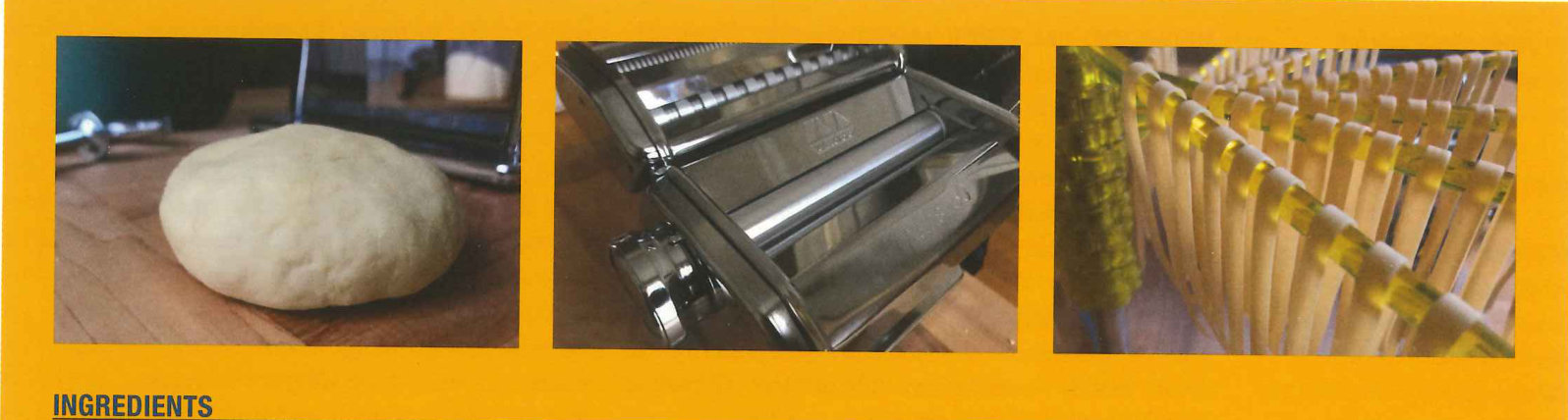
Roll the dough out with a rolling pin and cut with a knife (it is a lot of work to roll out) or use a pasta roller, which both rolls the dough very efficiently and usually comes with cutters for angel hair and linguine (I bought my first for $30 at Stokes).
If you plan to make pasta more than once or twice. a roller is a fantastic investment. At the same time. purchase a pasta drying rack too, which is also reasonably priced. You really only have to buy these once.
To organize and dry the finished pasta. you need a surface to hang long pasta on (traditionally, either a pasta drying rack or a broom handle: a friend uses a clothes drying rack) or a tray lined with floured parchment for anything hand-shaped, like macaroni. You can use either pasta fresh right away. To keep for later, water pasta can be dried all the way through and stored, while egg pasta can be refrigerated for up to a couple of days.
To cook, just toss in salted boiling water. giving it a quick stir to keep it from sticking. Homemade pasta only takes a couple of minutes to cook. Sauce it up and enjoy!
Originally published in bout de papier, Vol. 31, No. 3 (2021), pp. 36–37. Read the rest of this issue →


