
bout de papier, Vol. 31, No. 1 (2020), pp. 47–51
We are walking a country road behind a deserted church, cold wind blowing. A waning moon casts knife-thin shadows from the bare branches and silent owls cut across the stars. Father Guido says, “There are four kinds of places. Most, like the street you stepped into this morning, are not hard to find. Others are always there, but most people can’t see them — like Diagon Alley. The third is only sometimes there, like Brigadoon, which appears one night in a century. Then there is the Caravanserai of Moon and Moonlight. Always somewhere, but not always where it was the last time.”
I say, “So GPS is not a big help.” “No, but there are other things.” He lifts his hand and flashes a silver ring with a black stone. “Crafted for Saint Bevan the Bewildered, last seen entering an amusement park in Tuscaloosa. The ring was found stapled to a kumquat in his refrigerator.
THE STORY BEGINS A FEW days before in my office, where I help merchandise of negotiable provenance find new owners. There is a tall guy in the client chair, long dark robes and a broad-brimmed hat. The dog-collar makes him one of God’s mechanics, the bandito moustache says he’s no St. Francis. He introduces himself as Father Guido Gnocchi. I ask how I can help.
“What do you know about the seal of the confessional?” he says. “No seal ever makes me confess,” I reply. “No, it means when someone confesses their sins to a priest, the priest cannot on pain of excommunication tell anyone what was said.” “Right, sort of omerta with incense.”
“Tf you like, Mr. January. But things can get complicated. A hypothetical example. A man, call him Mr. Christian, comes to a priest. He confesses a big crime he’s about to pull off. He’s skipping town as soon as the deed is done, he wants it off his conscience, this priest is the only one he trusts. He spells it out and asks for absolution. The priest says no, because Christian refuses to abandon his plan, and anyway we do not absolve in advance. Christian goes away. The next day, he is run down and killed in the street.”
“But two days after the funeral, Christian’s daughter visits me, shows me a USB key. She found it in his desk with instructions to give it to me in the event of his death. The key held a long audio file. It was encrypted, but we broke it — the Church has always been good with cryptic texts.”
I ask, “So what does the file say?” “It was a recording of his confession to the priest. I can’t tell you more, because of the seal. I can say it poses severe legal and theological issues. But the immediate problem is that the key was stolen from St. Peter’s last week, by a man called Rialto Sleazewagon. I am a trouble-shooter for the Apostolic Penitentiary…”
“The Vatican hoosegow?” “No, the tribunal that handles cases involving the confessional. The Cardinal in charge wants me to get the key back. You know Sleazewagon and have a record for finding objects that have gone astray, so I’m asking your help.”
“T am willing. I can take the Church or leave it. Sleazewagon, however, gives cockroaches a bad name. But can you not tell me more? Being cautious has kept me breathing and I generally do not enter a dark room without a flashlight.” “Sorry, no.” “You are dogmatic.” “I’m a priest, dogma is my middle name.” He shows me his passport. It really is.
Back in the moonlight, we look down on a clearing in the forest. Half-hidden by patchy fog is a low stone fort from a Foreign Legion movie — high blank walls with towers and domes visible over the top. Father Guido strides up to the gateway and greets the two guards. They are eight feet tall, dark blue, mean-looking and muscular. They flourish scimitars and snarl. Other than that, they seem friendly.
Father Guido comes back. “The djinn will admit us. In fact, the Lady in Indigo wants to see us tonight.” We walk through the gate. If the outside of the place is shabby and dusty, the inside is bright and gaudy. A huge open space is surrounded on all sides by rows of archways, with a second row on top. The square is a crowded and noisy night market, lit by long rows of torches along the walls and on tall poles among the booths. Merchants and hawkers sell everything that is exotic and colourful.
Father Guido says, “Caravanserai serve as a resting place for caravans. Here the traders can find safety and shelter for themselves and their goods and their camels. They can get food and drink and other supplies. There is a mosque and a hospital. You can still find caravanserais in places Starbucks and the Internet have not reached. This one is different because it moves around as much as the caravans do. Every new moon, it vanishes and reappears somewhere else.”
I say, “Is there somewhere to get a drink?” “The Inn of the Wandering Han. Everybody goes there, so it’s the best place to start looking for Sleazewagon.” Passing along the colonnade, we enter an archway into the sound of loud voices and bad singing, the smell of spilled beer and ganja. It is Rick’s in Casablanca, minus the piano and the Nazis. White walls, low ceiling with whirling fans, palms and cactus in pots, waiters rushing among tables crowded with people from all over — traders in the latest kaftans, mercenaries in the latest weaponry, tourists taking selfies, a guy in the corner eating cotton candy, a samisen player being pelted with food but refusing to take the hint. Some of the guests are not human, but Guido does not seem to notice. No sign of Sleazewagon.
By the bar, two bruisers start to fight. Just as things are getting interesting, this dame wanders over. She is tall and broad and has a warm smile. “Boys, boys. You know the house rules.” She flattens one of the uglies with a right to the throat. The other one charges her and gets thrown right out the window over her shoulder. Not a hair out of place, she nods to the barman. “Refill on fire-water for Table 13. Get the waiter to check the extinguisher while he’s there.”
Guido says, “The innkeeper. She was a top gladiator until the league tricked her into a death-match with her lover and she watched him bleed out on the sands. After seriously downsizing league management, she took her savings and bought the Inn. They call her La Serena ’cause there’s no trouble when she’s around. If anyone knows about Sleazewagon, it will be her.”
He goes over. “Serena, hello.” “Hey, the holy tumbleweed rolls back. Of all the djinn joints in all the towns….” “Let’s not go there, sweet lady, lest memories be stirred.” He sneaks a glance in my direction. “But can I ask if a man named Rialto Sleazewagon has been around?” “Short, skinny guy with a moustache like a dying shoelace? Yeah, he skipped town yesterday in a hurry. Word is, he was looking for a safe place to cache something. He spent most of his time with the boys in the back room. Who want to talk to you, by the way.” Guido replies, “Not big on wizards, me. Besides, I have an appointment with the Lady in a few minutes, so they’ll have to wait.” La Serena nods him off.
The Lady in Indigo is waiting for us in a private garden off the far end of the square. She sits on a marble bench under a jasmine arbour. A short but statuesque figure in a dark sari, she has grey hair, she is still beautiful and she has a voice that lets you know who is in charge. “Father Guido, welcome back. Mr. January, a pleasure. I don’t have much time, so let’s get down to it.”
“You are looking for Rialto Sleazewagon. He came recommended by a man who, as a result, is no longer my advisor. He wanted safekeeping for a small item, something he said would make him rich. He said you were on his heels, so I have been expecting you. I offered him our usual contract and suggested he try the wizards at the Inn on the details. But he wanted one more thing. If he could not get back to reclaim the item himself, he said, he would send someone else. Against that possibility, he left a half-clue for me to give his agent if he or she convinced me to do so. So, Father Guido, can you convince me?”
Guido thinks hard and says, “I’m not going to tell you I am here as Sleazewagon’s agent. I am here to get back something he stole. The only way to convince you is to tell you the story of that item. He doesn’t even know what it is.” And he tells her the story of Mr. Christian, starting with what he says in my office, then going on, “What I am about to tell you violates the laws of my Church, but I can think of no other way to go.”
“What Christian confessed went back 20 years. While enrolled in an MBA program, he did case studies of famous financial fraudsters. Learning from their mistakes, he drew up a scheme to make himself rich, by setting up a charitable trust drawing in money from the rich, investing the funds and devoting the income to good works — medical research, grants to education, housing for the poor, Indigenous reconciliation, support for human rights. He lived a life that was genuinely unostentatious. He distributed billions, he became a byword for practical charity, he changed the lives of myriads. Yet it was all a sham, he confessed. His only purpose, from the very beginning, was to get control over a vast amount of money and then disappear with it. All the rest had been nothing more than a means to that end. He was a week from pulling the plug when he went to see the priest, and he died before he could carry it off.”
“T don’t know why he had the recording sent to me after his death. We did some work together at one of our missions, and I knew the priest he’d confessed to. Anyway, news of the key’s existence leaked and Sleazewagon found out, but he didn’t know the details. He always thought Christian too good to be true and assumed the key contained the access codes to his secret bank accounts. But part of Christian’s genius was that he hadn’t embezzled anything — yet. It was ready to disappear into his pocket with a click of the mouse but was still in the fund’s accounts when he died. Meanwhile, the decrypted recording put the cat among the pigeons at the Vatican. The problem was theological. Was a man who had done nothing but good all his life, given a hand up to millions, funded worthy causes, never hurt anyone — at the same time a man who the whole time planned to steal from people who trusted him, money that could have helped millions more — but a man who was never able to carry out his evil plan — was that man evil or good in the eyes of God?”
“Pater dimitte mihi quoniam peccavi. I have told you this at peril of my soul. But that is why the Church wants the key back, to curtail moral confusion. From Sleazewagon’s point of view, there is no monetary benefit in having it, so he is not losing anything. What do you think?”
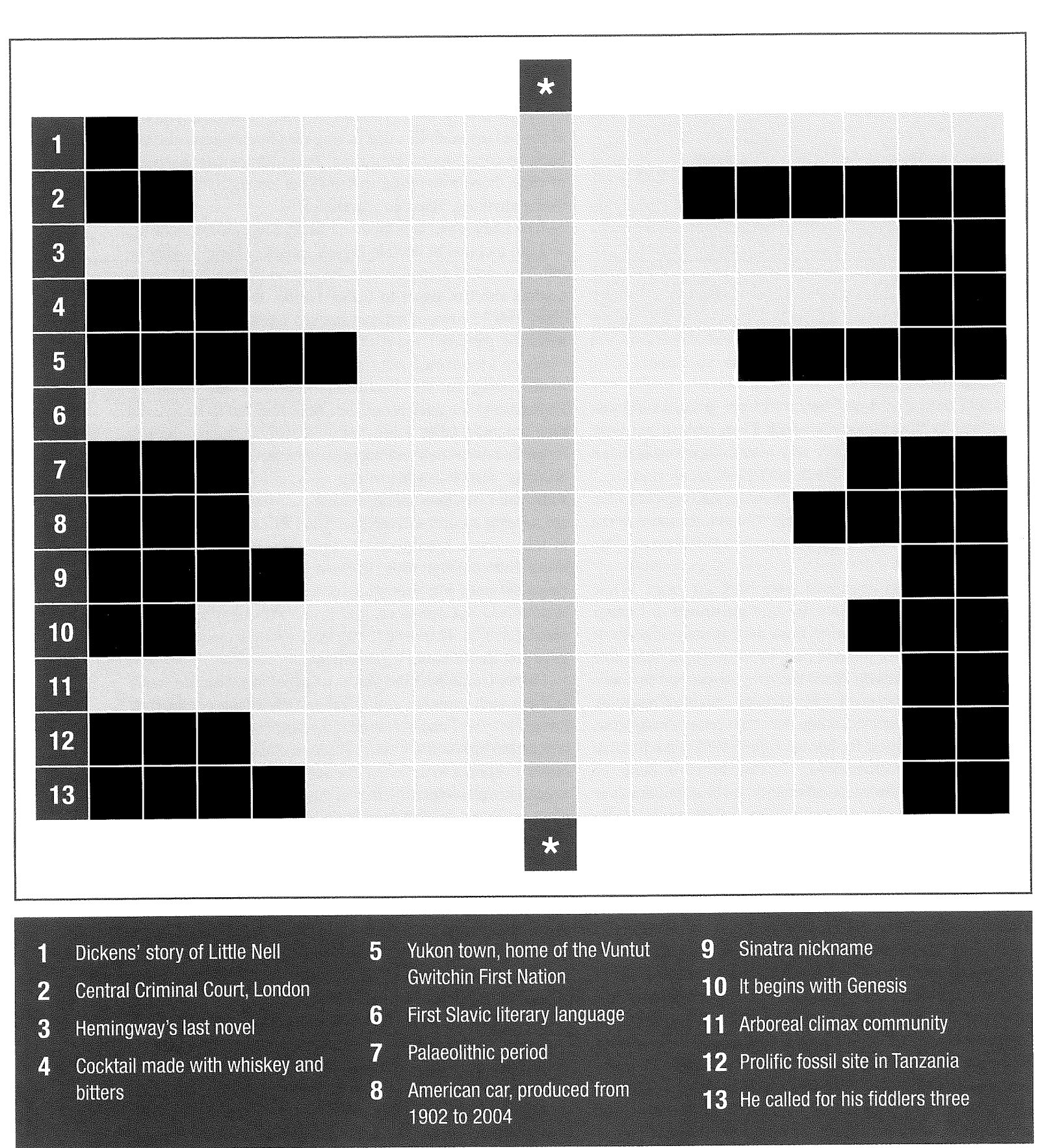
The Lady says, “It is far too unlikely a story to be made up, so I am inclined to declare myself satisfied. Here is what he left. You should discuss it with the boys at the Inn.” She hands a small sheet of paper to Father Guido. It contains a blank chart with 13 rows of squares stacked one on another. As we leave the garden, I see a straggle of what looks like cotton candy on a thorn bush not far from the arbour.
Returning to the Wandering Han, we are taken by La Serena to the back room. The boys turn out to be five old men around a table. I use “men” loosely, because one is a hippo in a safari suit and another a human-sized salamander, drinking what looks like a cup of lava. In front of them is some kind of chess game, except that the playing squares are moving around and the pieces are differently weird. One of the wizards speaks up. “Father, Mr. January. Welcome to our little conclave. Word from the Arbour is that you wish to claim the item Mr. Sleazewagon left with us. All you have to do is ask. Ask one of us. And if you ask the wrong one, no second chance. This list of clues goes with the chart the Lady gave you. Believe me, it gets old fast.”
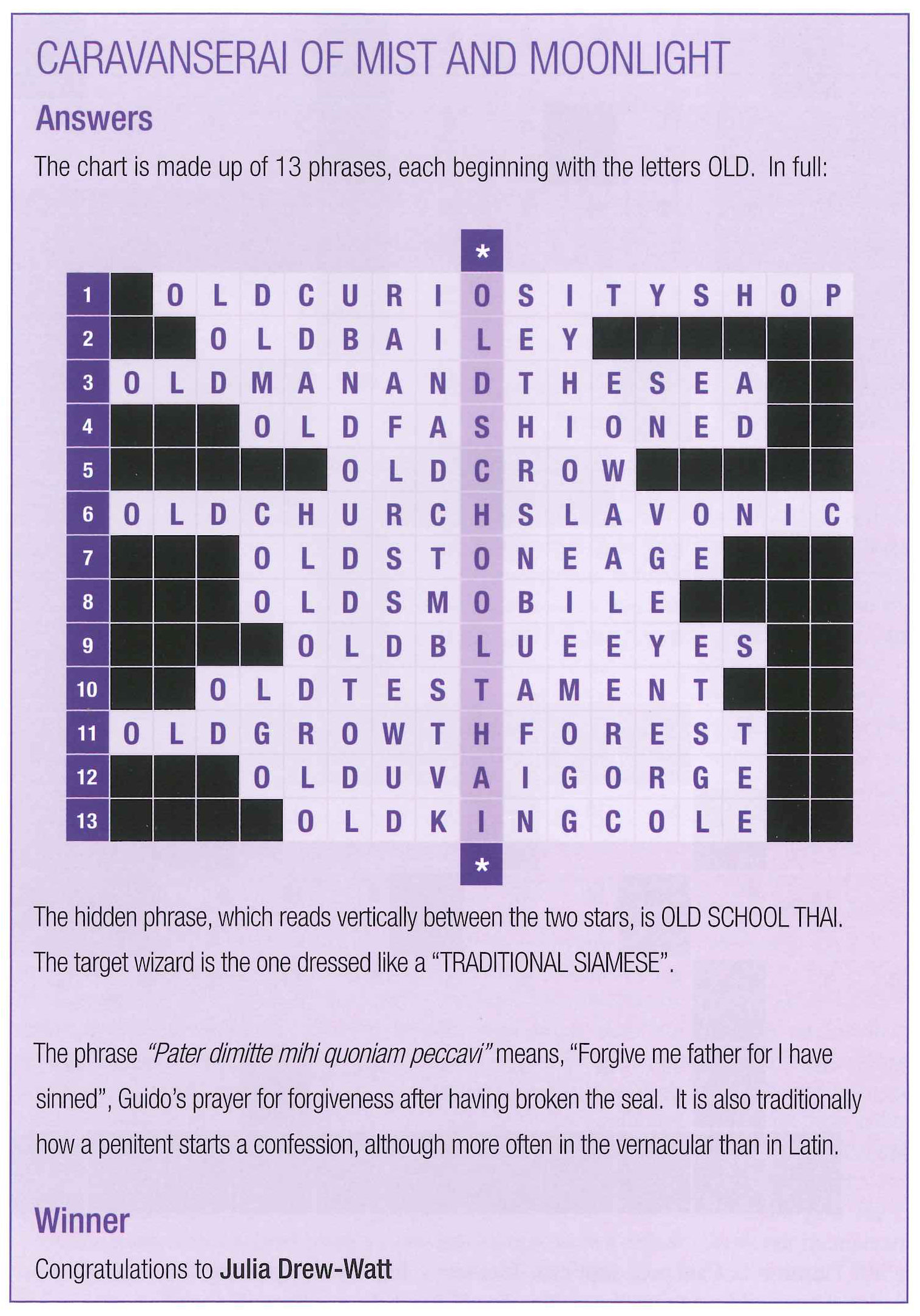
Father Guido puts the pieces of paper together. He stares at them with growing confusion and shrinking confidence. I say, “Maybe I can do something here.” And soon I show him a clue between the stars. We look over the wizards. The one who speaks to us looks like he is from Agatha Christie, a small town lawyer maybe, in a three-piece suit and granny-glasses. There is a thin little Oriental man in traditional Siamese get-up I know from fencing a job at the Costume Museum. The third is dressed like someone from Kiss, which I always blame for my early deafness. The hippo and the salamander I describe already. Guido steps up to one of them and says, “You are the holder.” The wizard says, “Correct. But I do not actually have the key. We gave it to the Bush Bazaar to hide.”
Guido explains for me. “It’s a shop just down the colonnade, seems to be full of treasure. Gold, silver, jewels, art, exotic food and drink, drugs, the works. But it’s really all trash, hidden under a glamour that makes you desperate to possess this stuff you don’t need and can’t afford.” “Oh yeah, like advertising.” “The firm started out as a garden shop with a specialty in barrier bushes but later went into banking and other financial services — it was the original hedge fund.” The wizard we finger earlier leans over the chessboard and lifts a small figure. “This netsuke is a duplicate of one you will find in the Bazaar. Its glamour hides not the usual kitsch but the item you seek. Please give my regards to the djinn.”
The place is as Guido describes, full of amazing stuff, staffed by smiling bozos in silks and turbans and smiling women in not so much. I drag Guido away from the ladies and we toss the joint. Finally, on a shelf in the back, I spot the duplicate netsuke — a little Japanese carpenter with a hammer bending over his work. Guido swaps the two pieces under the beady eye of the merchants. The item he picks up changes into a small plain USB key. The merchants bow.
We go back to the Inn to tell the wizards the exchange is made. As we are shaking hands, claws and hooves, an old man in white walks into the room eating cotton candy. He picks up the key from the table. “So this is what all the fuss was about,” he says. “St. Bevan!” says Father Guido. “I thought you were in Tuscaloosa.” “Well, I was, you know, but I moved on. Thanks for bringing me back the ring. Why does it smell of kumquats? But those fools in Rome are wrong to make such a fuss about it. This Christian did a lot of good for people in need and he set a great example for others. Whether he was a good man or an evil one is for Saint Peter to decide.” And he drops the key into the iron cup of lava in front of the salamander wizard. Guido gulps and says, “The Cardinal is going to be so pissed…”
Can you duplicate Harry’s feat by working out the code phrase and identifying the target wizard? bout de papier will award a book prize signed by A Aalto to the submitter of the first correct answer drawn from a hat on 3 July, 2020. Not necessary for winning, but can you provide a translation for Guido’s Latin phrase near the end of his talk with the Lady in Indigo? Poetic licence here: the Church actually only grants sainthood after death. No wonder Bevan is bewildered.
Answers
Originally published in bout de papier, Vol. 31, No. 1 (2020), pp. 47–51. Read the rest of this issue →


