
bout de papier, Vol. 8, No. 4 (1991) — Fall 1991 // Automne 1991, pp. 50–52
“Know what a tontine is, Liebnitz?” said Detective Superintendent de Toombs. “Mmm yes,” his friend replied. “It’s a lottery where people put money into a pool and the last one left alive collects it all. Why?”
“It figures in a case. And frankly, I need your help on it. Interested? Good. Let me explain. Iwo nights ago, we were called to the residence of one Edward Evans by his butler, Flanders. When we got there, we found Evans shot dead in an inner room. Locked in with him were five other men. We grilled them all, and finally pieced together the story.”
“The six, including Evans, were the last members of the Ascot Tontine, set up in England in 1928 by thirty-one wealthy men. Each put in $100,000. The beneficiary was to be the last survivor among their sons, each born during 1927. The pool was to be handled by a firm of lawyers, who have done a wonderful job — the trust fund is now worth almost fifty million. With that big a payoff, homicide was bound to happen. In fact, that was the reason the six came together. Evans contacted them via the lawyers — I should add that the potential winners are not allowed to know each others’ real names, so they all use aliases. None of them wanted to wait for the money, so they joined in a kind of Russian roulette murder pact.”
“Look at this sketch map of the inner room. In the middle is a large round table with six chairs spaced evenly around it. Inscribed in its surface is a six-pointed star with one point in front of each chair. Attached to a bolt in the centre of the table are six heavy elastic cords, each with an identical single-shot pistol attached to the other end. On a tripod screwed to the table directly above each point is a white-painted globe. These globes all look alike, but each is made of a different substance; they are all tightly fixed in place and can’t move or even rotate.
“After arriving at Evans’ place, the men drew lots to decide seats (A to F). They dressed in identical tuxedos, ski masks and white gloves, so no-one would know which was which. Each had to sit down without speaking and pull a gun from the pile in the centre. Each placed his head directly behind the middle of the globe in front of him (hoping it was made of something very hard) and held his gun right under the globe. Then each one was allowed to fire at one of the others, but not at the man on either side of him, which for some reason was considered “unsporting”. Five guns contained real bullets, but one contained a blank, so each man could pretend he was not really a murderer. Once the shots were fired, the elastic cords pulled all the guns back into the middle, so no-one could tell who had fired which one – and the gloves meant no fingerprints.”
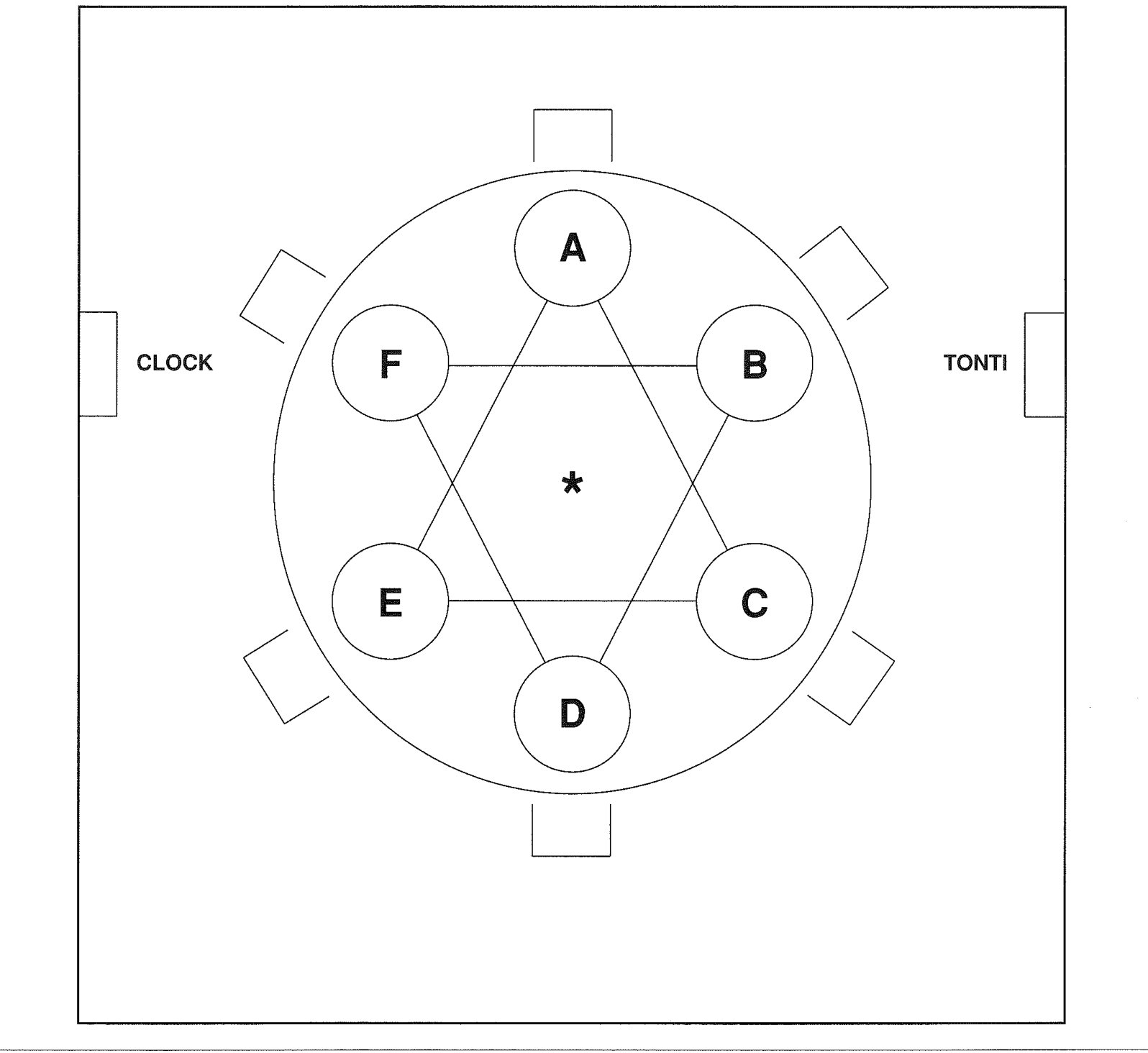
“So no way to tell who nailed Evans,” remarked Liebnitz.
“Right,” sighed de Toombs. “Although the bullet that killed him was so flattened that ballistics really couldn’t have done anything with it. In any event, the survivors were going to leave quietly, while Evans, who was an undertaker, had made arangements to dispose of any bodies. What no-one figured was the actual outcome. Evans was the only one killed, and when Flanders found out, he locked everyone in and called the police.”
“Bizarre,” noted Liebnitz. “But surely they are all guilty of conspiracy, regardless of who actually fired the gun that killed Evans.”
“True enough,” admitted the Superintendent, “but the Prosecutor wants to know all the details, and I made the mistake of giving the investigation to that idiot Clousseau. He put the results on a computer disk, which he tried to amend on a COSICS workstation. Parts of the report wound up all over the world, and the only facts we’re still sure of are the following:
(a) Each man had a different real name, alias
(printed below in CAPITAL LETTERS) and country of current residence. (b) Evans was in chair D, shot right through the centre of the forehead. Wanting to make sure that he at least killed someone, he had palmed the ticket for this chair and then ordered Flanders, before the others arrived, to place the fragile glass globe in front of chair A right opposite. Unfortunately, Flanders asked the footman Swann to do this; Swann, who is nearly deaf, mis-heard the order and put the wrong globe there.
(c) Axel Adams shot at one of the others but missed. His bullet passed between AL-ISLAMABULI and the man immediately counter-clockwise from him, and also between the globes in front of them, hitting nothing on the table. Everyone but Adams was a crack shot and aimed accurately.
(d) Frank Frost shot directly at WHELAN, who sat two chairs to his left.
(e) The globe in front of Barry Barton, a tightly-inflated balloon, exploded, but neither he nor his high-backed chair were hit.
(f) CZOLGOSZ, the man from the USA and Douglas Dunleavy all shot accurately at the centre of the globes right opposite them.
(g) The man from Egypt in Chair C was wounded by a bullet in the arm, but survived. He was the only one hit aside from Evans.
(h) The man from Canada had the marble glove immediately to his right and the steel globe immediately to his left. (i) One bullet hit a clock on the wall and stopped it at midnight. Another smashed into this portrait of Lorenzo Tonti, who invented the tontine. We recovered both bullets from the walls behind.
(j) GODSE from Yugoslavia deliberately fired between Colin Cameron and the man clockwise from him, and between the globes in front of them.
(k) The wooden sphere had a bullet buried in it and the brass sphere had a heavy gouge, both precisely in the middle of the side facing the centre of the table and neither present before the shots were fired. (1) The glass globe in front of MERCADOR was shattered.
(m) PRINCIP, the man from Mexico and the man from India were in three adjacent chairs, not necessarily in that order, but with the Indian higher in alphabetic order than the Mexican.
“Hmm, a pretty puzzle,” said Liebnitz, “but there seems to have been too much damage. Could there have been any other shots fired?
Are you sure one was blank? And how tough were the globes that shattered?”
Replied the Superintendent, “We’re sure about the blank, and while the paper wad from a blank cartridge has occasionally been known to cut someone’s cheek or maybe blind an eye, all of the wounds we got were definitely caused by bullets. No other shots were fired — there were no unaccounted-for bullets at all and no unexplained marks other than those noted on the list. The glass and balloon globes were about as fragile as they could be and still hold the paint – they’d have to be hit to break but they’d be no kind of obstacle for a bullet. Think you can help?”
Twenty minutes later, Ludwig looked up, nodded and murmured “Nice irony.” Can you duplicate his feat by giving for positions A to F the real name, ALIAS and country of each tontine participant plus the nature of the globe in front of him? Can you also give the real names for (1) The man who killed Edward Evans? (2) The man who stopped the clock? (3) The man who wounded the Egyptian? (4) The man who burst the balloon? and (5) The man who shot Lorenzo Tonti? Finally (but not necessary as part of the solution), can you say what specific acts link each of the aliases?
View the original scanned pages →
Originally published in bout de papier, Vol. 8, No. 4 (1991) — Fall 1991 // Automne 1991, pp. 50–52. Read the rest of this issue →



