
bout de papier, Vol. 8, No. 4 (1991) — Fall 1991 // Automne 1991, pp. 39–40
What the Canadian public had long feared finally happened. The Canadian foreign service went on strike, part of the national public service action. As expected, the strike spared no Canadian.
Strike Action
Picket lines quickly formed around selected COSICS machines in the Lester B. Pearson Building. “Our strategy is to stop consultations on Ministerial memos between divisions,” explains James R. Bodwell III, U.N. desk officer on Torture and Children’s Rights and strike coordinator for Tower A. “We believe if officers cannot consult with the requisite number of divisions, the Department will soon grind to a halt.”
“We are not physically preventing those officers who continue to work from doing so, but nothing can prevent the free expression of views. Believe me, there have been frank and far-reaching exchanges of views with those who continue to work and those who are on strike. The two sides have taken note of the differing positions and promised to expand and intensify the dialogue with a view to reaching a solution agreeable to both sides. Yes, I am not kidding — the language has been that rough.”
Although this is his first strike, Bodwell dismisses any suggestion that he is inexperienced. “I am well versed in union strategy from watching Canadian postal strikes on T.V. for the last ten years. As well, on my first posting in Chile in the seventies, my American colleagues and I were best friends with the truck drivers union. Believe me, our strike resolve is strong, even if we have to extend the picketing beyond our coffee breaks.”
Overseas, François Gravel, second secretary in the Canadian Embassy in the Hague, directs the rotating strikes in different European capitals. “We are trying to interrupt the normal conduct of diplomatic relations by selectively picketing hospitality events in Europe — the U.K. Ambassador’s Brunch for MBEs in Copenhagen, the USA reception for Fulbright scholars in Paris, celebrations of Walloon Day at the Belgian consulate in Milan. We do not want any Canadian official to cross our picket lines.”
Gravel adds, “Sure, there have been nasty incidents. We have reports of an officer who had a tray full of prunes and bacon canapés shoved down his trousers at a Danish reception in Rome by a waiter who obviously does not respect picket lines.”
The Strike’s Impact on Canadians
Wilma Carruthers, a hefty middle-aged matron, is sweeping her front porch in Battleford, Saskatchewan. “It is dreadful. FIl always remember it — sort of like how you will always remember where you were when Kennedy was shot, or the first moon landing or when Paul Henderson scored the winning goal against the Russians.”
“When I heard about the public service strike, I immediately thought, “My goodness, what if External goes out”. I mean, I can live with cancelled Air Canada flights, no mail, customs officials on strike, no movement of grain shipments but holy Toledo if External goes, who is there to promote international security and peace through bilateral démarches and representation at multilateral meetings?”
Wilma’s face shows the stress and anxiety common to all Canadians over the last few harrowing days. “Wilbur, that’s my husband, and I did take some precautions. We sent the kids to their aunt’s in South Dakota. Before they left, I explained to them what was happening to our once peaceful lives. With External on strike, I told them to expect little progress on the Conventional
Arms Reductions in Vienna; not to hold
Here
FOR MEMBERS their breath for movement on reform of the Executive Committee of the Office of the U.N. Commissioner on Human Refugees; forget about reforms to Basket Il of the CSCE; and only prayers can help get a Canadian elected to the Technical Committee of the IMO on the Dumping of Toxic Wastes in the Oceans. I didn’t dare mention to the kids what might not happen at the Third Committee of UNGA on women’s issues, drugs and children. I didn’t want to scare them.”
Losing a Sherpa
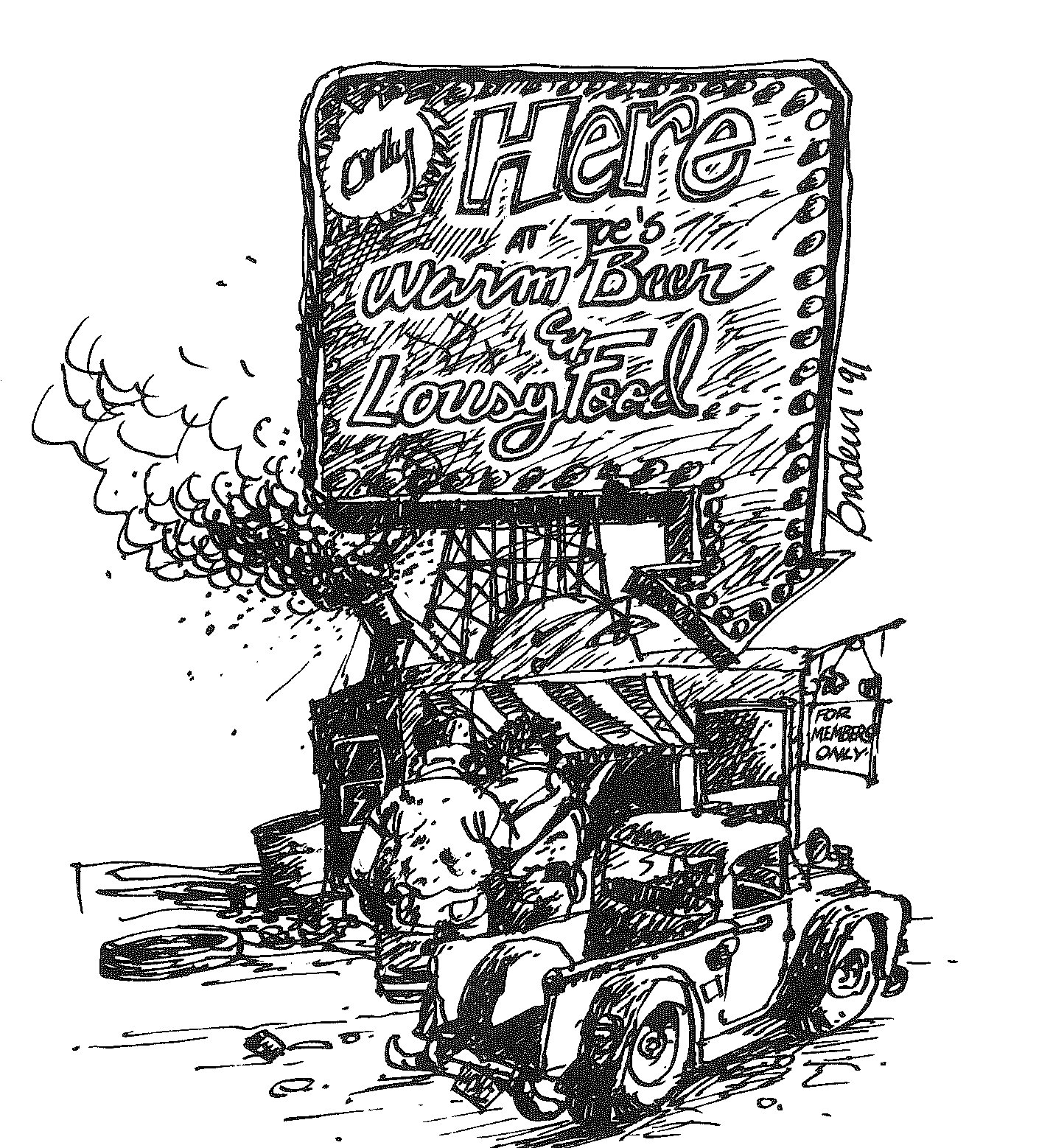
Joe’s Tavern is packed after the second shift from Stelco. Burly men, their faces and T-shirts soaked with sweat, crowd around small tables, downing pints of draft and looking at the colour television on the wall. Talk soon turns to their common interest — G-7 Summits and sherpas.
“Best all-time European sherpa?” Luigi Pesico pauses. “Sure, Tietmeyer may have had a great season in 1985 in Bonn, but if you’re looking for a versatile back to the Prime Minister, one who can scramble at the last moment, you gotta go with Ruggiero. He sherpa-ed those great Italian teams in the eighties.”
Frank Hanrathy guffaws brusquely. “You’re full of it, Luigi. Gimme Attali any day — a gutsy little player with the defensive moves typical of most French players, but with great offensive sense and always a ’Hail Mary’ initiative up his sleeve at the Summit.”
“You guys, always talking about European sherpas.” Bobby Todd shakes his head. “But, look at ours. Sylvia is a Hall of Famer. And the big guy in Washington, now he’s got potential — a real Bronco Nogorskitype sherpa — up the middle, no prisoners, over bodies, straight on.”
Soon the conversation turns somber. Frank looks glumly at the near-empty pitcher. “This strike is really going to screw up the entire season for Canada. Jeez, if External is on strike, who’s gonna think up all those nifty Summit initiatives and redraft and practise them for nine months? At this rate, our sherpa might have nothing to huddle about at the next Summit. He will have to call audibles at the line. Someone says, that luckily he’s good at audibles.
WIN Some; Lose Some
It’s three o’clock in the morning. Jersy Kovak, active member of several Canadian export and small business associations, is feverishly supervising the on loading of an export shipment at the Montreal docks. The shipment is marked for delivery to the Vatican via Libya. Wooden crates, simply marked “Highly Volatile, Do Not Drop” are being whisked onto an unmarked ship.
“Do I miss the import and export services of External Affairs?” Kovaks responds quickly to his own question. “Yeah, Yeah, I miss them like a hole in the head. Ha, Ha. Joke, Joke. Get it? No, really, I do miss them. When you’re a pineapple wholesaler like myself, I depend on the Trade Commissioners to open up markets. Even to the Vatican, like this shipment.”
Suddenly, Kovak’s attention is diverted by the noise of a tumbling crate. “What’s the matter with you guys? You trying to blow us up with those Exoc…” Kovaks looks around quickly, “with those exotic fruits for the Vatican. Ha, Ha, Joke, Joke. Get it?”
The Official Line
A departmental spokesman has a worried look in his eyes. “I really wish I could assure Canadians that the department will soon be back to normal, that we’ll soon be back on the front pages and before parliamentary committees. But we cannot guarantee anything at this stage. A strike means it is not “business as usual.’
He stops for a moment and smiles. Suddenly, he is not so worried.
View the original scanned pages →
Originally published in bout de papier, Vol. 8, No. 4 (1991) — Fall 1991 // Automne 1991, pp. 39–40. Read the rest of this issue →



