
bout de papier, Vol. 8, No. 2 (1991) — Spring 1991 // Printemps 1991, pp. 29–30
Was it Murphy who said that anything that can go wrong will go wrong? If so, when he formulated his law, he must have had in mind what I will call the great “totem pole caper.” We, in the foreign service, are called upon to do many unusual and unexpected things in the course of our careers, and during my 17 years in the Department I thought that I had run across quite a few of the more bizarre. But, as the totem pole episode proved, there is always one more waiting around the corner to test one’s ingenuity and patience.
Why, you may ask, was the Canadian Embassy in Seoul involved with a 40-foot Haida totem pole? I can assure you that it was all in a good cause; namely, the promotion of Canada’s image in Korea, and in particular, the promotion of Canadian high-tech products. In 1988, Olympic year, the Embassy mounted a series of promotional activities which it labelled “Canada Week.” Special funding, the presence of Olympic athletes, and a televised “twinning” between the Seoul and Calgary towers had all made for a very successful event. In 1990 it was decided to mount a second Canada Week, albeit with a much more limited budget, built around a Canadian Products Show that was to be organized by KOTRA (Korean Trade Promotion Corporation) and the Embassy. While the Products Show was a significant event in its own right, it was not the sort of thing that would generate much media attention, particularly since it had already been preceded by much larger U.S. and European Products Shows. What we were looking for was something to distinguish our show from the others, and at the same time, get Canada’s name before a large segment of the Korean public. Thus was born the idea of adding cultural events to the trade show to make a second Canada Week And thus was born the idea of the totem pole. Seoul is rapidly becoming a fairly sophisticated city. The New York Philharmonic now includes it on its Far East circuit, and the Bolshoi has been in town, so any Canadian cultural activity either had to be world calibre or else something really different. A 40-foot Haida pole, accompanied by its native carver, Mr. Jim Hart, was both. Once the idea took root in the mind of an enterprising officer at headquarters, there was no stopping it. While we at the Embassy were asking a number of mundane, but necessary, questions such as how it was to be erected, and what equipment was required, the pole was loaded into a container in Vancouver and was on its way. Knowing that it was coming, regardless, somehow made it easier to deal with problems that subsequently arose. It was going to happen, and it appeared inevitable that somehow all the problems in the end would resolve themselves.
Looking back, it is not surprising about the complications that arose, given the number of players in this little drama. First of all there was KOTRA, co-sponsor of the show. To say that KOTRA was unenthusiastic about the pole would be an understatement. KOTRA clearly regarded the pole as an unnecessary complication in what should have been a routine trade show similar to those already successfully organized for the U.S. and the Europeans. While never overt, KOTRA’S opposition manifested itself in a subtle variety of ways, usually by letting the Embassy unilaterally solve complications with other sections of the Korean bureaucracy. The second major player was KOEX, the government-run exhibition hall. Then there was Korean Express, the local freight forwarders who were to handle the pole and their subcontractors, Pico, who were to install it. And there was the City of Seoul on whose land the pole was ultimately supposed to rest. On the Canadian side, there was Hillman Enterprises of Vancouver who were undertaking the operation, the Vancouver Museum, the Haida, the Embassy and of course headquarters. Add a dose of cultural indifference, mix thoroughly, and you have an idea of the dimensions of the problem.
At first, all seemed to go quite well. We decided that the pole had to be erected in front of the KOEX building where the trade show would take place. We hired a public relations consultant who developed the idea of twinning the Haida pole with similar, but smaller, Korean shamanistic poles called changseng. Both North American totems and Korean changseng appear to have similar functions in native society and may have common historic roots. To celebrate the twinning, we enlisted the services of the Korean Folk Village, an organization which I can best describe as the Upper Canada Village of Korea. They were willing to enact a dedication ceremony, known as “Je”,, and to provide musicians and dancers. The “Je” involves a ritual presentation of a pig’s head, rice and fruit to the poles by village elders clad in traditional Korean costume. The dancers beat drums, gongs and cymbals and, generally, raise a ruckus to befit the spirit of the occasion. So far so good, except that Folk Village wanted to keep the Haida pole in return for its participation.
This was impossible, as we soon found out. The Haida pole, a reproduction of an original found in the village of Yan in the Queen Charlottes, had been exhibited at Yokohama the previous year. Jim Hart, working through Hillman Enterprises and the Vancouver Museum, had carved the pole which, after this exhibition, would be taken to Yan to replace the original which was in bad condition. In return, the Museum was to receive the original pole for its collection. And the reproduction, which had taken several men working under Hart’s guidance three months to carve, was valued at $80,000. After considerable persuasion, Folk Village relented and settled for out-of-pocket expenses in return for the ceremony.
Having secured the cooperation of Folk Village, we were pleased that KOEX identified a site for the erection of the pole on its grounds just outside the main entrance. Most of the courtyard was paved, so it was fortuitous that there was a small parcel of land, ideally situated, where a tree had once stood. We contacted the television networks and the print media and drummed up considerable interest in this original cultural twinning (bilateral ties through shamanism) all in the name of the greater glory of Canada- Korea relations and trade. Then it all started to unravel.
KOEX suddenly decided that the pole site, so admirably suited for a tree, should indeed have a tree. The date for the Products Show was March 27-30, with the pole to be installed on March 26. KOEX’s gardener decreed, however, that the tree had to be planted on March 25. Surely, we argued, the tree could be planted a week later. Why not plant it April 5, Arbour Day, when the President had decreed that all Koreans should plant a tree? Canadians, we pointed out, loved trees. Planting a tree was a laudable act — but couldn’t it wait just one week? We rolled out our big gun, the Ambassador, who made a special call on the President of KOEX to “review arrangements” for the show. He was assured that there would be no problem with the tree. It turned out that this meant the gardeners had won, and that we were to be given another site, which we were assured was “just as good”. During all this imbroglio, KOTRA stood on the side-
30 bout de papier Vol. lines in bemusement. They had not wanted the pole and, in particular, a twinning ceremony on opening day because they feared it would upstage or delay the official ribbon-cutting inside the KOEX building to which a number of Korean VIPs had been invited. Now it looked as if they might get their wish.
We were finally shown the new site. It was a tiny slice of land squeezed between the road and the sidewalk. When I pointed out that we had to excavate a hole 8 feet deep to receive the pole, I was assured that there would be no problem. I pointed out the fire hydrants nearby, the lamp standards which ran from underground wiring, but was again reassured that there would be no problem. In this part of the world, when you are informed that there is no “problem,” it usually means you have a problem — we did
However, before we got to the installation stage, Korea Express came to us with another insoluble “difficulty.” All the show samples were being brought into Korea in bond. The show area itself was designated a bonded area. The pole was entered under the same conditions, yet the site where it was to be erected was outside the bonded area. We would need special permission from Korea Customs to remove the pole from the bonded area (as if a three-ton, 40-foot pole was likely to be illegally entered into the commerce of the country). So I cranked up my best letter-writing technique and explained to the Director-General of Customs how his cooperation was essential if this important bilateral cultural manifestation, upon which the continued goodwill of of our two peoples rested, would take place. We received permission.
At last the pole arrived at installation day-minus-one. At this point, Korea Express decided that the portion of land allocated to us by KOEX actually belonged to the municipality and before digging could start they would need a municipal permit. It was made clear that this was not their problem to solve; as usual, it was the Embassy’s responsibility. Within a couple of hours I was having ginseng tea with a very charming gentleman who was Chief Engineer for the Municipality of Kangnam, where KOEX was located. He would like to help us, he explained, but would have to do an on-site evaluation to determine whether there were traffic or safety hazards. With not much time to lose, we provided all the technical specifications and prayed.
The next day, Saturday, was when work was to begin, I showed up in a heavy drizzle to meet Mike Hillman and two Korean workmen from Pico who were armed with shovels. We looked at the sky and hoped for sunshine at the opening. The workmen broke ground; I went home. The next thing I heard, just after I received a letter from the municipality authorizing us to install the pole on public land, was a call from Mike to tell me that they had struck telephone wires about 2 feet down. It was impossible to put the pole in the ground. Mike seized the initiative and went to Plan B, which was to lay the pole down on an incline on a wooden scaffold. But he had trumped it by getting KOEX to agree that this would be directly in front of the main doors under the entrance canopy. If it rained, we would be protected. Our PR consultant immediately began to dissuade us, saying the media would never come for a prostrate pole, and that she would be a laughingstock. But we had no option.
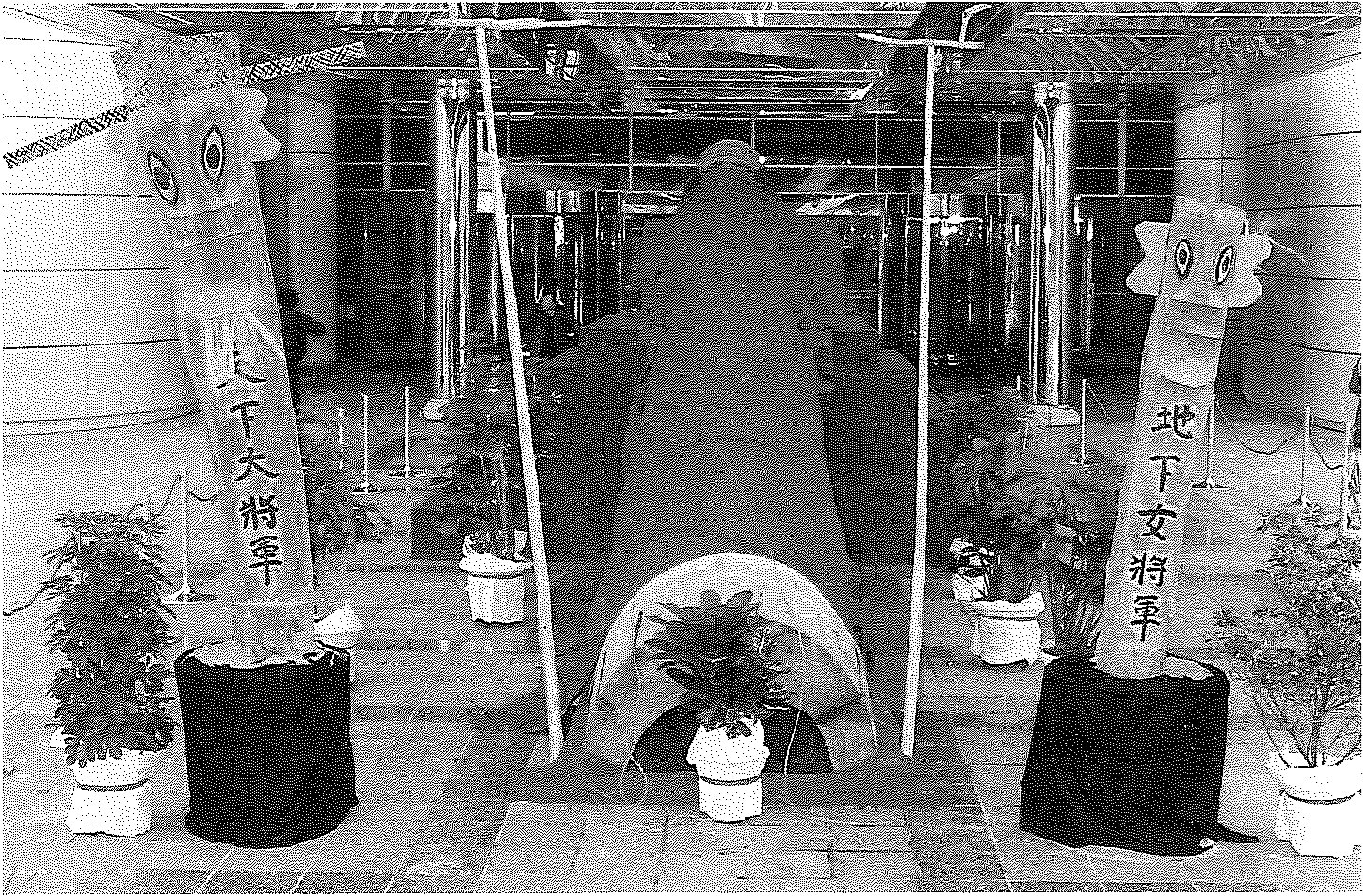
Finally the big day came. The Haida pole lay under its red shroud like some fallen king, with smaller Changseng poles, one male and one female, flanking it. In front was a low table adorned with a pig’s head, wine, fruit, rice, and three old gentlemen in traditional horsehair hats, chanting and burning incense. Off to the side 15 or more dancers and musicians from Folk Village warmed up with considerable gusto. A large crowd gathered. TV cameras were there from both national networks. Female “anchorpersons,” one a former Miss Korea, zeroed in on Jim Hart and the Ambassador for interviews. Jim talked about the pole and Ambassador Schumacher about the show, bilateral trade, Canadian high-tech products — all the things that were on our agenda.
After the unveiling (by Ambassador Schumacher, Mayor Duerr of Calgary, President Lee of KOTRA, and Mr. Maeng of Folk Village), Jim Hart spreadeagled (not chicken-feathered as one uninformed bystander was heard to remark) over the pole and danced to the accompaniment of the Korean music. Cameras rolled; flashes popped. And when the VIPs went inside to open the Canadian Products Show, the cameras and the media went with them and coverage continued of the ribbon-cutting and the VIP tour of the show.
We made the national news that night, and had specials on the morning shows of both networks the following day. Press coverage was substantial. The pole had done its duty. The show attracted over 10,000 visitors, more than both the U.S. and European shows which preceded it. We received enthusiastic plaudits from the Korean media for combining culture with trade and, I like to think that the cultural aspects of Canada Week, especially Jim Hart and his work of art, played a part in that success. The Ambassador was pleased; visiting firemen from Ottawa were pleased; and even KOTRA was pleased. I breathed a sigh of relief; the great totem pole caper was over.
View the original scanned pages →
Originally published in bout de papier, Vol. 8, No. 2 (1991) — Spring 1991 // Printemps 1991, pp. 29–30. Read the rest of this issue →



