
bout de papier, Vol. 8, No. 1 (1990), pp. 14–15
(Editor’s note: Sidney Freifeld’s new book about some of the amusing sidelights of the Department over the years, Undiplomatic Notes: Tales from the Canadian Foreign Service, is being published by Hounslow Press in October.)
In the middle and latter thirties, I worked for the New York Herald Tribune in Europe and the Toronto Star in New York, and I was an early member of the Overseas Press Club, which had been founded in Manhattan. That membership turned out to be the cause of the most agonizing, the most excruciatingly embarrassing, episode I ever suffered in my subsequent External Affairs career. God forbid it should ever happen to any member of PAFSO. Nearly a half century later John Starnes, George Grande and Harry Carter may still remember it. I shall never forget. This is what happened..
In its early years the Overseas Press Club did not possess the fine headquarters building and paid administrative staff that it has today in Manhattan. The Club used to meet weekly or fortnightly for a luncheon, usually with a speaker; for this purpose it would engage a hotel room, floating from hotel to hotel for a room of a size the Club anticipated its next speaker would draw. A Club member’s wife, herself a member of the working press served as the (unpaid) Club secretary, responsible for mailing out notices of where the next luncheon would be held and who the speaker would be.
In the early years after World War II, I was serving at our early Permanent Mission to the United Nations. It was in the winter of 1948-49, if I remember correctly, when Mike Pearson was chairing the UN General Assembly’s First Committee, which dealt with the most important political items on the General Assembly’s agenda.
By then, Mr. Pearson was reaching the height of his international fame, and his performance at the UN was attracting world attention. I was in charge of press and public affairs at the Permanent Mission at the time, and the Overseas Press Club prevailed on me to produce him as speaker for a forthcoming Club luncheon. He agreed.
Mike was especially popular among the international, as well as the Canadian, press corps covering the United Nations, and a record turnout for the luncheon was expected. In fact, newly independent India’s first Prime Minister, Pandit Nehru, had come to New York and the United Nations at that time, and had been the Club’s guest speaker the previous month before a record turnout. As some Club members and their guests could not gain entrance to the crowded luncheon with Mr. Nehru, the Club engaged the largest banquet room they could find for the luncheon with Mr. Pearson. I think it was at the Pierre or the Sherry Netherlands, certainly one of New York’s finest.
In pleasurable anticipation of this public relations coup for Canada, I decided to reserve a table at my own expense and invite as my guests my working colleagues from the Permanent Mission — including George Ignatieff, John Starnes, George Grande and Harry Carter.
In those early days, the United Nations was headquartered in the former Sperry Gyroscope Building at Lake Success, a town out on Long Island about an hour’s drive from Manhattan. UN committee meetings were held at Lake Success and plenary sessions in a converted skating rink auditorium in Flushing, also on Long Island but closer to Manhattan.
Mr. Pearson agreed that I pick him up at 11:30 a.m. at Lake Success with a PERMIS car and driver, so that we could make the hour’s drive to Manhattan for the Club’s luncheon, which was called for 12:30. He had arranged to turn over the First Committee’s meeting to a vice-chairman, so that its contentious proceedings would not be interrupted because of his invitation from the Overseas Press Club.
The Club had told me that they were prepared for an attendance of around five hundred. During the drive in to Manhattan from Lake Success, I filled in Mr. Pearson about the persons he could expect to be flanking him at the head table. And I sought to anticipate for him questions he would likely be asked from the floor and by the working press covering the event, and who might be expected.
The drive in to Manhattan on the crowded Long Island highways, in mid-winter conditions, went smoothly enough and we reached the hotel, on Fifth Avenue, promptly at 12:30. A prominent notice in the main lobby directed us to our locale.
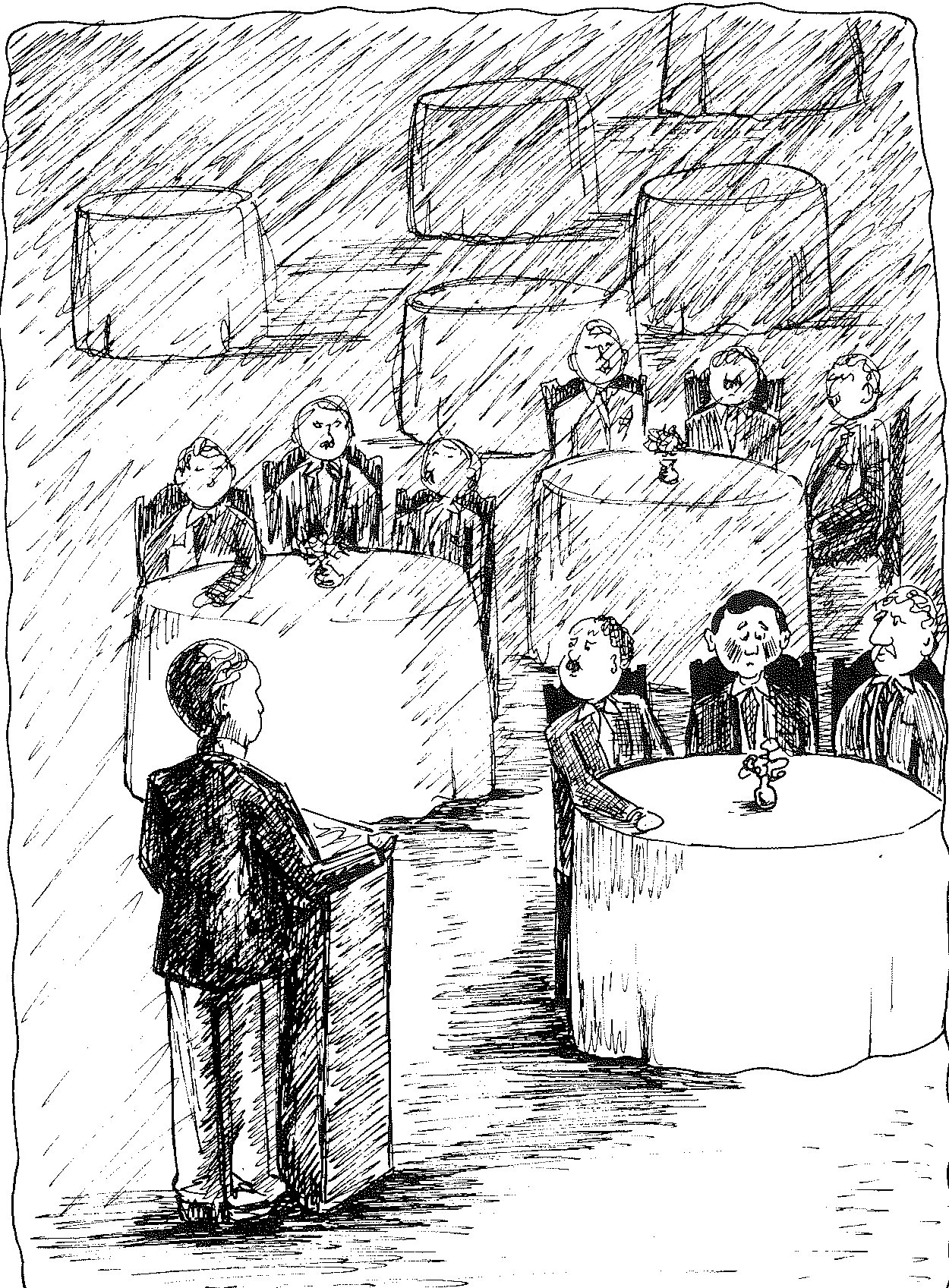
When I entered it with Mr. Pearson my heart stood still. Instead of a noisy audience of four or five hundred filling the main ballroom, there were four tables under lights in the centre of the room and the rest was in near darkness.
At one table were Overseas Press club officers, with a chair for Mr. Pearson. At a second table, on the edge of the cavernous darkness, sat members of the working press assigned to cover Mike’s speech. At the third table sat my grim-faced guests from the Permanent Mission, with whom I unhappily seated myself in a virtual trance, wishing I could disappear into the darkness beyond. In the near darkness I could barely make out the fourth table, at which were seated some OPC members with their guests.
As we ate our lunch, which I could hardly touch and which seemed to go interminably, I tried to think of some way of breaking out of the disastrous morass. Should I slip over to the chairman and suggest that Mike not be asked to speak in the circumstances? Had the people at the head table explained to Mike — if in fact there was some explanation — how this debacle had come about? I sat immobilized, uncertain what to do. Coffee was served, lunch was finished and Larry Blockman, the club chairman, rose to his feet and introduced the speaker of the day.
Then Mike rose, pushed aside the microphone as there was no need for amplification for the minuscule audience, and began to speak.
He spoke as though the ballroom was full, not empty. He spoke as though he was up at the rostrum of a packed plenary session of the United Nations General Assembly. He gave a superb run down of the contentious items with which he was dealing as chairman of the First Committee: The Netherlands-Indonesia dispute, the conflict between the Arab states and Israel, the threatening warfare between India and Pakistan. His impromptu, spontaneous, off-the-cuff wit was scintillating. I have heard Mike Pearson speak on many occasions, in all kinds of circumstances but never anything like this. He was magnificent.
After questions from the “floor” and from the working press, I escorted him silently out of the hotel into the PERMIS Cadillac. We headed over the Triborough Bridge, out Grand Central Parkway and onto Long Island, towards Lake Success.
After a few minutes of unbearable silence in the car, I muttered something about the unpredictable work stoppage called by the Newspaper Guild (wondering whether indeed that was a plausible explanation or just the reverse — would striking members not have had more freedom to attend a long luncheon in the middle of the day?).
Mike replied briefly and if he was annoyed or angered, he suppressed it remarkably: “Well, the Club president might have phoned out to Lake Success to suggest we not come in, under the circumstances.”
Nearly a half century later, as I write these lines, I still wonder what I could or should have done to avert disaster on that cold winter day in Manhattan. Any suggestions?
View the original scanned pages →
Originally published in bout de papier, Vol. 8, No. 1 (1990), pp. 14–15. Read the rest of this issue →



