
bout de papier, Vol. 8, No. 1 (1990), p. 13
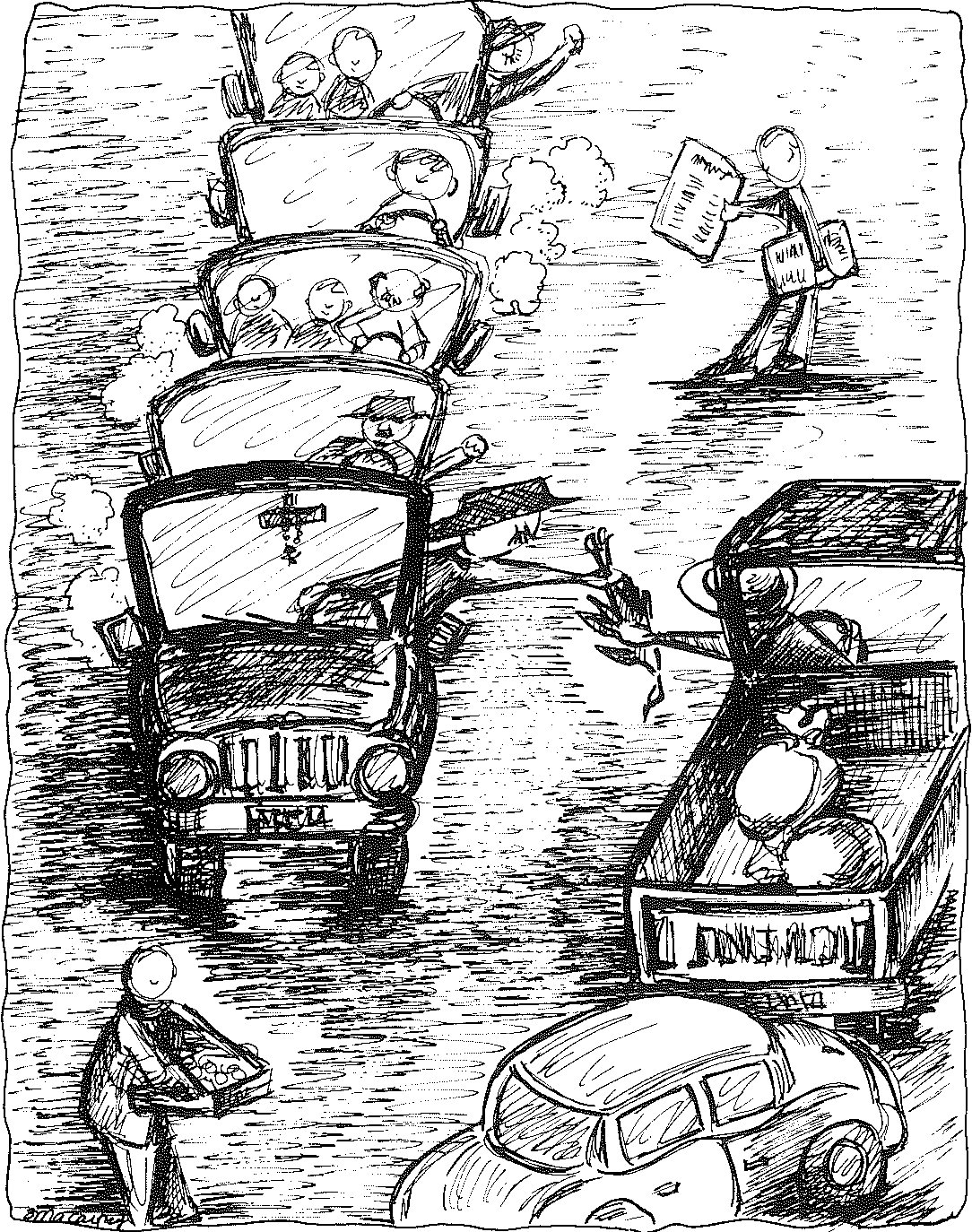
Dining-out across cultures, working across cultures, dating across cultures. Among all the platitudes earnestly delivered over the years to prepare people for the shock of discovering that there is more than one effective way to do things, such as cook rice or raise children, or make a pass or confront the boss, no one honed in on the obvious, driving across cultures. The fastest short course on the cultural differences between Canada and one’s new country is a drive across town at rush hour, preferably on a rainy day with a national bike race about to begin.
The Canadian Embassy in peaceful Costa Rica is near as nought at ground zero San José, a place so relaxed that offices and businesses close for a two-hour lunch break. However, safely navigating the three kilometre drive from Paseo Colon to Calle 3 is a sweat-rousing hybrid between a Calgary chuckwagon race and a charge of Roman chariots. In the land of mañana, they drive like there is no tomorrow.
This is not a form of aggression but an expression of the joy of life and a reaffirmation of its inconsistencies and surprises. Thus, when a two-way main street becomes one way, there is no indication of the change except the on-coming traffic. This also explains the lack of street addresses, road signs and lane markings; after all, the route markings along life’s path are often obscure and ambiguous.
Besides, too many rules and regulations would make it difficult to see and wave at friends and relations along the roadside. One’s fervent hope when driving along a narrow lane is that the driver of the ice cream truck ahead of you is not a cousin of the driver of the approaching furniture van or you will be stuck for twenty minutes while they exchange family news.
Unannounced closings of major arteries do not indicate lack of planning, rather they express national pride and allow citizens to cheer runners or bicyclists or celebrate special days with street parades and fiestas. Also, the resultant congestion on the narrow seething side streets allows an unexpected pleasant opportunity to fulfil a driver’s main obligation, blowing the horn.
At an intersection with a red light, for example, when the first driver in line toots his horn it may be to call the lottery ticket seller, emphasize a point to a fellow passenger or attract the attention of a pretty girl. The second and third drivers honk to let the first driver know that they are behind him and he had better look sharp when the light turns green. The last driver repeatedly honks to ensure that the light stays green until he clears the intersection. The car horn is merely an extension of the Tico (Costarican) love of social interplay and general gusto por la vida.
During the election campaign, horn-honking took on another responsibility. Partisans flew their party colours on long poles tied to the door’s handle inside so the flag could stick up much like a bicycle safety flag outside. When cars with the same flag passed each other, they honked in encouragement; when opposition cars passed, they honked in derision; when unmarked cars passed, they honked to spread the word. This made for an endless dialogue of significant tooting which terminated in twenty-four hours of celebratory/compensatory honking and tooting on the day of the election.
In most matters the Ticos are conservative and tradition-bound. For example, their favourite dish is rice and black beans. Now I love rice and beans, however, I also love variety. As an exercise in compromise and togetherness I planned several menus for the household around an assortment of rice and bean dishes. After a week the cook sadly informed me that all the books and recipes were in error about the preparation of rice and beans. In any case, there was only one way to make rice and beans so no other recipe was really necessary, thank you very much but here were my recipes back.
Costaricans are proud of their peaceful traditions and go to great pains to avoid confrontation, nationally and personally. Conflict is resolved by long, albeit sometimes loud, discussion. Hence, there is no army and no armed police force. A contractor will agree to every suggestion. A salesman will write up an order for a hundred square metres of blue tiles rather than upset you by telling you that there are none in stock. A colleague will accept an invitation even if she knows she will be in Miami that day. A repairman will agree to come on Thursday even when he means Monday — by Friday it will be too late for you to call another repairman, and by Monday you will have cooled off and be grateful to see him.
Therefore, among a charming peace-loving people, apprehensive of change and adverse to confrontation, it is revealing that behind the wheel (of anything) they become risk-taking range-riding vagueros. Seatbelts and sobriety are an affront to self-esteem, signaling lane changes hinders self-expression and pedestrians and potholes defy the adage, close only counts in horseshoes.
Tico driving should not be viewed as reckless or irresponsible, rather as a joyful expression of faith in God, immortality and a continuous supply of rice and black beans. The motivating question is not, “Will I like it when I get there?”, rather, “Will I enjoy getting there?”
View the original scanned pages →
Originally published in bout de papier, Vol. 8, No. 1 (1990), p. 13. Read the rest of this issue →



