
bout de papier, Vol. 7, No. 3 (1990), p. 23
Brasilia
Sunday, July 11th 1989
Yesterday, I dropped by Brasilia’s airport on an errand and on the way out I stopped for a chocolate milkshake at the cafeteria. The last time I was at the airport, two weeks ago, I did the same thing. The only difference was that yesterday my milk-shake cost 3.65 new cruzados (NCZ), whereas two weeks ago, it only cost NCZ 1.15. I stared at the billboard, which registered similar price increases for all of their offerings. Had inflation been that high over just the last two weeks? Well, in fact the price of a milkshake had remained pretty constant for the last few months around NCZ 1.15. Clearly, this government-run cafeteria has only recently received permission to raise its prices to recoup past inflationary losses. That last milk-shake had been a bargain. I drank up quickly, before the prices changed again.
At I went to pay on the way out, the cashier gave me four new little aluminum disks in change. What were these? Coins? I paused to think of the last time that I had seen a Brazilian coin in circulation. It must have been before Christmas. Peering closely at the aluminum disks in my hand, I realized that these were the first batch of new centavo coins just launched into circulation. It was a touching discovery. When the new cruzado was launched on January 15th, this year, this 10 centavo piece would have been worth 10 American cents. Today, it is worth about 3 cents. At Brazils’s current rate of inflation — estimated last week at 25 percent for this month – these coins will drop below I cent in value by Christmas time, and shortly after will no doubt disappear from circulation. In less than three years in Brazil, I have seen this coin’s predecessors (the 100 cruzeiro coin and the 10 cruzado coin) follow the same trajectory into inflationary oblivion. But it seemed particularly sad at our first encounter to be able to predict this coin’s lifespan with such mathematical precision.
The higher denomination bank-notes of course stick around longer. In fact, I walk around with no less than three Brazilian currencies in my wallet, all of which are still legal tender. The first are cruzeiros (actually 1402 021 new cruzeiros, because they replaced the old cruzeiros somewhere back of the mists of time in the mid-60s). Cruzeiros were abolished on February 28th 1986, when the government decided to knock three zeros off all prices by launching a new currency, the cruzado. Cruzeiro bank-notes remained legal tender however, because it took a while to print up cruzado bank-notes with the same plates, but with three zeroes fewer. Cruzeiros are getting pretty scarce by now, but the old 100,000 cruzeiro note with the proud figure of President Kubitschek (the builder of Brasilia) still serves for paying little boys to watch your car in the parking lot. When I arrived here in September 1986, it was the largest bill in circulation.
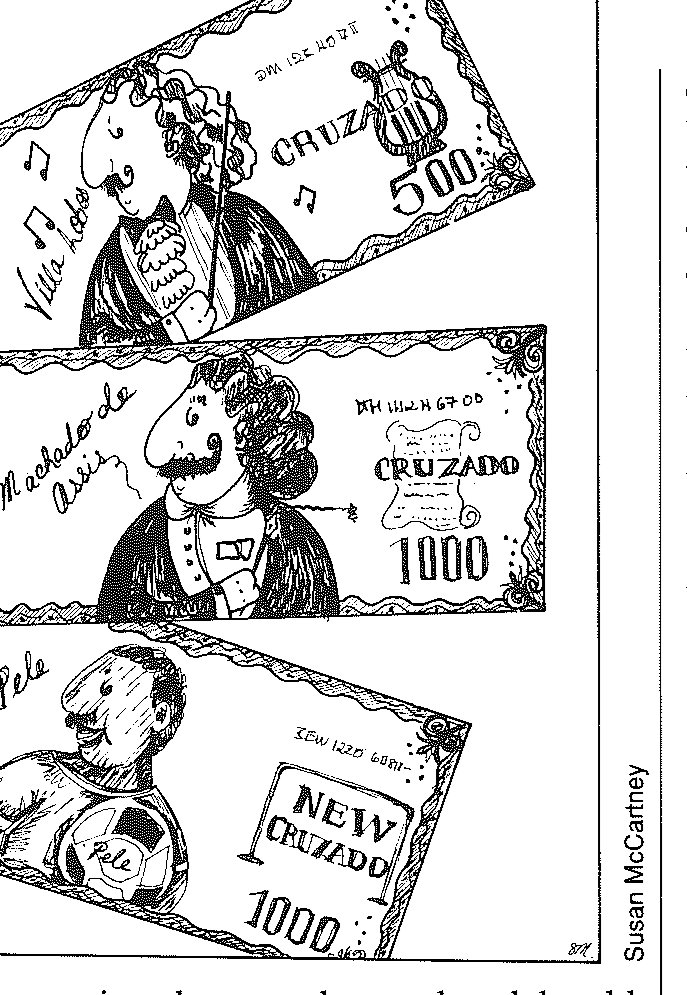
Next came cruzados (a word which in Portuguese has deliberate overtones of the word for “crusade” — in this case, the crusade against inflation). Cruzados toughed it out for just under three years. At first, it seemed confusing to have both cruzados and cruzeiros in circulation: President Kubitschek’s face appeared on two bank-notes — the 100,000 cruzeiro and the 100 cruzado — which had exactly the same value. However, pretty soon you learned to remember the pictures and forget the numbers — which after all is what 30 million illiterate Brazilians have been doing for years. Over time a whole series of cruzado bank-notes were launched that had no cruzeiro equivalents: the 500, 1000, 5000, and 10000. Sensibly, the Government decided to stop commemorating really important people like Presidents on the rapidly devaluing bank-notes and switched to more ephemeral cultural figures instead. In fact, the acceleration of new bank-notes helped contain social protest. When the Brazilian Writers Union protested that the musicians had beaten them to the punch, by having the great Brazilian composer Villa Lobos on the 500 cruzado bank-note, the Government issued the 1000 cruzado bank-note shortly thereafter, adorned with the face of the equally great Brazilian writer, Machado de Assis.
Of course, now both Villa Lobos and Machado de Assis seem doomed to go the way of the dinosaur — or at least President Kubitschek. On January 15th 1989, the Government trashed the cruzado, by knocking three zeros off it, and introduced the new cruzado. This time, the Government wised up and decided only to issue new cruzado bank-notes in new denominations: thus we now have the great Brazilian male poet Carlos Drummond Andrade on the 50 new cruzado note and the equally great (but more obscure) female poet, Cecilia Meirelles on the 100 new cruzado note. Unfortunately, this policy has led to a new phenomenon of “face inflation”, as the Central Bank has had to resort to increasingly less well known 20th century figures to put on the new banknotes. Old-timers confidently predict that the Government will shortly have to draw the line —perhaps when they have to obtain Pele’s endorsement to put his face on the new 1000 cruzado note – and they will need to revert to the classical figures of 19th century Brazilian history who last were seen in circulation on old cruzeiro banknotes around 1984.
Of course if they do that, they might as well just trash the new cruzado and rerelease all the old cruzeiro bank-notes as legal tender. Indeed, this might be the perfect technical solution to inflation that Brazilians have been seeking for years. Old currency never dies — it just goes into hibernation. The cruzeiro is dead — long live the cruzeiro! It would certainly make life simpler the next time I go to buy a milk-shake.
Editor’s Note: In fact, on March 16, 1990 Brazil reintroduced the cruzeiro.
View the original scanned pages →
Originally published in bout de papier, Vol. 7, No. 3 (1990), p. 23. Read the rest of this issue →



