
bout de papier, Vol. 7, No. 2 (1989), pp. 20–22
by Benjamin Rogers
Fifty years ago, at the time of the outbreak of the Second World War, the Department of External Affairs was a very small organization, sharing the East Block of the Parliament Buildings with the Prime Minister’s Office, the Privy Council Office, the Department of Finance, and a couple of members of the Governor General’s staff. When I entered as a Third Secretary (Temporary) (Probationary) in the summer of 1938, we were fifteen officers, including the Under-Secretary, and about forty-five support staff. Two of the fifteen officers were assigned to the office of the Prime Minister, who held the portfolio of Secretary of State for External Affairs.
The Under-Secretary, Dr. O.D. Skelton, we regarded with awe, respecting him for his great intellect, appreciating his gentle manner, and recognizing the heavy burden that he bore manfully in spite of indifferent health. He had great qualities, but a gift for organization was not one of them. An effort had been made in 1937 to spell out areas of responsibility in an organization chart, but it was not revised to take account of the arrival of new officers or the posting of others. In any case, the Under-Secretary paid little attention to it.
Though the assignment of tasks appeared to be somewhat haphazard, there was in fact some specialization, some recognition of individual officers’ aptitudes and experience. The Assistant Under-Secretary, Laurent Beaudry, dealt mainly with consular, passport and protocol questions and matters relating to Western Europe. John Read was Legal Adviser. Loring Christie, Counsellor, represented the Department on the main defence policy committee, wrote memoranda on high policy, and helped write speeches for the Prime Minister. Hugh Keenleyside, First Secretary, normally spent most of his time on non-commercial relations with the United States, and matters relating to the Far East and Latin America; but in the early months of 1939 he was heavily engaged as secretary of an interdepartmental committee making arrangements for the visit in early summer of the King and Queen. Norman Robertson, First Secretary, was a one-man economic division: he was a key member of the team that negotiated the trade agreements of 1936 and 1939 with the United States. Howard Measures, classified as an Assistant Private Secretary to the Secretary of State for External Affairs, did most of the protocol work and looked after press clippings. Administration was ruled with an iron hand by a Chief Clerk, Agnes McCloskey, who had joined the department in its infancy before World War I, and had won for herself a position of very considerable authority. We junior Third Secretaries – Max Wershof, Jean Chapdelaine, Fred Fraser (who spent only a short time in the Department before leaving to become editor of the Halifax Chronicle) and I – performed varied tasks.
By the summer of 1939, Loring Christie had been appointed Minister to the United States; and Scott Macdonald, First Secretary, and the two senior Third Secretaries — Temp Feaver and Léon Mayrand — had been posted. Herbert Norman had come in as a Japanese Language Officer, and after some months had taken a leave of absence to complete his doctorate at Harvard.
All work was assigned by the Under- Secretary, and all outgoing communications
– letters, telegrams, memoranda — were signed or approved by him. He normally assigned work by sending an incoming paper, attached to the appropriate file, with a slip addressed to Mr. So-and-so — there were no female officers — “for disposition” or “for preparation of reply”. “Disposition” might involve merely marking for file, or referring copies to other departments, or whatever else the officer concerned might consider appropriate. Letters and other papers went up to the Under-Secretary for signature — and sometimes were returned for revision. On one occasion, after consulting the file, I prepared a letter to a woman who had a problem relating to some property in Romania, saying that there was nothing the Department could do to help her. It came back from Dr. Skelton, who had a phenomenal memory, with a note saying, “Didn’t we have some correspondence with this lady about three years ago?” Indeed, we had The variety of work assigned to a junior officer was considerable. To cite a few examples: I drafted a dry-as-dust annual report of the Department, based largely on reports from our posts in London, Washington, Paris, Tokyo and Geneva; worked on a request from a religious order for help in getting some money out of Germany; handled an offer from Lord Beaverbrook to give iron lungs to Canadian hospitals; and did some work on a proposal to ask the United States to establish a free port at Skagway. I referred League of Nations documents, mostly relating to the trade in narcotics, to other departments. I prepared a commentary on the agenda for the League of Nations Assembly, simply by making very slight editorial changes in excellent despatches on agenda items from Hume Wrong, our Permanent Delegate to the League of Nations.
The fact that the Prime Minister was also Secretary of State for External Affairs not only explained the assignment of Jack Pickersgill and James Gibson to the Prime Minister’s Office (PMO) and a long-standing arrangement whereby External Affairs looked after such administrative matters as travel, pay and purchasing for the PMO. It also resulted in the Department’s being asked to do odd jobs that had nothing whatever to do with external relations. Prior to the royal visit of 1939, [ handled correspondence with a woman in Nova Scotia who claimed descent from an illegitimate child of the Duke of Kent, Queen Victoria’s father: she thought it would be nice if the Government would give her money for clothes and pay her way to Ottawa to meet her cousin, the King.
Whenever the two clerks in the code room were unable to cope with the traffic, we juniors were called on to help. The British Government Code of 5-letter groups was used for unclassified messages, simply because code telegrams were transmitted at cheaper rates than en clair messages. Classified messages came from the commercial telegraph offices in 5-digit groups. Subtraction of four digits from the corresponding digits in a “one-time pad” of numbers used by both sender and receiver would yield a 4-digit number that would represent a word or phrase in the cypher book. Frequently corrupt groups would yield something nonsensical like “Bulgarian Minister to Newfoundland”. In such a case one would try to solve the puzzle by experimenting with different combinations of numbers until one found something that made sense. A somewhat similar procedure was followed for encyphering outgoing messages.
The cypher work was tedious and eye-straining: I changed my glasses after the Czechoslavak crisis of September 1938. But it had one positive by-product: it encouraged writing in a succinct style. Knowing what was involved in cyphering and decyphering telegrams, one didn’t waste words in composing them.
Before World War II, the Canadian Government’s main sources of information on important international affairs were circular telegrams from the Dominions Office in London to the governments of the self-governing members of the Commonwealth; Foreign Office “prints” of despatches from British diplomatic missions; and reports from our own missions in London and Washington. Practically nothing of value came from the other missions – Paris, Tokyo and the recently established legations in Brussels and The Hague. All of the posts had inadequate staffs, and received precious little information or guidance from Ottawa.
By the summer of 1939, Hitler had already seized Austria and Czechoslovakia, and seemed bent on further conquests. On the last Monday in August, Dr. Skelton told me that, if it should be decided within the next few days to send a delegation to the League of Nations Assembly, I would be attached to it, and we would sail from New York on the following Saturday, September 2. Incoming telegrams soon indicated that the British Government was seriously contemplating declaring war on Germany in the event of a German attack on Poland. I heard nothing more of the proposed delegation to the League Assembly.
Germany invaded Poland on September 1. On turning on my radio on Sunday morning, September 3, I heard the British Prime Minister announcing that Britain was at war with Germany. When I went to the East Block, the first person I encountered was John Read, the Legal Adviser, I asked him if Canada was at war. He said that members of the Cabinet were meeting at the other end of the corridor, trying to screw up their courage to take the right decision.
The question whether Canada could legally be neutral while Britain was at war had been widely discussed in the press, in the Canadian Institute of International Affairs, in academic circles, and even in Parliament where the Prime Minister had done his best to stifle discussion of the possibility that Canada might be involved in another war. The late Dr. R.A. MacKay and I had devoted a chapter to the subject in our book, Canada Looks Abroad, which had been published in the spring of 1938. We concluded that the principle of the unity of the Crown had not been affected by constitutional developments since World War I, and hence that Canada under the existing legal situation could not be neutral while Britain was at war. The Prime Minister, Mr. Mackenzie King — and, indeed, the leaders of the other political parties — had dodged the question, declaring only that, except in the event of invasion of Canadian territory, it would be for Parliament to decide whether and to what extent, if at all, Canada should participate actively in any war.
In the event, the legal niceties were brushed aside. Parliament met a few days after the outbreak of war and approved the Government’s policy of declaring war on Germany; and on September 10 the King, on the advice of his Canadian ministers, approved a proclamation declaring war on Germany. Meanwhile, for a week, Canada’s neutrality was recognized by Germany and, more importantly, by the United States. President Roosevelt overruled his advisers who considered that Canada could not be neutral when Britain was at war. (Bert MacKay and I wondered if they had read Canada Looks Abroad.) The practical effect was that the U.S. Neutrality Act was not immediately applied against Canada, which was able to import considerable quantities of military hardware from the United States between September 3 and September 10. As for the Germans, one day I saw my friend Schaffhausen of the German Consulate General sitting at a table in the cafeteria of the Chateau Laurier, and did not hesitate to sit down with him.
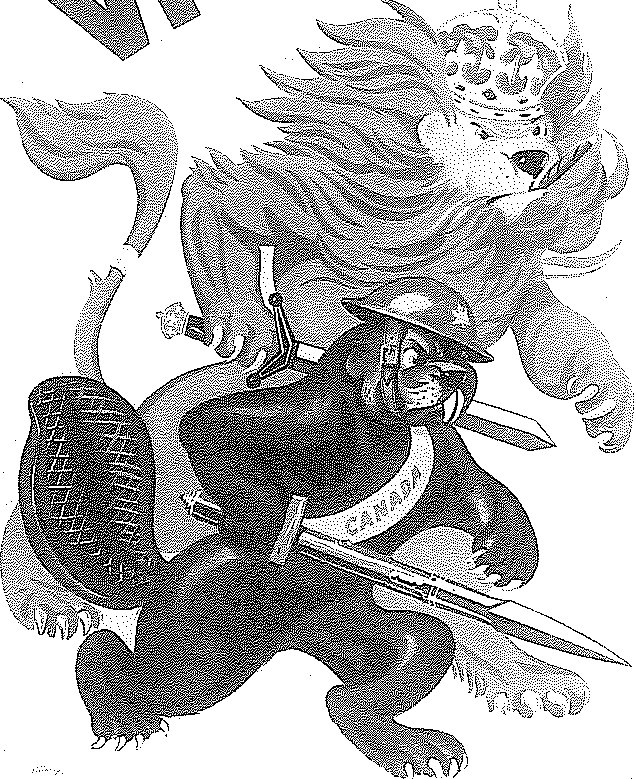
In 1938 and early 1939, there was a general recognition in External Affairs that Canada probably could not escape involvement if war came. It was known that Dr. Skelton himself resented the British connection, which in his view would almost inevitably have the effect of dragging Canada into Britain’s wars: he would like Canada to remain neutral, but if that were not possible then active participation should be limited Loring Christie would like to have severed the British connection completely, and wished Canada to remain neutral in the event of war. Some officers shared Dr. Skelton’s views. Others felt more or less strongly that Canada could demonstrate her independence in making her own decision, and that the decision should be to participate actively in a war to resist Nazi aggression. In the end, our country’s decision to participate to the full was accepted loyally, and it soon became evident to all that a world in which the Nazis controlled all of Europe would not be safe for the rest of us.
The historians tell us that things were being done in External Affairs in 1938 and 1939, of which junior officers were at the time completely unaware. We knew nothing of the memoranda on high policy being written by Dr. Skelton and Loring Christie. We did not know that John Read was drafting the Defence of Canada Regulations, or that Hugh Keenleyside was writing the terms of reference for Cabinet sub-committees to be set up immediately on the outbreak of war. Our limited knowledge of important developments was gleaned from the telegrams that we helped to encypher or decypher.
In the weeks preceding and immediately following the outbreak of war, we juniors spent many hours working on telegrams, were frequently called in at nights and during weekends, and were “on call” even if we were not summoned. Arrangements that were acceptable in an emergency soon became intolerable. It was clear to us that the war was going to continue, that the already heavy cypher traffic was bound to increase, and that a larger cypher staff working shifts was required. Max Wershof took our complaint to the Under Secretary, and some additional staff was soon found.
Immediately on the outbreak of war Tommy Stone appeared on the scene. He had been a member of the service for some years, and as a Third Secretary in Paris with a rich American wife had entertained more lavishly than his chief, the Minister. He had resigned from the service to take up the life of a country gentleman in South Carolina. Dr. Skelton thought of him as a playboy, and rebuffed his subsequent efforts to return to the Department. When his country found itself at war, he simply appeared, saying that he would do anything he was asked to do, with or without pay. Dr. Skelton promptly put him to work in the code room, possibly to test him, and probably also because that was the area of the Department’s activities where help was most urgently required. Tommy remained in the code room for several months, and was largely responsible for bringing order out of chaos. He was subsequently assigned to more substantive work, and went on to have a distinguished career.
Soon after the outbreak of war it was decided to establish direct links with the other self-governing members of the Commonwealth. Mr. Charles J. Burchell, a distinguished Halifax lawyer, was appointed High Commissioner to Australia, and I was chosen to accompany him. By early December, we were on our way. The opening of the mission in Canberra was the first step in the wartime expansion of the Foreign Service.
View the original scanned pages →
Originally published in bout de papier, Vol. 7, No. 2 (1989), pp. 20–22. Read the rest of this issue →



