
bout de papier, Vol. 6, No. 2 (1988) — Summer 1988 // Été 1988, pp. 22–24
In June, 1947, Canada opened its first mission in India. On Dominion Day, the High Commissioner, John D. Kearney, with his Counsellor, Morley Scott, called upon Mahatma Gandhi. From Scott’s private papers, in the Archives of the University of British Columbia, comes the following account, as reported by Morley Scott, of the first meeting between Canadian representatives and the great man of India.
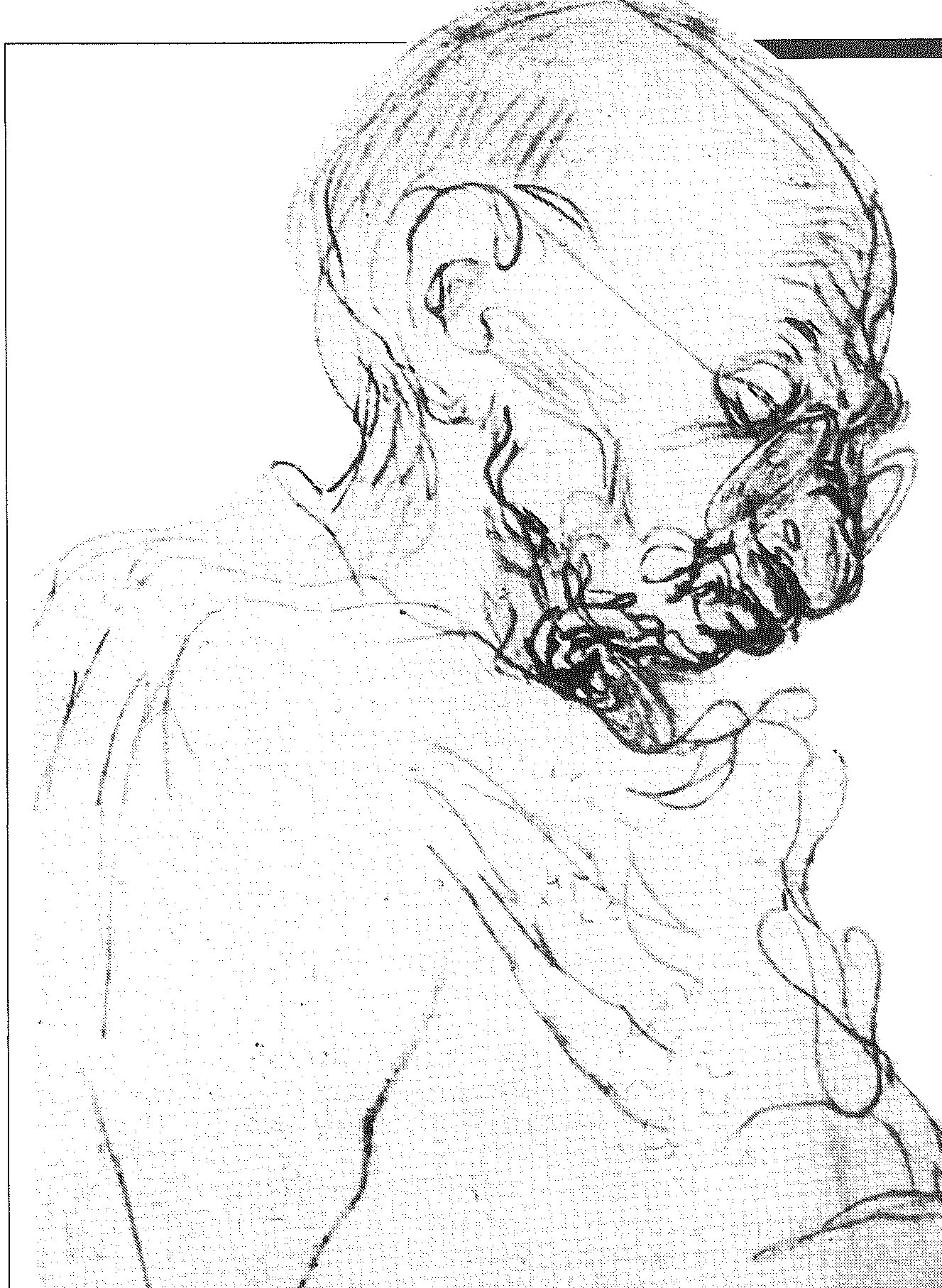
The High Commissioner and I today called on Mahatma Gandhi. On the High Commissioner’s part it was a courtesy call, following his official visit to Nehru and in the midst of his ceremonial visits to Heads of other Missions. On my part it was accidental. Mr. Kearney had invited me to go along (as I had on his visit to Nehru) to wait outside during the interview and then to go in to be presented. In this instance, there was no outside in which to wait, so I went along in… Our departure from the Hotel was simultaneous with the first and long-awaited rain storm of the monsoon; we ran at full speed from the car to the cottage which housed Gandhi.
Mathai, without ceremony, raised the cus-cus covering the door, and bade us enter. This we did, picking our way through an assembly of slippers and sandals in the entry. We found ourselves in a small, whitewashed, cell-like room, but rather a monastic than a prison cell. Two armchairs had been placed for European guests, but from my point of view it would have been more comfortable and convenient to squat upon the floor as I could have heard much more easily what the Mahatma had to say. Opposite the door, against the wall was a board bed, raised two inches from he floor, and covered with a thin mattress, and this by a sheet, which carried one pillow at the end and another in the middle against the wall. On the bed lay a large silver pocket watch and chain. The Mahatma sat toward one end of the bed, only slightly supported by the pillow, his legs crossed in an attitude which a European would not find comfortable. In front of him, or half in front of him at the end of the bed was his spinning box, which was, in fact, a small spinning wheel on its side and constructed within a box perhaps six inches high, perhaps a foot wide and more than a foot long. He held a small piece of cotton in his left hand, and this he spun as he talked, turning the larger wheel with his other hand. The wheel did not work very smoothly. There were many interruptions through the breaking of the thread, and the amount actually spun during the half-hour of our interview was not economically important. In front of the bed, between it and Mr. Kearney, stood a small writing desk, raised perhaps nine inches from the floor. It bore three or four typed and manuscript pages weighted down with a “see-speak-hear-no-evil” monkey paper weight and by a paper-covered volume whose title I could not see. Under the desk lay Webster’s Collegiate Dictionary. On shelves cut into the wall were perhaps two dozen books and some papers carelessly arranged. The only discernible title was that of a white brochure, “Eternal Life” ’ The floor was decently carpeted and on one side of the room was a screen concealing a second entrance through which people occasionally entered and left. There was no other furniture and the general affect was that of cleanliness and austerity — the latter perhaps carried very close to self-consciousness.
Mr. Gandhi is 77 years of age. He had already seen the Viceroy and the new Government of India Bill that same morning, and a number of other visitors of sufficient note to be mentioned in the press, and he was to see others and to hold his prayer meeting.
He began by apologizing for not rising, but extended a friendly hand to both of us. It was apparent from his opening remarks that he had mistaken Mr. Kearney for Mr. Grady, the American Ambassador, who was expected later in the afternoon, and he later closed the interview by apologizing for this mistake, which took a few sentences to clear up. This opening, coupled with the extremely low voice in which he talked (rendered the more difficult to understand because of the absence of upper teeth) at first gave the impression of the uncertain understanding which comes with extreme age. His memory for names and dates is imperfect and he had once or twice to appeal to his friends for this information, but the early impression of extreme age soon passed. We were both surprised at the apparent robustness of his frame — large-chested with a firm round neck. The arms are not wasted; only the legs seem enfeebled. We were not introduced to his friends, one of whom (a youngish, bespectacled, handsome woman) sat across the wheel from him perfectly passive in pose but following the conversation with interest. We were told afterwards she was the wife of an eminent socialist leader. Another, and presumably younger girl, whom I could scarcely see, was Gandhi’s grandaughter. The men remained anonymous.
The early part of the conversation threatened to be rather hard going, as the Mahatma contented himself with brief replies and himself provided no opening. He warmed up when Mr. Kearney asked him to explain the instrument upon which he was working. Gandhi pointed out that it was at the opposite extreme from the vast machines which he had seen in Western countries, which would do the labour of a hundred or a thousand people. It was one which could be taken into the smallest hovel, and that was where it ought to be, to provide industrial employment for the poor. The High Commissioner remarked that De Valera had much the same idea and that he had seen many wheels recently introduced into cottages in the West of Ireland. The Counsellor successfully resisted the temptation to offer at this point some historical remarks upon the rise and fall of the Domestic or Putting-out System of Industry. In fact, it may here be said, the Counsellor resisted all temptations to engage in the conversation.
The High Commissioner turned the subject to conditions in India: They were difficult and trying; but all nations, as all children, were born in travail. Gandhi accepted this lure and said that he was disappointed with events, particularly at the lack of unity in India. Mr. Kearney deplored the absence of real and popular understanding in India of the nature of Dominion status within the Commonwealth. Such restrictions as existed, existed by the free choice of the member countries. He cited, as an example of liberty approaching license, Irish neutrality during the war. Gandhi said, yes, this was indeed an extreme example. But he thought India did not fit into the Commonwealth. The Commonwealth was an exclusive organization, and he was against exclusive organizations.
There appeared to me to be for the next few sentences, some failure of minds to meet. Gandhi was referring, I thought, to the great, even leading part which India should play in a world state, by which he meant some ideal, almost mystical, union of peoples. Mr. Kearney applied his remarks specifically to the League of Nations, and pointed out the Commonwealth had, in point of time, preceded the League of Nations, and had survived and proved itself useful while the League rose and fell. We looked upon it as a re-insurance against the dangers of collapse of future world bodies.
The only difference between the two views was that we lacked Gandhi’s greater faith in world organisations. Under the belief (as he explained to me afterward) that Gandhi had exclusiveness of race in mind, he pointed out that in Canada, for example, only one third of the population was of British stock. Gandhi said he was compelled to reject the compliment of having great faith in world unity. His faith had been greatly shaken by the failure of the United Nations to obtain peace, coupled with disappointment that India, the way she was heading, would not be the force in the United Nations that he had hoped. He intended to do all that a lone man could to make India an important factor in a world so organized. Mr. Kearney made here some reference to the large population of India. “I have learned by experience,” said Gandhi, very seriously, “that numbers do not count. It is quality,” he added rather sadly. “It is quality.”
The conversation shifted to personal matters. Some remark was made that induced Gandhi to say that he had difficulty in keeping up his work of writing. Mr. Kearney opined that he was, nevertheless, working under better conditions than he had sometimes enjoyed. Gandhi acknowledged the reference with a smile, but denied the implication, saying, with a woeful expression, he was again a prisoner — now of the Viceroy and of Pandit Nehru. He had never worked so well as in prison. He had there done most of his reading of the English classics. He had felt freer than at any other time. “They could not imprison my spirit,” he said. His friends here exchanged significant glances.
Mr. Keaney asked him when he was last in England. Passing over the visit of 1940, he said that in 1931 (he said first 1933, but this was corrected) he had gone at the invitation of an important person (he could not at the moment recall who) to attend Commonwealth conversations. He said little about England, but with a sudden and jovial smile said: “And I met Mussolini”. He did not think much of the dictator. There was no pomp in his immediate entourage, but everywhere he went in Italy, there was nothing but pomp. Gandhi had been made uncomfortable by Mussolini’s insistence that in audiences, when Gandhi was visiting him, “even great generals” were compelled to remain standing. Gandhi seemed to retain a lively regret that he had not seen the Pope. The Pope was ill. “It was a political illness” he said slyly. There was no question about it. Gandhi had given every facility to see St. Peter’s and the Vatican, offered every courtesy, but the Pope was “frightened” (I think he used this word) to see him. He had seen many works of art, especially sculpture, in Rome, but he had carried away most vividly the memory of one piece of sculpture, a representation of Christ, which had moved him extremely. This work he did not identify. I was much struck with the long continuance of this feeling of regret at not seeing “His Holiness”
He had once, he said, very nearly got to Canada, and regretted that he had not done so.
Mr. Kearney asked about his prayer meetings, and received an open invitation to attend them. He suggested that as a special concession to the Europeans in Delhi, Gandhi should one day address the prayer meeting in English. Gandhi demurred, saying that in the present circumstances it would be unsuitable, and there were millions to listen to him the language of the country. He sometimes spoke English in speaking of political subjects.
There was some bustle at the door, and as the visit had lasted a half-hour, we took our departure, the Mahatma again pleasantly offering a firm handshake, and apologizing for his initial failure to “place” the High Commissioner….
About a week after our visit to Gandhi, Mr. Kearney and I attended one of the prayer meetings. These are held at the Bhangi Colony, less than a hundred yards from Gandhi’s cottage. The grounds of the Colony are small and scrupulously clean. There is no grass and but few shade trees. A large open space is divided through the middle with a wire fence. In the centre of this space is a small platform about four feet high, bearing a microphone. The area in front of the platform and just on the other side of the wire from Gandhi is open to the general public, except for a small section immediately in front of the platform which is kept clear to prevent crowding. This public area is open to the streets and people keep coming and going. There was perhaps three hundred people in this area, i believe all men.
24 bout de papier Vol.
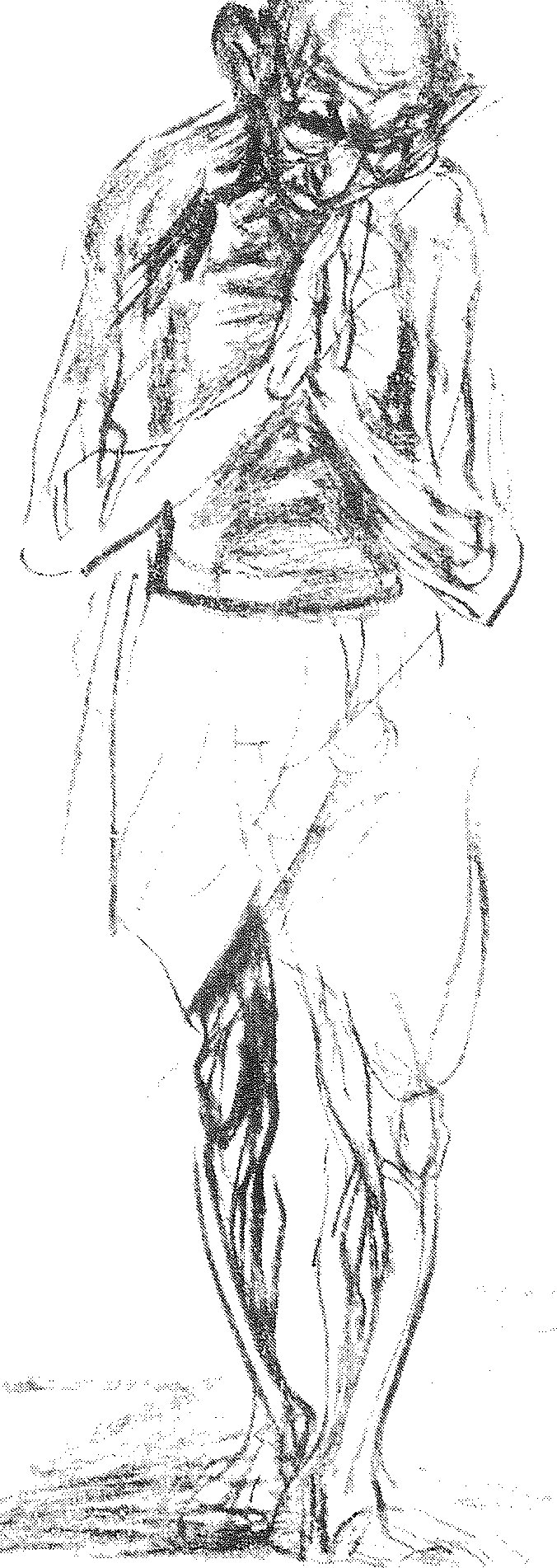
One may, I know not by what authority, pass through a gate to the other side of the fence and enter the enclosure behind the platform which is the front yard of the cottages of Gandhi and his neighbours. In this section were seated a hundred or so women, many of them with young children, and there were standing about a score or two of men. There were no chairs anywhere.
Gandhi left his cottage accompanied by six or eight people. Several acquaintances were standing by his door and he saluted them and exchanged a few words with some. He walked slowly to the platform with his hands upon the shoulders of two young women. There were gathered on the platform about eight people, Gandhi himself in the centre and four young women choristers and two or three men. By the wire stood a dozen grown boys in an informal sort of uniform. There function apparently was to prevent any undue demonstration.
Gandhi having been seated, the choir sang a number of songs or hymns drawn from the sacred Hindu writings. This was, of course, Indian music, but the effect struck me as not very dissimilar to the sung ritual in a Roman Catholic Cathedral. I do not doubt that to a musical person, there was all the difference in the world. The last of the hymns had more swing to it and was accompanied by the clapping of the choristers hands in which the congregation joined. It reminded me, for the moment, of the revivalist meetings of my youth, though much less enthusiasm existed.
Gandhi spoke for perhaps half an hour. We were told he seldom, if ever, speaks in English. His voice is low, but apparently capable of being heard. As reported in English, his addresses, including this one, contain much humour and good nature, but this one at least was received with complete gravity. The Hindu and the English language paper invariably report his post-prayer meeting addresses. Gandhi has become in effect a columnist with an enormous circulation. They are very informal talks. He is apt to ramble on a bit and an examination of them would doubtless reveal may inconsistencies.
It was not at all the sort of thing I would have expected to find before coming to India. I had pictured much larger congregations, much more enthusiasm and more inspired orations. What happens is that Gandhi walks into his front yard at a certain time every evening and speaks to whoever may be assembled there on whatever is on his mind at the moment. He may or may not have had time to prepare his remarks. He had some notes on this occasion to which he sometimes referred, but did not seem bound by them. He was, of course, squatting on the platform before the microphone. He rarely moved his body. He would slightly raise his hands with upturned palms and once in a while raised his whole arm. It was a moderately warm evening and one of the young women fanned him from the back during his whole address. When he had finished, some of the people in the near court drew up beside the path to see him pass. The young lads in uniform joined hands to form a chain around the party and the party returned toward the cottage. He seemed more fatigued than before and was still leaning upon the shoulders of his supporters. We were told that after the prayer meeting is a customary time for his receiving visitors in the garden.
View the original scanned pages →
Originally published in bout de papier, Vol. 6, No. 2 (1988) — Summer 1988 // Été 1988, pp. 22–24. Read the rest of this issue →



