
bout de papier, Vol. 5, No. 4 (1988) — Winter 1988 // Hiver 1988, pp. 36–37
Registered Retirement Savings Plans today account for millions upon millions of dollars of savings which represent the future hopes and dreams of many of our nation’s future pensioners. The question is, will the allowable contributions which a Canadian may make to a Registered Retirement Savings Program or, in fact, any of the other retirement vehicles, provide an adequate pension?
What is an adequate pension? – this in itself has been the subject of debate for some time and is currently a major topic among Financial Planners, Estate and Retirement Counsellors, Stock Brokers and Mutual Fund Salespeople and just about anyone who is involved with the subject of Retirement Planning, not the least of which are people in my profession of life and business underwriting — Chartered Life Underwriters.
In our firm, we have for some time used a “75% formula” as a target towards which our client can focus his or her retirement goals. In essence, the Stanford Research Institute has said for a number of years, as reported by the Wall Street Journal, that at the retirement of an individual, if less than 75% of that person’s income is replaced, then both they and their family are going to have, in the majority of cases, an extremely difficult time maintaining the lifestyle to which they have grown accustomed. (In some circumstances, this amount may range as low as 50% or as high as 100% subject to the spending habits and lifestyle of the individual).
It is interesting to note that while debate has raged for some time in Canada about the allowable level of contributions into a Pension Plan (be it a Defined Contribution or Money Purchase Plan or a Deferred Profit Sharing or Registered Retirement Savings Plan), the majority of Company Pension Plans focus upon the ultimate pension paid and not the amount of contribution which is deposited into the pension fund. These plans are known as Defined Benefit Plans since they define the ultimate benefit the retiree will receive and not the contribution that is placed into the fund. While Defined Benefit Plans have the focus on the benefit, many employees wish to focus upon the contribution and the accumulating capital, thus, the great interest in RRSPs, which are really individual Defined Contribution Plans.
If an employee is participating in a Defined Benefit Pension Plan, then there is a specific limit to what he or she may in fact withdraw in the form of a pension (based upon a pension formula that is a multiple of the years of service and earned income of the employee). Let’s suppose that for every year of service an employee retired with 2% of his final average income. Thus, if he served for 35 years at 2%, he would retire with a pension equal to 70% of salary.
However, what many people are not aware of is that the 70% of final average earnings is subject to a limit in the Defined Benefit Plan of $60,000 per year of allowable pension which a company may pay to an individual from the Defined Benefit Pension Plan.
This comes as a shock to most people, not early in life when they are not interested in pensions, but later in life when they are.
It is critical though, if a person wishes to build a retirement nest egg with a Defined Contribution Plan such as an RRSP, that not only are “available years” important but also the three key factors of shelter, time and compound interest are required for the Plan to become effective and amount to a meaningful sum at retirement.
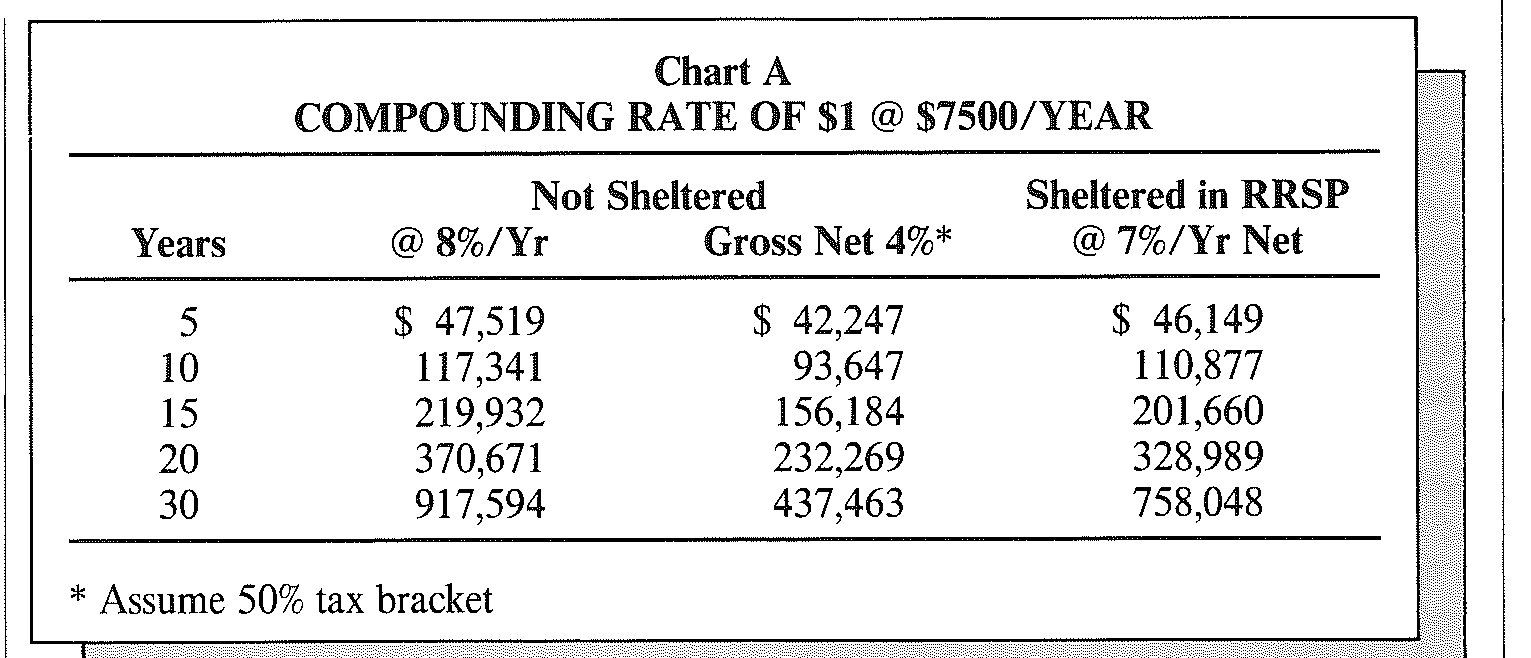
Namely, it requires that the money have time to compound for the benefit of the future retiree on a tax sheltered basis, for as you can see from Chart A, interest at very conservative rates, when not taxed on a compounding basis, will obviously provide a substantially greater sum of funds than interest that is taxed.
The participant in a Defined Benefit Pension Plan, however, does not have to worry about compound interest rates but rather requires a significant amount of time because his pension will be based upon years of service, ie. time with an organization which is just as important to a Defined Benefit Plan as is compound interest to the Defined Contribution Plan.
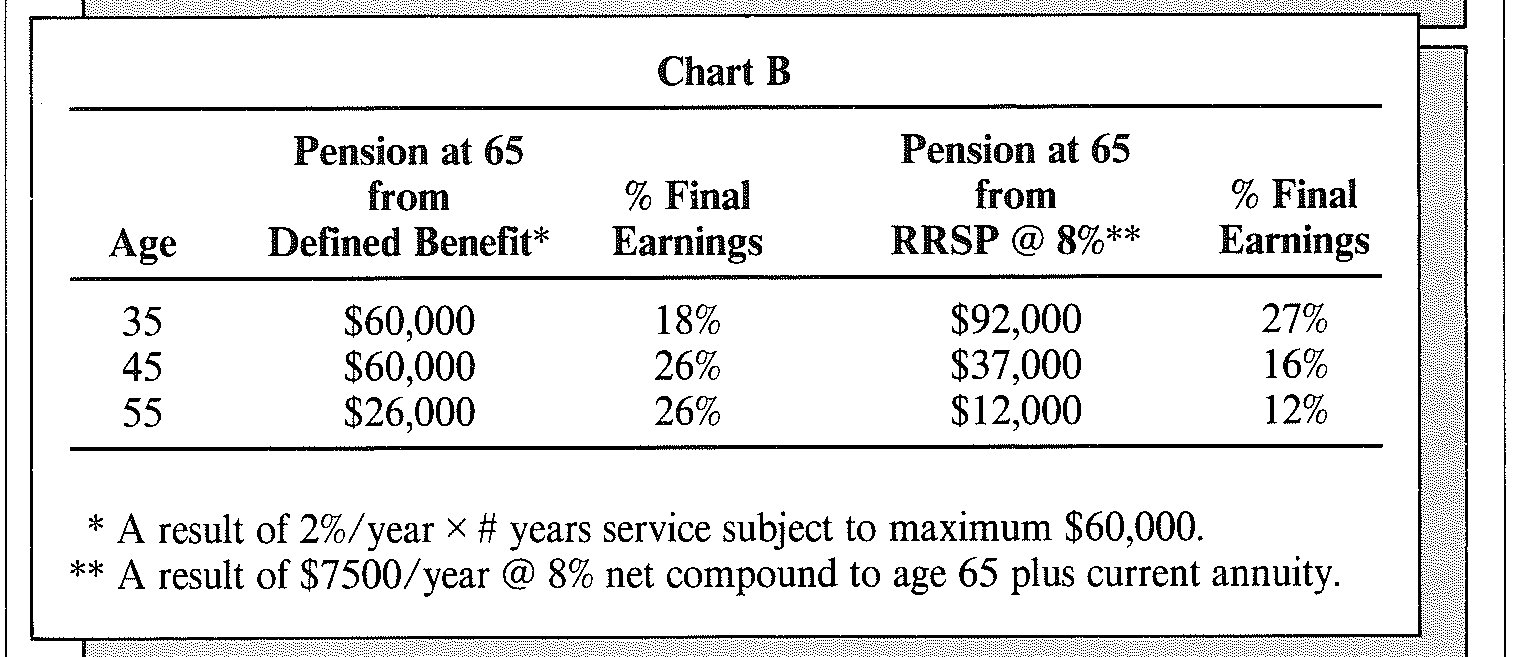
Now let’s look at the results for three different people in both Defined Benefit and Defined Contribution pensions and see who is better off in which vehicles, assuming their incomes increase at 5% per year from now to age 65.
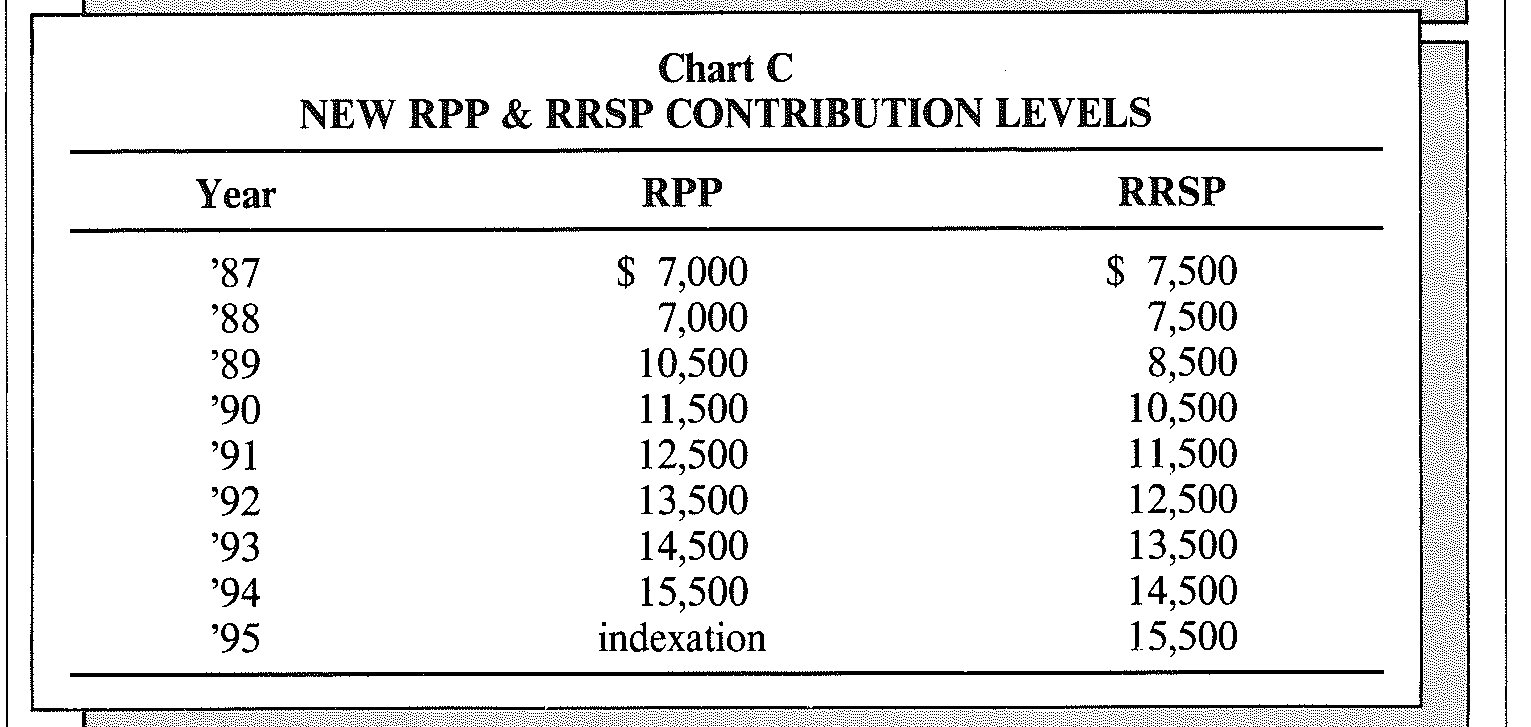
As you can see from Chart B, the 35 year old is better off in an RRSP (Defined Contribution Plan) even allowing for conservative rates of interest earned in the Plan even with level contributions of $7500/year, while the others with less time within which to allow money to compound are better off to capitalize on the years of service with their company and participate in the Defined Benefit Plan, the maximum of $60,000 notwithstanding. The 45-year-old, because of his earnings level and years of service, will receive a $60,000 pension which could only be exceeded by an RRSP with maximum contributions as per Chart C for 20 years, assuming at least 8% per annum net compound interest. This could produce, at 65, a pension of $70,000 per year.
While the 55-year-old is limited in both plans by lack of time, less years of service help to provide a bigger pension at 65 in the Defined Benefit Plan.
Since the current contribution limits are now set as per Chart C, the resultant pension figures as per Chart B are both a product of time and/or service plus, in the case of RRSPs, compound interest and annuity rates.
The key point is that with a Defined Benefit Plan which may or may not include indexation, the ultimate pension, although limited by law to a maximum of $60,000/ year, is in fact, guaranteed, whereas a Defined Contribution Plan (i.e. RRSPs) is not either guaranteed or limited to a maximum.
View the original scanned pages →
Originally published in bout de papier, Vol. 5, No. 4 (1988) — Winter 1988 // Hiver 1988, pp. 36–37. Read the rest of this issue →



