
bout de papier, Vol. 5, No. 3 (1987) — Fall 1987 // Automne 1987, pp. 46–49
As Walrus said to the Carpenter, the time has come to talk of many things. But for the ex-editor, with his bottom no longer in the chair, to pretend to have suddenly found fresh things to say would be suspect for having not said them earlier. The best and the worst he can do as he bids farewell, is to muse on what has been.
It was a different time when I became editor and concurrently a member of the Executive. Pierre Trudeau was Prime Minister, Allan MacEachen, Gerry Regan and Jean-Luc Pépin were our ministerial triumverate. Marcel Masse, de Montigny Marchand, Bob Johnston and Maggie Catley-Carlson were the principal deputies. At PAFSO, Russ Davidson was finishing out the term begun by George Haynal. The big issues were improved childbirth benefits for women, an assignment policy for employee couples, the FS3-EX conversion and the creation of a PAFSO honour roll. In celebration of our diamond jubilee a sixteen page tabloid-style bout featured an interview with Under-Secretary Masse, and a photographic essay on the Department’s first 75 years.
So what has changed, aside from the political landscape and the under-secretarial pool? The most significant development has been the growing radicalization of PAFSO. While we will never be militant and I doubt we shall ever see foreign service officers on strike, there is new appreciation of ourselves and our problems and a growing willingness to speak out, even publicly, on what we believe is important. At a time when idealism and commitment is said to be on the wane, we surprise ourselves on what we have done. Today’s organization is much different from the group I joined in the summer of 1984.
In looking back, certain events stand out as landmarks. The gag order of November 1984 was a singularly dumb move. It signalled a lack of confidence by the new political masters in a service which has prided itself on its non-partisanship and duty to the government of the day. It was the first time, since an earlier Prime Minister had spoken in derisory terms of “pearsonites” that the loyalty of the Foreign Service had been cast in doubt. Happily, performance and the passage of time has assuaged unfounded fears.
The decision in March 1985 by Treasury Board to unilaterally impose a 25% increase in shelter costs ended, especially for those abroad, the complacent belief in the benevolence of management. Coming at the end of 6 and 5, Treasury Board justified their Friday night surprise with the pious claim that they had to catch up with rising costs. What made it harder to stomach was that this occurred shortly before Treasury Board offered us a 2 year contract based on a 0% increase (later extended to 1.5% with rollbacks on weekend overtime and severance pay). We had, they preached, to do our bit for restraint! In an unprecedented move, PAFSO President Jean-Paul Delisle went on radio and spoke to the print press about the issue. When the Department refused to permit departmental telex facilities to be used to send PAFSO’s statement to our members overseas we did it ourselves through private means. And we took the Department to court and won. The Association’s right to communicate with its members is now backed up by jurisprudence. While we did not succeed in rolling back the rent increase, we achieved a gradual phase-in of the rent increase by working with the other unions in the National Joint Council.
The rent increase was a watershed. Until then there was an almost feudal relationship between senior management and the officer class. The managed would accept a certain amount of paternalism in return for grace and favour benefits. We thought, naively, that by depending on that relationship everything would work out. It did not, so we went to court. And we broke with tradition by choosing, for the first time, to take our case to the court of public opinion.
That summer, negotiations on a new contract broke down and PAFSO went to arbitration for the first time since collective bargaining was introduced in 1967. A survey of membership, the first ever conducted in a methodical fashion, showed that members were prepared to hang tough rather than settle when the contract expired. Preparing opener. We soon realized that within the category we have been placed (Administrative and Foreign Service) not only was PAFSO the group that had received the lowest cumulative salary increase since the introduction of collective bargaining but was the only group that had failed to keep pace with the consumer price increase. Collecting information to make our case was no easy task. Management’s refusal to provide basic data on recruitment, years in grade and composition of the group forced us to file under Access to Information Act and to go the Public Service Statt Relations Board for help. Our goal, which was realized in the subsequent Arbitration Award, wasto end the ongoing deterioration in the terms and conditions of our employment. In the latest contract negotiations we employed a new tool, mediation, as a means to resolving the outstanding issues.
Observing the transformation in attitude that occurs to those most intimately involved in the negotiation process has been fascinating. Listen to the articulate passion, even anger, of our negotiators, be it Margaret Huber and Jon Fried in 1985, or Jon Allen and Rodney Briggs in 1987, after they had been diddled by Treasury Board. The experience has been instructive.
The mark of any union is its defence of the individual. And in the cases of members Massip, Gordon, Egloff, Fraser and others, PAFSO has not shied away from taking on the unpopular in support of the basic tenets of fair play and justice for all. A policy on appeals and grievances has been established and funds made available. Slowly, we have begun to develop our own jurisprudence.
Adequate pay and acceptable conditions of service are the bread and butter of a healthy foreign service. The Foreign Service Directives are our shield against the perils of life abroad. They work well but can and are being improved. Perhaps their greatest strength lies in the fact that their interpretation and day-to-day enforcement lies in the hands of those who serve abroad. And still undone is a Foreign Service Act which would recognize, under the law, the unique conditions under which we serve.
The McDougall Royal Commission emphasized the importance of keeping the family and the entire foreign service community — clerks, secretaries, communicators as well as officers, adequately housed, properly paid and with sufficient recreational facilities. “Access to recreation facilities for all staff members and their families is vital for the maintenance of physical and mental health” wrote Ms. McDougall and should be a priority for the government. In response the Department created the Recreational Hardship/Support Program and it has made a signal difference to life abroad.
Applying this policy has required common sense; not always a big commodity. Putting most of the funds into the purchase of shares in Hong Kong’s Aberdeen Marina Club was virtuous but inept. We made ourselves an unnecessary target for the Auditor General and an easy mark for public ridicule. The unhappy affair was compounded when, in spite of pleas to stand fast from PIPS and PAFSO, the political masters buckled and ordered the membership sold, a move that even Tory MPs on the Public Accounts committee thought was an overreaction. The slow sale of the memberships has provided easy copy for journalists with no ideas and an approaching deadline. It has also served to cast a pall on what is a very good program.
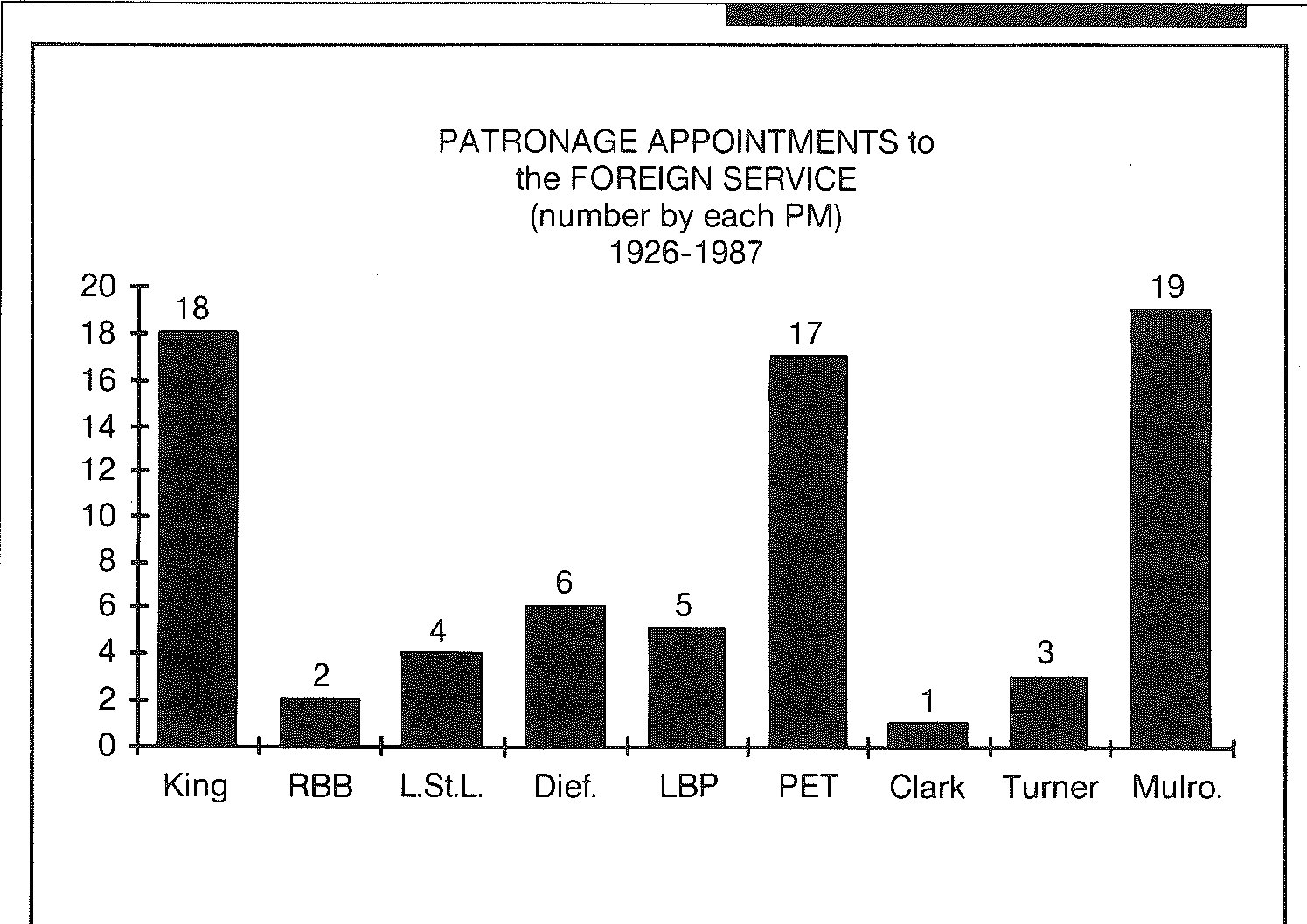
The foreign service is no stranger to political patronage and there is no question that there will always be a place for the talents of a Vincent Massey, Roland Michener or Stephen Lewis. They make a valuable contribution to the conduct of Canadian external relations. And over the years successive governments, Conservative and Liberal had arrived at a balance between political and professional appointments. The professionals received the bulk of assignments, on average one a year came from outside the public service. King appointed 18 over 22 years, Bennett 2 in 5 years, St. Laurent 4 in 8 years, Diefenbaker 6 in 6 years, Pearson 5 in 5 years, Trudeau 17 over 16 years and Clark I in 9 months.
After the appointment of Messrs. Dupras, Mackasey and Whelan, and with an election underway, PAFSO president Russ Davidson had written to the party leaders to seek their stand on patronage. After September 4, the reply from Brian Mulroney was eagerly awaited. His letter of October 2 promised that the “standard of professionalism so characteristic of our foreign service will be maintained by my Government and retlected in the diplomatic appointments we will be making.” His words were made good by deed when nine days later he rescinded the appointments of the Turner-appointed trio. This action, combined with his strong words on patronage during the election debates — “you had an option sir” “, established the standard against which future actions would be measured.
And the measure would find increasing use. After the appointment to Los Angeles in March, 1986 of Joan Winser, former president of the Tory constituency association in Westmount a letter reminding the Prime Minister of his pledge was sent to him. It received a neutral reply. Then came the appointments of Lucien Bouchard, a former school chum of the PM, Chris Pearson, former Tory leader in the Yukon and Pierrette Lucas, a former Clark aide and defeated Tory candidate. Two letters of mild protest were sent to Mir. Clark. They did not receive a reply. Following the appointment to Ireland of Dennis McDermott in January, 1986 another letter was sent and, in PAFSO’s first press release, provided to the media. It gained minor media play as well as the attention of Mr. Clark. In his reply the minister claimed that “important Canadian communities are inadequately reflected now in Canada’s public appointments – most notably women, organized labour, and Canadians of heritage other than English and French…. External Affairs must reflect those national priorities in our activities, appoint-standards.
More patronage appointments followed In December, another press release was issued in the wake of the Drapeau appointment to UNESCO. PAFSO President, Len Mader, appeared on CBC’s The National to make our case. The item was linked with the closure of Canadian posts abroad. It was the first time we had ever received national television coverage. In February the only head of post from the shut six to receive a commensurate reassignment was Pierrette Lucas, the sole political appointee of the bunch; she went from Philadelphia to Boston. PAFSO protested by press release. An amiable meeting subsequently took place between the Minister and Len Mader in which patronage was discussed but left unresolved.
Then came the Glorious Tenth, as one wag dubbed it. Following a series of press stories rumouring the appointment of Patrick MacAdam, a long time crony of the prime minister, to London, PAFSO held its first press conference in which John Lobsinger, our new president, using forthright and unambiguous language warned of the consequences of such appointments to the national interest. The reaction of the Prime Minister and Minister guaranteed national attention. Mr. Clark’s letter to the Globe and Mail remains a remarkable piece of literature. He decried our “crude and unprofessional… outburst,” accused us of ’distorting history’ and dismissed the “newly-elected executive” as representing “only the two most junior levels of the foreign service and none of its members would be senior enough to be considered for any of the positions in question.”
In a dispute with our Minister neither we nor he will gain. It marks no victory for either party. As diplomats we should be able to do better. But we take heart from the many members who looked to us for leadership and decisive action. The nation’s editorialists and pundits (see this issue) found merit in our cause. Speaking out against the political masters is no easy task. It is the last resort. It can only be employed when quiet diplomacy has failed. It requires courage and conviction. And it must be done in defence of professionalism.
Keeping faith with professionalism has served to make us more aware of the place of the Foreign Service within the Canadian public service. To point out the importance of having career officers handling the conduct of foreign policy, we submitted a brief to the Joint Parliamentary Committee studying Canadian foreign policy and met with its chairman, Tom Hockin. The Committee later concluded that a “highly professional” career service is “a valuable national asset, strengthening Canada’s hand in its international dealings.” The Professional Committee, the brainchild of George Haynal and Howard Balloch has proved its worth time and again thanks to the efforts of its successive chairmen John Higginbotham and David Adam. Their breakfasts and seminars have put clothes on the dress horse of our profession. It has also mended the artificial tear created by the EX (FS) conversion exercise. We share a sense of community which transcends rank.
The most felicitous result of all these events has been their effect on PAFSO, especially its Executive. In 1986 the Executive was chosen for the first time by contested election. Candidates took stands on the issues and the membership got to pick and choose. If nothing else, it has breathed a diversity of opinion into executive meetings. Debate over issues like the Commercial Officers’ conversion exercise, streaming, the creation of the Development stream, an AIDS policy, and affirmative action, as well as lost causes like evaluating managers are the vital signs of a vibrant organization. This year, two worthy candidates stepped forward to contest the presidency after Len Mader resigned. Today, when the Executive speaks it is with the confidence of the ballot box behind them. One day, we may even see direct election for a president. In my experience, finding time to devote to PAFSO business is our greatest handicap, we would benefit from having one of our own at the helm on a full time basis. And at long last, PAFSO has a new home. It was no easy task and Gordon Morrison is owed a great debt for his patience and perseverance.
What of the future? We must learn to adapt in pursuit of both principle and interest and ride time with a purpose but not be ridden or unseated by it. There will always be the gadarene who cry up, and whore after change everywhere. There are the bourbons to whom change is always unfriendly and to be resisted. They can always be found, especially among the chatterers in the cafeteria. There is danger in change, but the greater danger is in the blind conservatism of the reactionary. This is the real threat to the Foreign Service. We could do with more, not less, fire in our bellies.
As we recognize change and use it, some observations to guide our path:
• The Foreign Service has been described as having many of the virtues as well as the faults of a jesuitical order. Our dedication to the institution is unique to the civil service. We have been a closed shop. With few exceptions, advancement through the ranks depends on a wholehearted and life-time commitment to the Service. This is changing because the nature of modern diplomacy requires more specialists than we can develop. A freer flow in and out of the Foreign Service is inevitable and should not be resisted. As well, there will be more non-rotational senior officers. This, too, is not a bad thing. Fortoo long, External Affairs and the Foreign Service have suffered when we play the Ottawa game because of our exclusivity and unfamiliarity with the Capital scene.
• The traditions and camaraderie of what is still an essentially male-dominated profession are worthy. But they do not lend themselves well to the realities of our age. Affirmative action is an idea whose time has come and governments, regardless of their stripe, will enforce it. The hard truth is that there are too few women and minorities in the foreign service. It will require accommodation and adjustment in attitudes.
• The popular image of diplomats remains one of striped-pants dandies lolling poolside with their martinis. We have a long way to go to correct this false image. As journalists David Halton and Jeff Simpson pointed out when they spoke at a recent seminar of the Professional Committee, our preoccupation with secrecy and innate caution does not work to our advantage. When we are abroad the foreign correspondent can be one of our best sources. Without betraying confidences but by sharing what we do with them, the media has the potential to be our most important ally. Because when we appeal to the court of public opinion on issues like patronage it is the journalist who makes it relevant to our countrymen.
• It is ironic that the work we do which is most important to the average Canadian — immigration and consular assistance, are the areas which are seen by us as the rube work on tripofed. yet, when the refugees in Central America or Indochina knock at our doors, when an earthquake rocks Mexico City, when Chernobyl melts down, when the boat-people arrive on the beaches of Nova Scotia, when terrorists kill Canadians in Malta, or when future citizens apply for entry and a Canadian abroad loses his passport it is our immigration and consular officers who are in the front line and must be seen to perform. And the Canada of tomorrow is created by the immigrants whose eligibility they determine. They are our most public face. They are our front line. Their actions create the impressions on which Canadians decide what the Foreign Service means to them.
• The Foreign Service continues to offer extraordinary opportunities to ourselves and our families. It is still an ideal career to gain an appreciation of our country. The skills we develop serve us well be it in industry or the boardroom, as Ministers or as chiefs of staff to prime ministers and premiers, as senior officials in the provinces or in Ottawa, or as international civil servants in the United Nations, the Commonwealth or NATO. But hand in hand with opportunity are demands and duties that can be difficult, especially for our spouses and children. The benefits and conditions of service are generally good. To ensure they are maintained we must continue to demonstrate through our professionalism and performance that we serve Canada well. Among other talents, this demands a certain political astuteness. In return, our Masters, who require able servants to carry out the conduct of our diplomacy, will be more easily persuaded that excellence must have its rewards.
• The gap between ambition and achievement will grow larger. Promotion will continue to be slow; post closings, patronage and consequences of restraint will further skew the road to advancement. The pollyannas who dream that one day ’merit’ will be the sole criterion for success would do better to pack their bags. It never was the sole criterion. And success depends as much on time and chance. The magazine’s greatest debt is to its contributors and readers over the years. The former have made it what it is and the only recompense they have received is our warm thanks and the knowledge that they have served to further debate on vital subjects. Our readers tend to know much more about issues and we have benefitted from the argumentative letters and bent ear in the corridor. And if this journal has on balance informed its readers and provoked discussion it has succeeded. To those outside the foreign service, we have tried to present an accurate picture, warts and all, of Canadian diplomats as they are and describe the conditions in which we and our families serve. We still have a long way to go.
Once when younger, I thought all problems had solutions. Now, I merely think we should pursue the solutions we think right. Editing this journal has been very satisfying. It has grown. It is improved and it is improving, although it is never as good as one would aspire to. I leave, confident that with an able editorial board and a stable of contributors, my successor will make an even better go of it.
View the original scanned pages →
Originally published in bout de papier, Vol. 5, No. 3 (1987) — Fall 1987 // Automne 1987, pp. 46–49. Read the rest of this issue →



