
bout de papier, Vol. 5, No. 3 (1987) — Fall 1987 // Automne 1987, pp. 30–35
We asked four retired Canadian diplomats: George Grande, John Halstead, John Holmes and George Ignatieff for their views on the success of containment. They all reread Kennan’s famous piece and then went to work.
George Grande
Has containment worked? The short answer is in the affirmative. Otherwise, we wouldn’t be here writing learned themes about such a question.
It is impossible to measure the degree to which containment has helped maintain the peace — or heightened East-West confrontation – in the past four decades. But the fact is it has worked.
Is containment the wisest policy for us to pursue today even if it were the right one for the U.S. forty years ago? Indeed, is containment still a feasible policy in these days of satellite observations, mutual nuclear restraints, confidence-building measures and summit diplomacy?
Perhaps not.
The West’s greatest strength is not its military power. It never was. It’s difficult in peacetime for democracies to maintain strong military forces against the competing demands of social services, industrial superstructure and a better standard of living.
Wartime sacrifices are patriotic. Peacetime ones are usually politically disastrous.
For all kinds of reasons, the most sensible policy for the U.S. and the rest of the Western Club to follow vis-à-vis the Soviet Union is a multi-faceted one complete with carrots and sticks — economic co-operation and nuclear deterrence, joint crisis management where feasible and maximum pressure for the observance of basic human rights and fundamental freedoms.
Our optimum strength is the freedom enjoyed by individuals in democracies and the resultant lack of fear. The tyranny of dictatorship does not make for strong unity of purpose and a resultant social base on which to espouse the merits of communism/ socialism.
Next to freedom, the West’s economic superiority is its finest asset. It is a lightning-rod that can be used to promote close co-operation with the Soviet bloc that badly needs our superior technology and economic support. And it can help maintain strong defences for as long as necessary.
Containment in today’s multi-polar world cannot be only a facet of American policy. To work it must be embraced wholeheartedly by a united and willing Western family of nations.
Yet our joint determination to face together any Soviet challenge is offset to a large degree by differing priorities among Western nations and different views about the need for détente, nuclear-free zones and a strong Western presence and response in the world’s trouble-spots.
To maintain a strong and unified Western policy is much more difficult than the maintenance of a strong and unified Eastern one. Democracy’s limitations are there for all to see. Communism’s are of a different nature. They are more apparent in the fields of social progress and personal liberty than in that of national defence which always receives top priority.
To the extent that successful containment counts on the weakening and ultimate collapse of socialist societies, it is both unrealistic and even undesirable in national security terms. That wouldn’t lead to a more stable world.
The history of Russia, both imperialist and communist, has generated a fear and suspicion of the outside world. The result has always been that Russia builds up its military strength to a level far above that required for defensive purposes only. This has been accompanied by a process of sealing off its people from perceived bad and infectious outside influences.
Another consideration is that — up to now – communism has depended for its survival on expansionism and a dedication to its ultimate domination of the world in both territorial and ideological terms. For the West to adopt a similar public policy could spell permanent confrontation and needless and dangerous instability.
Freedom will survive and prosper because of man’s inherent nature and provided enough attention is paid in democracies to collective Western defence and co-operation. It doesn’t require expansionism to survive.
The challenge the U.S. and the rest of the West faces today — 40 years later — is that being posed by the new Soviet leadership under Mikhail Gorbachev.
As British Foreign Secretary Sir Geoffrey Howe put it in a landmark speech a few months ago to the Royal Institute of International Affairs: “Their ’new political thinking’ does now acknowledge that there is more to security than military might and that one’s own security cannot be maintained on terms that inevitably mean insecurity for others. It brushes aside fears of Soviet claims to world domination as outdated. Theories of the triumph of Socialism worldwide, we are told, were just that — bookist theories, not guides to action. The “new political thinking” lays stress on interdependence and the joint search for solutions to problems of global importance. It recognizes that the Soviet Union cannot play a part on the world stage commensurate with its intrinsic power until it has put its own house in order, and that to do this it needs a stable international environment.”
If there has really been such a fundamental change in Soviet thinking – and it continues — containment must be gradually replaced by the West with a combined policy of realistic political détente and other tension-reducing measures, on the one hand, and the continued firm defence of our national and Western interests, on the other.
There is no single simple policy still suitable in today’s complex world where, unlike 40 years ago, both sides have countless nuclear warheads and the ability to wipe each other out thousands of times over. Nuclear war can never again be either an Eastern or a Western policy. It would be mutual suicide.
Strength? Yes. We must continue to deny the Soviets the opportunity to increase their control of other parts of the world. But we must also give them the opportunity to live a better live without fear of war or conquest. This is the challenge today’s statesmen must deal with in trying to define the best policy for the West.
It is not simple containment we need so much as a greater resolve to use strong collective defences and other measures as the means to forge a successful working relationship with the Soviet Union. That’s containment with a difference. It isn’t an end in itself any longer because the only end has to be a new beginning characterized by mutual tolerance, trust and survival in a balanced and sane world.
The alternative is mutual assured destruction (M A D).
John Halstead
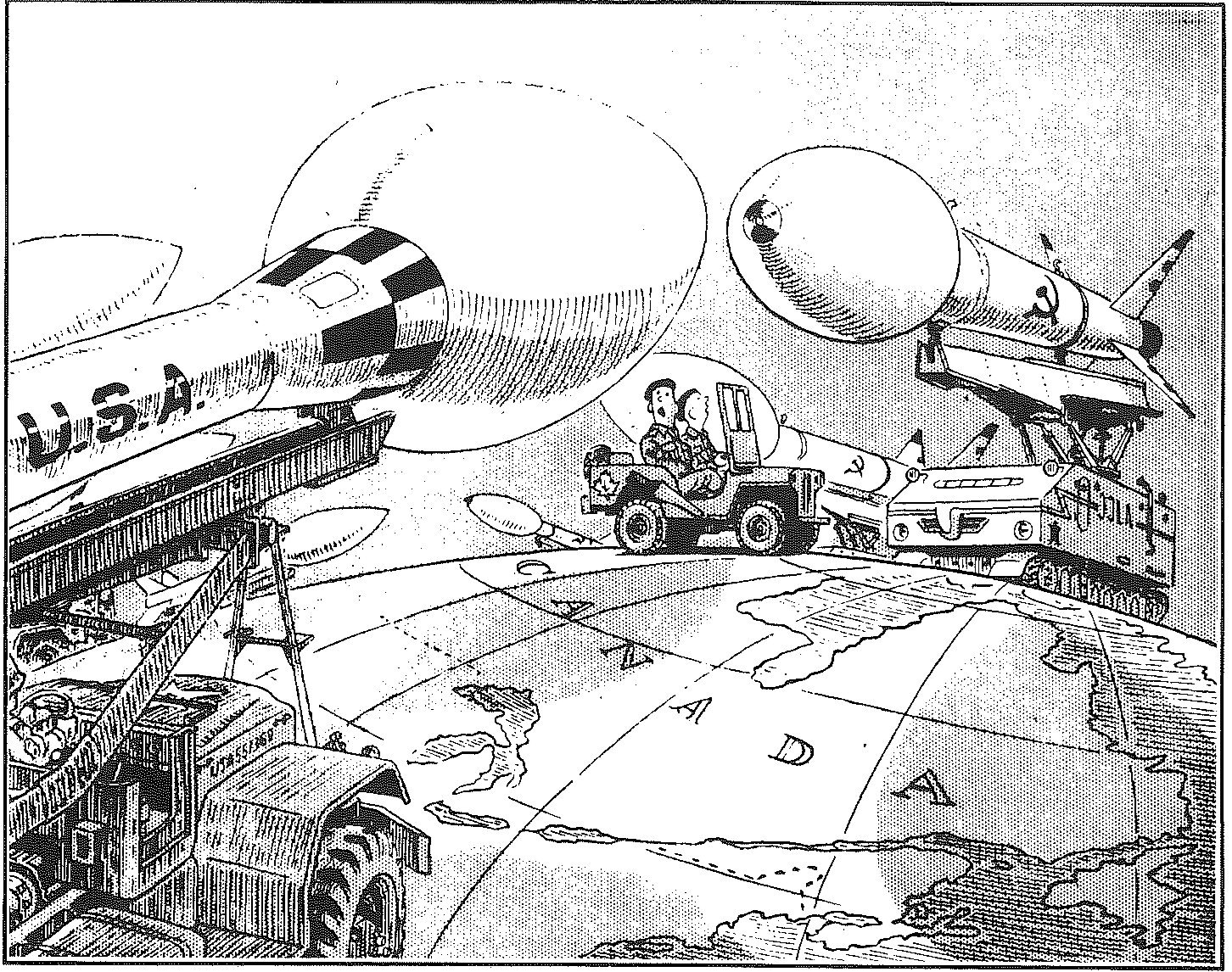
Forty years ago the Soviet Union, though exhausted by World War II, appeared to have the political will and the ideological power to exploit the weakness of the war-torn states around its periphery to expand its influence. In response the United States took two major steps which marked a decisive departure from pre-war isolationism. The first, which became known as the Truman Doctrine, was to’grant aid to Greece and Turkey against internal subversion and outside pressure. The second was to adopt the Marshall Plan to help the Western European economies to recover. Thus was born the policy of containment, which was given its name and its intellectual concept in George Kennan’s famous “X” article in Foreign Affairs, fittingly reprinted in the Spring 1987 issue.
It is significant, I think, that Kennan’s article was entitled “The Sources of Soviet Conduct.” That reinforces the impression that its main purpose was to present a reasoned analysis of Soviet foreign policy, its motives and ambitions. That is the part that Kennan clearly felt most at home with, but he did not stop there. He went on to present a prescription for U.S. policy. He advocated “a policy of firm containment, designed to confront the Russians with unalterable counter-force at every point where they show signs of encroaching upon the interests of a peaceful and a stable world.” He also contended that “it is entirely possible for the United States to influence by its actions the internal developments, both within Russia and throughout the international Communist movement.” He went so far as to suggest that “the United States has it in its power to increase enormously the strains under which Soviet policy must operate… and in this way to promote tendencies which must eventually find their outlet in either the breakup or the gradual mellowing of Soviet power.”
If he had to do it again, I suspect Kennan might be more precise in the terms of his prescription for U.S. policy, making it clear that he was not advocating a global policeman’s role which would put the emphasis on military means. Indeed, he has now explained that he did not intend to depict the Soviet Union as primarily a military threat, but rather as an ideological-political threat, and that his main objective was to prevent the Soviet Union from manipulating Communist parties to seize power in Europe and Japan.
At the time, his article was strongly attacked by Walter Lippmann, one of the leading commentators, in an article which is also reprinted in the latest Foreign Affairs. Lippmann argued that the strategic conception of the containment policy was “fundamentally unsound… and that the attempt to make it work will cause us to squander our substance and our prestige.” He contrasted the Truman Doctrine, of which he disapproved because it treated those who were supposed to benefit by it as dependencies of the United States and as instruments of U.S. policy, with the Marshall Plan, which he commended because it treated the European governments as independent powers which the United States was trying to help but not to govern.
The containment thesis was in my view based on three premises: first, that Soviet expansionism was embedded in a combination of Communist ideology and Russian national interests; second, that it would be deterred only by the prospect of facing superior force; and third, that the United States had the strength, self-confidence and dynamism necessary to contain the Soviet Union successfully. Each of those premises was valid within limits, but each held a defect which, if not recognized, could lead to fatally flawed policies.
Take Kennan’s analysis of Soviet foreign policy. He was undoubtedly correct in observing that the United States must regard the Soviet Union as a rival, not a partner, and that there could be no appeal to common purposes. But this led all too easily to the conclusion that the Americans could do no serious business with the Soviets as long as that was so. Moreover, Kennan’s reference to the possibility of influencing internal developments in the Soviet Union and the eventual breakup or mellowing of Soviet power was all too apt to feed the illusion that the Soviet system was on its last legs.
Again, it was undoubtedly correct to assume that Soviet expansionism could be deterred only by the prospect of facing superior force, but it was too easy to slip from that to the view that military measures should constitute the main ingredient of the U.S. strategy to deal with the Soviet Union. That was playing to the Soviets’ strong suit, instead of focussing on the economic field, where the United States had by far the stronger suit. And it worked out in practice that the United States, in pursuing its military rivalry with the Soviet Union, made three serious mistakes: it chose partners on the basis of anti-communism alone; it failed to distinguish between vital and less important interests; and it became over-extended.
Finally, the assumption that the United States had the strength, self-confidence and dynamism necessary to contain the Soviet Union successfully, while certainly true in the short term, was fraught with hard questions over the long haul. Dynamism could be misdirected if it were applied exclusively to holding the line against Soviet expansionism. Self-confidence could become overconfidence if it were based on the wishful thinking rather than on an objective calculation of the strengths and weaknesses on both sides. And strength could too easily be dissipated in an effort to confront the Soviets with counterforce at points of Soviet choosing, particularly if it involved defending weak border states.
These dangers were only heightened by the sense of historic mission which infused the containment policy. At the end of his article, Mr. “X” expressed gratitude to a “Providence which, by providing the American people with this implacable challenge, had made their entire security as a nation depend upon their pulling themselves together and accepting the responsibilities of moral and political leadership that history plainly intended them to bear.” To which Lippmann replied that “it is not leadership to adapt ourselves to the shitts and manoeuvres of Soviet policy at a series of constantly shifting geographical and political points.”
History may well have intended the United States to bear the responsibilities of leadership at a time which was fateful for the free world. But there was nothing pre-ordained about containment, still less about the way that policy was implemented. It was most successful in Europe, where the United States worked effectively with its allies to put together both an economic recovery plan and a collective defence alliance to ensure that the power vacuum left by the collapse of the Third Reich would be filled peacefully. It was least successful in Southeast Asia, where the United States suffered a humiliating defeat in a war fought on the opponents’ ground, without well defined political objectives and without effective allies. In this sense it can be said that containment has worked only in part, and that a dreadful price has been paid for the part that failed.
More important, in my view, is whether the correct lessons have been drawn from this experience. Today the United States is in greater need of allies than ever, because its relative strength has declined and it is more vulnerable to the international environment; yet the “go it alone” voices are stronger than ever in Washington. At the same time, the Soviet Union under Gorbachev represents a far more subtle challenge than the overtly expansionist power of yesteryear; simple anti-communism is no longer sufficient to ensure Western solidarity. Where containment was once enough to define what the United States was against, a new effort is now needed to define what the United States and its allies are for.
John Holmes
Canada’s legendary first ambassador consistently argued that we should be firm but fair with the Russians. Insofar as the doctrine of containment was pursued in this spirit it was successful. George Kennan, the author of the doctrine, used similar language, and the Canadian ambassador in Washington reported that the State Department thinking was very close to that of Wilgress – but the State Department’s influence on the policy of its government is much less than that of the Department of External Affairs. They did, however, have the ear, most of the time, of President Truman. The acceptance of containment as a sober rather than a hysterical policy did fortunately prevail in the climactic years 1947 and 1948. Already there were over-excited ideologues in America and Europe preaching military provocations, but the crises were met in fact with steady nerves. The Russians won Czechoslovakia, but they lost Yugoslavia, and in that latter reverse there was a message about the ’Communist monolith’.. The loss of Czechoslovakia was heartbreaking. Military intervention would have been folly, but it was the Prague coup that started the move to a rational response, NATO. The blockade of Berlin shook our hope that the Russians would be prudent in their probing of our containment, but in the end we won because the Western powers rejected the proposals for violent response in favour of the air lift, which was certainly fair as well as firm.
By the end of 1948 the Russians were pulling back. They had pressed too far in Greece and Turkey and brought American power into the area. Their hostility had cost the French and Italian Communist parties much ground. Most important of all was the Marshall Plan, which brought new life and confidence to the peoples of Western Europe. It proved the most effective kind of containment because its main purpose was broader than that and recognized as such. It is unfortunate that in the standard history of that great enterprise, no mention is made of the fact that a Canadian loan to Britain, far larger in scale than anything the Americans had offered, kept Britain afloat while the Americans were going through their endless round of policy making among the divided powers in Washington. We and the Americans were, of course, serving our own interests in our endeavour to restore the Europeans as prosperous trading partners, but it was in their interest to be prosperous. If in so doing we thwarted hopes of the Russians to build communist states out the misery of Germany and its neighbours, that was positive rather than negative containment. The Canadians and the British were prime movers also in getting out of the US Senate a commitment to European security that would give the Europeans confidence in the future and dispel panic, a dangerous state of mind in times of crisis.
I think it was essential to let the Russians know that there were limits beyond which they would meet stiff resistance in their efforts to extend a security zone. However, as the wise men in Washington who sponsored the doctrine of containment have admitted themselves, they oversold the argument. Far from being eager cold Warriors the Americans at the end of the war had happy illusions about getting on with the Russians. They had to be convinced that Soviet aims were hostile. To get the message across it was put in almost religious terms, the fight between good and evil. Truman said everyone had to choose between two alternate ways of life. Kennan and company were horrified, but the endemic American messianic spirit was unleashed against the devil. The Russians, even more paranoid, did everything they could to aggravate the blackness and the whiteness.
It seemed particularly unfortunate that containment was getting out of hand in the late forties when its more sober application was proving successful — in Europe at least. There was still great uneasiness, however, about how far the Russians would go. I recall the sinking feeling I had in Moscow in 1948 when they took great risks over Berlin, because we believed they would be prudent at the brink. I was at the UN in 1950 when we met to cope with the North Korean invasion, and the feeling was even worse. Contrary to the hopes of the sober men, it looked as if the Communists were going to act as a bloc and challenge the West on very disadvantageous ground. They met, however, not just an American but a United Nations response. It was a very near thing, but fortunately the UN forces did manage to repulse the aggression. As it worked out, I think it was worth while to discourage Soviet expectations of easy expansion, but we became more cautious about enforcing collective security universally.
So long as the United States acted with its allies and through the UN over the Middle East or the Congo, containment was based on rational calculations of strength. But when John Kennedy proclaimed that the United States would bear any burden, fight any battle anywhere in the cause of liberty, containment as a sane strategic calculation of Kennan and company was gravely threatened, although Kennedy did respond rationally to the Cuban missiles. The great powers had got together in Geneva in 1954 to contain the fighting in Indo-China, but the Americans eventually went their own way to ultimate disaster. In the wake of the disaster they sought to share the burden with their allies, but they had lost the art of sharing policy. During the Reaganite regime they have sought to act unilaterally even though the enormous economic and military power which had assured their hegemony is melting away. Their nuclear power is still predominant, but it is largely inapplicable.
We are still dependent nevertheless on a strong and healthy American counterforce to maintain détente and deterrence and make possible a transition to a more stable world order. We have to show an honest disposition to move beyond cruder doctrines of containment when there is an opportunity to do so. Prudence is always required in dealing with the USSR, but we dare not ignore the opportunities Gorbachev is holding out for a more lasting détente. The really serious issues confronting the world, economic and environmental, make the Cold War irrelevant. If — and it is still a big if — Gorbachev has realized this, then we can say that containing Soviet messianism has been successful. Containing the American crusaders is, however, an urgent problem. If we judge United States policy by their deeds rather than by their rhetoric, the prospects are more hopeful. They are seriously trying to get an arms control agreement, and they have tried to get a united policy on the Persian gulf in the UN Security Council despite all the sabre rattling. They haven’t invaded Nicaragua either. There is reason to hope that, as in 1947 and 1948, the sober containers will prevail. Kennan did believe that if the Russians realized they had been checked it would be possible to coexist with them. The mad escalation of nuclear power has made all of us more keenly aware than we were in the Forties of the need not only to contain our adversaries but ourselves as well.
George Ignatieff
To answer whether containment has worked, one needs to go back to the objectives of containment as originally perceived by George Kennan and distinguish between the military, political, and economic problems which it was supposed to address.
I met George Kennan originally in 1947 when I was Secretary of the Canadian delegation in the tripartite conference on atomic matters in Washington, D.C. This conference had been called to review the wartime Quebec agreement, which provided for cooperation between the U.S.A., U.K. and Canada on atomic matters in sharing materials, research and bomb-making. This agreement was being subject to criticism by some U.S. senators and was revised. The war-time agreement provided for consultation between the U.S.A. and Britain before the use of the new “absolute weapon”. This promise that Churchill and Roosevelt had agreed to was to be terminated. This was to lead Britain to make its own bomb and nuclear proliferation was to start.
The meeting took place under the chairmanship of James V. Forrestal, then Secretary of Defence, (and soon after to throw himself out of a window of the Bethesda Naval Hospital). The diplomatic advisor at these talks from the American side was George Kennan. He and General Lauris Norstadt tried hard to persuade the British to rely on the American nuclear deterrent — but to no avail. The British insisted on their own; the French were to follow.
I recall this because the setting of Kennan’s historical article was written in the context of his views of what problems the West faced in dealing with the Soviet Union, their wartime ally that had admittedly borne the brunt of the war in Europe against Hitler, as the U.S.A had in the Far East. Particularly Kennan set out in detail how he regarded the prospects for cooperation between the victorious allies. His answer first given in a ’long telegram’ direct from Moscow, (of which the article in Foreign Affairs was a condensation), argued that the Soviet Union under Stalin was going to “play hard ball” and it was no use relying on any illusions or blandishments of the kind used with “Uncle Joe” at Yalta. This came as a shock to Washington in the days preceding the Truman doctrine, and the cold war enunciated by Churchill, and had something to do with both developments.
Kennan, incidentally, was not by any means alone in uttering timely warnings about the limitations on cooperation to be expected from the U.S.S.R. in implementing the new cooperative institutions set up under the United Nations Charter, which assumed, in the first place, great power cooperation in maintaining international peace and security. It was on this assumption that the five permanent members of the Security Council were given each a veto to encourage “unanimity.” Arnold Smith, then at the Canadian Embassy in Moscow with Dana Wilgress, wrote me letters warning me about being too optimistic concerning the tendency of the U.S.S.R. to “go-it-alone”, instead of cooperating to make the newly founded institutions required to build “the brave new world” operate in the way some Canadians had hoped.
While attacking the naive hopes for Soviet collaboration, which stemmed from idealism as well as from an awareness of what the Soviet wartime contribution had meant in defeating Hitler, Kennan found wild-eyed anti-Communism, which spouted hatred of Russia, equally insidious. His theme, in short, was that Russia would probe into areas of weakness but had no compulsion to wage wars of aggression when faced with resolute opposition. Lecturing at the War College in Washington, D.C., Kennan summed up his theory of containment in words which have been interpreted as a military doctrine, (which was not Kennan’s intention, as he told me many times). ’There is no reason in theory,” he said, “why it should not be possible for us to contain the Russians indefinitely by confronting them firmly and politely with superior strength at every turn.” This was to become the basis of the Truman doctrine in stopping Soviet pressures against Turkey, the Balkans and the Middle East. It was also to be the basis of the North Atlantic Treaty, the intent and terms of which were to be subject to various interpretations at the time of its negotiation as well as subsequently.
It was to Canada’s credit that we did not overlook the word “politely” in Kennan’s formula, in addressing the question of how Canada was to commit itself for the first time to an alliance for the purpose of containment in peacetime. It was on Canada’s insistence, (as I know, having worked with Escott Reid on the text), that Article 2 was included that committed NATO members “to contribute toward the further peaceful and friendly international relations by strengthening their free institutions… and by promoting conditions of stability and well-being.” It was Kennan’s view, as well as Canada’s, that the manipulation of political and economic power was involved in containment as well as military.
Kennan, as I know from personal contact with him in Washington in the late forties and early fifties, was among the first to come to the realization that because of atomic weapons, the concept of total war, which sought the unconditional defeat and occupation of an enemy country, when nuclear powers were involved, at least, was no longer realistic. Future wars would either have to be avoided altogether or restricted in scope, conducted with small flexible strike forces to achieve limited political ends. He went on to urge later that the U.S.A. should make it clear that it would never be the first to use atomic bombs, and that NATO must restructure its strategy to take this into account. In this rational way Kennan anticipated the agreement reached in the 1986 summit at Geneva between President Reagan and General Secretary Gorbachev that nuclear wars are “unwinnable and must not be fought.”
Kennan, like Harriman and other knowledgeable American statesmen familiar with Russian history and attitudes, at the time realized that the language of military power and intimidation was likely to provoke a response in kind from the Soviet side. The trouble was the military language and the idea that containment meant a striving for superiority, or at least parity in weapons and armed forces, has stoked the East-West arms race ever since.
This interpretation of containment overshadowed an awareness that the lives of real human beings with real values were at stake, and that the real issue was how to engage the cooperation of both nuclear superpowers in working for the improvement of the human condition, instead of threatening mankind with destruction through unilateralism in preparations for war and the cultivation of super-nationalism.
The dispute over why Soviet-American cooperation failed, or more broadly why the cold war began, has been debated ever since. The misinterpretation of George Kennan’s essay on “containment” has something to do with it. Certainly the dictatorial excesses of Stalin domestically, and his pressing for ever greater reassurance against Russian security concerns, at the cost of his neighbours, had started it.
As far as Canada and the Canadians were concerned, the combination of the Gouzenko spy revelations, and our experience with the negative Soviet approach which we encountered at the United Nations, especially over the discussion of the control of the atom, and the coup in Czechoslovakia in 1948 followed by the Korean war, all convinced most Canadians of the need for containment by 1948.
How has it worked? In my view it is the impact of modern technology, in its benevolent as well as potentially destructive aspects, and the reaction of the new Soviet leadership to the revolutionary developments in science and technology that have had nore effect than any military theories. lowever justified they may have been originally.
Unlike Stalin, Gorbachev and the new leaders around him have shown convincing signs, in my opinion, of turning away from the terror tactics of a secret police state, a centrally planned and controlled economy, and isolation from the “imperialist” West, and the expectation that somehow “historical dialectics” will give them the victory without the incalculable costs of modern war.
Soviet domestic reform has been combined with a new emphasis on international cooperation. Russia is seeking membership in economic institutions of cooperation, previously spurned, like GATT and the IMF. Their new plans seek to derive as much as 15% of GNP from foreign trade. Help in management as well as foreign investment is being sought through joint ventures. Domestically, farmers are being encouraged to sell more of their produce on the private market. Individual initiative is being encouraged as a corrective to the errors of centrally controlled planning and excessive bureaucratization.
Gorbachev’s program of liberalization, including freeing dissidents like the Nobel Laureate Sakharov, threatens the power and privileges of a vast network of party functionaries and the habits of citizens accustomed to the state’s cradle-to-the-grave control of their lives. His success is therefore by no means assured at this time. Gorbachev’s campaign is “rocking the boat” domestically and abroad. Conservatives, who would prefer the known status quo to the unknown new thinking and action in the Soviet Union, have to adjust the concept of containment to opportunities for cooperation through joint ventures, respond to more open contacts across frontiers, as well as an invitation to seek a less threatening system of international security than one founded on the terror of mutual nuclear annihilation through arms control negotiations and disarmament.
There have been various reactions to the challenges of technological revolution so far. The Soviet reaction may be out of “sync” with that of the U.S.A. at the moment, but changes have to be anticipated on both sides. Then we have the reaction of fanaticism and terrorism, and the reversion to tribalism in order to establish “identity” in face of the global blending effects of computers, word processors, and communications by satellite.
Canada, situated between the two superpowers, has an unusual opportunity to choose between being helpless or helpful, in working for a more cooperative world through functional institutions, as we have shown ourselves capable of in the past.
The change-over from the closed noncooperative society of the Stalin era, which had provoked containment, to a more open internationally cooperative society of the Gorbachev experiment, was best summed up by Andrei Sakharov, the great Russian scienforum held in Moscow in 1987, as recorded tist and Nobel Laureate, at the international by Time magazine of March 16, 1987.
A nuclear-free world is a desirable goal, but will be possible only in the future as the result of many radical changes in the world. The conditions for peaceful development now and in the future are settlement of regional conflicts, parity in conventional arms; liberalization, democratization and greater openness of Soviet society; observance of civil and political rights; a compromise solution on the issue of antimissile defences without combining it in a package with other strategic weapons. Convergence — a rapprochement of the socialist and capitalist systems — offers a real and lasting solution to the problem of international security.
This sounds to me a pragmatic and realizable agenda, if we are to move from containment to cooperation.
View the original scanned pages →
Originally published in bout de papier, Vol. 5, No. 3 (1987) — Fall 1987 // Automne 1987, pp. 30–35. Read the rest of this issue →



