
bout de papier, Vol. 5, No. 3 (1987) — Fall 1987 // Automne 1987, pp. 20–23
James Barros is the author of a controversial book, No Sense of Evil, on Herbert Norman. He lives in a row house on a cobble-stone street that looks more Bostonian than Toronto. These past couple of years he has immersed himself in the mystery that surrounds and continues to shroud the memory of Herbert Norman. In view of the controversy surrounding the former Canadian diplomat, bout de papier decided to interview Barros.
bout de papier: The book aside for a moment – what did you think of the man? Barros: I thought he was terribly intelligent, very sophisticated and probably a terribly hard worker. I think the most important thing about him was that he was a very well-meaning person — one who helped out his fellow human beings. He was the type of fellow you would like to be on a desert island with if you had to be isolated with anyone. That is one aspect of him. The other aspect is that a well-meaning person of this type, particularly someone who goes through the trauma of the Great Depression, is exactly the kind of person that the Russian intelligence services were interested in recruiting. The question is whether they recruited him. We know that he was a member of the Communist Party but went beyond that. He was someone who was in the Communist Party and went out and recruited others into the Party. Let us assume it is like being a Catholic but not going to church. Then you are the type of Catholic who does go to church and that shows further commitment. Then you are the type of Catholic who goes out and tries to convert others to Roman Catholicism — that is an even greater commitment. I think that same process can be looked at from the point of view of Herbert Norman. He was a Communist and a member of the Communist Party. He went out on the Cambridge University campus and recruited his Indian classmates of the sub-continent into the Communist Party; that shows an element of commitment which goes quite far. To go from that type of commitment to being recruited for the Russian intelligence services I do not think would take very much effort on the part of the Russians. I think if they made that proposal to him in 1934 he might have jumped at it. I know that in his op-ed column for The Globe and Mail, Michael Straight raised that possibility. Straight was in a position to write this since he went through that type of experience himself when he was a member of the party. and then recruited into the Russian intelligence services by Anthony Blunt. I can see this scenario unfolding from being a Communist, to being a member of the Communist Party, to being a member of the Communist Party who goes on to recruit others and then is asked to join the Russian intelligence services. Norman also had some attributes which were very important to the Russians: he spoke fluent Japanese. Their ability to penetrate Japan and Japanese circles was very difficult and Norman, of course, would have a perfect cover. If he became an academic he would have a perfect cover, or if he went back to Japan in some capacity, assısting his tather or teaching English at a University. He would have been of enormous value to Russian intelligence, particularly Russian army intelligence because Russian Army intelligence was greatly interested in Japan. The KGB were largely concentrating their attentions on Western Europe, particularly on Weimar Germany and later Nazi Germany.
bout de papier: To go back to the one possible scenario, do you have proof that he may have made that quantum leap from being a member of the Communist Party in Cambridge to actually going to work for Russian intelligence?
Barros: No, we have no direct evidence but we have lots of oddities and similarities. For example, when all the Communist neophytes left Cambridge, they were going to get themselves involved in the Foreign Office or into some department of the British Government. The interesting thing about Norman is that no sooner does he arrive in Toronto (keep in mind that at this point he admits to a former classmate that he is a committed member of the Communist Party) then he immediately writes a letter to Oscar Skelton making an application to join External and he keeps on pounding at the doors of External for the next four years until he is finally admitted into External in the summer of 1939. Now, I grant you, at some point between 1935 and 1939 he may have dropped out of the Party or his attitudes may have changed but that scenario- coming back in August 1935 and asking for a job – fits into the general scenario that we have of people who left the Cambridge circle of Communists who successfully did infiltrate different departments of the British Government. The similarity is too great to be dismissed or ignored.
bout de papier: At the same time there were a lot of Canadians that had gone to Cambridge and Oxford who came back and joined External Affairs.
Barros: Yes, but they never were members of the Communist Party who recruited other people. In particular, they were not members of the Communist Party who were in Communist Party pay. Norman admitted to his classmate in the summer of 1935 that not only was he a Communist, but he was working for the party and being paid by them (see Chapter 3 of my book). The classmate was a chap called Alexander George Heakes, who described this conversation to Paul Martin in a letter he wrote to him in the 1950s. Again, the similarity of his behaviour with that of other Cambridge men who became Communist intelligence agents and his connection with the Party is just too strong to be dismissed. We do not have a shred of evidence that he ever left the Party. Indeed, even in his suicide notes he never admits that he was a member of the Party and also never discusses that he left the Party. We do not know when he left the Party, assuming he ever did; that is another conundrum which makes prudent and reasonable people uneasy.
bout de papier: He joined External in 1939. After that date, were there still associations with the party?
Barros: There are no documented associations with the party but we begin to see a number of oddities. There is the famous telegram that Gouzenko tells us about from Moscow Central to his GRU boss Colonel Zabotin saying, “Do you know Norman?” I examine this at some length in the book for it is a very odd telegram. Whether it meant Herbert Norman is unclear, but External Affairs in its discussions with the RCMP was willing to admit that it probably pertained to Herbert Norman and they thought he was being discussed as a possible target for recruitment. I think if he was being discussed for recruitment it would not have been in a telegram form; it would have been in some other form. They do not use a telegraph process except if it is very necessary. The less they use the telegraph process the better, as it lessens the possibilities of their codes being deciphered. Something like that would probably have been put into a letter. Why would they send this telegram to Zabotin asking about a Norman when the problem for Zabotin would remain whether they were referring to Herbert or not. That is an oddity among many that the book points out. Another oddity is that when he was in Japan after the war, he makes it a point of seeing an old Chinese friend, Chi Chao-ting. This relationship with Chi Ch’ao-ting begins about 1935 when he returns from Cambridge. Chi Ch’ao-ting was an American National by 1935 although he had been born in China. Chi Ch’ao-ting is an identified member of the Communist espionage apparatus. He was a senior member of the American Communist Party and during the war years he was seconded into the Chinese Nationalist government to work in the ministry of finance. During the period he was working for the ministry of finance in China, he was an agent for Chou En-lai. This association between Norman and Chi Ch’ao-ting, which Norman never divulged to anyone, is again one of these oddities. He picked up the friendship in Japan after the war, although exactly when is unclear. Was it after the Chinese Communist takeover of Peking or was it before? I think you will admit that it is odd that a senior official of the Department of External Affairs should have a friend who is an identified member of the Communist espionage apparatus. Another friend, V Frank Coe, was a member of the Communist espionage apparatus who fled from American jurisdiction to China, where he died, because he was going to be prosecuted by the American government for espionage and perjury. I think that very few people in the Department of External Affairs have friends of this nature for so long a period of time. Again, it is an oddity. I do not believe in guilt by association — because he knew these two people is not a crime. However, I do not think that CSIS or the old RCMP would have been very pleased with any member of External Affairs who happened to have such associations.
bout de papier: Did you have any proof that Norman knew these chaps were agents?
Barros: Yes I do. Norman probably knew Chi Ch’ao-ting was an agent. He was with Norman in February of 1936 at a meeting of the Canadian League Against War and Fascism. The presiding officer of the meeting, Alexander MacLeod, was a member of the Communist Party. Indeed, MacLeod introduced Norman to others as ’Comrade’ Norman. Chi Ch’ao-ting told Norman to become the provisional secretary to a Communist front organization which was going to be set up called the Canadian Friends of the Chinese People. There was already such an organization in the United States and there was also a similar organization called the League Against War and Fascism. I think that he knew Chi Ch’ao-ting was a Communist, certainly in 1935-36.
bout de papier: But to know he was a Communist and to argue that he was a communist agent are two different things.
Barros: Yes, I think they are two different things, but it is odd that he seeks out Chi Ch’ao-ting when he returns to Japan. Is it possible that this man at one point was assigned as his control officer? It would not have been an unusual association. If you look at how the Russian intelligence services operated in the 1930s, many non-Russians were intelligence control officers. We do not have an example of an oriental as a control officer, but you have to keep in mind that Norman was a very unusual fellow and it would have taken a very unusual control officer to handle him. I think Chi Ch’ao-ting had that brilliance of mind. He was sophisticated, an intellectual, a student at Chicago and Columbia, he wrote a very fine dissertation, subsequently published in England. He would have had the intellectual-type credentials to have kept up with Norman. But did Norman actually know that Chi Ch’ao-ting was a Communist agent? I just do not know. Again, it is another oddity.
bout de papier: Pearson gets a chapter in the book. Why?
Barros: Elizabeth Bentley’s executive session testimony before the United States Senate Sub-Committee on Internal Security that Pearson conveyed secret information to the Russians during the war through Hazen Sise is mere hearsay. However, all the other testimony she gave the afternoon of August 14, 1951, which can be checked out, proved to be absolutely accurate. Her track record that day is excellent. She was a good witness before Congressional Committees and trial juries in the sense that she had pretty good recall and was very accurate. Like any witness she made small mistakes. You notice she misspelled Sise’s name. She probably had the sequence of events wrong as to when she first met him, but on the substance she seems to be quite exact. When you get to the Pearson question, she is telling us something that Hazen Sise told her which is hearsay….
bout de papier: Elizabeth Bentley never identified Pearson. She talked about Hazen Sise but nothing was ever proved. You are drawing a long reach to get to Pearson.
Barros: No, nothing against Pearson and certainly nothing against many of the other people that she named because there was no collaborating witness or documentary evidence. But in those cases where the American authorities could use her as a witness she proved to be correct and the accused was convicted. Bentley knew Hazen Sise very well. The problem with her testimony about Pearson was how it was perceived in the United States at very high levels of the American government. I suspect that from August 1951, top level Americans had the deepest suspicions about Pearson. I think the way he handled the Norman case increased those suspicions and indeed certain aspects of Canadian foreign policy may have increased those suspicions even more.
bout de papier: Aspects such as…
Barros: Canada was initially sluggish in responding or reacting to the North Korean invasion of South Korea. It was not until some months later that it began to pick up in the sense of materiel and military support. If you read Acheson’s memoirs you come across those episodes in 1952-53. Public opinion was pressing on the Canadian government to respond. It would have been very difficult for the government not to have responded beyond their initial response. I think certainly people in Washington were suspicious.
bout de papier: Does that not say more about potential paranoia in Washington?
Barros: Of course it does. But intelligence types are not people who are moved by the first ten amendments to the American Constitution. I do not think I am misquoting Norman Robertson when he says in Granatstein’s book that where the security and safety of the state is involved and the privilege of working for the government is involved, the privilege would have to be waived and the civil servant would have to be dismissed if there are suspicions about him. The safety of the state is really the be and end all of politics. We are there to see that the state and its value system are not destroyed. If intelligence types, whether they be in Washington or anywhere else, are suspicious of people it is the nature of their work and I think it becomes a conditioned reflex that they develop over the years. They are interested in the safety of the state. If suspicions develop about someone, they are going to take them seriously even if there is no collaborating evidence or witnesses. Certainly in Pearson’s case, as you begin to look at the record, there is a whole series of events which undoubtedly made them very uneasy. I think the sluggish response…
bout de papier: Perceived sluggish response.
Barros: Yes, the perceived position he assumed in the Korean cease-fire negotiations where he was hand in glove with Krishna Menon who was certainly perceived by the Americans as unfriendly. All Indians were perceived as unfriendly.
bout de papier: But our association with India was part of the basis of our foreign policy in building a close association with developing commonwealth countries.
Barros: That is right. Then they would look at the Norman case and that would add, to use your expression, to their paranoia. The Vietnam business in the 1960s would have also added to their paranoia with Pearson’s speech at Temple University.
bout de papier: At that time, Pearson was reflecting Canadian opinion on the war.
Barros: There is also the liquidation of the Canadian military which starts with Pearson and begins to pick up speed under Trudeau. All these things, misperceived or correctly perceived, nevertheless, contribute to paranoia.
bout de papier: Do you honestly believe Pearson was working for the opposition?
Barros: I do not know. I just find it very odd.
bout de papier: But you have no doubt about Herbert Norman?
Barros: I think with Norman there are just too many coincidences and too much lying. Something is wrong somewhere.
bout de papier: Going back to the early 1950s when there was great concern over the Soviet influence is it not possible that a man like Norman, holding a very responsible position and a successful career in the foreign service, would deny this kind of association simply because he knew that during the spirit of the times that if he identified himself as a Communist he would likely lose his job over what some could interpret as youthful indiscretion?
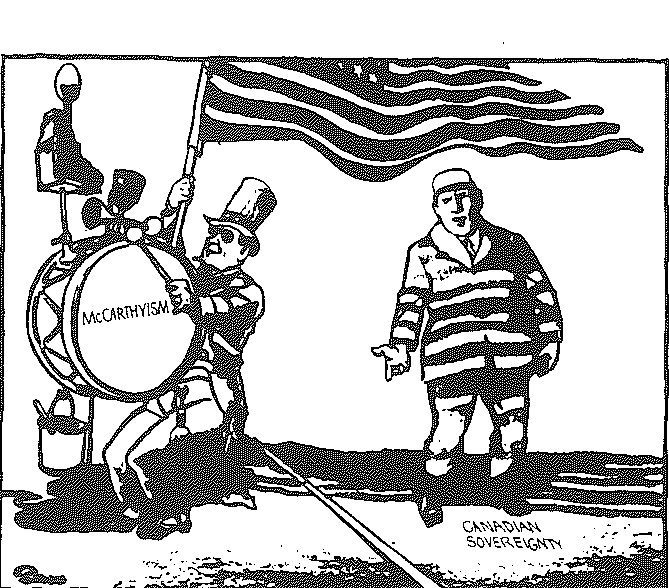
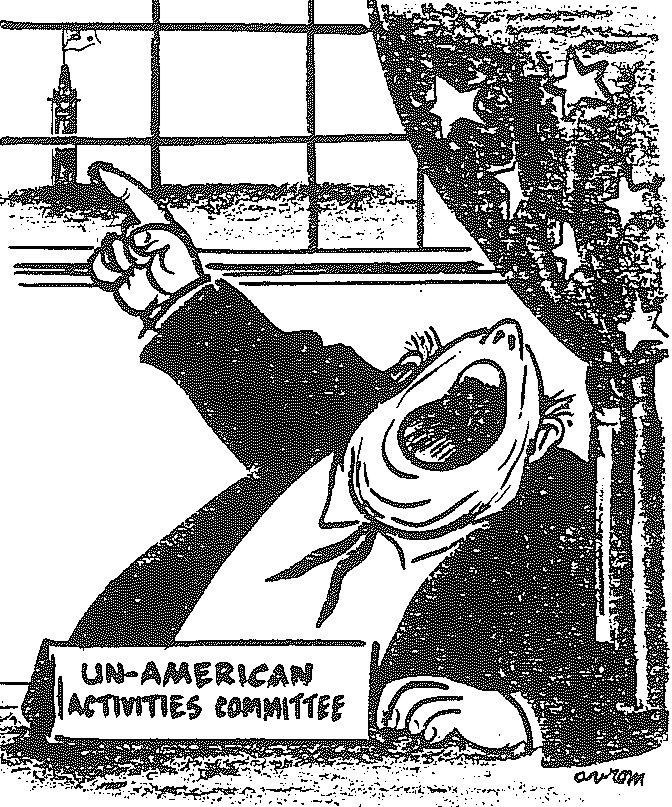
Barros: He could have. But Canadians cannot have it both ways. Canadians say that there was McCarthyism in the United States and unfortunately they are right. There was no McCarthyism in Canada. McCarthyism was an American phenomenon. I grant you that there may have been some-spill-over the border but not the way it was in the United States. In the early 1950s, the St. Laurent government was attacked for being weak on Communism. If Norman had come clean in the first interview he had with Norman Robertson and Arnold Heeney, keep in mind it was one mandarin talking to two other mandarins who are of the same class, had gone to the same universities, the same meetings, clubs and so forth, if he had told them about his indiscretions I think he would have found a sympathetic hearing. That would have been as far as it went and the RCMP would never have gotten involved ever. Let us face it, Norman Robertson, when he was at Oxford, had also ’bitten the apple’ so to speak. But we are not going to say that Norman Robertson was a communist. Even later on in 1952 during the only interrogation that took place with Norman, one of the interrogating RCMP officers threw him the life line by saying to him, “Look you were a Communist in the 1930s. It was no crime then and it is no crime now so admit it — let’s get that water under the bridge and start off now from square one”. But Norman was quite vehement that he was never a Communist. Even though he denied it, in the correspondence between Glazebrook and Heeney, they came to the conclusion that he was a Communist. What bothered them was that there was no evidence that he had ever left. But they gave him the benefit of the doubt. He said that he almost became a Communist. He was a near Communist. It strikes me that as colleagues they were damn generous and very understanding.
bout de papier: But with their own credibility at stake, surely if they had doubts, would they not have pursued it?
Barros: That is the question I raise. Why is it that the government never asked the RCMP to do a full field investigation? They could have gotten around the difficult position they were in by asking the RCMP to do a full field investigation but they never did that. Norman says many things in that interrogation which are not true. For example, he says that he was a student at the University of Toronto in 1935, but he is not to be found anywhere in the records. All these oddities could have been discovered by having a full field investigation. Certainly the greatest oddity is when the German, Professor Karl Wittfogel of Columbia University, a former Communist, testified to Congress that he knew Norman as a member of a Communist study group in 1938. No one ever bothered to call Wittfogel up here and subject him to a a real thorough RCMP interrogation. I suspect that Wittfogel met Norman in 1934 at Cambridge. It is a slip that Norman makes in one of the documents he wrote. He said that he had first met Wittfogel after he had recently been released from a German concentration camp. If he had admitted that he had met Wittfogel at the home of the two men who were his hosts, Maurice Dobb and Roy Pascal, this would have had the RCMP off and running because both of these men were charter members of the recruiting organization for the Communist Party at Cambridge. He would not have wanted to admit that because it would have raised all sorts of eyebrows. So he admits meeting with Wittfogel in Columbia in 1938. Had there been a full field investigation, they may have discovered that he met Wittfogel in 1934. Wittfogel should have been subjected to a very thorough interrogation by the same officers who interrogated Norman.
bout de papier: Are you continuing your research?
Barros: Yes, since I have written the book lots of people have stepped forward with some interesting information. Not so much about Norman but a lot of it about Pearson and I hope to revise the book because Random House intends to put out a revised edition in the United States….
View the original scanned pages →
Originally published in bout de papier, Vol. 5, No. 3 (1987) — Fall 1987 // Automne 1987, pp. 20–23. Read the rest of this issue →



