
bout de papier, Vol. 5, No. 2 (1987) — Summer 1987 // Été 1987, pp. 45–49
Commerce sans frontières by Bernard
Landry, préface de Jacques Parizeau,
Éditions Québec-Amérique, Montreal, 1987,
189 pp., paper, $16.95.
Leap of Faith: Free Trade and the Future
of Canada by James Laxer, Hurtig Pub-
lishers, Edmonton, 1986, 146 pp., paper,
$12.95.
Taking the Initiative: Canada’s Trade
Options in a Turbulent World by Richard
G. Lipsey and Murray G. Smith, C.D. Howe
Institute, Toronto, 1985, 183 pp., paper,
$10.00.
The United States and Canada: The Quest
for Free Trade, an Examination of Selected
Issues, by Paul Wonnacott, with an
Appendix by John Williamson, Institute for
International Economics, Washington, 1987,
173 pp., paper, US $10.00.
Reviewed by Michael Hart
Over the past three years, as Canadians have debated the pros and cons of a freer trading arrangement with the United States, one of the more common themes struck by the media and echoed by opponents has been that little is known either of the issues at stake or the probable consequences of such an arrangement. Nothing, of course, could be further from the truth. Putting aside the fact that the beneficial effect of free trade is one of the oldest and most respected of economic theories and the fact that we are among the last of modern industrialized nations to seek such an accord with its neighbour, there is a rich literature on Canada-United States free trade, much of it from a Canadian perspective. Any gaps that may have existed at the start of the current debate have by now been more than filled as academics, governments and research groups have rushed to organize conferences and seminars, the results of many of which have been made publicly available.
Among the dozens of books published in the past few years on the Canada-US free-trade issues are: James Laxer’s Leap of Faith, Paul Wonnacott’s The United States and Canada: The Quest for Free Trade, Commerce sans frontières by Bernard Landry, and Taking the Initiative by Dick Lipsey and Murray Smith. James Laxer, the well-known Canadian pamphleteer long associated with the left wing of the NDP, has crafted an eminently readable apologia for the negative. Dick Lipsey and Murray Smith reply with a highly readable and persuasive case for free trade; Lipsey is Senior Economic Advisor to the C.D. Howe Institute and Smith was Canadian Secretary to the Canadian-American Committee. Bernard Landry is a former Quebec trade minister. Paul Wonnacott, ex-patriate Canadian A Western view of the tariff question. (Courtesy of t) teaching at the University of Maryland, provides an American perspective.
Before evaluating the contribution of these books, it is worth stepping back and looking at the issues they address from a broad trade perspective. None of the authors can be said to be trade policy practitioners, although all are reasonably familiar with the forest of trade policy if not its trees. What they lack to some extent, and what the debate in Canada lacks, is the long-term perspective of the development of Canadian trade policy. The issues are viewed in terms of today; it is the immediate that is arresting. Yet the compelling reasons which led to the current bilateral trade initiative developed over a period of more than a generation. Understanding this background helps to dispel some of the more egregious nonsense bandied about today.
Throughout the post-war years, the multilateral exchange of rights and obligations of the Winnipeg Free Press) and multilateral negotiations under GATT were the bedrock of Canadian and US trade policy. The GATT proved to be the most efficient means of achieving the fundamental Canadian trade objectives of secure and enhanced access to world markets and a stable international trading order. In each of the multilateral rounds, the Canada-US negotiation was the most important…and the bilateral trading relationship the largest and most significant governed by GATT. For Canada, the achievement of its trade objectives thus depended upon the surety which GATT provided against abrupt changes in US trade policy and on its capacity to continue to serve as a forum for far-reaching and successful trade negotiations.
Few initially questioned the general result of this policy and benefits — the gradual exposure of the Canadian market to more world competition, but particularly US competition, in exchange for better and more secure access to foreign markets. But in the past decade there has developed a growing questioning both of this basic policy thrust and of the means chosen to pursue it. Nationalists like Laxer question whether we want a liberal trade policy and economists like Lipsey and Smith wonder whether the slow pace and incremental achievements of GATT negotiations are enough to provide the required impetus for growth in Canada. A number of developments and perceptions have nurtured this growing polarity in consideration of Canada’s trade policy options.
The first is Canada’s place in a rapidly changing world economy. Canada’s post-war economic wealth was built upon ready markets and the products of an abundant and low-cost resource base. New competitors in developing countries, new technologies in developed countries producing substitute materials and the increasingly higher costs of extraction slowly brought home the truth that Canada’s resource base was no longer an assured source of wealth. More significantly, it became clear that the resource base could no longer finance the maintenance of an inefficient manufacturing economy sheltering behind high tariff walls. Canadians have been able to enjoy reasonable standards of living despite being up to one-quarter less productive than Americans. Canadian manufacturers, hitherto stout opponents of trade liberalization, began to accept that they could no longer prosper from the domestic market alone. But they lacked the secure and free access to larger markets, especially the US market, to invest to achieve economies of scale and specialization.
In each of the multilateral negotiation was the most important…For Canada, the achievement of its trade objectives thus depended upon the surety which GATT provided against abrupt changes in US trade policy.
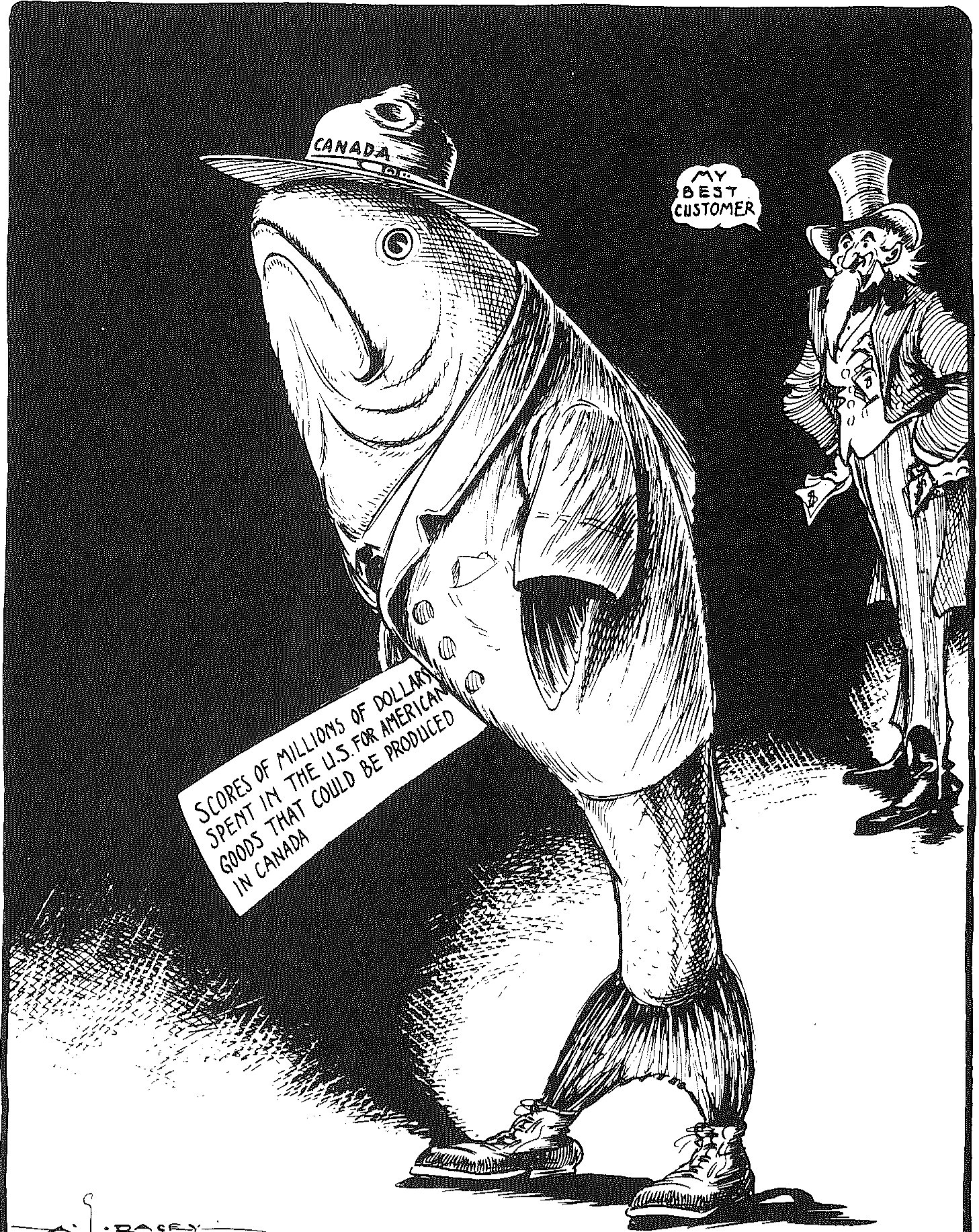
A second development was the growing importance of the ÜS market to Canadian entrepreneurs. At Confederation, Britain was Canada’s premier trading partner, with the United States a distant second, primarily as a source of imports rather than as a market. While the United States as our principal source of imports, primarily food and manufactures, has not changed in more than a century — fluctuating between 60 and 80% of total imports – its role as an export market has grown steadily. Fifty years ago, at the beginning of the modern era of trade liberalization, the United States and Britain each took about one-third of our exports. In 1947, at the establishment of GATT, Britain took 27% and the US 37%. A decade later, the US percentage had risen to the sixties and Britain’s had fallen to the teens. Today, the US takes up to 80% and the UK around 2%. An important feature of this change is that US customers have always been more interested in end products and British customers (and their EC partners today) more in raw materials. The US has always been and remains Canada’s only significant customer for intermediate and end products.
Concurrent with growing dependence on the US market came realization that the US was not necessarily a secure market. The US may initially have led the onslaught against protectionist barriers in the early post-war years, but in more recent years it has been a leader in developing scientific protectionism: anti-dumping and countervailing duties and various other devices meant to ensure “fair” trade, as well as voluntary export restraints, orderly marketing arrangements and similar protectionist departures from market discipline. Additionally, the US introduced Buy America rules and the special regime which shields world agriculture trade from the same rules which apply to trade in industrial products. This protectionist tide gathered momentum in the 1970s and by the mid- 1980s had become a torrent. The combined effect of existing and threatened trade laws, unilaterally determined and applied, made Canadian entrepreneurs, heavily dependent on that market, into firm believers in the need for a new approach to managing the bilateral relationship.
A third development was the perceived breakdown of multilateral rules as surety for investment. The foundation of modern international trade rules among industrialized countries is non-discrimination. The economic rationale for non-discrimination is security of market access as the basis for achieving economic growth through the application of comparative advantage and specialization. The legal expression of nondiscrimination is most-favoured-nation and national treatment, the two basic precepts of the General Agreement on Tariffs and Trade.
In practical terms, however, as articulated in the GATT and practiced by its contracting parties, most-favoured-nation has had a chequered history. In recent years, there has been an epidemic of voluntary restraints and orderly marketing arrangements which deny MFN in all but name. The principle of national treatment has been no less immune from assault. Here the major weapon has been the sumerie an of reare int gention. Ment procurement as well as the application of trade remedy laws to replace tariffs and quotas as powerful and discriminatory instruments of protection.
Whatever the diminishing strength of multilateral disciplines, a further development in reducing support for both the end and the means of post-war Canadian trade policy has been the changing nature of the GATT itself and its capacity to serve, for Canada in any event, as a forum for trade liberalization. Two key factors have been at play.
Developing countries consider the inability to achieve more discrimination in their favour a continuing shortcoming of GATT. They want to tear the GATT down and remake it in their image. The United States, frustrated with GATT’s failures in recent years to respond to US concerns, is turning increasingly to unilateralism.
Since the first round of GATT negotiations in 1947, the GATT has grown from 23 to over 90 contracting parties with a further 30 countries applying the GATT on a de facto basis. Consensus, accordingly, has become much more difficult to achieve. Most of the new entrants are developing countries which have concluded that they benefit from GATT rights only until they become too competitive in traditional products such as textiles, clothing and steel, and therefore accept — perhaps with reason — few of the obligations. These countries, with some notable exceptions, pursue mercantilist trade policies based on import substitution. They are, furthermore, wary of efforts led by the United States to extend GATT principles of non-discrimination into new areas such as services, intellectual property and investment. A further consequence of increased membership and loss of consensus on basic issues has been the breakdown of the contracting parties into regional groups with decisions on what to do resulting from arduous discussions of texts. While industrialized countries, of course, retain the capacity to negotiate within the framework of the GATT, the task of determining negotiating agenda and timetables has become enormously more difficult.
A further factor has been the reduction of developed countries capable of and interested in playing an independent role. During the Kennedy Round, most EFTA countries including Britain, as dependent as Canada upon the multilateral system, were full and independent participants. Together with Canada, they formed a group of smaller countries with whom alliances could be forged on particular issues to combine bargaining power and leverage against the larger countries in pursuit of common interests. During the Tokyo Round, these had been gathered into the smothering embrace of the EC either through accession in the case of the UK, Denmark and Ireland, or through free-trade agreements for industrial products with the EC. Not only were such countries no longer independent participants, but they saw their principal trade policy interest to be the preservation of their preferences in the enlarged European market. Multilateral trade liberalization no longer held the same attraction for them. Today, Western Europe has become one large free-trade area governed by arrangements loosely blessed by GATT but essentially outside it. Only Canada remains as a smaller, wholly independent industrialized country. Even Australia and New Zealand have established a free-trade zone between them.
The positive GATT experience of the past thus appears to have little resonance today and holds even less promise for the future. The GATT has not been what it used to be for almost a generation, even though much trade policy remains grounded in the old reality. GATT has become a residual trade agreement for most Western European countries, whose trade policy is based first and foremost on maintenance of their discriminatory regional arrangements. Together with Japan, they see GATT largely as a tool with which to manage trade relations with the US. Developing countries consider the inability to achieve more discrimination in their favour a continuing shortcoming of GATT. They want to tear the GATT down and remake it in their image. The United States, frustrated with GATT’s failures in recent years to respond to US concerns, is turning increasingly to unilateralism. This is not to denigrate the GATT, but to recognize its limits.
It was the triple impact of a changed domestic economy, a growing dependence on an increasingly protectionist US market, and a perceived erosion in the benefits flowing from the international trading system which triggered questioning in Canada of traditional trade policy. Questions began to be asked in the mid-1970s. It was not until the mid-1980s that these questions matured into policy. Growing US protectionism convinced Canadian business that while their future depended on the US market, their goals could not be achieved on the basis of existing policy. That questioning is reflected in these books. Laxer questions the efficacy of relying on trade for our wealth and fostering a more competitive economy through a steady process of trade liberalization. Lipsey and Smith question the efficacy of GATT as the principal means of negotiating our trade policy objectives. Landry establishes an eloquent case for free trade under any circumstances and Wonnacott’s purpose is to explain Canada’s desire for a free-trade agreement to an American audience.
Let’s start with Laxer; he is both the most interesting and the least informed. He has a populist appeal and his book represents an elegant expression of much of the nonsense fed Canadians daily by the news media; at the same time, he provides a good foil for the pro-free trade arguments of Landry and Lipsey and Smith. Laxer’s strength lies in his analysis of problems. He provides a compelling case both that there is a need for change in the Canadian economy and that there are major structural deficiencies in the US economy. The weakness lies in his almost hysterical criticism of the trade policy prescription and his defense of mercantilist options. To suggest that those who espouse free trade, for example, do so because they see US economic organization as a model is plain silly.
To some Americans, free trade brings forward images of low and unfairly priced goods invading the land of the free and the brave from across the Pacific. To their Canadian counterparts, free trade brings up spectres of an invasion of evil Yankees from south of the border. Yet the issues in both countries are largely the same.
His criticism of the free trade option is in part based on an attack on the neo-classical economists — that is what the neomercantilists call those economists whose theories are grounded in the operation of the market. The arguments are as old as those between Adam Smith and the Physiocrats, except that the detail has become more sophisticated. As such, Laxer provides a Dick and Jane primer for nationalists, trade unionists and others of protectionist persuasion and seeks to clothe their arguments in less nakedly self-interested garb
Much of his case, however, is built on demonstrating that the US model has its own weaknesses, based on an analysis of the US steel and related industries, a sort of rust-belt theory of US economic decline. Taking the same facts, however, one can come to an entirely different set of conclusions. Rather than concluding that the problems in the industrial mid-West resulted from the free reign of the market, it is more credible to conclude that it resulted from an inability to adjust to changing competitive conditions, in part encouraged by government actions, both in the US and abroad, which did not allow markets to work. Protectionist actions such as quotas or special duties or subsidies undermined adjustment. But despite these problems, the United States remains a very productive and innovative economy.
Laxer’s solution to today’s economic problems is to foster the smothering embrace of industrial policy rather than the cold shower of international competition. His advice is to build a wall around the country and become ruggedly self-reliant. He looks forward to a future based on the past: bicycles for transportation, potatoes, turnips and bread for dinner; and Pierre Berton for entertainment. We would no longer need either a trade or an immigration department — we will not be exporting and no one will clamour for access. His case is based on the analysis of fear. It emphasizes the negative problems of change, adjustment and dislocation and ignores the positive dimension of adaptation and opportunity. The most flagrant flaw, however, comes from the conviction that the Canadian economy is large enough to generate within itself the necessary factors for restructuring: capital, resources, a trained labour force, research and development. It ignores the crucial fact that today close to one-third of Canadian wealth is generated by exports of goods and services. Canadian industry cannot survive without benefit of imports and Canadians are not prepared to limit their consumption in order to implement a protectionist trade policy and join the world’s poor.
Not surprisingly, Laxer really doesn’t understand the nature and negative impact of the current wave of US protectionism, which he pooh-poohs and characterizes as the scare tactic of the storm troopers of free trade. While Canada cannot under any circumstances afford a policy of protectionism, the US is large enough to be able to afford, at least superficially, an inward-looking policy for a limited period of time. It would not lead to growth, but its destructive impact would be sufficiently diffuse to be politically tolerable. No one would disagree that in terms of day-to-day, measurable impact, US protectionism is manageable. Its real impact is on investment decisions – business does not thrive on uncertainty and the current US trade regime, as noted above, more than anything else promotes uncertainty. Trade negotiations are not about today’s trade, but about tomorrow’s investment decisions which will in turn generate trade. Government policies in the trade field, similar to other horizontal policies, are geared to influencing investment in productive facilities.
Laxer’s final and overriding straw man is the spectre of loss of sovereignty. It is a nonsensical argument and requires, in order for it to be convincing, that all kinds of unrelated issues be dragged in: social programs, policy harmonization, the dollar, militarism. It is hard to equate sovereignty with the tariff on shoes, a quota on shirts or a health and sanitary regulation for meat. It is an argument without foundation and sorely lacking in perspective. In making it, Laxer and others tend to betray a sad anti-Americanism based on political rather than economic considerations. It is the jingoistic slogan of 1911: “no truck or trade with the Yankees” ’. In order to make his position more respectable, he wraps himself in the flag and counsels multilateral negotiations under GATT, a position wholly inconsistent with his espousal of industrial policy and closed borders.
In her damming criticism of Laxer in the Montreal Gazette, Dian Cohen implored that we read more on this subject than this book. I had. I had read, among others, Lipsey and Smith’s Taking the Initiative including its compelling economic analysis and realistic assessment of the various alternatives. Only a dyed-in-the-wool mercantilist would come to different conclusions.
Methodically, clearly and simply Lipsey and Smith develop the case for a free-trade arrangement. In their first two chapters they sketch the background: a changing global economy and Canada’s troubling prospects They use this material effectively in the third introductory chapter in spelling out the theoretical foundations for trade liberalization and the evidence of empirical research. In part two they map out the options available to meet the problems identified in part one: the status quo, an inward-looking policy (hello, James Laxer), the “third option” of trade diversification, the aggressive pursuit of multilateralism and, finally, bilateral free trade. With each option, they develop the pros and cons which in each case point to the next option until we are left with the single choice of bilateral trade liberalization. It in turn is examined in terms of a number of sub-options: sectoral free trade, functional free trade and comprehensive free trade. The latter option is then given detailed treatment in the next five chapters, addressing the issues and the political, economic and cultural objections that have been raised. This is done convincingly. To add to their credibility, Lipsey and Smith map out what they see as the negotiating agenda and how many of the issues could be resolved. This section, however, is less credible, reflecting that the book was written more than two years ago and the fact that neither Lipsey or Smith has the kind of experience which would allow them to deal with such issues of detail.
But in their single-minded zeal to demonstrate the logic of the free-trade position, Lipsey and Smith leave the impression that Canada has no alternatives, that we are almost driven to petition the US government to grant Canada a free-trade agreement. Nor is this an issue which serves only Canadian interests. This approach helped the structure and logic of the book, but leaves an uneasy feeling. There are options and alternatives. If free-trade negotiations do not succeed, Canada is not left in an untenable position. Multilateral negotiations will continue and provide a less optimal but real basis for the pursuit of Canada’s trade options. Similarly, the US also has vital interests in an agreement with Canada. These ensure that any agreement would provide for balance and give Canada sufficient bargaining leverage to pursue the Canadian interest. Lipsey and Smith would have been more convincing to the less committed if they had devoted more space to this dimension of their case. But for a short, simple and convincing introduction to the subject, there is no better.
A further antidote to the reasoning of the economic nationalists, protectionists and other opponents of tree trade is provided by Bernard Landry. Rather than relying on economists associated with the business establishment, we have here the analysis of an admitted nationalist. His work is imbued with common sense and conviction and suggests that there is a wide gulf between a Quebec nationalist and a Council of Canadians’ nationalist when it comes to economic analysis.
Landry set out to write a book for the layman, a book which would place the issues into perspective, cast some light on the mysteries of GATT and trade-policy making and generally demonstrate why the Canada- US trade initiative makes sense. He found when being interviewed as Quebec trade minister that normally well-informed journalists were at sea when it came to GATT and related issues. He concluded that much of what ministers and government officials take for granted is so much gobbledegook to the man on the street. His book tries to fill this gap in understanding.
Like Lipsey and Smith, Landry builds his argument systematically, although the logic of it was at first confusing. He starts by explaining what free trade does not mean by contrasting two extremes: the free movement of all the factors of production (capital, technology, people, services and goods) versus protectionism (barriers which prevent or frustrate the movement of the factors of production). He argues that a free-trade agreement would be less than the first but a healthy step away from the day-to-day protectionism governments practice, even within Canada between provinces.
Landry next turns to the positive and defensive reasons for pursuing free trade – the economic case and the protectionist threat. Unlike Lipsey and Smith, he is able to draw on two years of debate and address the fears and myths which have appeared at times to dominate it — beer, agriculture, adjustment, social programmes, culture, the environment — and demonstrate their peripheral nature. He is thus able to put the naysayers — Ontario, the NDP and the trade union movement — in their place, as only a populist politician can.
His examples are drawn from everyday experience and explained in popular language. The result is a book which is credible and convincing for the average reader but which is at times misleading and inaccurate to the more specialized reader. Landry’s arguments are basically sound, but he is a little shaky on some of the technical details (e.g., the GATT was not signed by 90 signatories from the outset but started with a more modest 23 members in 1947; the Kennedy Round anti-dumping code did not introduce international discipline on dumping but codified existing practice provided for in GATT article VI). The book would have benefitted from some careful editing.
And what of the American perspective? Are Americans participating in the debate? Why is the US now interested in bilateral free-trade negotiations? Some of the reasons are the same; others are not. US interests include both the traditional agenda of any trade liberalization discussion (tariffs, customs procedures, non-tariff barriers such as licensing and technical regulations, import and export quotas, government procurement and dispute settlement) as well as newer issues such as enhanced protection of intellectual property (copyright, patents, trademarks), more open and secure investment conditions, and new rules to govern trade in services. Viewed from another angle, US interests include both issues of significance in the Canada-US context (largely the traditional issues) and issues of greatest importance in a global context (mainly the new issues). Unfortunately, we do not find this kind of anlaysis in Paul Wonnacott’s book. He does not address the economic and policy reasons underlying US interest in bilateral negotiations. What Wonnacott does is examine the Canadian case through US eyes. Within these limitations, his work is a timely and useful analysis.
Wonnacott also writes for the more specialized reader. He thus feels no need to debunk the myths or demonstrate that free trade is a good thing. He can begin with a survey of the real issues: tariffs, non-tariff barriers, trade remedy law, services and investment. This is followed by a quick review of the history of Canada-US trade and previous negotiating attempts. He then turns to a detailed, technical discussion of the gains from free trade for the US and for Canada in a manner which the non-specialist can understand
This background material sets up the heart of the matter: why Canada decided to proceed with a bilateral initiative at this time and the central importance of trade remedy law or contingency protection in the negotiation. Not only does he sketch the background and underpinnings for Canadian and US approaches to this issue, but he offers a range of interesting solutions for the most troublesome dimension: subsidies and countervailing duties. He suggests that an ambitious approach – regulating subsidies and eschewing countervailing duties — could be attained, but only after experience has been gained with bi-national rule-making and after there is clear guidance on what are acceptable and unacceptable practices.
Having examined the most crucial issue from Canada’s perspective, he next turns to the potential coverage and elements of a possible agreement and hazards a guess at what could be achieved in 1987:
• elimination of all tariffs, with some agricultural exceptions, over five to ten years;
• a narrowing of differences on trade remedy law, ie., the establishment of different standards for Canada as a transitional step towards a more ambitious package as experience is gained with the agreement;
• national treatment for government procurement at the federal level with some opening of state and provincial procurement;
• rules governing trade-related investment issues;
• a statement of general principles on services; and • establishment of a bilateral commission. Such a limited package he believes to be attainable in 1987. It would provide a basis for further negotiation on the more ambitious demands of the two governments in the areas of trade remedy law, services and investment in the future.
Wonnacott’s major fault may also be his strength: his assessment of a possible agreement is far from being as ambitious in scope, reach and coverage as Lipsey and Smith and Landry. He thus reflects US prejudice. While US readers deserve a fuller explanation of why Canada is seeking an agreement ambitious in scope, broad in coverage and imaginative in design, Wonnacott’s more cautious package may be the more realistic. Perhaps before critical decisions are taken, other US sources will fill the gap. For now, we will have to be satisfied with Wonnacott’s sober assessment and cautious point of departure.
And is there debate in the US? One of the distinguishing features of the discussion of free trade policy on both sides of the Canada-US border in the 1980s is that while both sides talk of free trade, the debate is entirely different. Americans debate the issues of free trade, fair trade, competitiveness, industrial obsolescence, etc. without a single reference to Canada; their concern is both domestic and world-wide. Canadians are incapable of conceiving the issues without reference to the United States; their concerns are consumed by the bilateral dimension. To some Americans, free trade brings forward images of low and unfairly priced goods invading the land of the free and the brave from across the Pacific. To their Canadian counterparts, free trade brings up spectres of an invasion of evil Yankees from south of the border. Yet the issues in both countries are largely the same: what public policies are required to nurture competitive economies for the future capable of meeting the challenge of a global economy and economic interdependence as well as the transition from labour-intensive and resource-based industries of the past to the knowledge-intensive industries of the future. But let’s leave all that for another review. Suffice it to sway that they too have their patriots. Even Americans believe they have something to fear from world competition. Their bogeymen are in Europe, Japan and the Third World. The arguments, however, are the same.
View the original scanned pages →
Originally published in bout de papier, Vol. 5, No. 2 (1987) — Summer 1987 // Été 1987, pp. 45–49. Read the rest of this issue →



