
bout de papier, Vol. 5, No. 2 (1987) — Summer 1987 // Été 1987, pp. 35–38
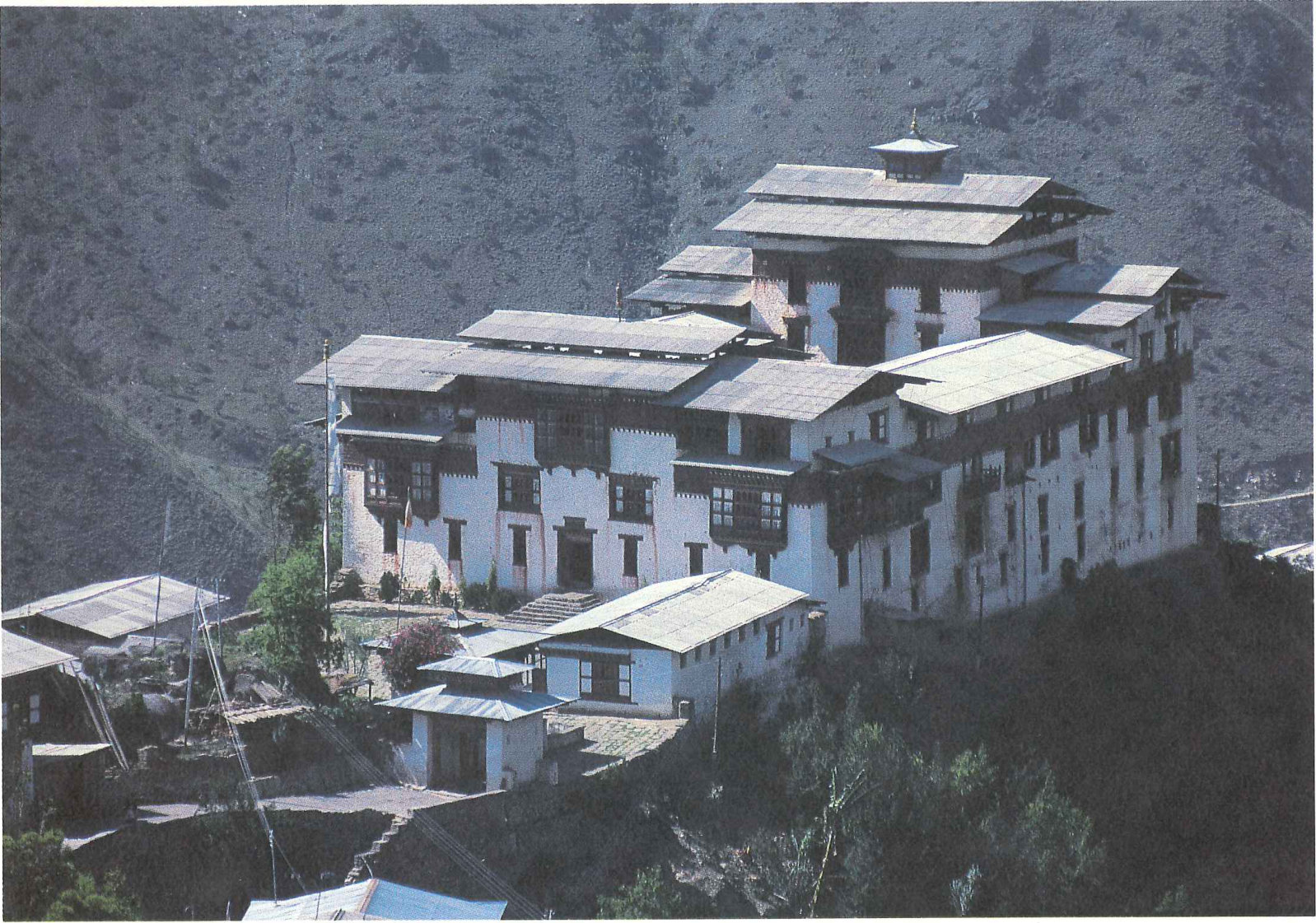
Bhutan is a country which has long held a strong personal appeal, due to its reputation for scenic beauty and for its legendary isolation. A land of massive dzongs (fortress monasteries unique to Bhutan and Tibet) under the shadow of the highest mountain range in the world. A place where the practice of lamaistic Buddhism is still deeply entrenched in the society.
During the course of my consular work at the Canadian High Commission in New Delhi, I had become familiar with a small and diminishing group of Canadian Jesuits who came as teachers and missionaries to Darjeeling and environs in the immediate post-war period and who, since Indian independence, have been “staying on” in the foothills of the eastern Himalayas. As the political and bureaucratic climate in India became more hostile to missionaries in the 1960’s and 1970’s a few of the Jesuits moved to nearby Bhutan — a country which even now proudly maintains part of its lifestyle in a bygone age but which back in the 1960’s was just beginning to emerge into the modern world. I decided to visit this small and intriguing coterie of Canadian residents as an ad hoc exercise during my FSD 50 travel leave in 1985. One of the Jesuits was living in Thimphu. The others were located in small villages in the remote eastern part of the country.
I was fortunate to be able to secure an official invitation to visit Bhutan, but without the concomitant restrictions of being a formal guest and thus encumbered with an escort. My objective was to travel solo across the high road of Bhutan from the capital of Thimphu to Tashigang dzong in the east of the country, then south to visit the villages where the Jesuits were living and ultimately to leave the country through Assam. The Thimphu to Tashigang road alone is over 550 km long, cutting against the natural north-south grain of the land, and traversing six mountain passes at elevations of 10,000’-14,000’. It is one of the most spectacular road journeys in the world.
I flew to Bhutan on Druk Air, the national airline, from Calcutta to the airstrip at Paro on an 18-seater Dornier aircraft (this was half of Druk Air’s fleet). There are no pretensions to grandeur on Druk Air. A crusty sandwich in a cardboard box and a cup of coffee passed from a thermos bottle was the extent of the service. Most of the flight time was spent over the flat plains of Bengal, although during the last thirty minutes the flight followed a beautitul course over the green hills and isolated settlements of southern Bhutan.
Paro airport is a typical introduction to the low-key style pervasive in Bhutan — no security, no baggage check, no customs formalities and only a couple of soft-spoken Bhutanese as immigration control who stamped the passport. Given that the country is one of the most difficult to visit for a low budget individual traveller the process seemed remarkably relaxed. The visa restriction is in fact the major control. Once in the country there are few limitations and one could move with relative freedom throughout the country.
Druk Air provided a free mini-bus service from the Paro valley to the capital of Thimphu located about two hours drive away. There I had the good fortune to meet my benetactor in getting me into Bhutan, the irrepressible Father Mackey. He had been living in Bhutan for over 23 years and virtually single-handedly established the present educational system in the country. His stature is so high that he has been given Bhutanese citizenship and been awarded the highest honour in that country, the “beloved Son of Bhutan”
We spent several days together at his small home in Thimphu, discussing such weighty matters as the most scenic valleys, Buddhist monasteries and hiking trails in Bhutan, over considerable quantities of chang (a form of home brewed beer popular in the Himalayas) and scotch. Thimphu is a new town built in the 1960’s, but retains much of the colourful architectural style which is characteristic of the country. The population is around 25,000 and it is by far the largest settlement. During my stay I took the opportunity to hike to a couple of isolated monasteries in the valleys to the north of the town. One local Bhutanese told me that the monks in one of the monasteries are reputed to practice levitation, a phenomenon which I did not witness. The rest of my time was spent wandering in the quiet streets of Thimphu, drinking tea in Bhutanese homes, and plotting my route east by public transport.
Transport in Bhutan falls into two categories. There are Japanese vehicles and jeeps for the foreign aid workers and wealthy Bhutanese, and much more spartan Indian trucks and buses for the masses. Twice weekly there is a “bus” which leaves from Thimphu, taking two days to travel halfway across the country to Bumthang, with an overnight stop in the old dzong of Tongsa. It also crosses three of the six mountain passes. With my time in Thimphu drawing to a close I booked the next bus east, leaving early the next morning.
I left Father Mackey’s house before dawn in the chill air of a Thimphu morning and walked to the bus, which left from the back of the main post office. The Royal Bhutan Mail Service Bus looked like a cross between a cattle truck and a small town fire engine. The boarding process was typical of much public transport in Asia, with lots of commotion and bustle but with a relaxed view to the announced time of departure. All and sundry eventually squeezed into the bus along with prodigious amounts of cargo, and a couple of hours after the scheduled departure time the bus struggled its way out of Thimphu. Within ten minutes of leaving town as we began the long ascent to the Dochong La, the first of the mountain passes we were to cross, the engine started wheezing. We were only twenty km out of Thimphu when the engine made a few pathetic coughs and then died. Everybody piled out of the bus while the driver and his young sidekick spent the better part of two hours pulling various pieces of metal out of their engine, looking quizzically at each piece and then putting it back. I have usually found it better not to observe this ritual, particularly on mountain roads with terrifying precipices, as one’s already tenuous confidence in surviving the journey is usually further unnerved.
Two hours later the driver and his sidekick had reassembled the various bits of the engine and put them back in the bus, minus one piece which didn’t fit back in. With a shrug the driver indicated to the passengers to get in. Despite some reservations, the passengers nervously squeezed back into our battered vehicle and we slowly climbed up to the top of the first of the passes, the Dochong La. As in virtually all parts of the Buddhist Himalaya there were prayer flags and stone cairns as we pulled to the top and stopped. The view of the Bhutan Himalaya from the pass was breathtaking with a clear view of the mountain peaks from Sikkim through the impressive peaks of Chomolhari and Kula Kangri all the way to smaller peaks of the Assam Himalaya in Arunachal Pradesh.
The bus then continued along the road’s winding course and we stopped for shorter or longer periods at each small settlement, ostensibly for tea and biscuits, but actually so the bus driver could chat with one of his friends. Mercifully the brakes seemed to be functioning adequately, if noisily, and the passengers’ collective anxiety about the bus trip began to fade.
Two striking aspects of Bhutan, in comparison to other Himalayan regions, are the relatively low density of population, and the lush forest cover in the hills. We would pass through stretches of dense vegetation with virtually no signs of habitation. This is in striking contrast to the situation in other regions such as Nepal and northern Uttar Pradesh where the ecological devastation of overpopulation, soil erosion and destruction of the forests is turning parts of the Himalaya into environmental disaster areas.
We stopped for lunch at Wangdiphodrang, a spectacularly situated dzong on a cliff overlooking a river gorge. The route beyond took us over the Pele La, an 11,500’ pass inhabited by a few yaks overshadowed on the north by 20,000’ peaks. With the late afternoon sun beginning to fade we arrived at Bhutan’s most dramatically situated dzong at Tongsa, on a cliff hundreds of feet above the Manas river gorge. Tongsa is the original home of the Royal family. The current king, Jigme Sigme Wangchuk, is fifth in line since the consolidation of Bhutan under the leadership of the royalty in 1907.
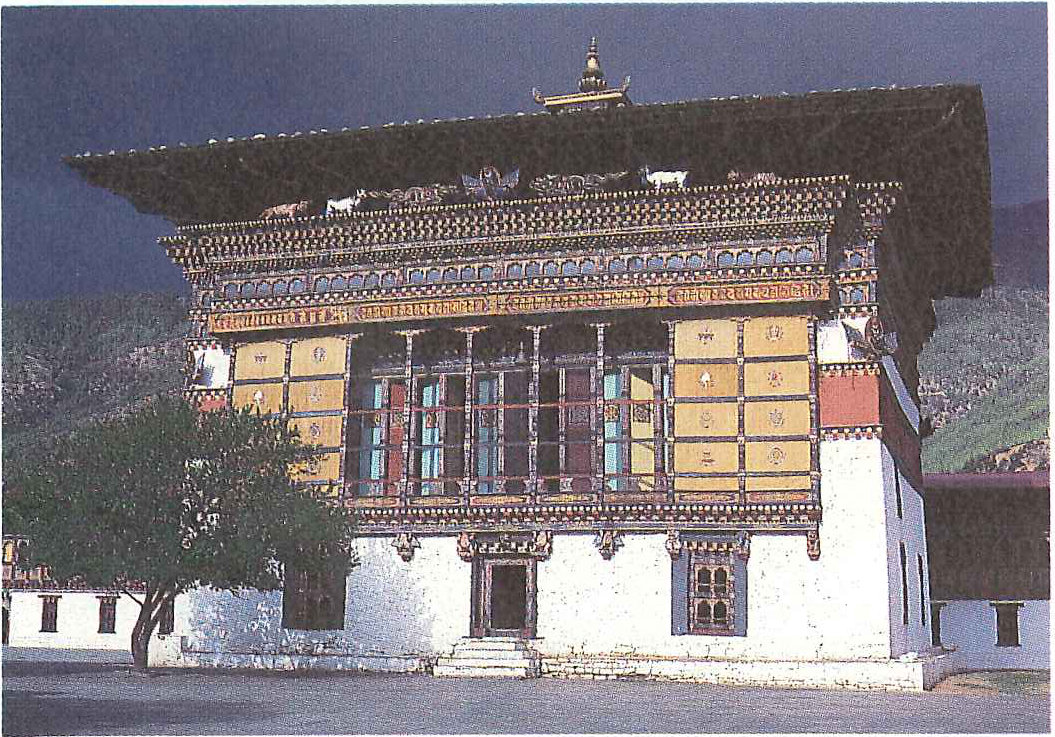
I walked up to the elementary school located on a hill above the village and talked to a few of the teachers (a preponderance of whom were from the tropical Indian state of Kerala) who offered me a place on their floor to roll out my sleeping bag. We spoke about life in Bhutan, drinking chang and talking late into the night huddled together on a bench by candlelight. Most of the teachers were homesick for India and dreaded the Bhutanese winter in the mountains. Their complaints focussed less on the cold weather conditions than on the lack of food in the winter months.
The following day the bus left at dawn to climb up yet the third of the mountain passes, the Khardong La at 11,200’ separating Tongsa from the 9,000’ Bumthang valley. We arrived in the early afternoon at the tiny settlement of Bumthang at the centre of a wide valley clustered underneath the impressive Jakhar dzong. There were a number of small shops and tea houses operated by Tibetans who had arrived as refugees in the late 1950s following the abortive revolt by the Dalai Lama against the Chinese occupation of Tibet.
I had been advised that the next stretch, from Bumthang to Mongar over the highest pass, would be the most difficult as there is no regular public transport and very little traffic. Just how difficult it might be became obvious after I arrived.
On arrival I asked around in the tea shops and bazaar to see if there were any trucks or vehicles going over the pass to Mongar.
All those I asked shook their heads gloomily and said it would be very difficult to get across. No truck, no jeep, no landrover, nothing. Not today, nor tomorrow.
A young school student gave me the most depressing reply, “Maybe in October”
I made my way to the small Swiss Guest House which is situated on a hill overlooking the valley. The various aid donors have carved up Bhutan into various areas and’one of the Swiss aid organizations “has” the Bumthang valley. Normally, aid workers in remote areas welcome the chance to meet other people but not this crew. They had a reputation in the valley of being clannish, sullen and unfriendly, a sentiment I was to come to share in the course of my time in the Bumthang valley.
Each day followed the same pattern of going to the bazaar to ask about vehicles going to Mongar only to get the same uniformly negative reply. There are certainly worse places to be temporarily marooned, so I would pass the afternoon hiking to nearby villages. On the third day in Bumthang I witnessed an archery competition which brought together people from all the surrounding valleys.
Archery is the national sport and the obsession of Bhutan, with most male Bhutanese learning it at a young age. The target, a tiny bullseye on a wooden peg is placed nearly 200 yards from the archers, more than three times as far as the distance used in Olympic competition. These archery competitions are social occasions where the Bhutanese come to meet friends from nearby villages for competition, fun and more than a little revelry. The competitions are animated affairs with spectator involvement, impromptu ritual dancing and voluminous amounts of alcohol consumption.
After four days the Bishop of Darjeeling, whose parish is responsible for Bhutan, came to Bumthang and very kindly offered to take me across the Thumsung La as far as Mongar. The first forty km out of Bumthang were a gentle ascent to the next pass, the Ura La at 11,500’. Shortly afterwards we passed the small village of Ura and began the roughest traverse of the journey. The road was in appalling condition — a seemingly unending quagmire of mud and rocks. At several points we had to get out in the rain and assist our landrover slither over a particularly muddy or rocky stretch. We finally reached the crest of the Thumsung La, the highest pass on the route at an altitude of over 14,000’ in pouring rain. The various construction crews, almost all tribal people from Orissa and Bihar, huddled in miserable hovels in the cold.
The descent from the pass was an equally grim quagmire for the first thirty km but then gradually began to improve as we lost elevation. There were a couple of spectacular waterfalls cascading down the mountain slopes in the almost totally deserted landscape. As we descended further the weather began to clear and we gradually emerged into a countryside quite different from the region to the west of the pass. The land was steeper and more rugged and, to my surprise, more densely populated. The ethnic group in Eastern Bhutan are the Shashups — distinct in language and culture from the Dzonkhas who predominate in the west. At the end of a rather long and tiring journey we finally arrived in the small village of Mongar.
Mongar has probably the least impressive dzong in Bhutan although it does command a splendid view of the Lhuntsi valley veering north in the direction of Tibet. Mongar, like most of the villages of Bhutan, consisted of little more than the dzong, a school and a few basic commercial enterprises in various makeshift structures. The higher population density and lower quality of the land has meant that the standard of living for the people of East Bhutan is lower than in other parts of the country.
Two days later I was off again by a local bus for the last leg of the horizontal traverse across Bhutan over the final pass, the Karo La, at just under 10,000’. In six hours we finally reached the easternmost dzong in Bhutan — Tashigang — situated on a knife edge ridge high above the confluence of two rivers. In Mongar and Tashigang I was able to stay at the Royal Bhutanese guesthouses which provide simple yet comfortable accommodation in traditional style for a reasonable $2 to $3 per night.
The east of Bhutan has recently seen the influx of a new group of young Canadians who are teaching at schools under a contract with the World University Services of Canada. There were only six in place (one in Mongar and five around Tashigang) when I visited, but there were plans to expand the eventual number of Canadian teachers to fifteen. Most had found the initial months difficult, a couple almost unbearably so, but over time most were gradually getting used to the quiet and very isolated ways of east Bhutan.
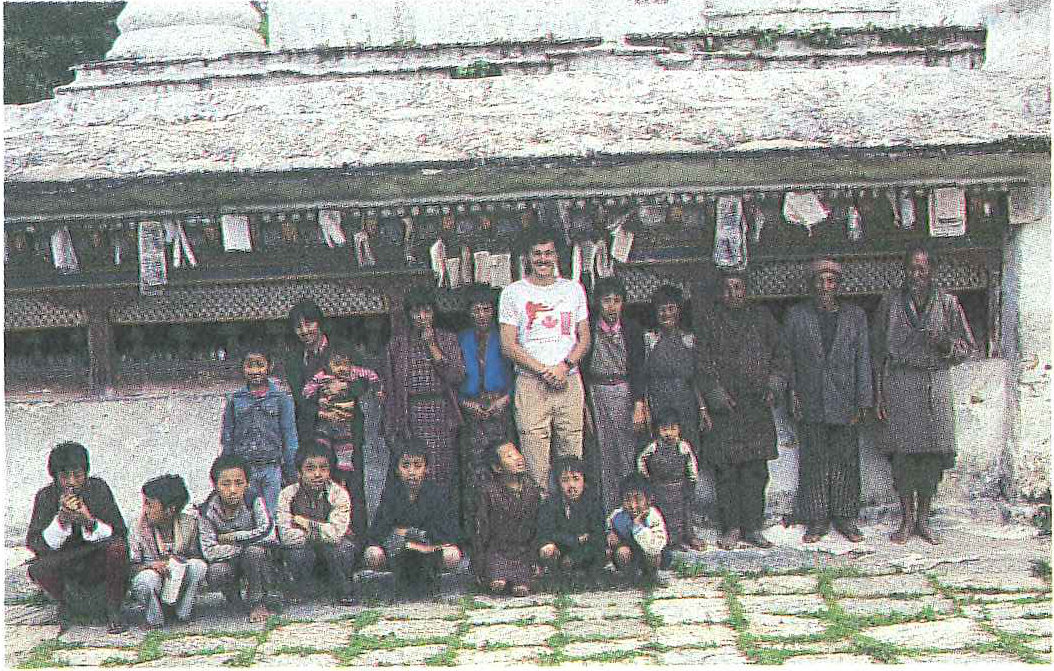
From Tashigang, I headed south to Kanglung along the road which leads eventually to the border town of Sandrup Jonkhar. The village is the location of the only post secondary education facility in Bhutan, Sherubtse College, set up yet again by Father Mackey. There were three Canadian Jesuit fathers working in Kanglung or nearby and they exerted a powerful and benign influence on the native Bhutanese. All of the Jesuits had been in the eastern Himalayas for at least twenty years, although they had come to Bhutan in the last ten years.
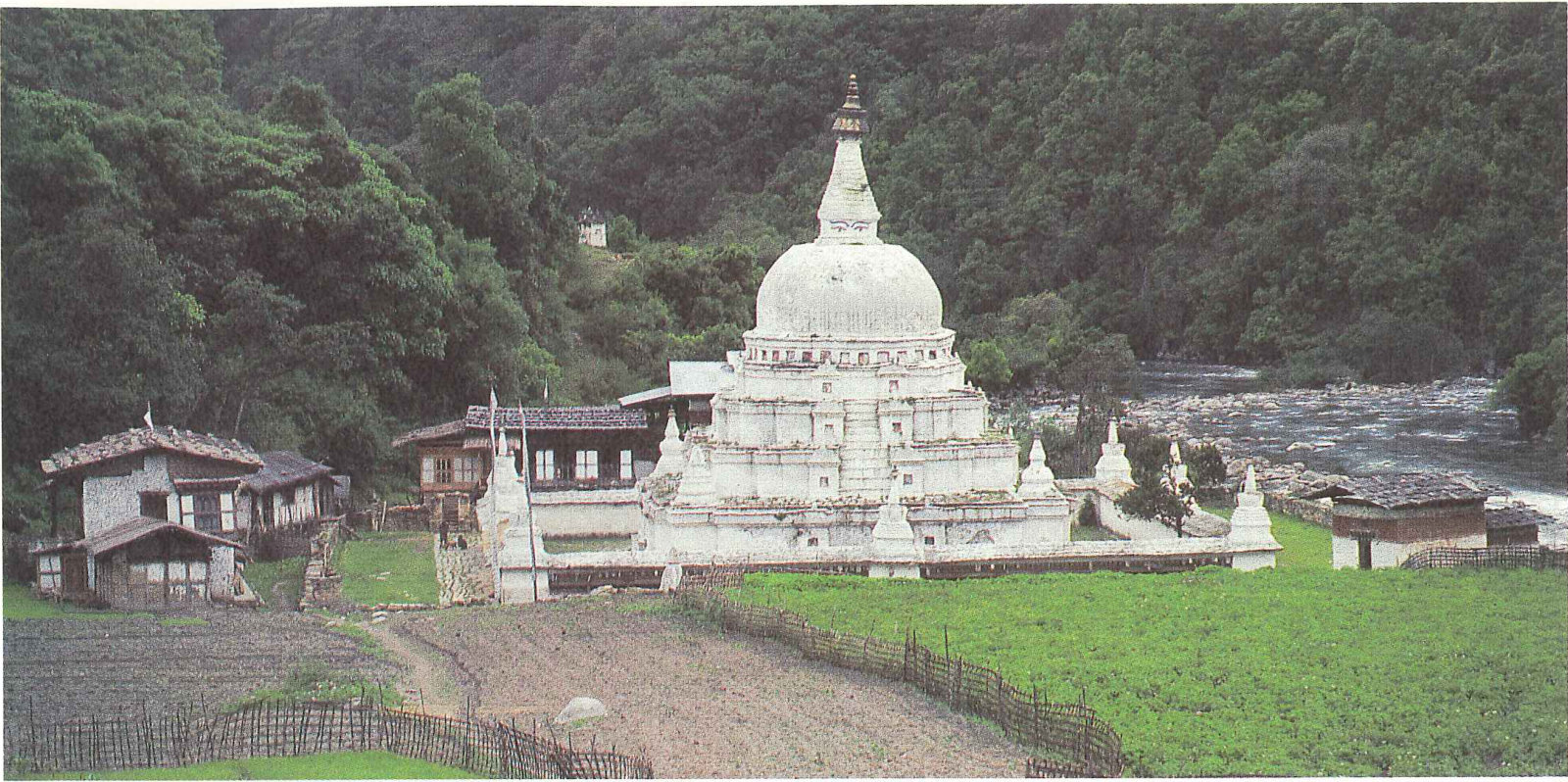
The days in Kanglung presented ample opportunities for hiking and exploring. One of the most interesting excursions involved following a small winding road north of Tashigang close to the border of Tibet where there is the small dzong of Tashiyangtse and, even further north, the isolated Chorten Kora (a Buddhist monument) beside a fast-flowing mountain stream. I had to repress my natural instinct to keep walking amidst the mountains and on to Tibet and Arunachal Pradesh. Unfortunately the area remains a sensitive military zone.
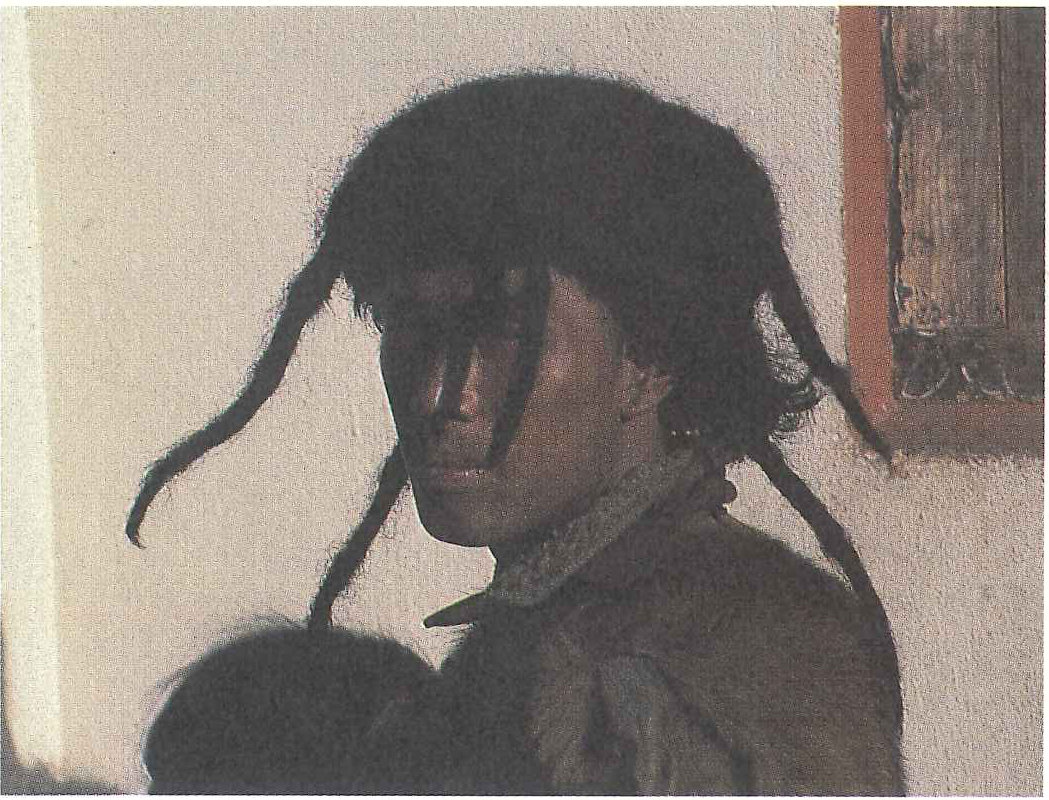
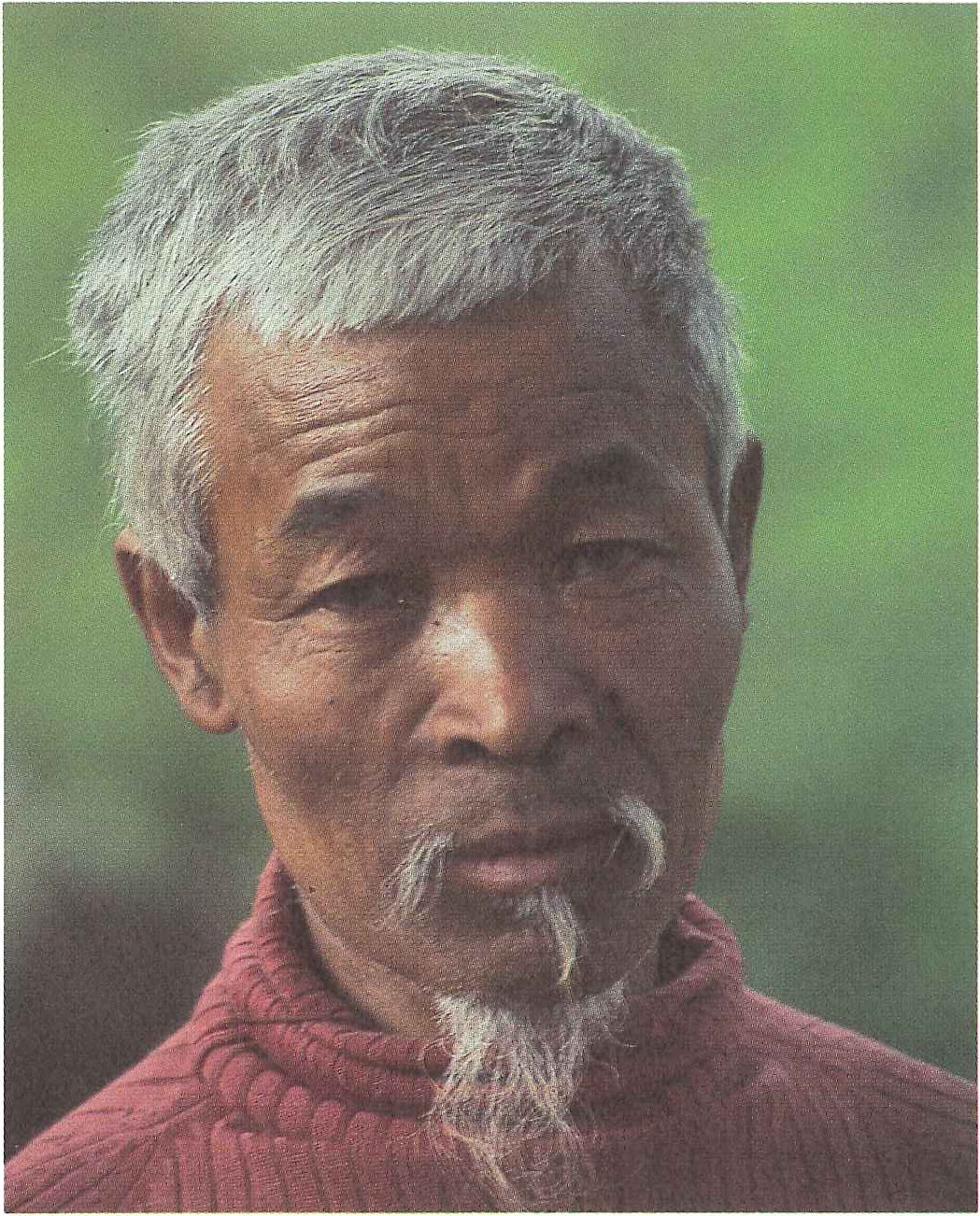
Tashigang and Kanglung were enlivened by the presence of a number of Brokpas, a wild, nomadic and boisterous people who still dress in sheep and yak skins and wander freely over the mountain passes between Tibet and Bhutan. Their home is located three days walk from Tashigang in the Sakteng valley. Among the most distinctive parts of their garb is a felt beret made of yak hair with “dreadlocks” hanging down their face and ears ostensibly to keep the rain from falling on their heads.
A few days later I hitched a ride south from Kanglung to Khaling where there was also a small resident Canadian coterie teaching at the public school. Khaling is also the location of the Blind Institute so the village was full of blind children. One of the Jesuit Fathers in Khaling, Father Perry, mentioned that he would be sending a vehicle into Assam to pick up some badly needed school and medical supplies. He offered me a ride in the vehicle the following day and I gladly accepted.
The road passed along side of a river for much of the way down and as we descended in elevation the vegetation became ever more lush. About 30 km before the border town of Sandrup Jonkhar we reached the town of Deotang where we had a clear view of the end of the hills (and Bhutan) and the beginning of the vast Brahmaputra valley which dominates Assam.
Sandrup Jonkhar is very much a border town dominated by Assamese and Bengalis. There has been a small building boom of late which has not made the place (a grubby dump of a town at the best of times) any more attractive. The town and the Indian border village to the south of it are well known haunts for students of eastern Bhutan who frequent its low-priced brothels.
We left the next day for Gauhati, the capital of Assam, crossing the sleepy Indo-Bhutanese border at the edge of town. The shimmering heat of the plains of the Brahmaputra basin began building up as the sun rose higher in the sky. Behind I could see the diminishing green carpet of hills and mountains which we had just left. Ahead, presuming we survived the onslaught of Indian trucks barrelling towards us on the road, lay Gauhati, and then Calcutta — the ultimate manifestation of urban chaos and frenetic high energy. I hoped I could count on the residual internal serenity which had been induced by my time in Bhutan.
Twenty four hours after leaving Bhutan I was in one of the squalid slums of Calcutta, squatting on the sidewalk, being shaved with a rusty straight razor by one of the local street barbers. Looking north I saw not the familiar sight of snow capped mountains but a sea of humanity crossing the Howrah bridge over the muddy Hooghly river.
No matter. Bhutan’s magic lived on.
View the original scanned pages →
Originally published in bout de papier, Vol. 5, No. 2 (1987) — Summer 1987 // Été 1987, pp. 35–38. Read the rest of this issue →



