
bout de papier, Vol. 4, No. 4 (1986) — Winter 1986 // Hiver 1986, pp. 20–21
Their enthusiasm runneth over. They treasure the experience of researching revisions to the Canadian widget export policy. They eagerly volunteer for prestigious assignments such as developing a left-handed architect exchange policy for the upcoming Canada-Ruritania Bilateral Commission. They all yearn to draft the perfect memorandum, but content themselves for the moment with dotting the i’s and crossing the t’s of documents prepared by their superiors.
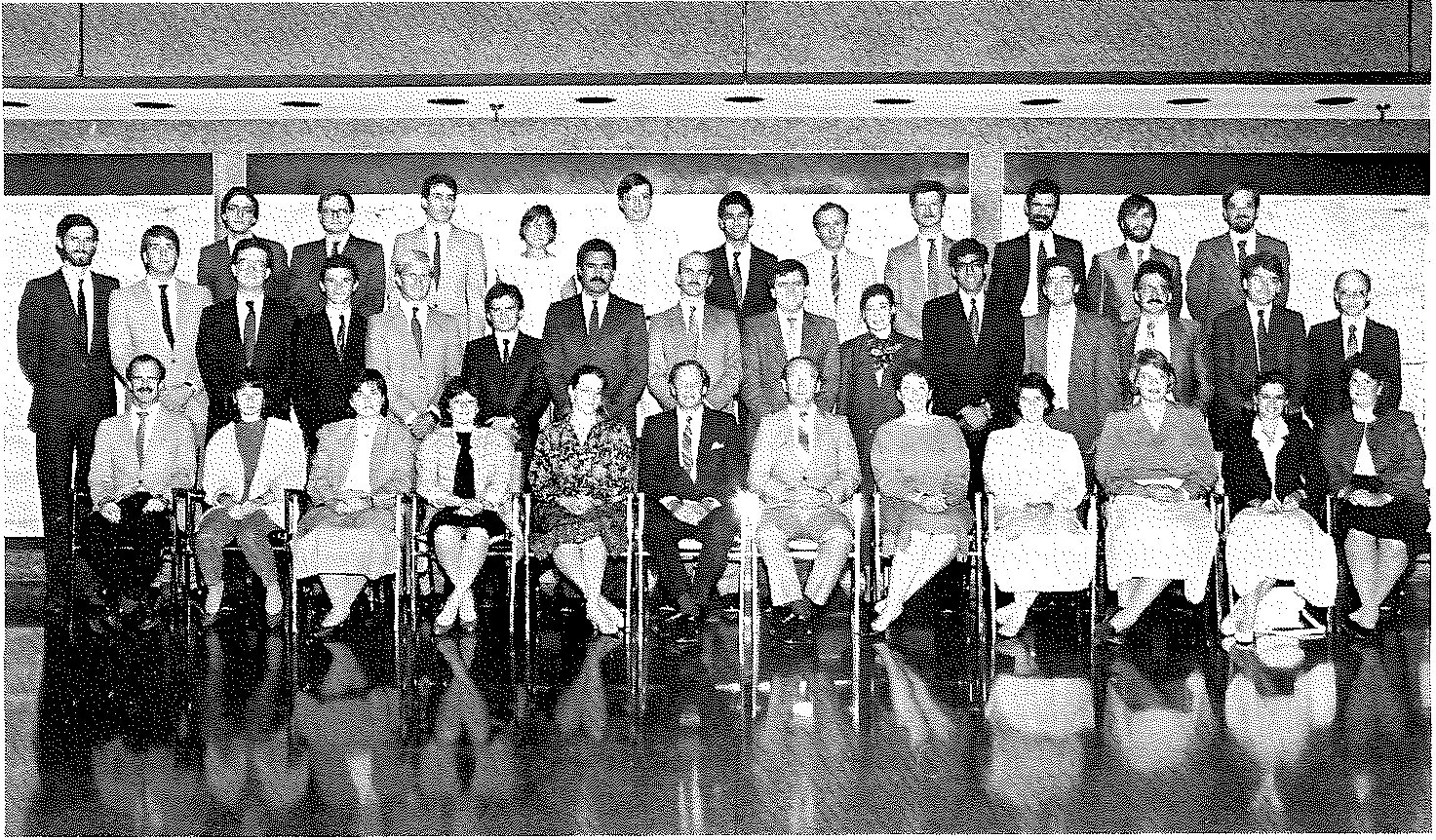
They are the newly-hired Foreign Service Officers – Level 1 (Developmental), commonly referred to as “FSIDs” in a department with a passion for acronyms. By mid-November 1986 they numbered 38, and represented the first significant infusion of new blood into External Affairs since the massive 1982 recruitment. The Development Aid Stream accounts for three of the new officers, the Trade Commissioner Service and the Social Affairs Stream each have 11, and the Political/Economic Stream has received a lucky 13 FSIDs.
Ranging in age from early 20’s to middle 30’s and drawn from all 10 provinces, this year’s recruits contribute a broad range of skills and interests to the foreign service. In their university years they specialized in such disciplines as economics, law, communications, history, political science, languages, international relations, development studies and public administration, many at a graduate or even post-graduate level.
What leads otherwise normal young men and women to surrender their innocence to the vicissitudes of life in the Canadian Foreign Service? Reasons vary greatly across streams and among individuals. One new officer caught the diplomatic bug after several years as a locally-engaged employee of the Canadian Embassy in Paris; another decided to follow the path of his father, a seasoned diplomat; and several decided to take the plunge after satisfying experiences of overseas study or work.
Among the most common motivations voiced are the excitement of foreign postings, the attraction of continuously changing and challenging assignments, a keen interest in international relations, a desire to contribute to the shaping and execution of Canadian foreign policy, and the expectation of high job satisfaction. Not surprisingly in days of budgetary restraint, none of the new recruits mentions high salaries as an incentive, and indeed some accepted cuts in their annual income ranging from several hundred to $12,000.
Public service hiring freezes produced an 18-month waiting period from the writing of the foreign service exam in October 1984 until the mailing of the first job offers in March 1986. Some candidates waited even longer as the department sought authority for additional person-years.
This unanticipated delay in hiring coupled with a generally more mature age configuration among new officers has resulted in a group with more extensive work experience than in previous years. The new recruits have proved their mettle in CIDA and other federal government departments, consulting firms, the House of Commons Page Program, business associations, legal practice, the Parliamentary Intern Program, and various non-profit organizations.
At least two-thirds of the new entrants are at ease in both official languages, and at least half as many are fluent in one or more additional languages, such as German, Italian, Russian, Spanish, Japanese, Urdu and Portuguese.
However, most useful to them at this point in their careers are those qualities that assist them to smoothly integrate themselves into a large and complicated bureaucracy, and when all else fails, a sense of humour and an ability to laugh at one’s mishaps. Below is a selection of anecdotes from the FS1Ds that reflects those first difficult weeks in the trenches.
“Over 18 months I tackled the foreign service examination with gusto, I underwent two intensive interviews replete with probing questions and role playing, I submitted to a battery of medical tests and a psychological examination, I spent hours filling out forms for an exhaustive security investigation, and I witnessed two federal hiring freezes that taught me the virtues of patience.
“I thought this entire rigorous process must be deliberately designed to test my ability to sustain the stress of a glamorous life of high-powered international diplomacy. Only after my first week on the job did I realize that it was more likely aimed at assessing my ability to cope with the mountain of paper that magically appears on my desk each morning.”
“All was not bliss my first day on the job. As I walked down the long corridors doing the ’rounds’, ’I tried to smile at everyone, not knowing which one might be my new or future boss. I soon gave up trying to remember people’s names, or trying to understand acronyms that made no sense. But my most vivid memory is of later in the day when I felt the pressing urgency to find a washroom. I spent several panic-stricken minutes stumbling through a maze of office warrens, BICOs, filing cabinets and photocopiers until I spotted one, and then it was the wrong gender. Can a posting in Lagos be this stressful?”
“During the first orientation week all the new FS1Ds were trying to be really diplomatic. All the suits were new with price tags still hanging from them. I myself had spent $800 on new clothes – an obscene amount of money. Then we had a party at the end of the week. The one stipulation was that we all had to wear jeans, because we were all sick and tired of dressing up.”
“On my first assignment I was asked to get more copies of a form that had been specially printed for my division. When I went downstairs to pick them up, I was told they needed the number of the form. When I returned with the number they told me they needed a signed requisition form. When I went back with that they told me they couldn’t find the form I wanted. Finally I decided to white out the entries on a used copy of the form and to photocopy it. No one noticed the difference.
“I’ve heard so many people talk about selling widgets during orientation week that I’m sure we must be exporting millions every year.
“I found my first weeks of French language training a little difficult because I was pretty rusty. As I was discussing this one day, an obliging personnel officer happened to overhear me and suggested that I needed a French-speaking lover. I told him I was working on that but it wasn’t easy to find one. “Yes,” he replied after a «Yes, moment’s thought. “It’s too bad. It’s just not a service we offer here.”
View the original scanned pages →
Originally published in bout de papier, Vol. 4, No. 4 (1986) — Winter 1986 // Hiver 1986, pp. 20–21. Read the rest of this issue →



