
bout de papier, Vol. 4, No. 1 (1985) — Winter 1985 // Hiver 1985, pp. 18–25
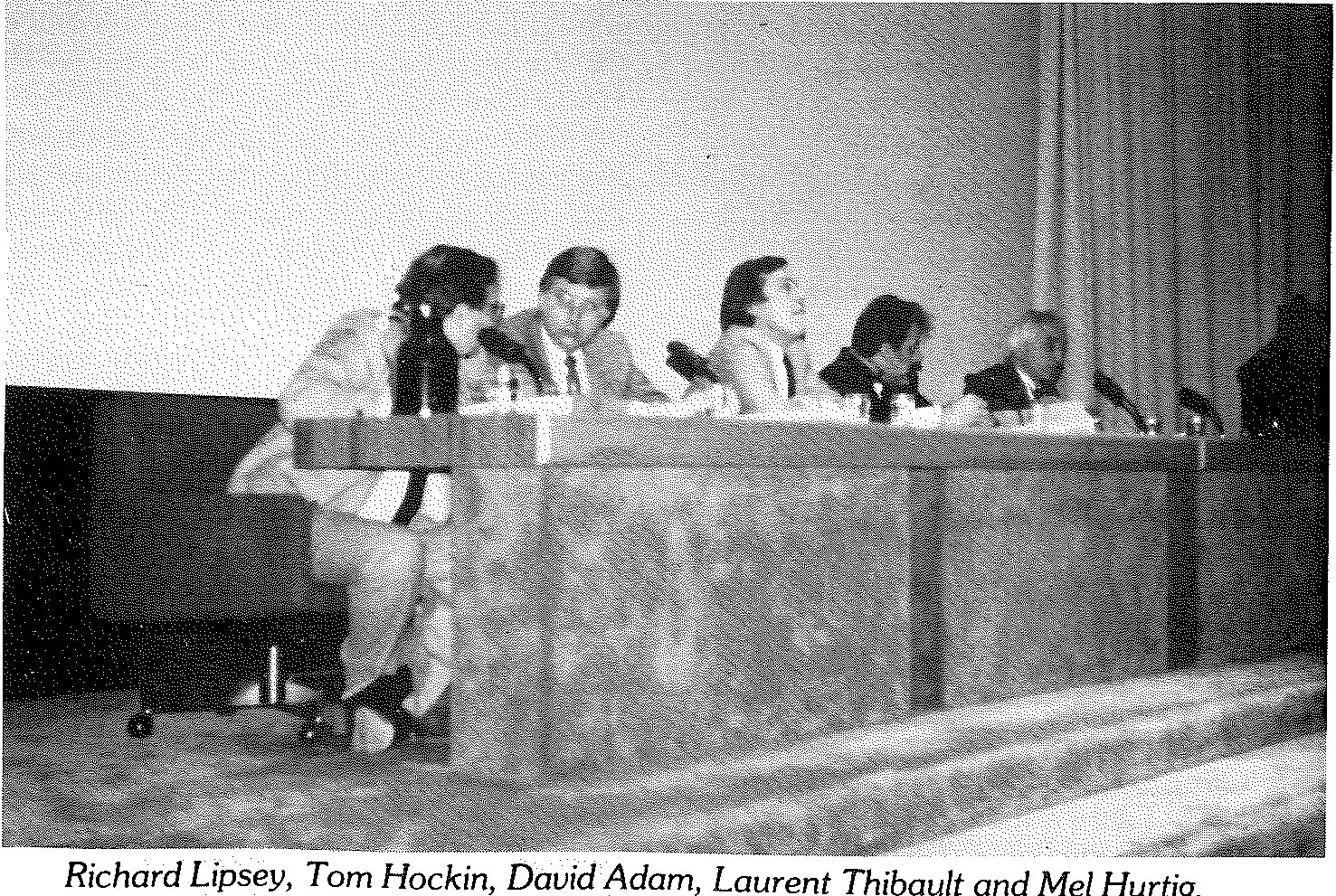
The PAFSO Professional Committee recently hosted its annual dinner-seminar on the Free Trade Debate.
Tom Hockin
I don’t think one can understand why this issue has so much resonance without a little bit of historical perspective. I am finding even the historical background is affecting us politically both as a government and as a committee.
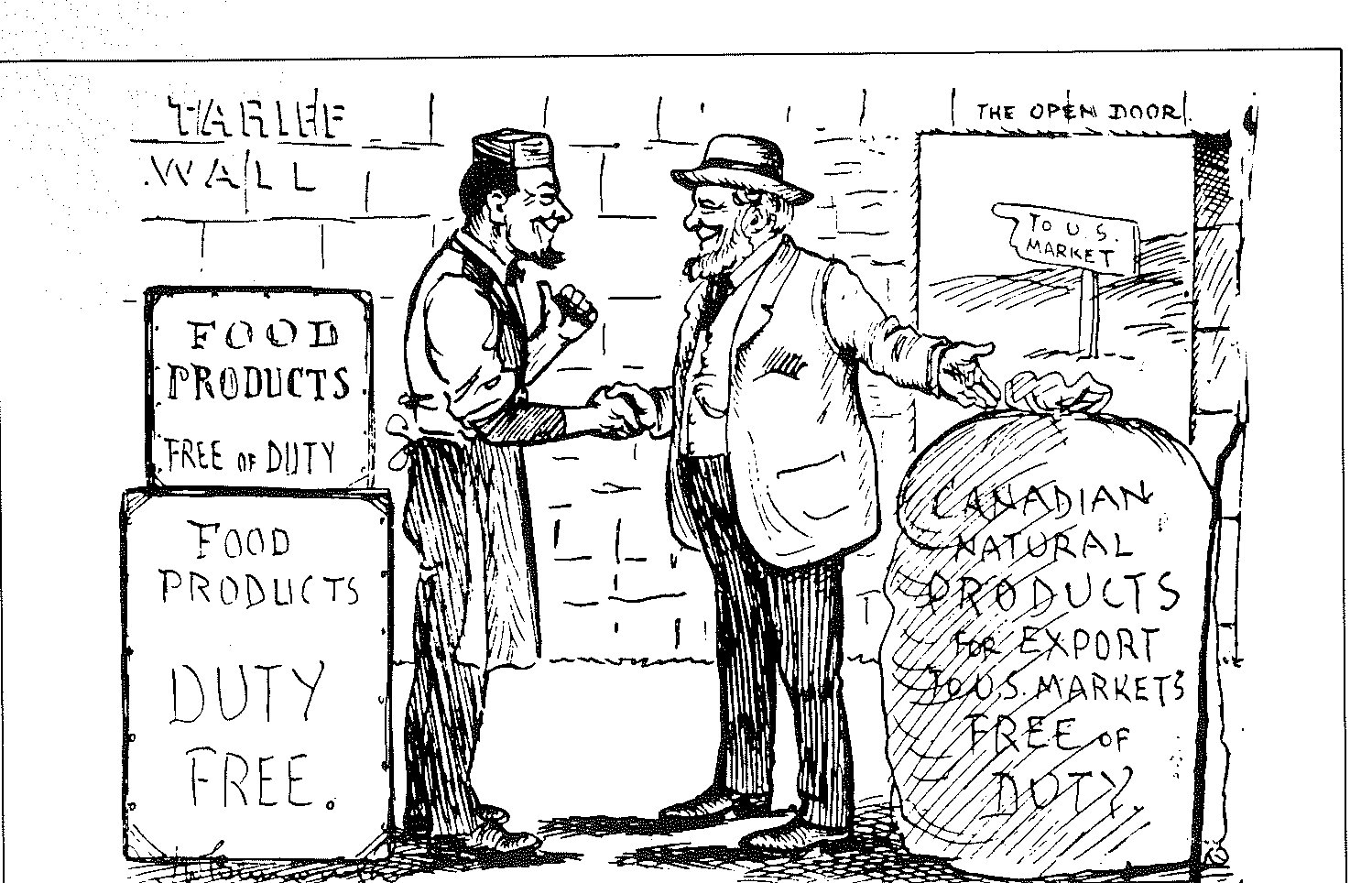
The first major formative event that has left its mark on the commercial side of our national memory was not the National Policy but the Reciprocity Treaty in 1854 and the American Civil War which led to a tremendous demand for Canadian goods. This period of 12 years resulted in tremendous economic growth in British North America. The U.S. failure to renew the treaty in 1866 represented for business its virtual expulsion from what was almost a Garden of Eden in terms of a secure and dependable market for business. After that what evolved were two distinct and opposed commercial schools among the Canadian political and economic leaders. The first school wanted to see if we could regain the type of arrangement that was in place from 1854 to 1866 because it was such a commercial success. The other school, which triumphed under Sir John A. MacDonald, put in place the National Policy. It stood for something quite different. These two schools have dominated the Canadian debate until the present time and they affect us even now as we make our decisions.
Great Britain and the Imperialist link was part of the National Policy that lost its weight after WWI. In the first decade of this century 54 per cent of our exports went to the United Kingdom; by the 1920’s the UK was still our most important customer but the division was 39 per cent to 30 per cent with the United States. By the 1950’s, 59 per cent of our exports went to the United States and the scaffolding of the National Policy began to be removed not only through increasing trade with the United States but through the various GATT rounds (e.g. the Kennedy Round, the Tokyo Round) which left more and more commodities between the United States and Canada duty free. We will have a situation in 1987 where 80 per cent of our exports to the U.S. will be duty free and 95 per cent will have duties of five per cent or less. The tariff situation has really been removed as a major issue.
I want to remind you about one other period in Canadian history: 1935. In 1935, Prime Minister King argued that R.B. Bennett’s Conservative high tariff policy was responsible for much of our economic difficulties and for much of the unemployment in Canada. Bennett, he claimed, missed the opportunity to negotiate a trade treaty with the U.S.A. In the election of 1935, King held out hopes of some sort of ’reciprocal agreement’ with the United States without, in his words, injuring any “legitimate industry” within Canada and without taking away any of the protection that he had put in place before 1930. What King tried to do, in a typical King fashion, was to blame high tariffs between Canada and the United States for part of Canada’s economic problems. He tried thereby, to transform the whole process into a technical question of tariff adjustment. He didn’t debate it in the great theological sense of national policy against continentalism. He talked about it in terms of tariff adjustments.
If you read the history of the debate in 1935 you will find parallels to the present day. King was not able to accomplish too much from 1935 to 1940 and then the war interjected. After that, there was a global trend away from protectionism and the Canadian Manufacturer’s Association, which originally was against King’s ideas, started to give grudging support to the GATT Round, to the Kennedy Round. By the 1980’s two-thirds of the C.M.A. thought that free trade would lead to expansion in our economies. We have a situation today where there aren’t as many forces against freer trade in the United States as existed decades before. We are now left with a situation with tariffs more or less removed. We are talking, therefore, about non-tariff barriers. With the historical memory of two great contending ideas in front of any parliamentary committee or Cabinet on this issue, as well as some historical lessons, we have to ask ourselves: how do you deal with the issue of free trade in political terms?
We found in our committee this past summer that business leaders, economists and others who supported freer trade with the United States, supported it, first of all, because it seemed to be a practical and acceptable formula to Canada’s economic difficulties. Economists and businessmen can give you the rationale. Secondly, there is a resonance to it of sound management. If you believe in the discipline of the market, freer trade with the United States is just part of good management and that is politically attractive, regardless of your party and regardless of the economic arguments.
The third thing that emerged in all of the soundings that we did this summer is that most of the successful exporters in the United States seemed to be concerned about maintaining and stabilizing that access. There is a kind of primal fear, similar to that 1866 rejection, sweeping across Canada. The fear is that we are going to be kicked out, like we were, even if they don’t know the history, 120 years ago. This is very much the political reality. We heard it constantly as we travelled across Canada and that’s what makes free trade with the United States a politically potent and attractive argument.
There are some downsides. The repoliticization of this issue holds some political risks. In terms of social distribution, I think labour will be very difficult to coopt into this project. I think they are always going to hang back, they are always going to be skeptical. There will be exceptions, but generally that’s a worry for any great national project that finds labour against it. Secondly, the nationalists are not comfortable with it and no government wants to be saying no to the nationalists all the time. Third, the fear and loathing that we get everyday from the opposition on this issue is affecting the debate in the government. We took a rather low key position towards freer trade and this has allowed the debate to be dominated by the pessimism of Question Period: worrying about this exemption, what’s on the table, what’s off the table and so on. This takes its toll. A recent Decima poll shows that while over 80 per cent of Canadians thought freer trade a good idea in September, today its 65 per cent.
The fourth risk of the free trade issue is to federal-provincial relations. If freer trade works, especially on the non-tariff barrier side, you have got to do something about government procurement and issues of that nature. We’re talking about a loss of power and a loss of autonomy for the provinces and that’s a difficult thing to handle in any political society. The Macdonald Commission was really quite explicit about this even while they recommended freer trade.
In the midst of this, our committee came down with our recommendations. The Liberals joined with us in the recommendation for freer trade. I thought the NDP was going to join us, but it jumped off the train at the last hour. The NDP has an interesting strategy, it gets you to compromise and then it doesn’t stay on the train! I guess it’s classic labour negotiations. In our committee, the Liberals and the Conservatives agreed that we should talk to the United States to see if negotiations are worthwhile.
The Liberals wanted to load the recommendation with more qualifications and clear indications that certain things were not on the table. The Conservative members of the committee were concerned that we could not get the Americans’ attention to negotiate anything if we had to parcel a package. We recommended that and the Prime Minister accepted that recommendation in his statement of September
26. Second, we recommended that new energies should be placed by the Canadian government into the next GATT Round. Third, we thought a dispute mechanism should be put in place. There are some differences of opinion between the NDP and me on that one. The NDP wanted to have an International Joint Commission (IJC) for trade matters, but I don’t think you can sublimate the great issue of politics into an IJC. Those issues inevitably end up being political issues and I think that it is misleading to think that you can ever institutionalize all of that through an IJC for trade. We perhaps could improve sources of common information, especially on the whole question of subsidies and what is a countervailable action and so on, and we might be able to get common information which could lead to much less misunderstanding in American and Canadian relations on trade. We also reminded the Canadian people of the importance of dismantling interprovincial trade barriers if we are ever going to be competitive after joining the Americans in a bilateral trade arrangement. Those were our recommendations and they have been accepted, more or less, by the government. Our government’s strategy has been one of almost benign neglect on this issue to minimize the risk that the thing might not work. The Prime Minister hasn’t been giving too many speeches on it. I find that if the government believes in a deal that would give us greater access to the U.S. market is whole aroument is losino tavol cause there aren’t that manu defender out there. I think that strategy is going to change and it is going to change soon because if we find that there is insufficient support within Canada for it, we won’t be able to sell the deal once we get the deal, even if it’s a reasonably good one.
Also, if a government wanted to be diabolical and call an election on free trade as an issue, if you have lost some public support during the debate you really don’t want to bring that issue before the Canadian people. Therefore, I think the government is going to have to do much more to sell the whole notion of a freer trade package and more secure access to the American market and it should get some of the Chamber of Commerce and other interest groups that favour it to sell it as well.
Finally, I think Members of Parliament should do the same. I would suggest that we are at a very critical stage. We either have to start selling the initiative or give it up. I think we are definitely going to sell it. We can’t be coy with the issue, we have to sell it as best we can and as we do that I think you will see the debate sharpening. Maybe tonight’s session is a precursor.
Larry Thibault
As Tom Hockin said, there is a lot of history in this issue. I don’t think there is any organization in Canada that is more involved with the history of Canada U.S. free trade than the C.M.A. Going through our archives you find some interesting things. You find letters to Sir John A. MacDonald, but one of the most intriguing is the record of the first tariff structure that became part of the National Policy in 1871. Apparently, the Customs Committee of the C.M.A. actually drafted it and submitted it to government and government accepted it. Those were the good old days!
The C.M.A. was founded in 1871, precisely on the notion of developing a policy to protect what was then the fledgling sort of manufacturing capability in the colonies. For many years the Customs Committee was the heart and soul of it, as the whole reason for the C.M.A. was to protect and monitor customs and tariffs. This had a beneficial impact in the sense that after the U.S. Civil War there was a great fear among Canadian manufacturers that they would be totally overrun and overwhelmed by the enormous production capability that the U.S.A. had built up but that they had no use for one once the war stopped. That fear permeated the early years of the C.M.A., and throughout the 20’s and 30’s. It was in the post war period that things began to shift.
First of all, the manufacturing activity became much more complex and other interests started to be more prominent in C.M.A. affairs, i.e. labour relations, taxation, environment and so on. Other committees and issues became important. The tariff issue gradually receded and over the years, in the post war period, the C.M.A. committees and the board gradually became more and more supportive of the notion of multilateral liberalization of trade, including the last one where there was a lot of basic and positive support among our members to say this is a good thing. History shows that we can grow, and compete. We actively urge our members to study the issue of lowering barriers to trade and to put their thoughts to government and to help in the negotiating process so we can get the best possible deal. There are, however, a lot of sectors in manufacturing that have a great deal of concern with the gradual opening up of our market, much less the whole notion of going to full free trade with the United States.
So why is the C.M.A. supportive about the notion of even considering freer trade with the United States in a fairly open comprehensive fashion? You have to go back to 1981-82 and consider that at that time the manufacturing sector in Canada was hit very hard. The drop in industrial production in Canada’s manufacturing sector was the most rapid and deepest of any of the industrialized countries in the Western world. There was a really severe shock to manufacturing in 1981-82 and in late 82, when we were doing our soul searching about what was happening in Canadian industry, we published a piece that we entitled “Competing in the Global Village”
Ament, which made supportive of tha that the world was changing dramatically. We are now facing intense competition from around the globe. We’ve always had import competition — you may recall in the late “70s the percentage of our automobile market that was served by imports was a very comfortable 12 per cent. It shot up to more than 20-25 per cent and now it’s pushing 30-35 per cent.
That’s just one indication. You get the same intensive pressure in machinery and it has always been there in the traditional industries. You see it in every conceivable manufacturing product. Companies tell us every day that there are new competitors out there. The realization was driven home that we are now very much in a global economy and we are struggling with the strategy to deal with that. The notion of being world competitive, devising world product mandates and so on, is very prevalent.
It’s going through that process of shifting gears from being primarily oriented to the Canadian market and to some extent the American market, to the notion that if we were going to survive as manufacturers we have to be competitive with competitors from around the globe. That’s not easy when you consider some of the developing countries. Look at the automobile industry, look at the Hyundai Pony. Twenty to 22 months ago, there were no automobiles here from South Korea and now they are coming in at a rate of 100,000 a year or 10 per cent of the market and growing by leaps and bounds. That’s not an unusual phenomenon if you look at a whole range of manufacturing products. In thinking about this a number of issues emerged. We noted that our labour relations climate is not the greatest and that the Japanese were beating us because they had much more cohesion in their factories, much better productivity and so on. A whole theme and thesis developed on that front. In Canada we don’t put as much investment in developing new technology, R&D and so on as many other countries that began to have a new thrust.
There is a lot of pressure now to link companies with universities and generally do more R&D to upgrade our technological ability to compete right across the board. One of the reasons that committees, and eventually the board, was supportive of the notion of discussing with the United States the possibility of a fairly broad and fairly deep free trade arrangement was the strategic notion that if you are going to compete, one of the critical requirements that you need is a sufficient market in order to develop and grow to be big enough and strong enough to fend off competitors from around the globe.
The Canadian market is not big enough. For many companies – the classic is Northern Telecom – which grew inside the Canadian market but quickly realized that to sustain the development and the technology that it needed it had to get bigger markets. The United States was the most natural one.
Northern Telecom quickly expanded there and now it is leaping beyond that and going after major markets in the U.K., Japan and other countries as well. That kind of thinking is being repeated hundreds of times in different manufacturing sectors and different companies. This notion of how we get our manufacturing sector to improve its productivity and its competitiveness in a global context is driving manufacturing and that is why C.M.A. has come to be fairly supportive of the notion of negotiating a freer trade agreement with the United States.
Most companies are pretty well convinced that you have three options: you can be very protectionist and live in the past; you can say we’ll defend the status quo (let’s not move too fast let’s just stay where we are) and I guess many companies are saying, or the consensus seems to be, that’s not good enough either. We have to keep moving ahead, we have to ensure that we have access, expanded access, to the : U.S. market as one of the fundamental building blocks for the future.
We went to a sectoral approach but that proved inadequate; you go through the functional approach and that doesn’t seem to balance out either. You are left with the notion of a fairly broadly based approach. There is a lot of agonizing and a lot of stress and strain within the C.M.A. When we ask the question: how would you fare in a free trade environment with the United States, the membership breaks down in three broad categories: about a third of the members say “great stuff, gung ho, let’s go at them, what we need is markets, and we’re competitive, we’ve got the technology, and what we need is access, and let’s do it” You’ve got another third in the middle, who say “well we’ll gain a bit, and we’ll lose a bit, and we’ll change a number of things around, and we’ll rationalize and we’ll probably be alright and we have some concerns but no great opposition to the concept”. And then there’s another third – basically in industries where there is a fair amount of protection and where the adjustment would have to be very substantial, who have very serious concerns.
When you talk about the policies of adjustment that would be available to make the transition, a lot of these concerns are not so great. You are left with what one might expect – a broad range of views, although on balance the consensus is that we should go ahead but there is still a group of companies that feel concerned because of the tremendous adjustment they would have to make.
One of the greatest concerns is that if you are going to make the kinds of changes in machinery and equipment and products to succeed in this new environment, you need to make a lot of investment. Many companies are not sure that they have the financial capability or that their banking system is going to be supportive enough to help them make that transition. They’re afraid of being overwhelmed by stronger competitors. On the other hand, many companies have shown that they can compete in North America and abroad. The C.M.A. believes we should continue the broadly based approach through the GATT environment and move along that track and not compromise the option of multilateral trade negotiations. At the same time, we should proceed with negotiations with the United States on a possible bilateral agreement. There are several important cautions that our members want us to say loud and clear.
First of ali, there should be a very strong and real consultation mechanism with industry. Nothing would be more damaging to industry than the notion that in political circles, or in the public service, you can open the border and that you can let the manufacturers do their thing out there. That would be absolutely deadly. Look at the beer industry. They have made their case known and say if you don’t change the Canadian policy environment so that we can at least rationalize within our own market, we’re going to be wiped out. The new environment that we’re trying to create must involve all areas of government policy. If we’re going to do this, we’re going to be in this together, or manufacturing will go down the drain. You have to have a tax policy that makes investment attractive in Canada, competition policy that is restructured to allow companies to shift their assets to compete in the global trading environment and a set of labour relation regulations and institutions that promote, support and encourage better labour management relations. If we don’t create that policy environment, then manufacturing is simply not going to succeed.
Second: There must be very close consultation with industry so that government can understand in real terms what this means. And the whole range of government policies, both federal and provincial, must be geared to this whole concept.
It is not like traditional negotiations in the past, where you simply just cut tariffs and manufacturers then adjusted. It is not going to work that way. I think the challenge is one of finding the right trade strategy for Canada and integrating it with our total policy strategy. There is a lot of confidence in the manufacturing sector that we can do this thing right. There are great opportunities in the market south of us. If we have the guts and confidence to get our act together we can succeed. The U.S. market is attractive when you compare it to the alternatives of trying to meet the Japanese head on in their market or the Europeans in their market or even the third world where it is also very competitive and very expensive to do business.
Mel Hurtig
The other night I went to a wedding in Edmonton and I met a very conservative businessman, an old friend and tennis partner of mine. I asked him what he was going to do under a free trade agreement. This man is extremely to the right in his political philosophy, he is a native Edmonton-ion and has lived there all his life. He employs about 600 people in his factory and he looked me square in the eye and said “There is no doubt what I am going to do under free trade. I am going to move my company down to Texas and employ Mexican labour at somewhere between $2.80 and $3.50 an hour. I won’t have to spend $2,000 a month heating the warehouse with natural gas bills; I won’t have medicare premiums; I won’t have U.I.C. premiums; I won’t have C.P.P. to pay; I won’t have the tougher working condition legislation in the factory compared to what they have down there”. I have told that story numerous times and it’s bottom line to what we’re talking about. Here is another:
A young lady from the UCLA Bone Marrow Unit in Los Angeles came to visit me at my home last spring. She is a 27year-old nurse, and she said that every single week down in LA, she sees parents crying in the hospital room because the hospital is hounding them for bills that they cannot afford to pay. A shot of demerol for their child costs $180; the exercise bicycle in the room costs them $74 a day; two aspirins cost a $1; blood transfusions cost $300 and up. Isolation rooms, and most of the kids need to have isolation rooms, cost $1,200 a day or $36,000 a month.
What does this have to do with the subject that we are talking about? We know that Mr. Clark and Mr. Mulroney have said that no government would be stupid enough to put medicare on the table. Canada’s social programs are indeed a social trust, a special trust and we don’t have to be Canadians to be concerned about the erosion of those special social programs that we Canadians have built up. But it is going to have to include almost everything. It is a comprehensive deal we are talking about. Under the terms of the comprehensive deal you take a cold shower, you rationalize your industry, you suffer some dislocation as you take the leap of faith through the window of opportunity and rush out onto the level playing field to compete, eyeball to eyeball. This is why the Mulroney government’s secret leak document came out of the PMO saying “You know we got to make sure that this stuff is resolved fairly quickly” “, and it is a “selling job”. Those were the exact words in the secret memo. It is going to be a selling job and we have got to get it over quickly because the more Canadian business, especially small and medium size Canadian business, which have been the big job creators in this country during the past decade, understand the ramifications, the more opposition you are going to get.
I spoke to a couple of television station owners the other day. They are appalled by the possible ramifications that they did not know about three weeks ago.
Premier Pawley, who was conned into an incredible statement made by the Prairie Premiers at Grand Prairie last spring — where they could not even make the distinction between a free trade agreement, a custom union and a common market – is suddenly getting letters. An operator of a highly sophisticated printing plant which employs 800 people in Altola, Manitoba, wrote the Premier of Manitoba the other day saying “Look I can’t even compete for business with the Ontario government or Saskatchewan government, or the next door neighbours and you want to allow a company from Tennessee with excess capacity to come in and take over the Manitoba market”. He said: “My company would be put out of business.” The whole basis of a comprehensive bilateral trade agreement is that we Canadians are going to compete eyeball to eyeball. And I say to you if you want to compete eyeball to eyeball then you better have the same tax rates, you also better have the same working conditions in your factories, you also better have the same environmental clauses in the United States, you better have the same labour legislation.
If you want to compete eyeball to eyeball don’t charge them higher taxes to pay for medicare. The same people in the Canadian Manufacturers’ Association and in the Business Council on National Issues and in many of these continentalist organizations, who by the way are to a very large extent supported by foreign controlled corporations, the same people who today are pushing for this agreement are exactly the same people who a few weeks later are going to be at Michael Wilson’s door and Don Getty’s door and David Peterson’s door saying “Look we really can’t afford to pay for the medicare premiums. We can’t afford to have the comprehensive social system that we Canadians have built up that is the envy of the world”
Richard Lipsey, Carl Beigie and the other continentalists do not see any important differences between Canada and the United States that are worth preserving. If you want
• compete eveball to eveball vou better nake sure that all of your legislation is determined in Washington, D.C. Eddy Goodman, the past president of the Conservative Party of Canada said earlier this year “Free trade for Canada would be political hari-kari”. All the important decisions about our future would be made in Washington. The next question is vulnerability: Is the idea to further enhance the trade, into 80 per cent, 85 per cent, 90 per cent of our trade? If you become that vulnerable in a trading ratio and you want to enhance that vulnerability you are going to be put into a position where you simply can’t determine your own tuture.
Many of us look at this debate in terms of the old historical debate about free trade but we all know that is not the old historical debate about tariffs, because we know that by 1987, under GATT, 96 per cent of our exports will go into the United States with a tariff of 5 per cent or less. We know that such policies as interest rates and the value of our dollar have a much greater effect on determining our ability to export to the United States than any remaining tariffs.
The free trade debate is now a debate about signing a comprehensive, locked-in agreement that would curtail the powers of the provincial and federal governments to determine future policy. Even Donald Macdonald, in an interview with the Financial Post earlier this year, said he recognized that Canadians would have to modify and adjust and give ground on our political independence and the way we set our social policies.
Jim Kelleher can go and see David Peterson and say there will be the possibility of a 7 per cent dislocation or 840,000 jobs. The C.M.A. and Dr. Lipsy and others tell me where the new jobs are coming from. We know the natural resource sector is capital intensive and not labour intensive. We know there are some spinoffs into the treasury sector from the natural resource sector, but we know that most of the jobs, if we want to put those 1.3 million Canadians back to work, have got to come from a secondary sector. The purpose of a branch plant is to buy parts and goods, and components and services from their parent company mostly at non-arms length prices, mostly to maximize the profits in the jurisdiction that has the lowest taxes, meaning mostly in the United States. Is there anybody in this room who is naive enough to believe that the branch plants which occupy 50 per cent of our labour intensive and secondary industry are going to have a mandate to turn around and compete with their parent companies back in the United States?
The next question has to do with the nature of Confederation. Under any comprehensive bilateral trade agreement, the provinces of Canada are going to have to surrender power to the federal government. I have yet to meet one provincial premier or hear one provincial leader of the opposition who says he is prepared to surrender power to Ottawa. Even the Macdonald Royal Commission said that it’s the one problem that we have yet to solve.
Next, if you become completely economically integrated with a much bigger, much wealthier, much more powerful partner, then what you inevitably get, as Mitchell Sharp has written so eloquently and as Robert Bourassa said the other day, is harmonization. I have yet to hear of one single policy where the Americans are going to harmonize to the Canadians. We Canadians are going to do all of the harmonizing. And under the kind of comprehensive bilateral trade agreement that inevitably would be signed if Mr. Mulroney and Mr. Reagan get their way, and make no mistake about it, the American administration really wants this, then you would inevitably have the first step towards a customs union. The customs union would inevitably lead to a common market. Again, I have yet to hear any political scientist or economist who I respect, who has not said that in the kind of common market that would exist between Canada and the United States, it would be game over for Canada. It would be the first important step towards economic and political union with the United States.
Countervail — if you have been listening to Clayton Yuetter, Peter Murphy and Malcolm Baldridge and the others, they have made it absolutely crystal clear that under no circumstances will the United States have countervail as part of this deal. Murphy said the other day: “If we took countervail to Congress, Congress would throw us out quickly.” So countervail, just as is in the Israel-United States free treaty, will not be on the table. You know that that means in a nation where they already consider the stumpage rates in British Columbia as unfair subsidies, the hydroelectric power rates to Quebec Aluminum as unfair subsidies, natural gas prices paid by the petro-chemical industry in Alberta as unfair subsidies, 38 different programs for Maritime fishermen unfair subsidies, not to mention the subsidies to the automotive parts industry from the Ontario government, not to mention the Son of Crow, not to mention Canadian Wheat Boards, not to mention low interest loans, not to mention regional industrial development grants and loans, not to mention stabilization programs, not to mention marketing boards, and I could go on for the next half hour!
You sign this agreement and everytime politicians sit down to make new policy they will be looking over their shoulders and saying “what does the United States think about this, and is the United States going to slap countervail on this or not”
Next, I have yet to hear the continentalists come up with a list of what the Americans want. You know we have a vague idea of what we want to achieve from this comprehensive deal, but have you ever tried to make a list of what the Americans will want? You say, well Mr. Hurtig, you shouldn’t be so nervous because we have got good old tough Simon (Reisman), he’s going to be bargaining for us, and Simon is real good hard-nosed eyeball to eyeball bargainer. Well I read a speech recently that Simon gave on April 16 to the Economic Council of Ontario, in which Reisman says, in plain English, our bargaining position is so weak, we want this agreement much more than the Americans do and that if we are going to get it we are going to have to give away something important, and let’s start with the export of Canadian freshwater supplies. Is that a hard-nosed eyeball to eyeball bargainer? One who starts off by saying that our position is weak, and that we have to give away Canadian freshwater supplies? I would like the Conservative government to fight an election on that issue!
I want to talk briefly about the economic effects of free trade and I urge all of you to start looking at some of the new material that has been published in this area. If you haven’t seen the work by Bruce Wilkinson, you should get it. If you haven’t read the report out of the Economic Council of Canada in August about the gross overemphasis on the benefits of free trade, you should read it. If you haven’t read John Helliwell’s criticism of the Harris model that everybody is talking about, you should read it. There is all kinds of new disagreement coming up in the economic community about the economic benefits of free trade. All the continentalist economists talk about rationalizing Canadian industry. That’s great, that’s what happens under a free trade agreement, you rationalize your industry.
Have you heard any of them talk about rationalizing American industry? What about the incredible overcapacity that exists in the American northern tier states? Isn’t the likely thing for them to do, for Doubleday or Harper or Simon and Schuster, if they have a best seller of 100,000 copies in the United States to have a guaranteed further 10,000 copies in Canada? By the time the last 10,000 copies comes on the tail end of the run, the $29.95 book costs them maybe $1.30 or $1.40, and its a very profitable way to do business. What makes you think that the American plants are not going to rationalize, and start feeding the Canadian market with their products? Tell Puerto Rico all about the benefits of a free trade agreement, tell Newfoundland about the benefits of a free trade agreement, tell Tennessee about the benefits of a free trade agreement. Ask the four countries in the world’s largest free trade area in the European Common Market, that presently have double digit unemployment, about the benefits of a free trade agreement.
The biggest problem with the continentalist free traders are that they think it’s the only game in town, the only thing that they can think of, and they have made it into a panacea. It’s like the old medicine bottle that cures everything. If we enter into these negotiations, thinking of it as the panacea, the cure-all, the only game in town, and if we have the high expectations of the Harris Study, for example, then we will be prepared to give away much too much.
We will end up on the road to economic and political union with the United States!
Richard Lipsey
I think we care about the future of our country, I think we are all patriots, in spite of nuendo and we all really want to make thi ountry go. Mel Hurtig said a free trade area will become a customs union which will become a common market and we will become the 51st state. We are talking about a modest change in Canadian economic policy, a modest change in the policy of the country. We’re not talking about turning the place around. We’re not talking about selling the shop out. The hysteria of people who tell you that a free trade area will lead to a common market which will lead to a customs union, which will lead to the end of Canada as a nation — I don’t know how you deal with that kind of thing! I don’t know how you deal with a world that says we’re talking about small changes in commercial policy and people come and tell you that Canada, as a nation, will cease to exist. Now that’s nuts. Let’s talk about what we’re talking about – a modest change in Canadian economic policy.
Way back in the 1870’s, Sir John A. MacDonald did what every decent newly developing country did. He raised tariffs and he said: Let’s build up a set of industries within our country that will serve the Canadian market. That is what most developing countries did. Then most developing countries who were small like Canada, discovered, having built their industries, that they had to move out into the outside world. And, the only hope for a small country like Canada was that it integrate into the international trading world.
In 1947, we joined the GATT. In 1947 we started reducing our tariff barriers from a very high level down to a modest level. We have gone through a series of negotiations through the GATT from 1947 and we have integrated our economy into the rest of the world.
Each time that’s happened, each time we have cut our tariff barriers, our trade has increased. We have exported more, we have imported more, we have had more jobs and more employment and we have had more prosperity, based on our integration into the world economy.
All we are talking about is completing that process. We are not talking about something totally new, totally different, totally unheard of. We are talking about going one step further into the integration of the Canadian economy into the world economy by reducing tariff barriers. We would like to do it through GATT. We may get a chance in the next round of GATT to do it, but that’s very problematic. So the free trade arrangement with the United States is going one stage further in a policy that we have been proceeding with since 1947 – reducing our tariff barriers, integrating our economy with the rest of the world. We didn’t lose our independence when we did it in 1947, it didn’t reduce our independence when we did it in the Kennedy Round, it didn’t reduce our independence when we did it in the Tokyo Round. But now, we are told the whole world is going to change if we take one more little step in this direction and we are going to suddenly become an American satellite.
We are talking about trying to improve Canada’s trading position in the world. We are a trading country, trade is critically important to us. A little more trade is very important to us and a little more trade with the United States is not going to make us an American satellite. To those people who say it will, I say show me. We are doing what we have done for the past 20 years and completing the plan of integrating Canada into the world economy, completing the plan of reducing our tariffs. We’d like to do it with the whole world, but if we can’t do it with the whole world we’ll do it with America. Completing the plan that we have had for the last 20 years is not going to suddenly turn us into a satellite and destroy the economy. The people who say that, have got to prove the case.
Why do I care about free trade? The world is in an enormous set of changes. The world is in an extremely volatile situation. The newly industrialized nations are rising, adjustment is the name of the game. The Macdonald Commission thought about this problem for three years and came to the conclusion that we must adjust. We cannot try to freeze the Canadian economy in its present situation. I spent 18 years of my life in England and fought a desperate battle in England to try to make the English economy adjustable. The English continued to try to protect the old industries with a series of measures that inhibited change and now what have we got? You go to Liverpool, you go to Manchester, you go to Birmingham, they are disaster areas.
I don’t want Canada to be England, and I believe that if we’re not careful, Canada will be the England that I know. England’s a disaster area because the basic thrust of government policies was to inhibit change, it was to maintain the existing situation as it was, to maintain the economy as it was, to protect jobs. What are we going to do if we sit here? We’re going to levy tariffs, we’re going to have quotas, we’re going to have restrictions and we’re going to try to protect the economy that we now have, and we’re going to try and prevent it from adjusting We could probably succeed in that battle for five or ten years, but over the long run it’s a losing battle. There’s no hope for us if we try to protect the Canadian economy in producing those things that are in competition with the newly industrializing countries.
Take footwear. The contribution to our living standards is the world value of that footwear. Footwear has a much bigger value in Canada. Why does it have a bigger value? For two reasons. First we subsidize it and that means we are taking money from other people who are making money and we are giving the money to the footwear industry. That’s a transfer of income from other people, who are successful, to the footwear industry. Secondly, we have quotas; the quotas raise the price of footwear. That’s a transfer of income from the consumers to the producers of footwear. If we freeze the economy into a situation where we are producing those things that have low value in terms of the world economy, we are going to reduce the Canadian economy to the standard of living of an under-developed economy.
The only hope we have in Canada is to adjust, to change, to get out of those products that are in direct competition to the newly industrialized countries so that we can move into production that produces high value and high wages for labour. If we’re not willing to adjust we’re sunk. We will go the route that Britain went, we will go down the drain. The only way we can really adjust is to find a way in which Canadian industries can manage to hack it at world competitive costs in a world competitive market. We are an anomaly amongst industrialized nations. We, along with Australia, are the only two industrialized countries that don’t have a market of over a hundred million secured to us. If we go on the way we are going, we will go the route of Britain, the route of Spain in the 18th century.
We have a chance offered to us, the chance offered to us is that we can rationalize our industries on the basis of a North American market of 300 million people. Once we have rationalized our markets on the basis of that size, then we can sell to the other countries of the world and we can move into the third world and sell. A future with jobs requires that we have jobs with the future. How can we have jobs with the future? The only way we can have jobs with the future is that we get jobs that are integrated into a really big market. If we stay on our own, we are in real trouble. If we integrate into the North American market, all of the experience, all of the experience that goes from the European Economic Community through to the tariff adjustments in this country through the Kennedy and the Tokyo round, tell us that we will get a specialization within industries and particular product lines where those product lines can succeed
There is no other way to go but to present that competitive challenge to the Canadian economy and to be able to succeed in world competitive situations and to be able then to integrate ourselves into the Canadian economy. We have to be confident, our business community is confident. We have to be confident that we can stand on our own, we can compete in the modern world and we can sell at world competitive costs across the competitive spectrum.
Those who want to avoid the future, want to go back to 1876. They think Canada can maintain itself as an independent community that would sell just to the Canadian market and could live in a seige economy in Canada. If you read Abe Rothstein’s book it’s basically a recipe for a seige economy. Rothstein says we should raise all kinds of barriers against trade with the United States, we should protect
Canadian industry to serve the Canadian market, we should have R&D subsidies and we should build from within. That is to go back to Sir John A’s world. We are not in that world. We are in an anomaly in the industrial world. If we don’t integrate ourselves into a large economy, if we don’t discover how to sell in a world competitive market within 200 million people, we’re sunk.
In every single Canadian major industry we have increased our exports and we have increased our imports. We have rationalized, we’ve specialized in particular product lines, we’ve sold more of those product lines and the ones we’ve cut, we’ve imported. Trade and employment has grown year by year everytime we have gone through with tariff cuts. If we had this debate 20 years ago when we had the Kennedy Round, Abe Rothstein would be on the platform, Mel would be on the platform saying “We can’t dare cut these tariffs, industries will fall, employment will fall, it can’t be done. “ But it happened and the tariffs were cut and we’re all better off for it. Our employment has gone up, our income has gone up and all we’re asking is that we think about a further development of the same thing.
I’m a multilateralist and I hope we will pursue that multilateral agreement procedures from GATT and I think that will be a good thing. But I am fairly pessimistic and I think the next round of multilateral agreements will be about non-tariff barriers and NTBs are really tough. It’s much easier to do NTBs bilaterally than multilaterally. I think the next step in a policy that we have been pursuing for 20 years is a policy of trying to find a trade liberalization arrangement that we can have and the only one that’s available to us is with the United States.
Most people do not know the difference between a free trade market, a customs union and a common market. A free trade area exists with Sweden, Norway and a number of other European countries. In Europe you get free trade between those countries without having to worry about the political problems that concern people in terms of harmonization.
Harmonization is a big issue. We will be forced to harmonize but there is a lot of pressure to harmonize now. The Americans are telling us they don’t like our stumpage duties, they don’t like our unemployment insurance for the East Coast fisherman. They will probably wipe out the East Coast fisherman when they come to an agreement in the American courts. There is an enormous pressure on us now and that’s nothing to do with a free trade agreement. The Americans are continually redefining the rules of free trade to make it harder and harder for us to export to the United States. The whole point of a free trade agreement is that we can sit down, instead of letting the Americans unilaterally redefine the rules of free trade and say, “Oh you can’t sell softwood lumber or you can’t sell fish or you can’t sell this and that”. We could sit down across the table and instead of giving them the unilateral ability to tell us what we can and can’t sell to them, we could sit down around a table and try to work out a mutually advantageous agreement.
I spent the afternoon talking with Simon Reisman and I’m absolutely convinced that if Simon can’t get something that is mutually advantageous he will walk away from the table as he should. But, we have two choices. We can sit here inside our little circle and say gee whiz we’re Canadians and we don’t want to talk to you. You go ahead and tell us we can’t sell you softwood lumber or we can’t sell you fish or we can’t sell you something. You redefine the rules of free trade and screw us. Or we can say to them we want to sit down around the table and we want to see if we can’t work out mutually advantageous rules that will help us both.
If we can’t work out some reasonable agreements, fine. We will walk away from the table and we will be right back where we were and we won’t be any worse off. But, for goodness sakes how can Canadians lack such confidence that they’re not willing to sit down around the table with the Americans and say let’s see if we can find something that is mutually advantageous to you. Let’s see if we can find a resolution to our disagreements. The alternative is that we sit back and we let them do it to us unilaterally. Well, that just seems to me to be crazy. If the Americans are as intransigent as my nationalist friends think they will be then we Will walk away. But I think the Americans want an agreement.
I don’t think the Americans want to absorb us. I think that they would be thrown into bizarre confusion by the thought of 20 more seats in the senate. The derision I get in America when I tell them that Canadians think that Americans are dying to absorb them is really amusing. I don’t think that the Americans are at all interested in absorbing Canada. I think we are a completely independent, totally different country. I think we are deeply different from Americans in all kinds of ways. Why can’t we trade with America like Sweden trades with Europe and continues to be Sweden? Free trade areas have happened throughout the world, people have decided to trade with each other without giving up their independence or their sovereignty. I think that we can do that and if we don’t, we are consigning ourselves to be a small country, too small to be viable, so small that we will find that our standard of living 20 years from now will be so low that the cultural nationalists will think they are in hell.
I believe in cultural support. I believe the only way we can get cultural support is if we have a viable, reasonable living standard. We are talking about just going a little further than we’re already done. We’ve cut tariffs dramatically since 1947 and we’re talking about just completing that program, integrating ourselves by a small cut in tariffs finally with the United States. Why suddenly should that make things different than what has happened in the past 20 years?
Canadian exporters are voting with their feet. We are losing jobs and investment because Canadian exporters say the only way I can serve the North American market is to go to the United States. The objective of free trade is to have an integrated North American market so that successful Canadian exporters can serve the North American market out of Canada. If we can’t do that then we’re going to lose every successful Canadian exporter. We want to provide an integrated North American market, so that successful Canadian firms can stay in Canada with jobs and create employment. The idea that will suddenly make us the 51st state is a leap of faith that’s far greater than Macdonald’s leap of faith!A
View the original scanned pages →
Originally published in bout de papier, Vol. 4, No. 1 (1985) — Winter 1985 // Hiver 1985, pp. 18–25. Read the rest of this issue →



