
bout de papier, Vol. 3, No. 3 (1985) — Fall 1985 // Automne 1985, pp. 11–12
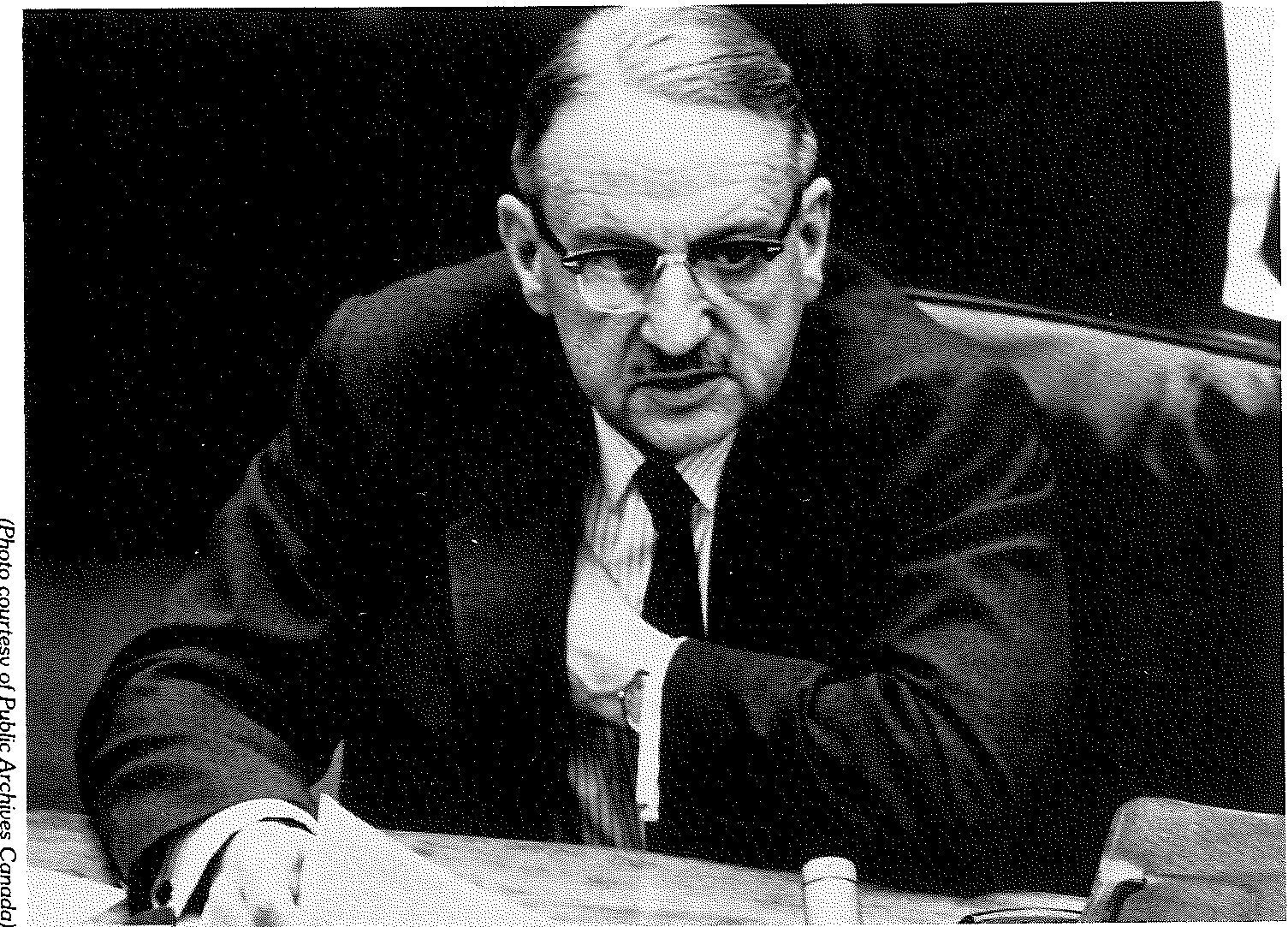
Tommy Burns died on September 13 at age 88. He was many things: soldier, teacher, writer, scholar and bureaucrat. But most of all he was a peacekeeper and peacemaker. He dedicated his post-war career to service in the United Nations peacekeeping operations and disarmament negotiations. We asked Michael Tucker, a professor at Mount Allison University in New Brunswick, who will shortly publish the official biography of Lieutenant- General Eedson Louis Millard Burns, for a restrospective look at this famous Canadian.
In May, 1953, the United Nations was seeking a new commander for its Truce
Supervisory Organization in the Middle East. The UN Secretariat had established certain criteria: a “retired soldier of general officer rank, not too old, and preferably with some judicial or other background in his miliary career. He must, in addition to being a good soldier, be able to act as an important negotiator and investigator in the delicate situation of adjusting differences …” UN officials also hoped that a Canadian would head UNTSO, to help adjust these “differences” between Arab and Israeli, and thus the call went out from New York to Ottawa to find the individual who possessed, in the words of an External Affairs memorandum, “in outstanding depth the qualities of toughness, impartiality and consummate tact required for this difficult post.” The Chiefs of Staff in National Defence, much to the chagrin of Dag Hammarskjold, found that in their judgement there was no Canadian soldier who could have met these rigorous requirements, and so the post of UNTSO commander fell to General Vagn Bennike of Denmark.
When the post became vacant once again, a year hence, the UN Secretariat again let it be known through informal channels that its strong preference was for a Canadian commander. The request was now put to the Department of External Affairs, and the recommendation of the perceptive Director of the Defence Liaison (1) Division for a successor to General Bennike went unchallenged in Ottawa and New York. That October 2 Major-General E.L.M. Burns took up his first tour of duty as a peacekeeper in the Middle East. During his two years as chief of UNTSO, and his subsequent four years as head of the United Nations Emergency Force, he did indeed exhibit the “toughness, impartiality and consummate tact” which were the foundation of his reputation as an international civil servant. He kept the peace as best he could, in what he described as an always “most ticklish situation.”
That the name of “Tommy” Burns did not register with defence authorities in Ottawa in 1953 was in a sense natural. He had left his military career behind him in 1945, to take up new duties as a senior administrator with the Department of Veterans’ Affairs. Burns’ 30 years as a soldier had by all accounts been distinguished by valour on the battlefield and by a dedication to the principles of military professionalism. He won the Military Cross in 1916 for bravery on the Somme, and in October, 1944, the Distinguished Service Order of the British Empire for his command of Canadian troops in the Italian Liri Valley. Yet if General Burns had one major fault it was his false modesty. He was a “hardrock” in army parlance, yet eminently fair; tenacious in holding to his convictions, yet as a shy man with a profound inner life. He had been dismissed from his command of the Ist Canadian Corps in Italy with indecent haste after the honour of receiving the DSO, and no event was ever to prove more agonizing for him. In retirement Burns would recollect, calmly, that this command was by far his most important contribution as a Canadian public servant. Yet in 1949 he refused Charles Foulkes’ suggestion that he return to military life with a view toward taking over as Chairman of the Chiefs of Staff. Sadly, Burns felt that he had lost respect among the Canadian military as a consequence of his wartime dismissal.
General Burns’ activities after 1945 – with the United Nations, with peacekeeping, and with disarmament — all seem to suggest that he turned away from the military ethic. Yet he remained throughout his life a soldier in spirit. His postwar professional activities were seldom through design; his calls to civilian duty invariably came in the first instance from those who knew and thus respected him. By his own admission he was in 1947 “shanghaied” into the hierarchy of the United Nations Association in Canada, although he quickly became a convert to the UN ideal of an international police force. And when the call came in 1959 to act as government adviser and chief negotiator for disarmament, Burns saw the position as a challenge and as a job that had to be done. At Geneva, however, he always felt, as he put it, “like a reformed drunk at a Salvation Army meeting.” Had the choice been his and not that of his minister, he would have relinquished his disarmament duties in 1962 rather than 1969, in order to head up ONUC as Ralph Bunche hoped he would do.
Yet Mr. Disarmament, as Burns came to be known in the Geneva meetings, was a moralist. He was the conscience of the eighteen-power disarmament conference, not only in quietly urging his colleagues to get things done, but in his apocalyptic thinking. He wrote of the dangers of nuclear war: Megamurder was not what Maryon Pearson once told Burns she thought it was — a murder mystery. And he wrote as early as 1949 of the need for disarmament as the only way to obviate these dangers. The nuclear umbrella, he would write, “what a poor metaphor it is.” Yet Burns, profoundly disillusioned with the changing role of the professional soldier in an era of nuclear deterrence, could never advocate unilateral disarmament, either by Canada or her allies. The disarmament measures he proposed stemmed from his soldiering and peacekeeping experiences, and his thoughts on
View the original scanned pages →
Originally published in bout de papier, Vol. 3, No. 3 (1985) — Fall 1985 // Automne 1985, pp. 11–12. Read the rest of this issue →



