
bout de papier, Vol. 2, No. 2 (1984) — June 1984 // Juin 1984, pp. 2–4
With the department settling into its new shape, and management due to undertake a review of policy on streaming later this year, PAFSO canvassed the views of its members on this issue, which has important implications both for the functioning of the department and for individual careers. A subcommittee headed by Daniel Marchand went to work in collaboration with the Professional Committee and suggested an evening colloquium in the Pearson Building.
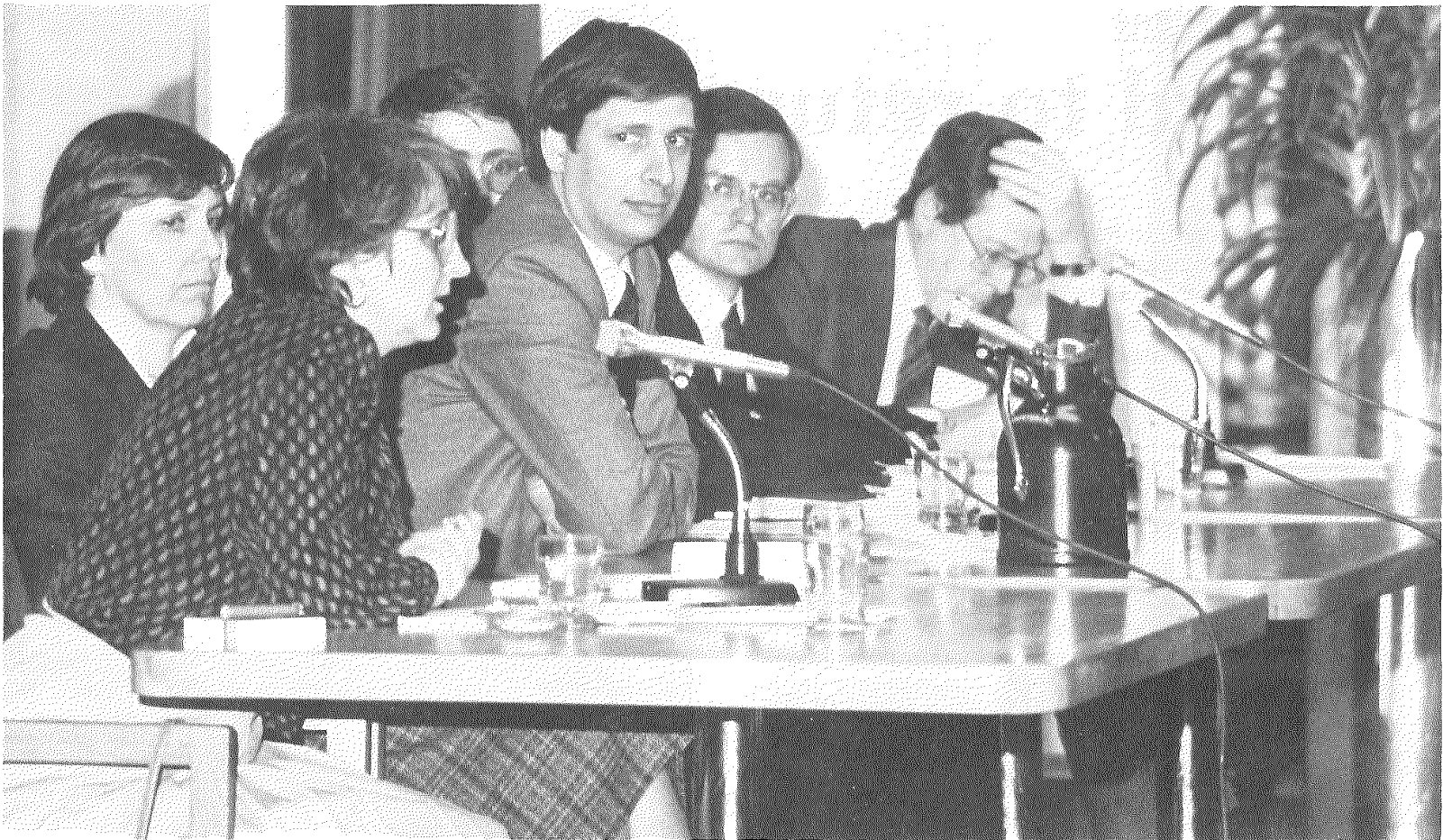
The idea was popular. On April 18, some 170 members (including guests from friendly foreign embassies in Ottawa with reorganization experiences of their own) gathered in the cafeteria to have dinner, listen to two panel discussions, put questions and points from the floor, and hear Dennis Hays, President of the American Foreign Service Association, speak to the US experience in organizing (and disorganizing) a foreign service. Management was not asked to participate in a formal way but was well represented. The evening was a great success.
Russ Davidson, PAFSO President, reviewed the events over the past 10-15 years which have led up to the consolidation of the Foreign Service and to the creation of an expanded Department of External Affairs. He was followed by the first panel, chaired by John Higginbotham, President of the Professional Committee, whose members – Scott Heatherington (Social Affairs), Paul Hitschfeld (Aid and Development), Kathryn McCallion (Commercial/Economic) and Louise Fréchette (Political/Economic) — tackled the subject “role and structure of the new department —issues for the streams”. • They discussed whether streaming met the needs of the new department in providing high quality services to the public, whether in policy advice or program delivery.
The panel members highlighted the history, tasks and responsibilities of their streams. Most recognized a continuing need for streams (or at least for specialization, a term which not surprisingly many found difficulty in distinguishing clearly from “streaming”) because of the need to deliver different services or programs for which particular training and experience is necessary. All agreed there should be mobility across streams so as to allow cross-fertilization of skills and to give officers a cross-section of experience before entering senior management. Kathryn McCallion stressed that special training for the commercial/economic stream • was necessary but emphasized that gone were the “good old days” of serving only one department abroad. She argued that a tendency to stream ’isolationism’ would be counterproductive.
The ensuing questions brought out some interesting ideas and revealing concerns. One questioner wondered whether stream integration was politically feasible, given the jealousy of client departments about their programs and the doubts of the business community. The response was that it could work if the “product” was good and perceived as such. Streaming is after all an “in house” arrangement. participant stressed the need for more officers to be given administrative skills. Another asked about the relationship between membership in the existing streams and the staffing of senior management levels. Social affairs and development stream panellists were concerned about the problems their streams would have in reaching higher levels, the need for cross-streaming, and of the resistance of some development stream members in particular to joining the new External Affairs (as well as resistance in the department to these new colleagues). On the other side of the coin a political/economic stream member worried that members of her stream might become “generalist” drones in a department of specialists. One participant suggested there could also be ’geographic streaming’ reflecting the fact that the department is now organized along more geographic lines.
The second panel moderated by Peter Hancock and composed of Mario Renaud (Aid and Development), B. Davis (Social Affairs), Bernard Giroux (Commercial/Economic and Paul Chapin (Political/ Economic) dealt with the issue of streaming and the individual career.
Recognizing that human resources are the most important resource of the department, the second panel aimed at presenting the perspective of the individual and how we have reacted to the numerous changes with which we have lived over the recent years.
Arguments were presented supporting both the maintenance of separate streams and the abandonment of the present practice of maintaining separate groups.
Officers are primarily looking for three things in their work: – job satisfaction, some encouraging sign of advancement, and some recognition for the work they do, both from their peers and from management.
Panellists maintained that individual streams provided officers with a sense of identity and with a means to pursue a satisfying career, at the same time, allowing for a more manageable service, in terms of recruitment, promotion and training. All streams are equally important for the department and should be recognized as such through an increase in cross-streaming opportunities, without removing the possibility to specialize. This, it seems, would offer a better way to prepare for mid-management positions.
Not all argued for maintaining the status quo. A strong plea was made for developing a common approach to the management of all foreign service officers. This would abolish the historical stereotypes and develop a much needed “new culture” for the new department
In conclusion we are reprinting the following statistics obtained from personnel and circulated as background information prior to the Colloquium. These statistics are self-explanatory. It is, however, interesting to note that a greater number of junior officers obtain cross-stream assignments in the political/economic stream while in the commercial/economic stream cross stream assignments are much more evident in the senior ranks.
Both the PAFSO Executive Committee and the Professional Committee would like PAFSO members posted abroad to contribute their views on streaming. Write to PAFSO office c/o the Executive Director
Composition of Streams 1983
FS1 FS2 FS3 TOTAL
Political/Economic 242 252 140 634
Aid 14 63 – 77
Social Affairs 119 106 29 254
Commercial/ 106 144 101 351
Economic
Total 481 565 270 1,316
Cross-stream Assignments 1983
FS1 FS2 FS3 TOTAL
Political/Economic 23 9 5 37
Aid 4 4
Social Affairs 10 15 5 30
Commercial/ 12 25 24 61
Economic
Total 45 53 34 132
View the original scanned pages →
Originally published in bout de papier, Vol. 2, No. 2 (1984) — June 1984 // Juin 1984, pp. 2–4. Read the rest of this issue →



