bout de papier, Vol. 10, No. 1 (1993) — Winter 1993 // Hiver 1993, pp. 30–31
Story and photos by David Bickford
Easter Island, or Rapa Nui, was christened by its ancient inhabitants “The Navel of the World”. Far from appearing to be something special, the island is a windswept, bleak and inhospitable chunk of rock far, far off the beaten track, some 3,700 kms from mainland Chile and 4,000 kms to Tahiti. Its 160 square kms can be covered in a few hours despite the dusty pockmarked tracks which serve as roads. The landscape is barren, grassy, with a few stubby trees, volcanic humps and lots of rocks.
The one “town” Hanga Roa, contains almost all of Rapa Nui’s 2,000 inhabitants. It sprawls along the rocky coast next to the airstrip, lengthened to three miles by NASA some years ago as an emergency landing field for the space shuttle.
The few people who live here maintain themselves precariously through small-scale fishing, agriculture and tourism. The pace is downright laid-back, but who needs to hurry here — there literally is no place to go. The overpowering feeling, in many ways shared by the locals, is the sense of isolation. If this is not the most distant inhabited point in the world (from anywhere else) it certainly feels like it. Why are these people here?
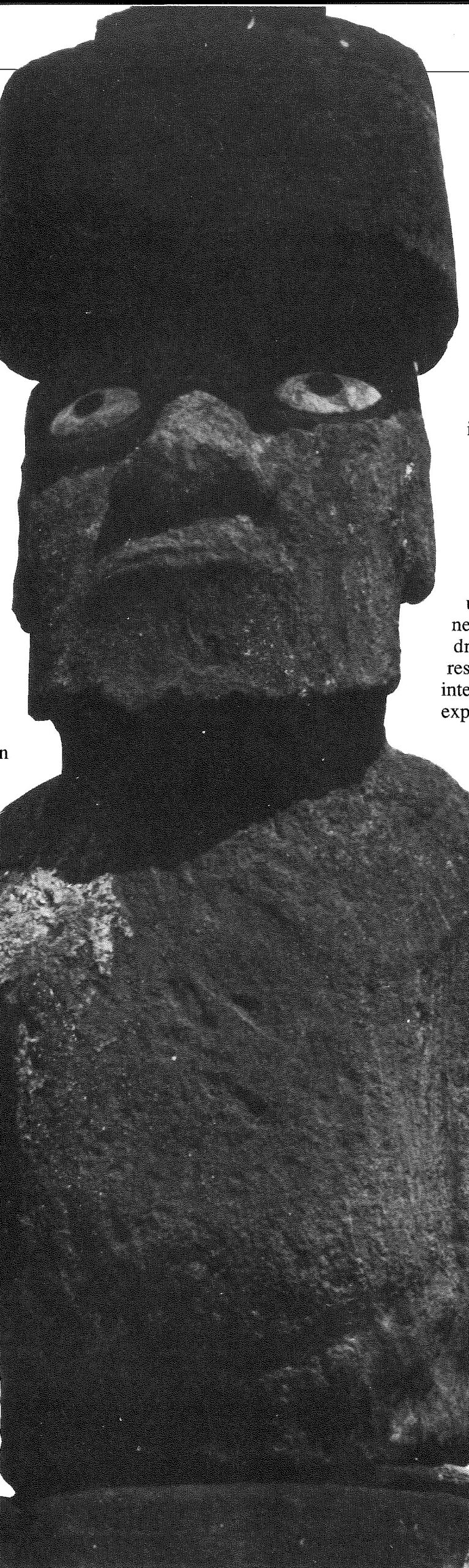
These questions fade when you come face-to-face for the first time with a “Moai”, the famous stone statues with their haughty demeanor, hooded eyes and enigmatic smiles which make them appear lost in a secret joke. Yes! the tired old pictures from postcards do come alive, and new questions leap out — Why did these people carve these monsters, how did they transport them, why did this come abruptly to an end? You attempt to place yourself back in time, but the answers don’t come. The Moai just stare back.
There are theories and possible answers, but research remains spotty and speculative. Those who produced the Moai, an alphabet, and petroglyphs came to Rapa Nui from Polynesia some 1,000 years ago – that much is known. They built a unique civilization which flowered for a few centuries. decline and fall of this civilization came, most likely, from overpopulation, deforestation, the devotion of too high a proportion of labour to the production of Moai and ancestor-worship, and finally to internecine warfare during which the Moai were toppled.
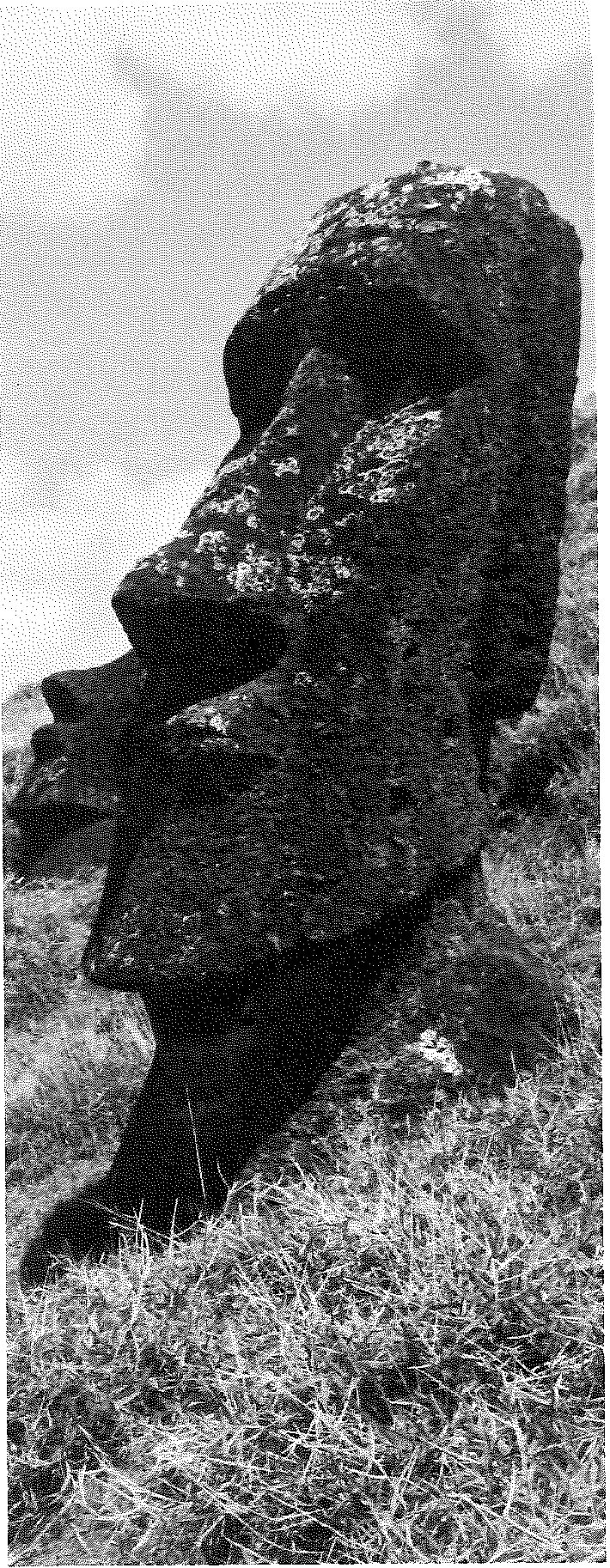
A visit to the south slope of Rano Raraku volcano provides several pieces of the puzzle.
The Moai quarry is found here with some 300 partly-finished faces staring up at the sky. The technique was to carve the face and trunk from the rock and gradually chip away the surrounding rock until the support or “backbone” underneath collapsed. This was accomplished with obsidian tools alone. The statues, weighing tons and measuring up to 20 metres long were then slid down the hillside and off to market. Many remain erected at the base of the hill. Was this a display from which buyers could choose, or was there a deeper purpose? Moai were dragged, in some manner, for up to 15 kms over broken ground from Rano Raraku, not a mean feat for a people who had not discovered the wheel and did not have trees of sufficient length, girth and strength to use as rollers. They made mistakes as evidenced by the number of abandoned broken statues en route. They must have learned since most Moai made it to their destinations where they were somehow erected on elevated ceremonial altars, again, without the aid of strong poles or levers. Such skills died with these craftsmen 800 years ago and the tightlipped Moai aren’t giving up the secret.
The severe lines of the Moai clash with the intricate petroglyphs which illustrate a different sense of beauty that these people possessed. At Orongo, a spectacular site perched on the rim of a volcano, between the crater and a thousand-metre drop to the ocean, a small village existed which was used once a year for ceremonial purposes. Low houses with thick stone walls, sod roofs, rounded corners, tiny doors and no windows — to counter the strong winds — and petroglyphs of the “bird-man” have given rise to many a legend about the site. One cannot but be impressed by the spectacular choice of site, notwithstanding the uncertainty of its purpose.
What is alarming is that the past is being slowly but irretrievably lost. This open-air museum is deteriorating not due to natural causes but through human thoughtlessness. Control over this heritage is limited. Anyone can enter these priceless sites, commit vandalism, collect “souvenirs” or generally tramp all over the past. Our own experience was shocking. We went with a local guide who let people clamber all over 1000year-old houses and petroglyphs in order to get better picture angles. It was the bus driver who eventually pointed this out to an embarrassed tourist. If this attitude continues much will be lost and the solutions to puzzles which have thus far eluded researchers will prove even more difficult to discover. Unfortunately, the awareness of the necessity to protect this heritage is just not there As another example, locals selling wood carvings proudly point ou certain of their works because they are produced from a particularly beautiful, slow-growing tree which is all but extinct – giving new meaning to the phrase “Get them while they last”
The uniqueness of Rapa Nui is found not only in its archeology, bu also in its people. The Rapa Nui came from the East — most likely the Marquesa Islands — perhaps a thousand years ago, and developed thriving civilization which came to end several centuries later. The descendants of these people first met Europeans in 1722. That and subsequent experience was not positive and the attitude towards strangers changed from open arms to hostility, a familiar theme for indigenous peoples everywhere. Disease, and Slavery reduced the population to about one hundred by the time Chile formally claimed the island in 1888.
The current population is small – some 2,000 people — of whom three-quarters are Rapa Nui, with perhaps another 1,000 Chile or French Polynesia. They are friendly but lack the drive, purpose and fire of their ancestors. The “native-people’s” syndrome is alive and well – substandard health, education which does not reflect culture, alcoholism, and high infant mortality rates. The problem is compounded by the dichotomy between political linkages with Chile and cultural links with Polynesia. This has brought political alienation and the attempt to recreate a previous culture by borrowing (or inventing) from the East.
While the authenticity of the Rapa Nui culture may be suspect, its rich linguistic heritage cannot be questioned. A highlight of any visit to the island is Mass at Hanga Roa church. Much is sung in Rapa Nui, unaccompanied, in four-part harmony, improvised and sung with joy. In contrast, the parts in Spanish lack spontaneity and life.
A bone of contention on the island is Thor Heyerdhal’s theory that the people came from South America — Kon Tiki and all that. There are indeed legends of two waves of immigrants of somewhat different physical characteristics, but was one of these from South America? Heyerdhal’s physical evidence is tenuous. The centrepiece is a platform near Hanga Roa built of close-fitting dressed stone without mortar, that resembles Inca or pre-Inca walls in the interior of Peru. This is more difficult to explain away than the presence of reeds in volcanic craters similar to those of Lake Titicaca.
Whether this is convincing or not, the local people don’t see themselves as having South American connections, nor do they appear to want them. In all, Heyerdhal doesn’t appear to be a popular figure on the island. Nonetheless, no one else has been able to complete the Rapa Nui jigsaw puzzle.
Perhaps Easter Island is fascinating because not all the answers are known, and we “advanced” folk are unable to explain how “primitive” people could have done what we could not do today if we used the materials that we believe they had at their disposal. It makes you think, but that is the magic of Easter Island. Maybe it is the “Navel of the World” after all.
View the original scanned pages →
Originally published in bout de papier, Vol. 10, No. 1 (1993) — Winter 1993 // Hiver 1993, pp. 30–31. Read the rest of this issue →