
bout de papier, Vol. 10, No. 1 (1993) — Winter 1993 // Hiver 1993, pp. 28–29
There will be a great variety of assessments of the life and work of the Right Honourable Paul Martin. It is fitting however that bout de papier contain an early appreciation of his service in the Department of External Affairs.
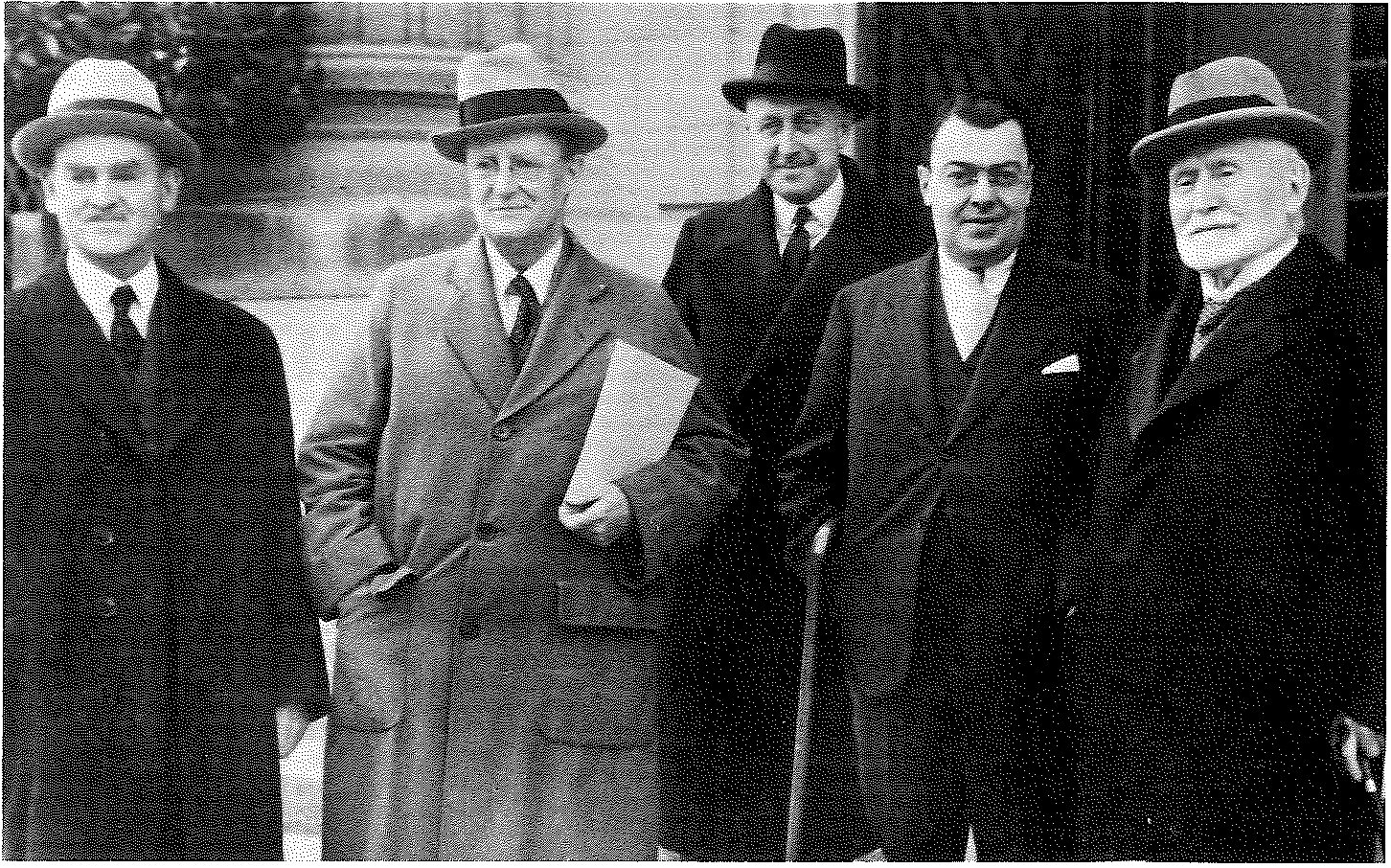
Mr. Martin’s life had many notable features, but one of the most significant was his commitment to Canadian international affairs. His first main address in the House of Commons, January 18, 1936 was on the subject and as a back bencher he attended the 17th session of the League of Nations in Geneva (see photograph).
As Parliamentary Assistant to the Minister of Labour, during the Second World War, as Secretary of State, and as Minister of Health and Welfare he assumed many foreign affairs tasks. He was proud of having initiated some of Canada’s welfare programs and, as a liberal by conviction, emphasized international humanitarian effort.
Throughout his time as Secretary of State for External Affairs (1963-68) he pressed constantly for “initiatives”. Some thought this an attempt to achieve personal credit, but his performance day to day and over the years was so consistent that the record will reveal the pursuit of Canadian national interest as his central motivation. One of the consequences of his aggressive style was that Canadian representatives, wherever they were, became involved in the heat of the foreign policy action. He kept to a punishing schedule in hours and in travel and responded to crises with vigor. In his time, Canadian foreign policy was activist and wide-ranging.
He was a legendary user of the telephone night and day in the pursuit of foreign policy concerns in Canada and abroad. He expected and indeed got corresponding efforts from his department.
Wherever he went as a foreign minister, he was required to swim each day as part of a therapeutic program. Anyone who worked with him has a Paul Martin story. In general these reflect regard for his original character. A devout Christian, he was never irritable for long and very forgiving. He was widely read and maintained a special interest in political biography. He balanced seriousness with an unexpected sense of humour.
Mr. Martin’s commitment to Windsor went beyond the usual. His staff at External Affairs knew that whatever the pressures, his constituency requirements were to be respected. Still, he kept his political priorities separate from his ministerial duties. He was very conscious of the borderline between personal or party interests and the dictates of foreign affairs. His family and friends were a continuing sense of strength.
Mr. Martin respected the public service. He required objective analysis and recommendations and almost welcomed official papers which gave rise to debate. Mr. Martin valued Marcel Cadieux as much as any public service confidant. External Affairs remained a strong coordinating and initiating agency of government during his tenure. In retirement, he produced a detailed record of his political lifetime and of his period as High Commissioner in London.
Mr. Martin was proud to be a member of the Department of External Affairs. He knew a great many individual foreign service staff members, and made friends among them. It is not surprising, therefore, that he received much support and many confidences. He accepted his ministerial responsibilities and expected departmental loyalty in return.
He put great effort into relations with the press and for that matter with many members of the parliamentary opposition. He was a “House of Commons man” and insisted on very detailed preparation each day and for special debates. His personal speechmaking style was discursive. A great deal of material was prepared and sometimes little used. Laurier was his hero, but Mackenzie King influenced his public style. Mr. Martin always managed however during many foreign policy crises and at innumerable public occasions to promote Canadian objectives.
Mr. Martin and Mr. Pearson had of course foreign policy differences but they agreed on public positions. For those who worked with both, theirs was a remarkable partnership. As Prime Minister, Mr. Pearson was scrupulous to respect Mr. Martin’s territory. There was full consultation when Mr. Pearson spoke or acted on foreign policy and Mr. Pearson was regularly and fully briefed by Mr. Martin. For his part, Mr. Martin admired Mr. Pearson and respected his record and his advice which was always sought on major issues. Their offices in the House of Commons were adjoining and the flow of paper between them constant. There was no trace of resentment over Mr. Pearson’s leadership. Together they managed, for example, the change from “support for the principles and objective of USA foreign policy in Vietnam” to an objective Canadian position. Mr. Pearson supported Mr. Martin’s efforts on Cyprus. Together they coordinated a response to M. de Gaulle. There were many other examples. Mr. Pearson valued Mr. Martin’s skills in the House of Commons. From the House Galleries it looked like and was an effective working collaboration.
Throughout his life Mr. Martin was proud of his heritage as a francophone. In the Department of External Affairs, he encouraged the use of French and spoke it constantly. He considered himself a friend of M. Couve de Murville amongst a host of colleagues at the ministerial level in world affairs. He emphasized Canada’s francophone character in foreign policy development throughout his career, and was one of the first to support the concept of la francophonie. National unity was a basic element in all his foreign policies.
Mr. Martin’s life will be remembered in many Canadian contexts. It may be, however, that he would have especially appreciated the respect and even affection with which he is remembered by his colleagues in the Canadian Foreign Service.
View the original scanned pages →
Originally published in bout de papier, Vol. 10, No. 1 (1993) — Winter 1993 // Hiver 1993, pp. 28–29. Read the rest of this issue →



