
bout de papier, Vol. 10, No. 2 (1993) — Spring 1993 // Printemps 1993, pp. 26–28
The establishment of the Canadian Foreign Service Institute (CFSI) by External Affairs and International Trade Canada (EAITC) is good news. It is the manifestation of a different kind of thinking in the Department. Its very existence embodies a guarantee that the unique professional skills of the Foreign Service have been recognized and will be systematically reinforced.
Je voudrais que ce message parvienne rapidement à chacun de nos collègues. Un grand nombre de lecteurs de bout a assisté à l’inauguration officielle de l’Institut le 1er octobre 1992, et d’autres ont vu le dépliant sur l’Institut ou ont pris part à nos cours de formation au cours des derniers mois. Mais j’espère que cet article fera prendre conscience à un auditoire plus vaste, tant au dedans qu’en dehors du service extérieur, de l’importance du nouvel Institut.
First, here is a little background. When I joined the Foreign Service in 1963, the training given to recruits was entirely ’on the job”.. We moved from division to division, learning by doing. Departmental lore was passed on to us through informal contacts with senior colleagues at the office or in occasional evening sessions, known colloquially as the “University of the East Block”.
This training, such as it was, was considered a sophisticated improvement over the training given to recruits thirty years earlier. Then, new Foreign Service Officers were routinely assigned to the code room at headquarters to cipher and decipher telegrams. This activity was expected to give them an overall view of the work done by the-then Department of External Affairs.
Today, much more focused, job-related training is required. Pressure is being applied on us from various sides to define our core tasks more clearly and to demonstrate our expertise. We in EAITC have not been quick to accept the need for a more professional approach, perhaps believing that foreign service expertise is too esoteric to be reduced to a training course. Changes, however, have occurred in the world of education too and new techniques have been developed to teach complex skills.
Depuis deux ans, le Ministère a profondément changé son attitude à l’égard de la formation. L’Institut canadien du service extérieur, créé en avril 1992, est le produit de ce changement.
Bien entendu, il se déroulait déjà au Ministère d’importantes activités liées à la formation. Avant le 1er avril 1992, la fonction « formation » était coordonnée par la Direction de la formation et du perfectionnement (APF). En 1989, le Ministère a fondé l’École des langues du service extérieur. L’Institut nouveau incorpore et développe maintenant les programmes de formation professionnelle et de formation linguistique déjà en place. Cependant, il concrétise une nouvelle manière d’aborder la formation : celle-ci est en effet considérée comme faisant partie intégrante de la culture du Ministère, comme une priorité permanente pour les cadres supérieurs et comme un élément essentiel dans la carrière de tout employé du service extérieur.
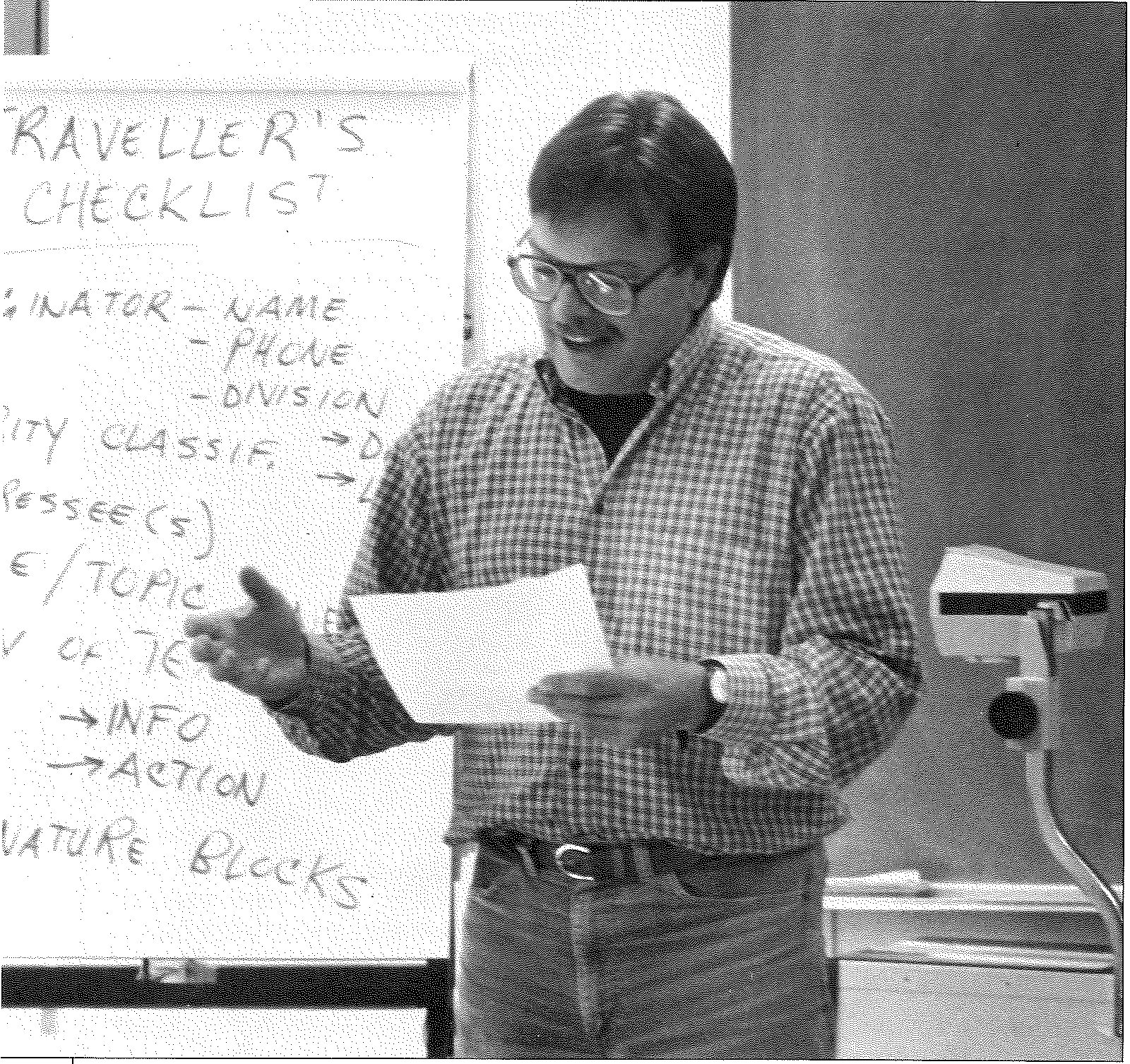
L’Institut a pour mandat d’offrir une formation reliée à l’emploi à tous les employés du Ministère, quelle que soit leur catégorie professionnelle, et y compris le personnel recruté sur place à l’étranger. L’automne dernier, les agents d’Emploi et Immigration Canada (EIC) se sont joints à leurs collègues d’AECEC dans le cadre d’un nouveau programme au niveau de recrutement d’une durée de sept semaines.
In this, its first year of operation, the Institute has undertaken two major initiatives: the creation of a Career Program for entry-level officers; and an Administrative and Technical Staff Program for employees in those fields.
The program for entry-level officers focuses on those job requirements which are unique to the Canadian Foreign Service. It is mandatory for all officers at the entry level and will be modified for presentation at the junior career level (up to five years in the Department). New programs will be developed for the mid-career (FS-2), and senior career levels (EX). We have also developed an innovative program for our administrative and technical staff. This consists of a series of course modules designed with three objectives in mind: job effectiveness; job enhancement; and career advancement. The Institute began to teach these new programs in October 1992.
Afin que l’Institut dispose d’installations appropriées, le Ministère a acquis de la Commission de la fonction publique un ancien centre de formation situé à Hull, Québec. Celui-ci a été rénové pour répondre aux besoins de l’Institut. Les premiers cours y ont été offerts au début de février. L’ouverture officielle devrait avoir lieu plus tard ce printemps. L’administration de l’Institut conservera encore une présence physique à l’édifice L.B. Pearson (ou se trouve AECEC) afin de rester à la disposition des gestionnaires et des employés du Ministère en ce qui concerne les questions de formation.
En établissant l’Institut, nous avons examiné ce qui se fait dans d’autres instituts diplomatiques du monde en ce qui concerne la formation du personnel du service extérieur. Nous avons tiré parti de leur expérience pour l’élaboration de nos programmes. De plus, nous avons misé fortement sur « l’approche systémique de la formation » dans la mise en œuvre de nos programmes, afin que notre formation réponde aux besoins du personnel d’AECEC. Je pense que nos programmes se distinguent par un certain nombre de caractéristiques.

First, all courses are tailored for designated stages in an employee’s career. For example, we created a total of forty-three courses for entry-level officers. These are delivered in a formal classroom setting. The I curriculum is comprised of a seven-week i Core Program for both EAITC and EIC i officers which covers general skill and ( knowledge areas. This is then followed by six-to-eleven weeks of specialized programs: I the Political-Economic Program, the 1 Commercial-Economic Program, and the ( Administrative Program.
This formal training will be comple- i mented with two on-the-job training assign- i ments, each of four months’ duration, and will finish with a cross-Canada tour. For the Administrative Program, one of the on-the-job assignments will be at a mission overseas.
Pour les niveaux postérieurs au recrutement, les trois programmes plus avancés mentionnés plus haut seront en cours de préparation; ils seront échelonnés de façon à offrir aux agents une formation reliée à l’emploi à mesure qu’ils poursuivront leurs carrières. Des cours réorganisés, conçus surtout pour les nouveaux directeurs adjoints et directeurs, ainsi que le Colloque sur le leadership sont également offerts par l’Institut.
La formation qui est directement liée aux mandats respectifs des secteurs individus du ministère continuera d’être dispensée par le centre de formation de la direction visée; c’est le cas, par exemple, du cours sur les droits de la personne offert par AECEC/ ADIC et du cours WIN offert par Directions des systèmes d’information sur le commerce (TPP) aux AECEC. Toutefois, l’Institut sera chargé d’assurer globalement la qualité et la rentabilité de tous les programmes de formation du Ministère.
A second key point is that all courses must be job-related. The process for determining appropriate skills begins with “needs analysis” which is conducted by training specialists. A series of interviews and focus groups is organized in which participants identify the particular skills and knowledge requirements necessary for doing their work. The Institute’s staff “clusters” this information into subject areas to be covered by specific courses and identifies the learning objectives. These are then confirmed by senior departmental officers working in what we call “Management Consultative Groups”
It is at this point that the design phase comes into play. The Institute contracts academic specialists, training firms or individuals who have the requisite skills, knowledge and experience. These consultants design appropriate courses around the learning objectives as they were identified earlier in the needs analysis. They also work closely with departmental officers — the “subject matter experts” — whose contribution is crucial in developing the course content. The final step, actually teaching the courses, is a joint effort between the training specialist and the subject matter experts.
Le premier cycle des cours en 1992 destinés aux FS-1Ds (ceux-là les agents du service extérieur en voie de « développement » dans leurs carrières) était un projet-pilote qui a été observé de très près. Les commentaires des enseignants et des étudiants sont analysés en détail à ce moment pour que les changements appropriés soient apportés aux cours du cycle suivant, à l’automne 1993.
Je n’ai fait mention jusqu’ici que du volet « formation professionnelle » de l’Institut. La formation linguistique est assurée par l’École des langues, qui offre actuellement 44 langues, mais la liste ne cesse de s’allonger. La formation linguistique est offerte suivant les besoins : maintien des connaissances (trois heures par semaine); survie (maximum de quatre mois, en prévision d’une affectation); et cours intensif (maximum de dix mois pour les langues difficiles). Nous comptons également tirer parti de l’expérience d’autres services extérieurs afin d’accroître les compétences générales de nos agents en langue étrangère.
The Institute has a very intensive period of development ahead. I estimate that it will take two to three years to put in place a full complement of courses. In addition, our planning must be measured continually against three basic operating principles.
1. To develop programs for all employees: We must provide all staff, whether at home or abroad, with a solid foundation of job-related skills and knowledge. Once the basic programs have been established at headquarters, we will be able to respond more actively to the needs of staff at Missions. Given the fact that the majority of the Department’s employees are located overseas, courses will be conducted wherever it is most cost-effective to meet specific needs. In recognition of the strong interdependence between family and professional life in a rotational service, the policy on spousal access to training courses and the provision of personal and life skills courses will be maintained and further developed to meet evolving requirements.
2. Pour doter que l’Institut poursuive d’une méthode pédagogique qui lui soit propre et que l’accent soit mis sur la participation active de l’apprenant : L’Institut se tiendra au courant des dernières techniques et méthodologies qui font leur apparition dans le domaine de l’éducation des adultes. Notamment l’apprentissage accéléré, l’enseignement à distance, la formation informatisée et l’auto-apprentissage sont des exemples. Il offrira des programmes comme le « programme en dehors des heures de travail ».
Les programmes de formation linguistique sont conçus de façon à ce que les étudiants apprennent une autre langue dans un cadre culturel plus vaste et de manière active. L’École des langues privilégie une approche communicative et met au point des méthodologies qui promettent d’accélérer l’apprentissage des langues. Elle encourage en outre l’utilisation de la technologie, notamment les laboratoires de langues informatisés, pour stimuler l’apprentissage interactif.
3. To ensure that the Career Program is delivered in a bilingual format: The Institute opted for this formula to ensure equal representation of the country’s two official languages. This methodology will give each participant the opportunity to practice in their second official language. All other courses, other than the ones included in the Career Program, are offered in both French and English.
I would like to emphasize how proud my staff and I are to be involved in this major new initiative by the Department. It is essential that those who manage Canada’s foreign relations possess the necessary skills to deal with the complexities of the international system. This is a fundamentally important area of the Department’s work and we have set as our goal to make the Institute a centre of expertise in Canada for training in the practice of international relations.
Nous prévoyons aussi que dans un avenir prochain, l’Institut voudrait grandir à fournir une formation en relations internationales et en langues étrangères à d’autres ministères, aux provinces, au secteur privé canadien et même aux services extérieurs d’autres pays. Nous considérons l’Institut, en fait, comme un puissant outil de politique étrangère qui puisse fournir une base commune de compétences et de connaissances à tous ceux qui œuvrent dans le domaine des relations internationales au profit de le tout Canada.
View the original scanned pages / Voir les pages numérisées →
Originally published in / Publié à l’origine dans bout de papier, Vol. 10, No. 2 (1993) — Spring 1993 // Printemps 1993, pp. 26–28. Read the rest of this issue / Lire le reste de ce numéro →



