
bout de papier, Vol. 11, No. 2 (1994) — Summer 1994 // Été 1994, pp. 55–56
Chief Inspector de Toombs slumped heavily on Liebnitz’s office couch, his face buried deeply in melancholy and a double Scotch. “Of all the foolish cases I’ve ever been part of, this one takes the cake. In fact, it takes the whole bakery. Someone has been murdered, and I know the murderers to be two among a group of twelve people. But the Feds have stolen the body and spirited off my suspects. All I have are some fragmentary statements and the computer records of the alarm systems. Unless I can provide an air-tight case against some very specific people, the Feds aren’t even going to admit that they know what I’m talking about.”
Replied the ace logician, “Well, I haven’t the foggiest notion what you’re talking about either. Why don’t you start from the top?”
The policeman thought a minute and then asked “Have you ever heard of the Witnesses to Extra-temporal Literary Crime Harbouring program? No? I thought not. WELCH is pretty hush-hush. It’s a witness protection program associated with the investigation of murders perpetrated in novels, poems and plays. Even I didn’t know that they had a unit over at the University — called the Institute for Creative Lassitude. Six of the protected witnesses had offices there, in a self-contained unit that also housed the office of the Director (a Fed, not a witness) plus a waiting room. Here’s a sketch map that may help.”
“Last Wednesday at six o’clock, a security guard checked the unit on his regular rounds,” he continued. “The Director and the fellows were all alive and in their offices, and there were six people in the waiting room. The door from the waiting room to the inner corridor was locked and could only be opened from the corridor side. After leaving the waiting room, the guard stopped for a cigarette in the outer corridor. He was still there a few minutes later when the lights went out. No-one else entered or left the waiting room while he was outside the door, and the only other way in, the emergency exit from the Director’s office to the parking lot, cannot be opened without setting off an alarm.”
“We’ve worked out that the fuse covering all the lights in the unit must have been e blown by one of the fellows short-circuiting a wall outlet. Without light, the security cameras were useless, but the motion detectors in the inner corridor indicated that one person came out of one of the offices (we can’t tell which one) and let in someone from the waiting room. The two went into the Director’s office. A few minutes later a shot was heard by the guard, and the alarm went off. He rushed into the waiting room, but was knocked down and out by people fleeing the other way.”
“When he came to, both the waiting room and the offices were empty, but there was a smell of gunpowder in the Director’s office. Pushing open the emergency exit, he spotted a cabin cruiser up on a trailer, burning fiercely near a large pond outside the adjacent cement factory. Inside was the body of the Director. The words “Alice May” were scrawled in chalk on the boat. The guard rushed to the nearest phone to call the fire department. By the time he got back, someone had put the fire out, erased the chalk marks, removed the body and vanished. I can add that we’ve polygraphed the guard eight ways from Sunday, and we’re convinced he’s straight.”
“Now, because of the WELCH connec tion, the Feds are refusing to cooperate. We know they have the corpse, the members of the Institute and the people in the waiting room. But they refuse to admit it or give us the least iota of help. We do know that each of the six protected witnesses had a different real name and a different cover name. They each had a different profession, as did the victims in the cases they were tied into. Each had in his or her office a different object associated with the case. Other than that, it’s all scraps, gathered from examination of the Institute unit and the fragmentary recollection of bystanders.” So saying, he handed Liebnitz a piece of paper with the following points:
(1) The Director was a Scrabble fanatic and always kept a box of tiles in a desk drawer. We found on his desk 15 tiles spelling out the words DELIVERIES KNOCK, covered with blood. (2) The miner in room 7 has the cover name TOULOUSE-LAUTREC. (3) The real name of the witness in the case of the murder-disappearance of a detective combines the name of the evangelist with the eagle and the last name of a co-discoverer of DNA. (4) The private investigator with the dark avian statue has the cover name of MARLOWE; the witness in the only adjacent office is a capitalist whose real first name means “stone of help” in Hebrew and whose last name is the first name of a cartoon bird.
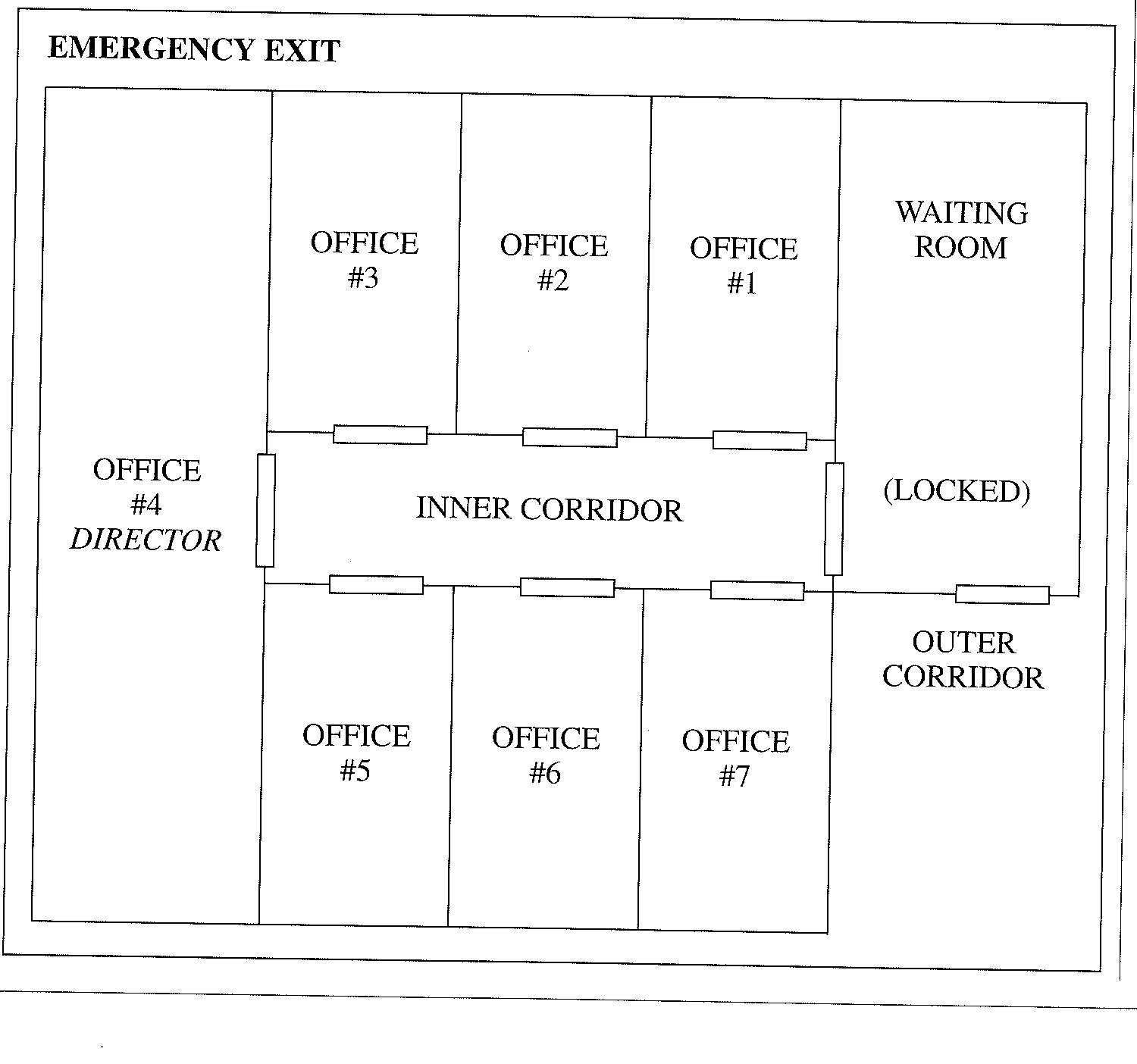
(5) The Director’s office is between that of the monk with the wedding ring and that of the doctor with the cover name “HASTINGS.”
(6) The dancer with the sack of gold dust is directly across the hall from the witness (cover name ROGER DE COVERLY) in the case of the death of a financier.
(7) The Director and a witnesses in a nonadjacent office both have as (real) first names the title of the 10th book of the Bible; the witness’s last name is something found in gardens and card games, while the Director’s is that of an Irish- Canadian Father of Confederation. (8) The witness in the shooting death of an American gangster, the man with the ledger and the man with the cover-name TUCK occupy three consecutively-numbered offices.
(9) One of the witnesses has a single real name, that of a knighted British portrayer of Hamlet, plus a title that sounds like a kind of chicken. Two more, in offices adjacent to each other, have real names given only as “Doc” (in an odd-numbered office) and “Lou” (10) The witness in the shooting of the gambler has the cover name TERPSICHORE; her office number is twice that of the witness in the suspected murder of the medieval debutante.
(11) The man with the apple is a witness in the poisoning of a princess; his office number is two higher than that of the man with the calabash. (12) There was one person in the waiting room linked to each of the six protected witnesses, but we don’t know who links with whom. They included a bad-tempered dwarf, a piano-player called the Ragtime Kid, somebody’s nephew Fred, the Count de Paris, a slim swarthy character whose last name is a Middle Eastern capital (the witness can’t remember which), and a British widow named Hudson.
“Well, well,” said Liebnitz. “Almost too many clues, but we should be able to sort everyone into their offices.” A pause for some pencil-work. “Right — so where do we go from there? Let’s start by assuming that the Director was killed because he found out something that implicated one of the protected witnesses with the murders to which they were supposed to be innocent witnesses. Maybe one of the people in the waiting room was the actual killer! So which one? You could make a reasonable case for almost any of them. Maybe the Scrabble tiles are a clue…. Yes, I see. Two anagrams, one a place, the other an author’s name. Highly suggestive, especially taken with the treatment of his body — that was pretty reckless, almost as if the murderers were taunting us. Well, de Toombs, why don’t you try these names on the Feds, and give them this line of reasoning?”
Liebnitz turned out to be right. Can you duplicate his feat by giving: (a) the office of the Mounta number, real name, cover name and profession of each WELCH witness; (b) the profession of the victim and the object associated with each witness; (c) the name of the person in the waiting room linked with each witness; (d) the name of the Director; (e) the anagrams found in the Scrabble tiles; and (f) the identity of the two murderers. In addition, but NOT necessary for the solution of the puzzle, can you give the actual name of the victim in each of the WELCH cases and the literary works in which they are found?
Mail or fax your answers to bout de papier. The winner will be announced in the September issue. Don’t delay — the deadline for entries is August 22!
A. Aalto Puzzle Winner,
Vol. 11, No. 1
Gina Smith
View the original scanned pages →
Originally published in bout de papier, Vol. 11, No. 2 (1994) — Summer 1994 // Été 1994, pp. 55–56. Read the rest of this issue →



