
bout de papier, Vol. 12, No. 2 (1995) — Summer 1995 // Été 1995, pp. 34–37
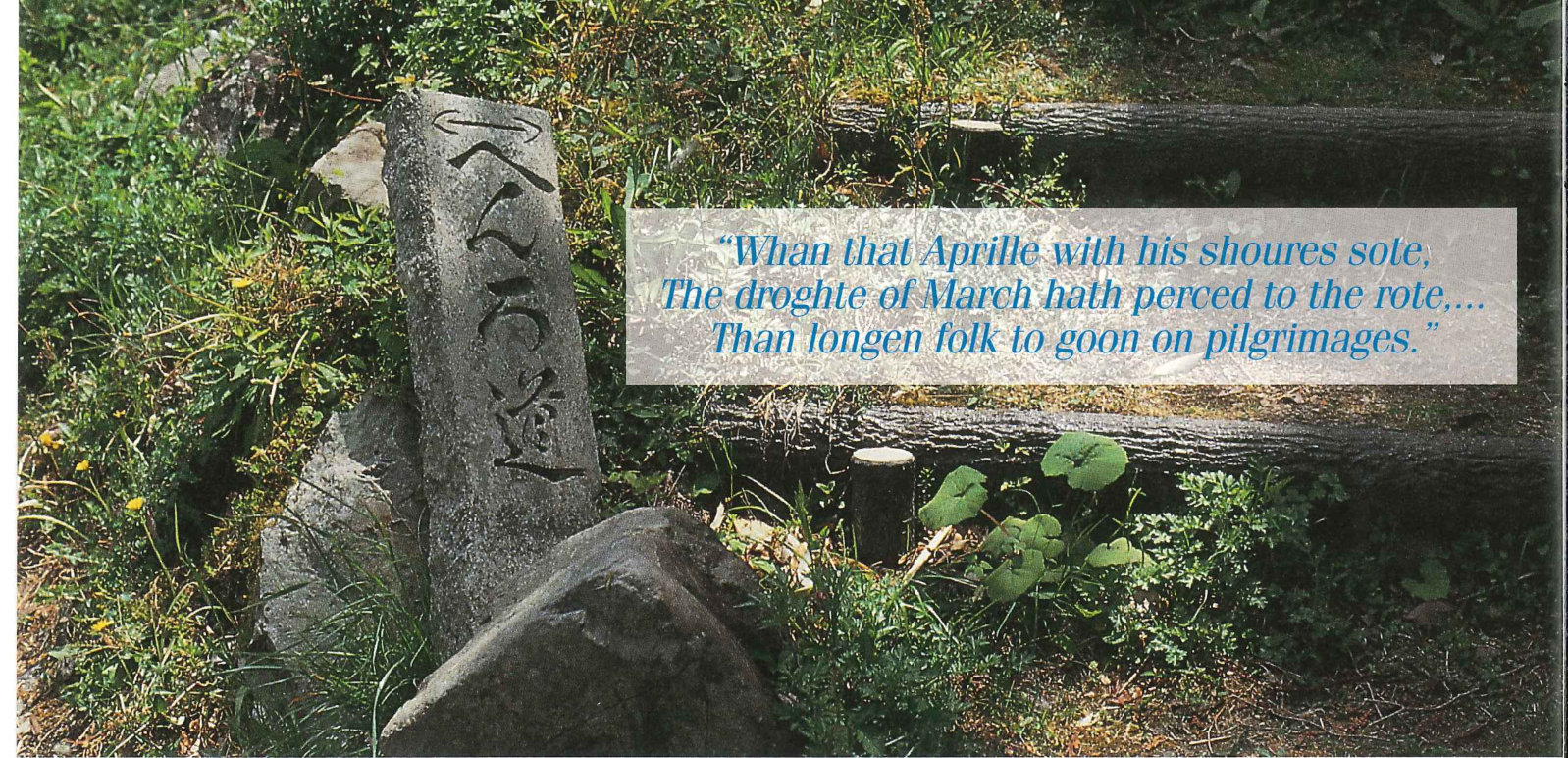
“Whan that Aprille with his shoures sote, The droghte of March hath perced to the rote,… Than longen folk to goon on pilgrimages.”
At the same time that Chaucer’s merry pilgrims were setting off for Canterbury in England 800 years ago, on the opposite side of the Eurasian land mass, Japanese pilgrims were answering the same call on the road to Shikoku. The most ancient, holiest, and best preserved Buddhist pilgrimage in Japan is the Shikoku 88 Temple Circuit. Although its origins date back to the 9th Century, the Shikoku pilgrimage still attracts tens of thousands of worshippers every year, and in our first year in Japan, my wife and I became two of them. Our Japanese language teachers wanted us to get out of the classroom, and practise our language skills with real people. Our experience told us that nowhere are barriers between people more readily broken down than between fellow travellers sharing the “camaraderie of the road”. If the tales on the road to Canterbury could be taken as an indication, we could expect to exercise both our Japanese and our muscles while we marched along the trails and by-ways of rural Shikoku.
The smallest of Japan’s four main islands, Shikoku is also one of the least developed parts of the country, but it was here in the 8th century that Kobo Daishi, the founder of the Shikoku pilgrimage, was born, educated and achieved his Buddhist enlightenment. Kobo Daishi (a posthumous name which means “Great Teacher Spreading Buddhism”) was probably the greatest figure in the history of Japanese Buddhism, and he is generally credited with having enabled the religion, which previously had been confined to the elite, to spread to the masses. The Shikoku pilgrimage is essentially a circuit of 88 Buddhist temples spread like a big circle around the whole island, and each temple is itself a holy place associated with the life of Kobo Daishi. There are temples near his birthplace; others where he studied as a youth; others where he practised asceticism on mountain tops; and most importantly, on the beautiful southernmost peninsula of Muroto, the place where he achieved Buddhist enlightenment. The total distance linking all these sites is about 1,300 kilometres, and walking the entire circuit takes about two months.
Pilgrim guidebooks for the Shikoku pilgrimage exist in several editions, and some dating back to the 16th century are still extant. My wife and I purchased our modern versions, and quickly learned that, contrary to expectations, one does not begin the Shikoku pilgrimage in Shikoku, but at Mount Koya in Wakayama Prefecture, just south of Osaka on the main Japanese island of Honshu. Amongst his many accomplishments, Kobo Daishi founded Japan’s major Buddhist study centre at Koya, and it is here that his body is kept. Tradition has it that he did not die, and that to this day, he is still in deep meditation within a special shrine in the most sacred Okuno-in Temple. All Shikoku pilgrims are expected to travel first to this temple, and in front of Kobo Daishi’s resting place, formally seek his protection, and accompaniment on their pilgrimage. Tradition holds that those doing the Shikoku pilgrimage will be accompanied in spirit by Kobo Daishi, and every pilgrim has written on his hat, cloak and walking staff, the words “Doogyo ninin” (literally, two people on the same journey). Indeed, every pilgrim carries a walking staff, which is always treated with special respect, and according to the tradition, it is here that the spirit of Kobo Daishi resides.
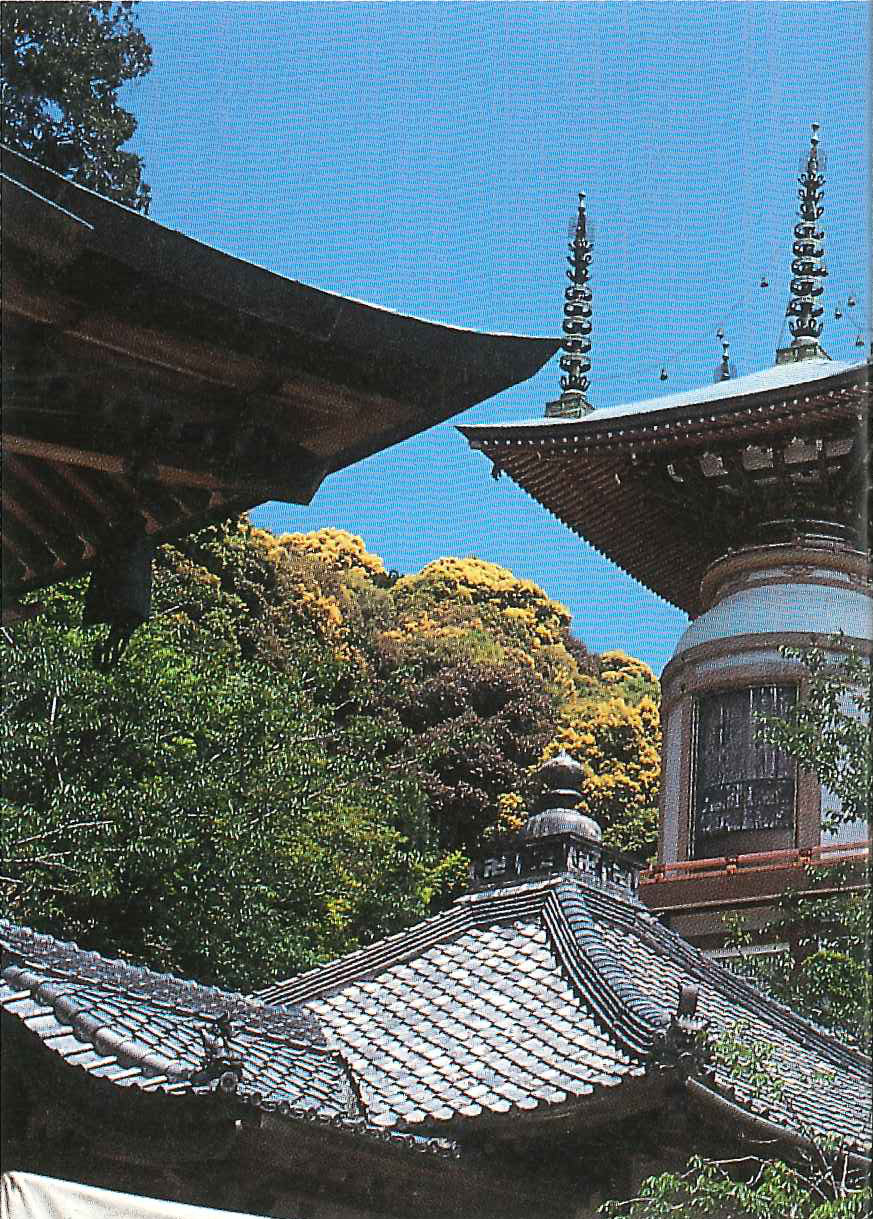
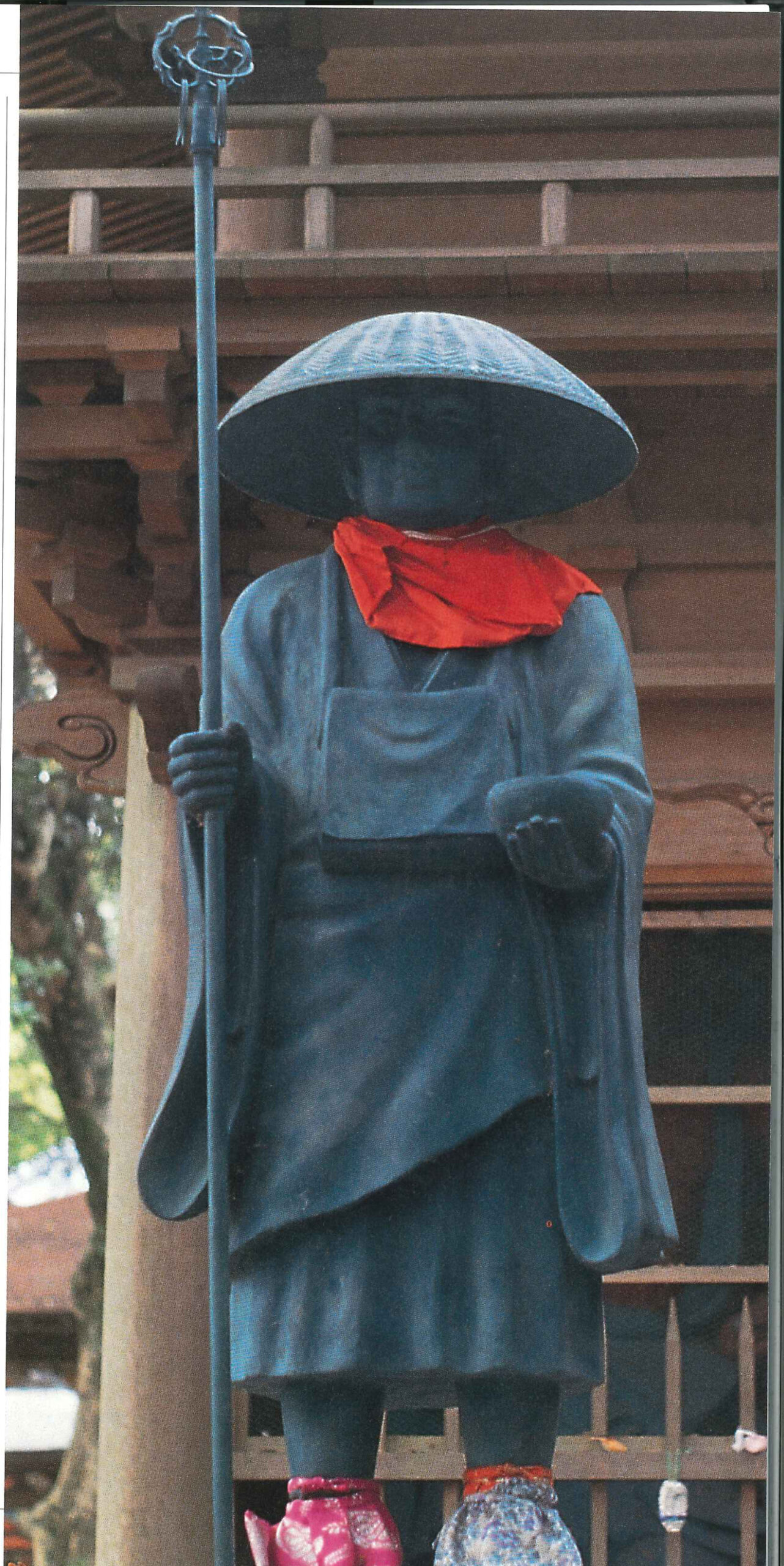
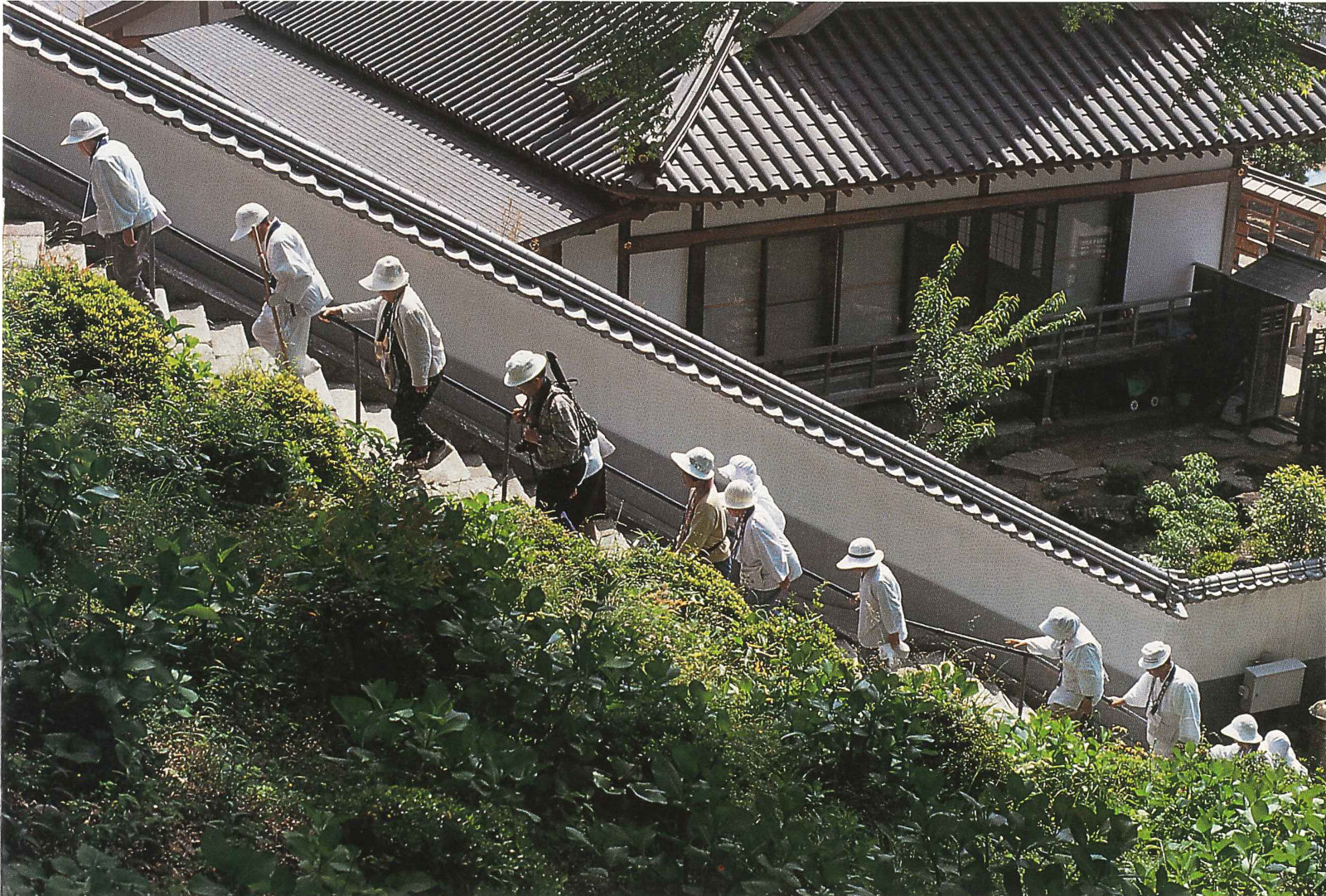
After paying our respects at Koya, my wite and I caught a ferry over to the island of Shikoku, and made our way by bus to the start of our marathon walk at Temple One. Here it was necessary to completely outfit ourselves as pilgrims. The main articles of apparel are the white cloak and pants. White is the colour of death and mourning, and in the case of the pilgrimage it is meant to symbolise the pilgrim’s temporary death, by parting from the every day world into a higher, more sacred plane. The staff mentioned earlier is also essential, as is a large straw hat. Purists might be tempted to obtain the traditional straw sandals, but at this we drew the line, and chose to stick with hiking boots. An essential non-apparel element of the pilgrim’s outfit is the stamp-book, with a blank page for each of the 88 temples. These are to be filled in by the priests of each temple, and once completed, this book becomes a holy heirloom which is cherished by the pilgrim’s family, sometimes for generations.
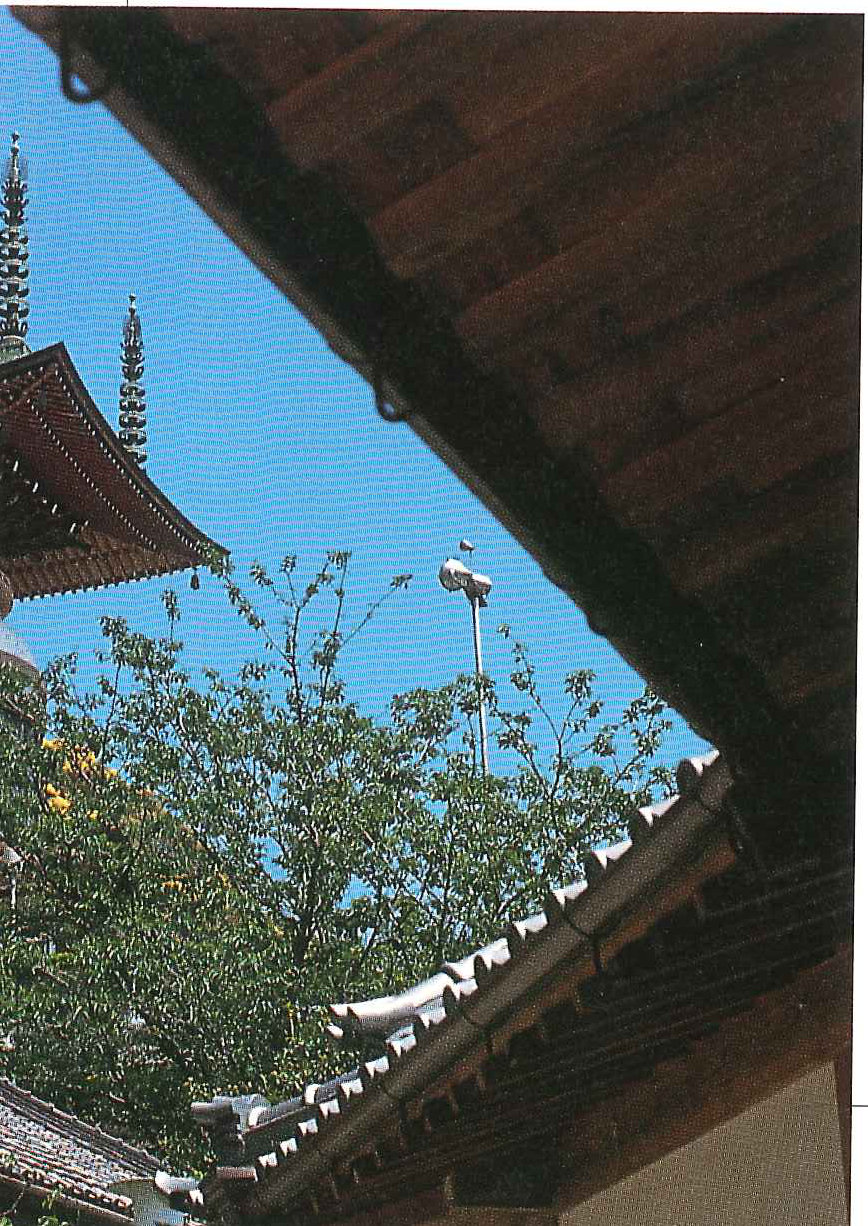
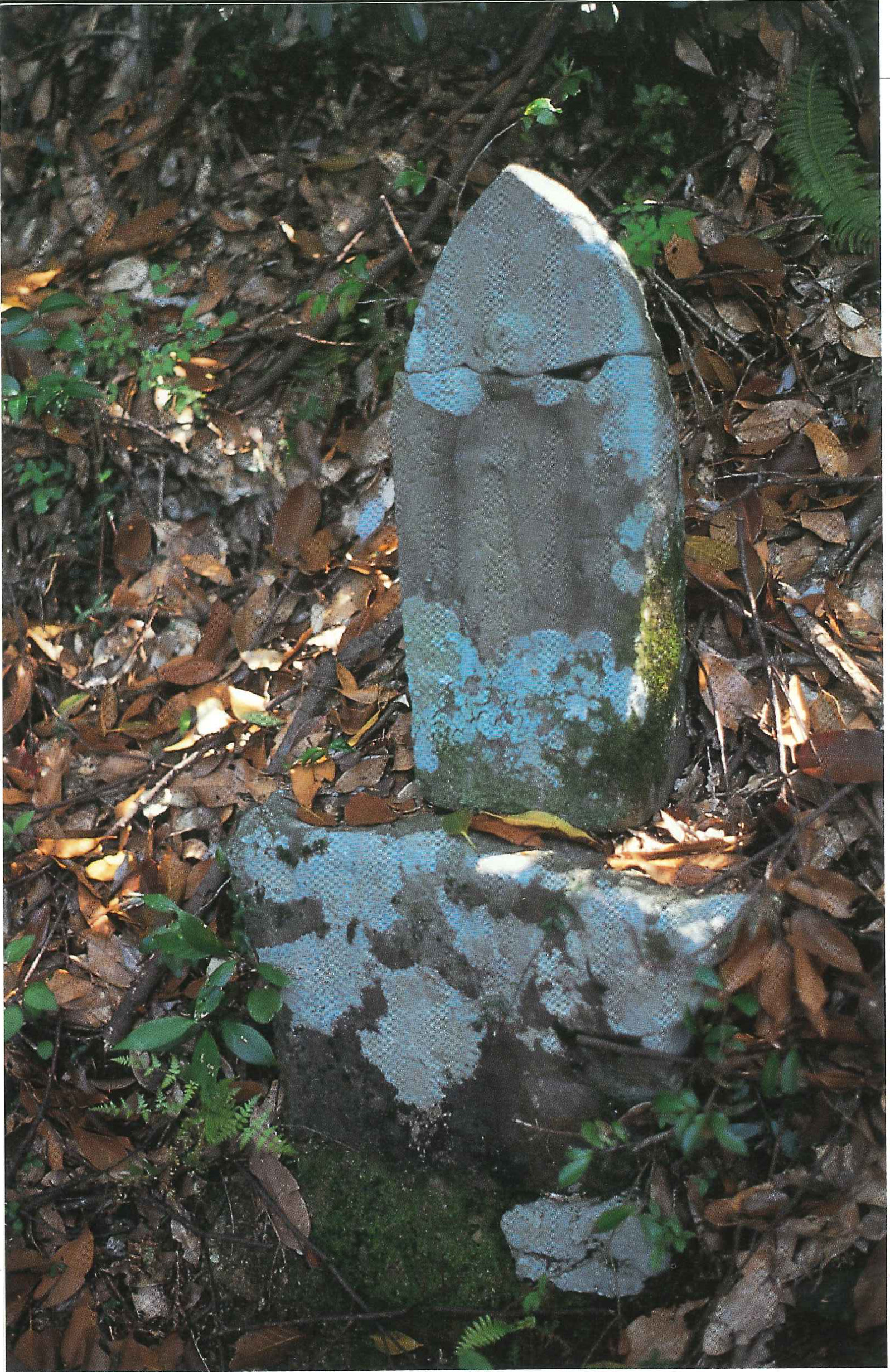
Suited up, and with our books duly stamped by the priests of Temple One we set off, with guidebook in hand, to begin our pilgrimage. The route was relatively easy to follow, as there were frequent special milestones and markers with the words “henro doo” (pilgrim’s road). Also, because of the holiness of the route, it has inspired local people to set up mini-shrines of all kinds, all along the way. Some are just small statues of Buddha or Kobo Daishi, or “jizo” (the guardian deity of children, while many are, in fact, reliquaries and tombstones, as people buried beside the pilgrim’s road were thought to benefit from it sacredness. Even on the lonely and isolated mountainous parts of the route, we constantly passed these marker stones, statues, and impromptu gravesites. While the actual route of the Shikoku pilgrimage has remained the same for centuries, the landscape has been regularly changed by the action of man, and for the first two days we found our trail mostly along paved country roads, crossing paddy fields and through small towns and villages. On the third day however, our route entered the mountains and we spent the next several days negotiating mountain trails, seldom encountering other people, except at the widely-spaced temples. Later we descended from the mountains and found ourselves walking directly through the city of Tokushima, one of Shikoku’s largest, with a population of over a million. While they were probably quite used to seeing pilgrims, two foreign pilgrims were a novelty and we attracted a lot of attention.
In the countryside as well, being different gave us frequent opportunities to chat with farmers and villagers who were quite eager to ask us questions. Foreigners of any kind are a rarity in the Shikoku backcountry, and we were exposed to a side of Japan that we could never have seen in the cities. When we told one group of farmers that we were Canadians currently living in Japan, they jumped to the conclusion that we were refugees from the hard life in this unknown place called Canada. In their view of the world, one would only leave home and settle in a far off land if under extreme duress. They went on to welcome us to Japan, and expressed their pleasure that their country could offer us refuge. After living most of my adult life in Asian countries (Sri Lanka, India, China, and Southeast Asia) where Canada was viewed as a kind of promised land, this was certainly a novel perspective. Hospitality to pilgrims was not just for us however. In the Buddhist tradition, support given to the holy acts of others, including alms for monks, is meritorious for the giver, and as pilgrims have temporarily forsaken the temporal world, they also qualify for support. All along our route we were constantly approached by local people offering us “settai” (gifts to pilgrims). At times people came running after us down the road asking us to stop and receive their gifts. On a few occasions housewives came from their homes with moist face cloths for us, but usually the settai were in the form of food or drink. One farmer insisted we take about 10 kilograms of persimmons, which by tradition, we could not refuse, even though it considerably increased the weight of our backpacks.
We spent our evenings in “shukubo” dormitories usually attached to key temples, and meant for the pilgrims. These provided an excellent opportunity to meet and chat at leisure with other pilgrims, and we got to see a side of the Japanese character which is well-hidden in the frenzy of big city life. People of all kinds performed the Shikoku pilgrimage, both young and old, and for a tremendous variety of reasons. Commonly the pilgrimage was done to keep a promise for favours granted by earlier prayers, but equally often, it was done to provide an escape from the pressures of everyday life; to allow time to think and rejuvenate oneself before re-entering the fray. In one temple we met a dentist from Yokohama, who told us he was a Catholic by religion, but was walking in the path of Kobo Daishi “to clear his mind and heart”. Pilgrims are enjoined to act as if they were Buddhist monks during the time of their travels. They are to eat only vegetarian dishes (although the shukubo refrain from sexual relations, and most frequently served sashimi – raw fish), importantly, remove all negative thoughts from their minds, particularly those of greed, jealously, and anger.
My wife and I walked the Shikoku Pilgrimage for a total of I days, and reached Temple
24, probably the holiest one of all. here, in southern Shikoku overlooking Muroto Cape, that Kobo Daishi achieved Buddhist enlightenment. We would have loved to continue our walk, with the remaining 64 temples beckoning, but we had to return to the real world, our children and jobs. While the ideal is to do the pilgrimage continuously from beginning to end, tradition allows for the journey to be broken, and continued later. The only strict rule is that one should travel in the same direction, and eventually close the circle by travelling to all 88 temples and then returning from Temple 88 back to Temple One. We gained tremendously, in this life, by our 11 days on the road in rural Shikoku, with experiences that helped form our understanding and appreciation of Japan. As for the next life, we should have stacked up a nice collection of brownie points with our 11 days of ascetic pilgrimaging. However you can probably never have too many, and some day, when we have more time and fewer responsibilities, we will return to Shikoku and finish what we have started
View the original scanned pages →
Originally published in bout de papier, Vol. 12, No. 2 (1995) — Summer 1995 // Été 1995, pp. 34–37. Read the rest of this issue →



