
bout de papier, Vol. 12, No. 2 (1995) — Summer 1995 // Été 1995, pp. 19–21
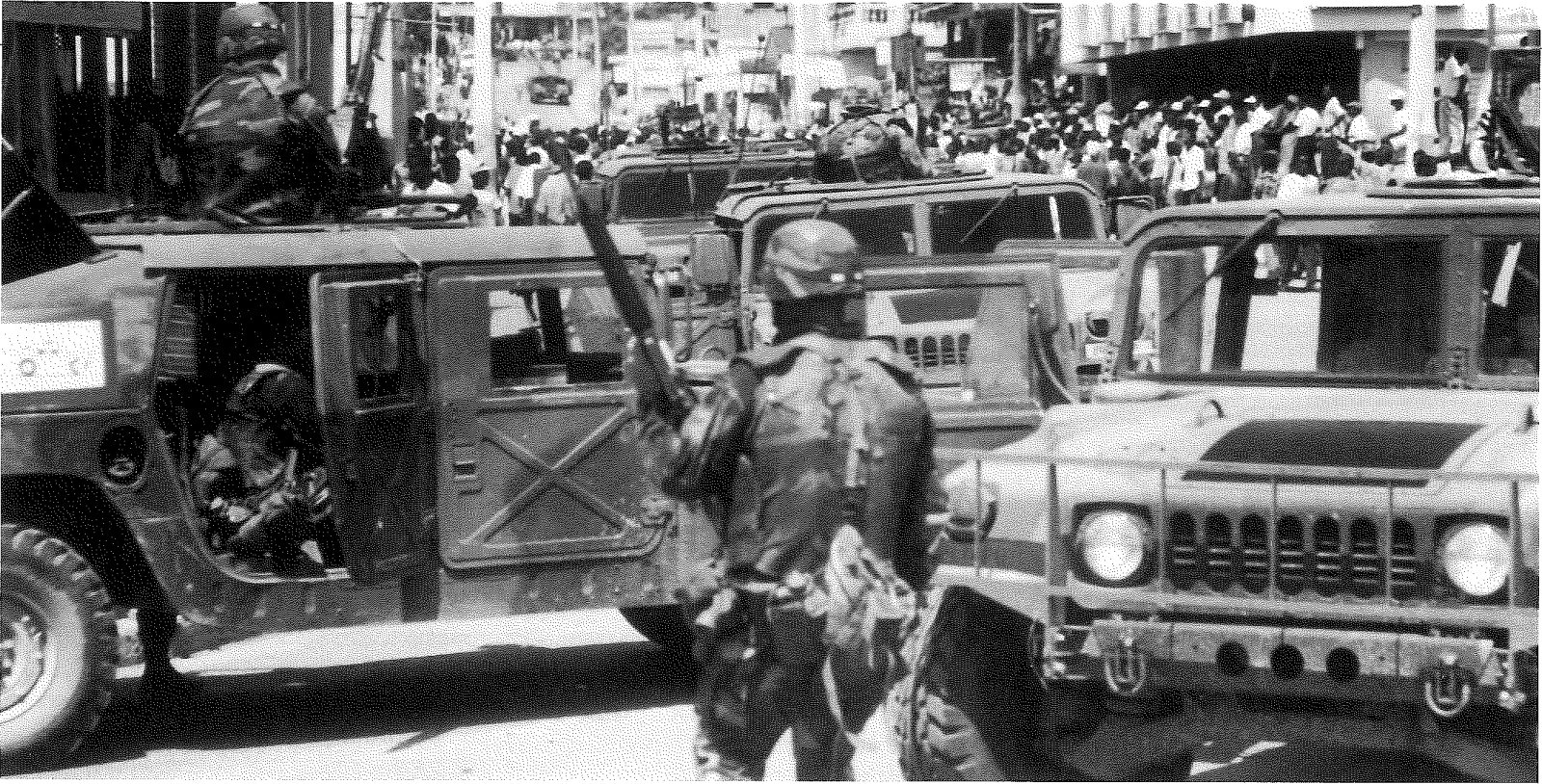
“Pa kouri! Sé démokrasi!” That was the message intoned over the loudspeakers of US Forces Apache buzzing Port-au-Prince on the morning of September 19th, 1994. “Don’t be afraid! It’s democracy!”
After a long and hot summer, the Americans had finally landed, bearing arms and the hope of democracy. All over the city, people watched from their rooftops as the low-flying helicopters delivered their optimistic advice to help calm an apprehensive population that had half-expected the Americans to blood and bombs. It was a day when a bit of hope was restored to a people who had lived in fear and despair for three awful years. This bloodless invasion to remove Haiti’s military dictatorship was seen as the triumph of international efforts to bring back exiled President Jean-Bertrand Aristide.
It was inevitable that a determined international community would get its way with a few weak soldiers who lorded it over the poorest inhabitants of the Western Hemisphere. Today, everyone is comfortably felicitous about the outcome of the crisis. The bad guys have been given the boot. But the international community was not always so determined. In a strange and paradoxical way that could be said to characterize much of the 1991-1994 Haitian crisis, President Aristide owes his restoration to the failure of the international community to dislodge the Haitian dictatorship by political and economic means.
Back in June 1994, many in the foreign media, lodged at the Hotel Montana overlooking Port-au-Prince, waited impatiently for the coming confrontation between the forces of good and the forces of bad. The UN and the US had turned up the pressure on Haiti’s stubborn dictatorship and its supporters by cutting off all remaining trade and closing down the airport. Foreign nationals were evacuated, and many diplomatic missions were cut back to the bare bone. Since October 1993, when the USS Harlan County beat a fast retreat rather than face a dozen or so armed thugs at the city port, dooming the first efforts to establish UNMIH in Haiti, a renewed embargo was seen as the only safe way to put pressure on the dictatorship. By July 1994 the international community coupled the threat of force to its Haitian strategy, reluctantly admitting in the process that the embargo was not enough. Instead of weakening the army, the embargo had strengthened it. The Haitian generals, encouraged by their experiences of American political ambivalence since the coup d’état in September 1991, did not believe there would ever be an invasion, and countered with the expulsion of the UN/OAS human rights observers, the blocking of what little humanitarian aid was coming in, and more terror. The army’s simple hope was to hide the human rights abuses, discredit the embargo, and eliminate the last vestiges of political opposition.
To foster the impression that serious resistance awaited any foreign invader, Champs-de-Mars became the staging ground for a militia force of mostly poor, hungry men. Training exercises were choreographed for the foreign media, particularly television which needed dramatic visuals to portray the sense of crisis. The absurdity of the four masked men known as the Ninjas dressed in black tights and brandishing Kalashnikovs was lost on a media that wittingly or unwittingly joined in the dangerous comedy of overweight thugs playing commando. These images served to fuel US domestic political opposition to an American military adventure in Haiti.
Throughout the summer, and despite growing threats to resolve the crisis with force, diplomats and foreign journalists moved about rather freely. The rhetoric on both sides created psychological pressures and the embargo made for some inconveniences. But anyone with money was able to get by. Members of Haiti’s political opposition and the poor suffered most. As the generals dragged the country down with them, the well-off who opposed Aristide continued to argue matter-of-factly against his return, blaming Haiti’s ills on the overpowering strength of the international community and the exiled president’s excesses.
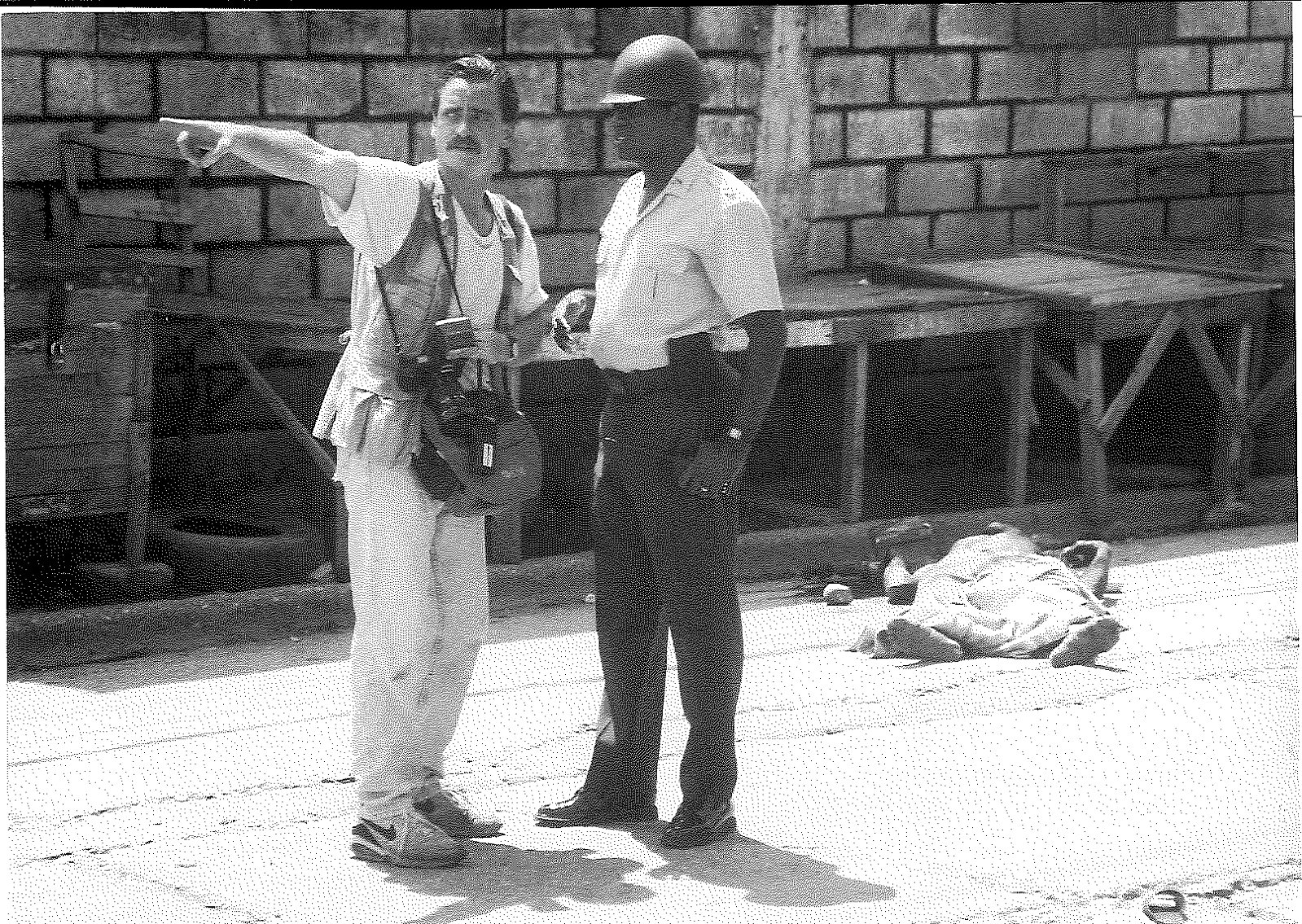
Many businessmen who had not been blacklisted by the US had left for Florida in June where they waited out the crisis. Most major factories were closed, so that poor and now unemployed workers and their families joined the bread lines, if any were left to join.
For anyone in Haiti in mid-August, it looked as if the generals were right: the Americans had no desire nor will to invade Haiti. The stakes were simply not high enough, and everyone knew it. The despair was palpable.
At his home in the walled-compound of the Holy Ghost Fathers in the slum-community of Sans-Fil, Père Antoine Adrien described the situation in Haiti as intolerable, but said that was not a reason for the US to act. “Haïti ne représente pas un pays stratégique pour les Etats-Unis.” Père Adrien, a close adviser of President Aristide, was chairman of the Commission présidentielle that represented him in Haiti atter the coup d’état. “Nous sommes confrontés par là dans la perpétuelle hesitation de la communauté internationale: quand leurs intérêts ne sont pas en cause — c’est caduc!”
The on-again, off-again international economic embargo, that was then on-again (in a way that it was never before, was far from cowing the military or its backers in the upper class. “Ne pensez pas que les sanctions pourront avoir un effet sur les militaires,” Père Adrien warned. “Eux, ils ne s’intérèssent pas au niveau de vie en Haïti.”
The embargo was a blunt instrument that could not distinguish between those who bore political and moral responsibility for the coup d’état and those who did not. It had a pernicious effect on the poor who were left without jobs. Street kids became a barometer of the hard times: there were more of them, and they were more aggressive. Inside the slums, it was worse: filth, disease, malnourishment, lack of health care — chronic problems that had always existed — now took a greater toll of victims.
Canadian missionaries who had lived in Haiti thirty years and more testified they had never seen anything as bad, even under the Duvaliers. Meanwhile, the embargo allowed a small group of soldiers and businessmen to grow very rich on the black market.
“L’embargo n’a jamais marché, nulle part,” Frantz Voltaire said on the eve of the US invasion. Mr. Voltaire was the Chief of Cabinet to Prime Minister Robert Malval, the only constitutionally-appointed Prime Minister during the coup d’état.
The embargo was provoked by the coup d’état and for that the Haitian military was responsible. For those opposed to President Aristide, all of Haiti’s problems could suddenly be blamed on the sanctions. Many well-to-do Haitians shamelessly exonerated themselves of any responsibility for the country’s ruin. For the rest of the world, obliged to act or be seen to act, the embargo was an easy strategy. How could a coup d’état against a democratically elected government (in an internationally-supervised election) go unanswered. Nothing back then could possibly have justified the use of force to resolve the crisis. In the context of the democratization of the Western Hemisphere, the coup d’état was a serious political affront that risked jeopardizing political and economic advances elsewhere in the region. But despite these important foreign policy objectives, little else was at risk to the immediate interests of the regional powers. The embargo was a simple but short-term and short-sighted political expedient.
From his safe-house at the height of the terror in early September, Evens Paul, the Mayor of Port-au-Prince, who remained in Haiti throughout the crisis at considerable personal risk, described the international community’s diplomatic efforts as a failure.
“Je ne dis pas que la communauté internationale est responsable pour la crise, “ he Said. “Mais son implication a aidé à renforcer les militaires. Le pays est de plus en plus déstabilisé. La répression a augmenté. C’est une situation de catastrophe.”
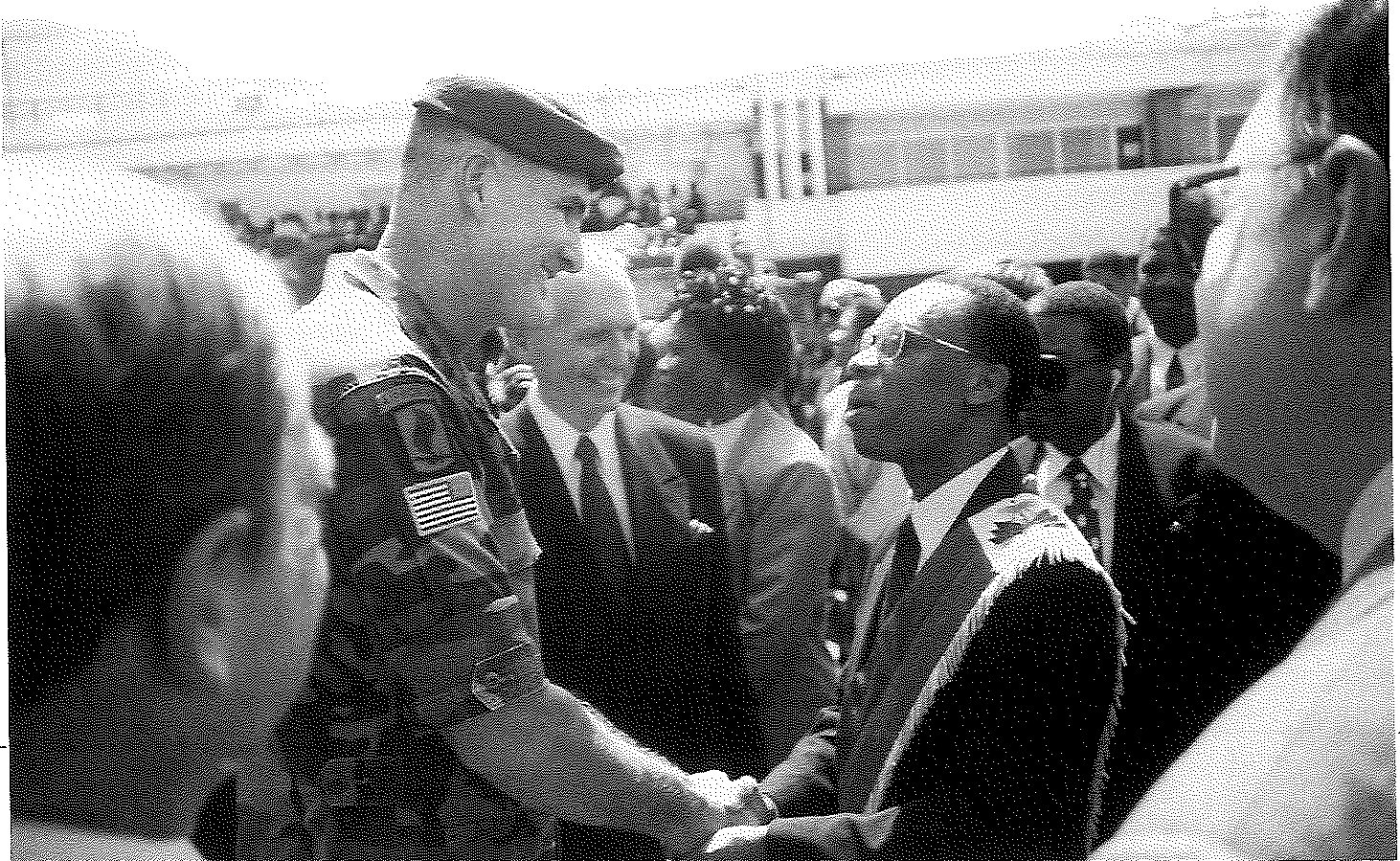
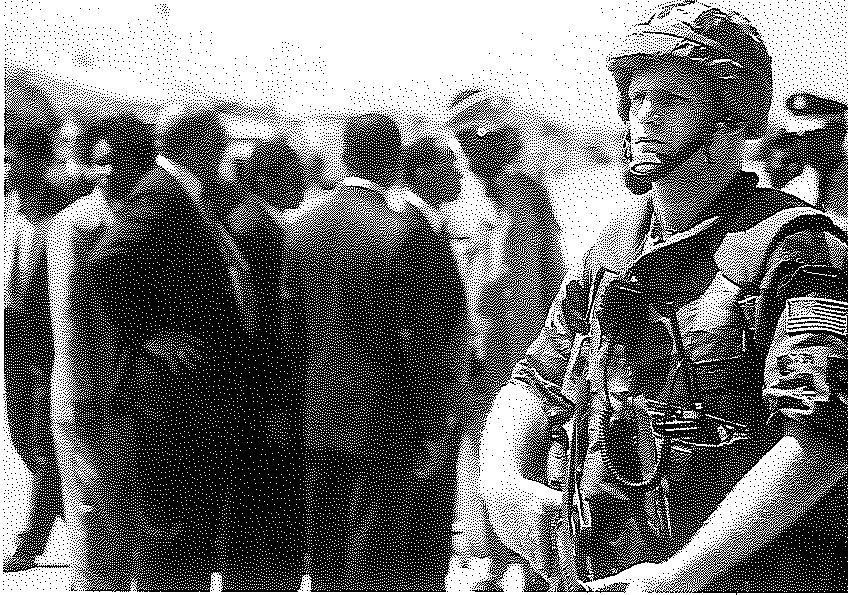
It is hard today, looking at the impressive deployment of foreign troops and the promises of international aid, to fault the international community. Its goodwill could not be in greater evidence. But in the summer of 1994, it seemed as if the US and its allies were being led deeper into the Haitian crisis by their own political reticence rather than any positive resolve on their part. President Clinton’s May 1994 executive order granting a refugee-hearing to all Haitian boat people picked up by the US Coast Guard helped unleash an almost uncontrollable flood of Haitian refugees. The hope had been that the new policy would help placate President Clinton’s own liberal constituency and show him honouring an old campaign pledge. But it also served to unmask the terrible tragedy that had been dragging on for three years, and caused a torrent of political activity on the US domestic scene to finally bring the crisis to an end. For Mr. Paul, too much bad faith had prolonged the crisis. Nothing put this in better relief, Mr. Paul said, than the public statements of former President George Bush, as a private citizen, warning the Clinton Administration against any military involvement in Haiti. It was President Bush who had welcomed President Aristide to the White House after the coup d’état and who had publicly declared that the US would do everything to restore him to power. Now he could be honest and say President Aristide was not worth restoring to power. “Comment peut-il (Président Bush) dire ce qu’il dit main-tenant? Le mensonge,” Mr. Paul said, visibly agitated. “Ce manque de moralité politique peut engendrer d’autres crises.”
Indeed, the lack of morality had probably dragged things out. As many came to recognize, no amount of moral indignation and no diplomatic threats would force the military in Haiti to quit power.
“La seule menace pour les militaires était la force,” Mr. Voltaire Said. “Alors jusqu’à l’heure ou la force était une vraie menace, ça ne voulait rien dire.”
The hope had been that UN Security Council Resolution 941, giving member states the green light to “use all necessary means” to resolve the crisis, and US military manoeuvres would be enough to bring the Haitian dictatorship into line. It wasn’t. In the end, it was not the threat of force but the use of force that made the difference.
“La communauté internationale s’est fait prendre a son propre piège,” Mr. Paul said ruefully. Today, Haiti is, in the words of President Aristide, a “dormant volcano”. Its economy is a mess, exacerbated by the embargo that was supposed to have helped the country shake the dictatorship. people are expecting economic miracles that will never come. Politically, the country is badly divided. The Haitian government is in a vice grip controlled by powerful international, regional and local economic interests. The poor majority is hankering for changes that may be considered too much. Lasting political-economic reforms will be difficult to achieve. If there is any consolation, it is that Haiti’s fragile democracy holds out more hope than anything that went before it.
View the original scanned pages →
Originally published in bout de papier, Vol. 12, No. 2 (1995) — Summer 1995 // Été 1995, pp. 19–21. Read the rest of this issue →



