
bout de papier, Vol. 12, No. 2 (1995) — Summer 1995 // Été 1995, pp. 10–13
The recent special edition of bout de papier featured an intimate look at foreign service life. A number of spouses responded to the call for articles. Rather than shorten them in order to include them in the special issue, several of them were held over to run as a feature in this issue.
Old foreign service documents refer to wives and families as encumbrances; more recent ones call them dependents or accompanying spouses. Less politely, married foreign service couples refer to themselves as “two-fers” – a reflection of the department’s regard for spouses as free labour when needed, expensive luxuries when not. The struggle of an accompanying spouse to support the employee and carry a full load of representational responsibilities while maintaining some measure of personal life continues unabated is reflected in these stories.
A Peaceful Day in Dhaka
Dawn. Casey’s old, wet black nose neck and wakes me up. My alarm clock has gone off early! Probable cause: missing “master”. Since Jon’s departure, Casey has been sticking to me like glue.
With just one person to care for during the next couple of weeks, the staff have an easy schedule. We consult briefly about the cook’s forthcoming, much-deserved leave. He assures me that he’ll come back rested and ready to oversee the Canada Day reception. This year it will be a Red and White big-top production, requiring four cooks and twelve waiters.
10 bout de papier Vol.
Thursday morning’s Daily Star, one of several English language dailies, is always enjoyable because of its Woman’s Page which often tackles delicate subjects — and this morning’s offerings include a very scholarly piece entitled “Women: Colonialism and Postmodernism.” Another thought-provoker suggests that women in development may be DIS-advantaged by “unequal benefits due to gender disparities”. Hmmm. Yet another article deals with women’s reproductive rights, lashing out with “In Bangladesh, the female-headed household not only forms nearly 19 per cent of all families, it is a rare polygamous household where both or all wives and children are supported by the found patriarch, whose ability to breed children is matched only by his disinclination to take responsibility for them.” and “To the question ’Have you any children?’, a man can blithely respond with an insouciant ’not to my knowledge’. No woman could ever make such a rejoinder… maternity is a fact, paternity is an opinion.”!!!
Before the heat becomes too unbearable, I decide to run a few errands. The overnight accumulation of grime still clings to my windshield — so a quick wash is needed. Quick? The hosepipe supply comes directly from the street source. Those who do have access to a public water pipe must wait a very long time indeed for delivery of a supply which must be shared amongst many! Too often they become impatient and take their water from the shrinking, pre-monsoon lake a few streets away which serves as water supply, fishing ground and sewer for thousands.
Which makes me think of another blessing — and one which Canada supports — the work of the ICDDR,B (International Centre for Diarrhoeal Disease Research Centre, Bangladesh). While the word “cholera” is not used here to describe the disease which claims too many lives each year, the work of the ICDDR,B has made it possible to treat and rehabilitate victims of this relatively new strain, identified first in 1993. The clinic here in Dhaka, which during one bad period last year admitted over six hundred new cases every day, and the centre down-river at Matlab return most patients who arrive comatose and close to death to their homes within three days, after IV and oral rehydration therapy, antibiotic treatment plus instruction on self-rehydration in case of repeat infection. Amazing! Seem as heartless and Out on the street, it seems to me there is increasing competition in recent weeks for the green spaces on the narrow dividing strip of Gulshan Avenue, the main thoroughfare in front of our house. Herds of goats and cows help the local council with weed and grass control but this area is also home to a couple of women with their children. Very large and luxurious homes are under construction nearby (for whom one wonders?) around which are the makeshift squatters’ huts of the construction workers. Piles of brick rubble are being made by women who break. bricks all day long while supervising their children who play in the roadside. Men also do this work, but usually with the benefit of an umbrella to protect them from the intense sun and without the encumbrance of children.
Local shopping is always an adventure. At the market, the car is surrounded by a dozen children, all trying to direct me to a parking space and earn a few Talus — either for “guarding” the car or carrying my shopping. This is totally unnecessary as my old heap has already lost much of her beauty. Most of us develop a policy on beggars. An Australian friend hires only blind people to guard her car. I choose only girls and usually they reward me with a broad grin in exchange for the equivalent of 10 cents, but occasionally one will whine that five minutes of her time should earn her at least twice that amount. I’m told these 8-to-12-year-old girls are frequently involved in sex transactions. This is very disturbing to contemplate but I’m encouraged to know of local organizations which try to help the street children of this city. Begging is a long-established and accepted practice in this part of the world.
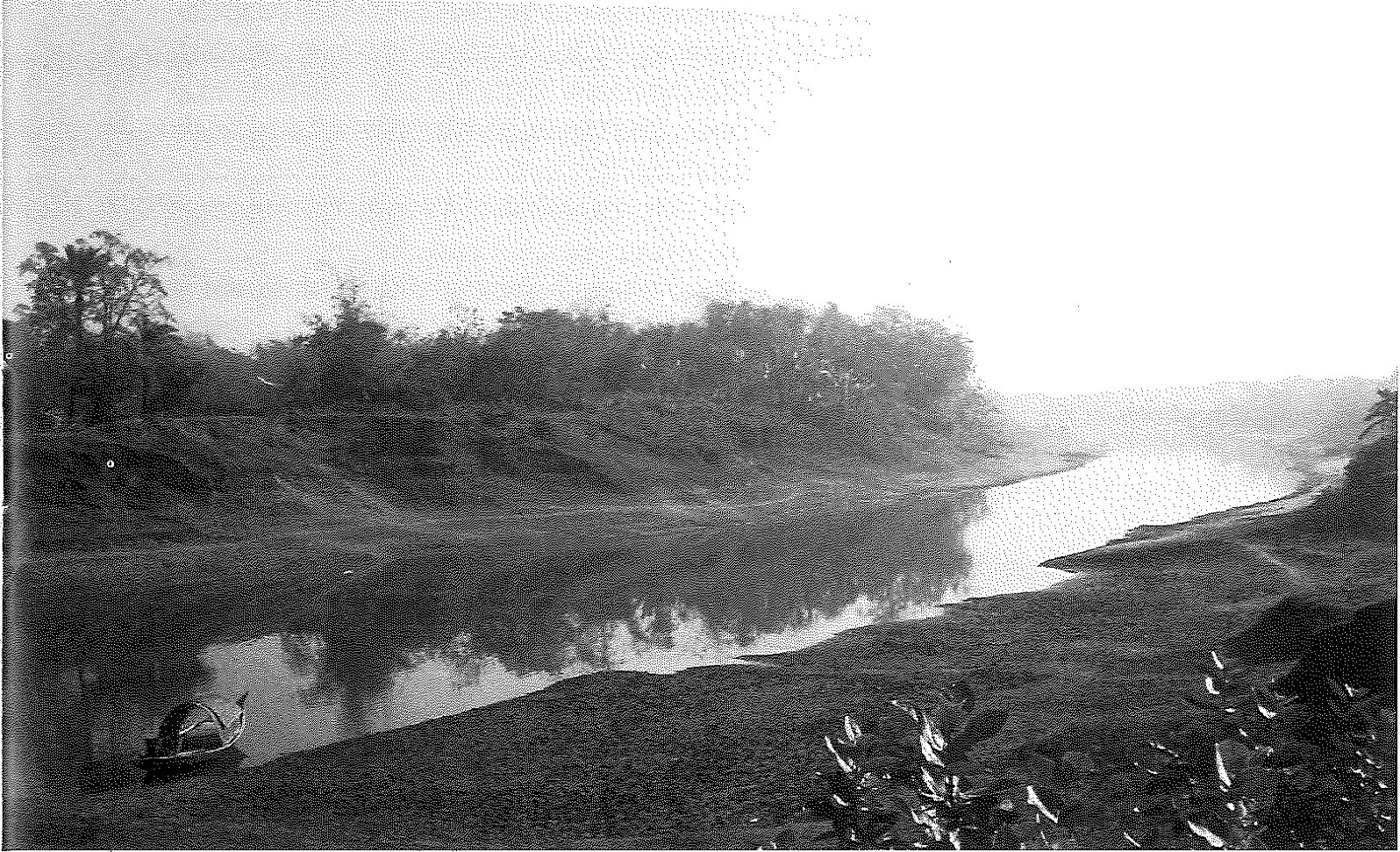
Later in the afternoon, a few phone calls are necessary to set up my next field-trip. Travel is very difficult and complicated in this country but visiting some of the projects supported by Canada brings its own special rewards with views of life outside the city of Dhaka which tends to overpower one’s sense of this place. Bangladesh is, in fact, a rural, agrarian country. Somehow, rural poverty doesn’t seem as heartless and grinding as the awful urban slum life one sees most frequently. Of course, this is an illusion, but I still have a happier feeling about the villages I’ve visited where the setting appears more idyllic, where children, just as undernourished as their city cousins perhaps, are nevertheless playing far away from speeding trucks, blaring horns, heaps of rotting garbage and over-crowded surroundings. Even a cremation I happened upon recently seemed very natural, dignified and appropriate, at a quiet ’ghat’ or landing stage overlooking a peaceful stretch of river.
My Bengali teacher arrives. Progress is slow but it’s so wonderful now to be able to read signs and billboards. Conversations are still very halting but my few expressions seem to delight Bangladeshi acquaintances.
With my husband away, there are no official functions to attend, or to organize, and the prospect of a quiet dinner followed by some televised tennis from Paris is very appealing.
Street Wedding in Delhi
This month marks the beginning of my ninth month in New Delhi and I still spend a portion of each day trying to get a grip on this strange, fascinating, wonderful, frustrating, beautiful, and thoroughly confusing country and its people. Today is no different.
As the wife of an Immigration Officer who has been leading the nomadic life for nearly thirty years, and one who is not gainfully employed, I am aware that I am probably part of a dying breed. A number of us still exist and our days are, naturally, quite different from those who are employed or for those who hold the foreign service position in their own right.
It is a month before the cooling monsoon rain will come, today’s temperature is forecast to be 44 degrees Celsius. It is not much different from yesterday, nor will it be much different from tomorrow. Many foreigners and Indian nationals will choose to remain house bound. Those with air conditioners will feel blessed and just a little guilty. Others will rely on fans, either ceiling or portable, to gain a little relief. The street people will try to find a bit of the limited shade and will snooze on their charpoys (string beds) or the ground itself. The markets will be less crowded during the daytime hours and will spring to life after the sun goes down.
There is water today. Not so every day. Water shortage is acute. The High Commission has its own water tankers. A telephone call to the HC puts one on the list for an emergency supply. One learns to ask, “Where do I stand on the list? How many hours before you can make delivery?” The demand is great and long waits are inevitable. Today we also have electricity from the mains. This means we can run all the air conditioners. By Indian standards, we are quite spoiled. By North American standards, the frustrations are real.
I have agreed to act as temporary Community Coordinator so I accompany my husband to the High Commission for a morning’s training session. I learn that during the next few days there will be three new families arriving in New Delhi. I take the training seriously. It will be my responsibility to see that the new arrivals are met at the airport, installed in their hotel (or directly into their assigned quarters), introduced to the people and places with whom they will need initial contact. I believe the first few days in post to be of utmost importance and my own priority will be the new arrivals. I will give them my best.
Training completed, I summon my driver. Servants are cheap and necessary in New Delhi, and help the economy. Each salary feeds and houses an extended family in a land where social services are virtually non-existent. We have more than we need: a cook, a bearer, a mali (gardener), and a driver. The cost per month is about $270 and we may be sustaining as many as forty people — wives, babies, cousins, aunts and grandmothers.
I return to the comfort of my air conditioned house. The servants take their leave for lunch and siesta and I settle down to enjoy the break in a now servantless house. I become engrossed in Gitanjali Kolanad’s Culture Shock, India. I have lived here long enough to be able to nod, “Ah, yes” and short enough to discover,, ’I didn’t know that”. The quiet time quickly passes.
Soon my husband will return from work. We eat early and then begin an attack on the accounts for the Canadian Club of which said husband is treasurer. The accounting is interrupted at nine-thirty by the sound of drums and other street sounds. We suspect a wedding and venture outside to investigate. It is still hot. But for the street people there is remarkable relief from the day time temperature and the street is full of life. Suspicions confirmed about a neighbourhood wedding, we join the chowkidars (night guards) and street people to enjoy the spectacle. We have no embarrassment about sitting on lawn chairs outside our front gate to get the best view. Nothing is really private in this land of shoulder-to-shoulder people.
The wedding confirms today as an auspicious one (or at least these hours of this day. We watch the motley band escort the groom on his white stallion towards his waiting bride. The bride is never seen unless one is actually an invited guest to the wedding. She waits in seclusion. The marriage is undoubtedly an arranged one. Most are. The process of the groom’s arrival is a lengthy one. We settle in. Hand held electric “chandeliers” powered by a noisy generator housed in a smelly truck provide the illuminations. Street people, invited guests, and eunuchs eager for the “baksheesh” to be gained by their presence (or departure all dance before the groom who is seated on his horse looking decidedly unhappy about the whole procedure. The group stops every twenty feet or so along the street for more dancing before it arrives at its destination, a large tent erected for the celebration. An invited guest asks us to dance. He suggests that we join the wedding. Again polite refusals, although had we felt so inclined we would have been made welcome. The “show” just about over, we bid the people “goodnight” and return to the neglected accounts. It is getting late. We pack it in and head for bed.
Dawn to Dinner in Hong Kong
Five-thirty on a pre-dawn Hong Kong morning. My regular waking time. This is the quiet uninterrupted time that I devote daily to skimming the three English Hong Kong newspapers. Next I complete some school essay corrections. My seventeen 22-year-old Chinese students, at the Canadian English Language College where I teach, have begun to write well and copiously. I’m very proud of their writing progress and I must keep up with their output.
It’s dawn. I rush out to check the sky where ominous rain clouds are lurking. This does not bode well for tonight’s dinner party on the patio for forty leaders of the Hong Kong Canadian Community. The awning will offer some protection but not if there is wind and rain, typhoon-style. I confirm the formal layout of the dining room table and double-check the spelling of place card names against the official guest list.
Time is speeding up. I rush upstairs to wake up Ian, our 16-year-old son. During our stay in HK, he has grown from a boy into a tall, sprawling teenager. In three weeks, he will be leaving HK for summer camp and residence at Ashbury College next year. I’ll miss him. This life abroad isn’t easy when tough decisions have to be made about leaving children in boarding school and university far away in Canada. No time for self-pity, I must make sandwiches for lan’s lunch and mine. I type up a quick fax to send off to Matthew, our 19-year-old son at McGill, to wish him good luck on his psychology test today.
Distance from one’s children and aging parents is a constant and difficult aspect of life in the Canadian Foreign Service.
Eight-thirty. On the way to school, I correct papers and review the day’s lesson plan. After three years of supporting John in his role as Head of Mission, hosting official functions at home and attending meetings, ceremonies, lunches, receptions, and dinners in the community, as well as studying Cantonese, I decided to return to my own career. Over the past twenty years, I have been lucky in both being an active representational spouse and in pursuing my career, in teaching English as a Second Language or development, or studying languages, when abroad and in Canada. Since HK is hardly a developing country, I looked for a job in teaching. It is unfortunate that all the work of a foreign service spouse — her language skills, organization skills, interpersonal skills, and knowledge of the world — are not easily translated into a CV, nor easıly marketable when trying to find a job on return to Canada.
The morning flies by. The Canadian English Language College in Kowloon is a joint venture between the Vancouver Community College and the Tung Wah Group of Hospitals, a respected private body which runs hospitals, homes for the elderly, and fifty schools of which ours is one. The Commission has strongly supported Canadian education in HK, including this new school, which was opened by Lt. Governor of B.C., David Lam, in 1992. We teach intensive English as a Second Language (ESL) courses to prepare HK Chinese students for their further studies in colleges and universities overseas. At the end of every 13-week term, at least half of the students in our classes will be bound for Canada, the USA, Australia or England. The students are therefore strongly motivated to learn. Their progress in these intense courses is rapid which is very rewarding for the teachers.
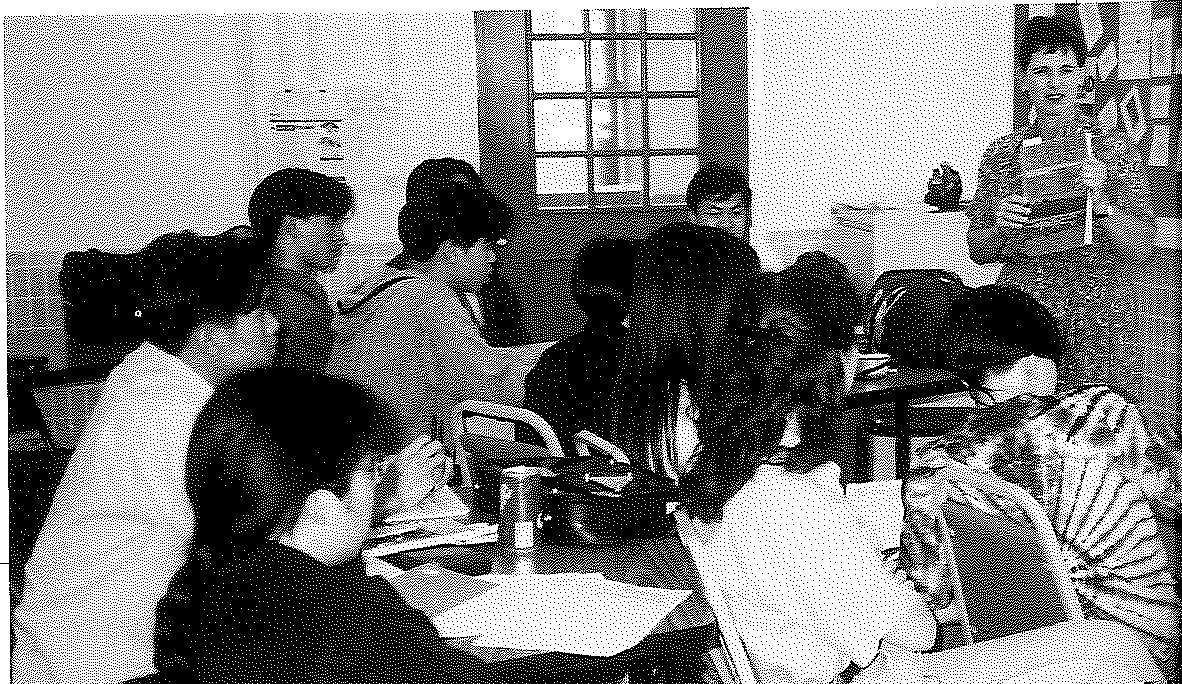
The teaching is particularly demanding when I have to go out two or three nights in a row to official events but adds a personal dimension to my Hong Kong experience. Because we are a small school, staff and students are all very close. We’ve gone through a lot together. Today, at the end of class, we took a class photo for a souvenir. The students all become very close to each other, and to their teacher, during these terms and we often keep in touch afterwards.
After school, I head off for the flower market in deepest Kowloon. This market, the cheapest in town, is one city block of flower shops with the freshest and most beautiful arriving every morning from China, Singapore, Thailand and Holland. I need to pick up one more bunch for a floral display for the roof patio where we will serve refreshments when our guests arrive.
I arrive home at five o’clock. All preparations for tonight are proceeding well. I count my blessings once again for having such a reliable and good-natured staff.
By eight o’clock the guests are starting to arrive. It is gratifying to be at a stage where I know so many of the people personally. They are from many fields— government, business, education, and the media — all have a connection with Canada. This event was to recognize officially once again their community spirit and to thank them for their work on behalf of the Canadian community all year. What a difference between this and our arrival where I probably met some 3000 new faces in the first three months and was expected to know all their names on second meeting! The weather tonight has cooperated and a light breeze relieves us of the tropical heat. We are on the roof patio and it’s sunset. We see the outline of nearby hills and some of the lights of Hong Kong city.
They are delighted with the candlelit tables in the small patio-garden. This is a novelty in a place where 97% of people live in apartments. Many admire the totem pole from British Columbia in the patio which was carved by native Canadians for our Canadian Festival in Hong Kong in 1991.
Eleven o’clock, the party’s over. The guests go home. I slip off my heels and sink into an armchair for a few quiet moments. But no! An emergency has arisen. Unknown to us during the party, Ian’s toe, which he injured by unwisely boogie-boarding in the polluted waters of Deep Wave Bay, has become seriously infected. John tells me we must take him to the Emergency of the Adventist Hospital. Ian has been given a shot of antibiotics and now has pills; the infected wound has been treated; the prognosis for healing is good. I’m relieved.
Now I can sleep. 5:30 a.m. is going to come very quickly.
View the original scanned pages →
Originally published in bout de papier, Vol. 12, No. 2 (1995) — Summer 1995 // Été 1995, pp. 10–13. Read the rest of this issue →



