
bout de papier, Vol. 12, No. 3 (1995) — Fall 1995 // Automne 1995, pp. 39–40
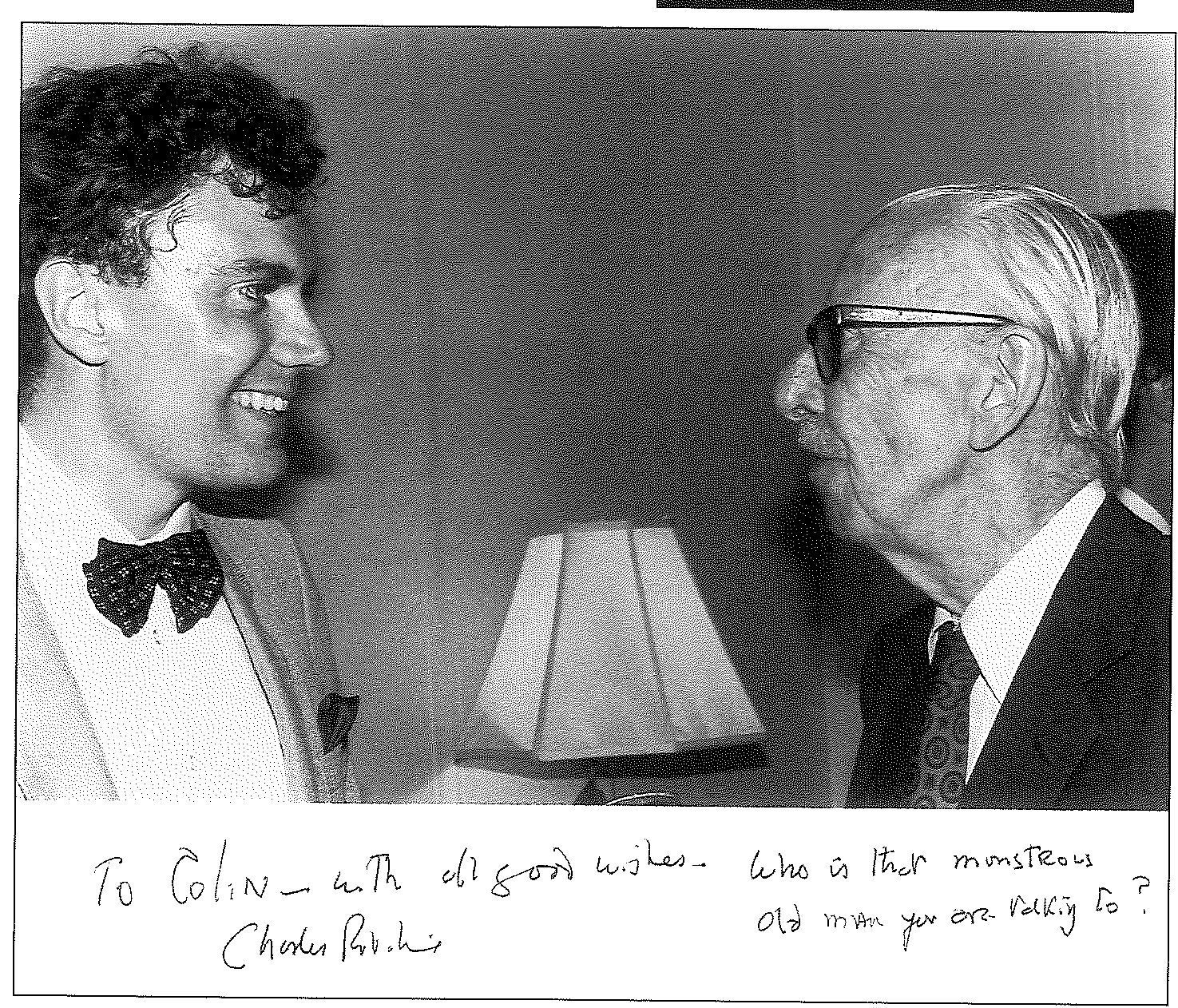
In that fabled golden era of post-war diplomacy when, through chance and sheer dint of intellect, Canadians really did make a difference in creating the institutions that have held the peace for half a century, the foremost man of letters and chronicler of his era was Charles Stewart Almon Ritchie. Ritchie, as Victoria Glendinning described him, was one of those North Americans to whom background, education, travel and elegant physical type give all the patina of the diplomat: learning easily worn, stylishness, finesse and savoir-faire.
I was at university trying to decide whether to go into law school or teach. Neither had much appeal. One of my professors included in his reading list Harold Nicholson. He meant Nicholson’s famous treatise on Diplomacy. By the time I got around to going to the library the four copies were on loan to my more industrious colleagues. The only books by Nicholson were the diaries. I had been keeping my own journal off and on for a couple of years and it seemed like a good idea to see how someone else did it. And I read and read and read. I recall that I didn’t do very well on the ’diplomatic practices portion of the test but diplomatic life sounded great fun.
And then I read Ritchie. The Siren Years had just been published. It was his account of life as a young foreign service officer, first in Washington and then in London. It was like living on the set of a Nick and Nora Charles ’Thin Man’ film. In what other profession could you read Henry V, cultivate rococo Romanian princesses and baroque dilettantes, bed ballerinas, and then be paid to write “impressionistic’ despatches on what you learned at dinner! There was no better advertisement for a career in the foreign service than Ritchie’s diaries. This wasn’t work. This was fun!
I first met Ritchie about a year after An Appetite for Life, selections from his diaries of growing up as a teenager in Halifax and then as a student at Oxford during the twenties. He was already a legendary figure within the service but with The Siren Years he had become a preeminent man of letters with a Governor General’s Award and critical ovation on both sides of the Atlantic. One of my colleagues, who played the piano, had taken an apartment in the Duncannon, where Ritchie and his wife, Sylvia, lived when they weren’t off to London or spending summers in Chester. She would tell us about talking with the great man while they walked up Metcalfe Street. Shortly before I was posted to New York I met him at a cocktail party given by the son of another of The Greats.
’Angular, beak-nosed and narrow-chested’ was how Ritchie accurately described himself in Appetite for Life. Fifty years had not made much difference. I watched and waited my turn for an introduction. I had recently read Elizabeth Bowen’s The Heat of the Day. So this was Stella’s Robert! He balanced a glass of white wine in one hand and a cigarette, which he appeared to suck the life out of, in the other hand. The voice was high, nasal and marked by that mid- Atlantic twang of the Canadian who has gone ’up’ to Oxford or Cambridge. From across the room, with his toothbrush mustache and languid manner he even looked like an aging William Powell. When I finally got my turn I muttered some inanity like ’I enjoy your books sir’ • He gave a practiced smile and returned his attentions to ladies.
The diaries kept coming: in 1981, Diplomatic Passport, and in 1983, Storm Signals. Diplomatic Passport picked up where The Siren Years had left off. Posted to Paris, he approached it in the spirit of the Renaissance Pope who said “God has given us the Papacy, now let us enjoy it.” There are delightfully wicked passages about those who failed to receive invitations to the ball in honour of Princess Margaret. Then there was Ritchie’s characterization of the most hatetul of vices — long extempore prayers, this one at the Protestant temple in Possey.
On to Bonn, his first head of mission assignment, where he learned to develop “an anonymous public face which expresses only cautious benevolence, controlling the spasms of nervous exasperation or high spirits, getting into the groove, the ambassadorial groove.” It was a game, like learning German through recitation of Little Red
Riding Hood to the “wives of German high officials, stout bodies, reddish faces, not a word of English.”
Then it was New York and the United Nations during the Hammarskjold years.
Fascinating but “not good for the diaries” For Ritchie there was no question when it came to boring away at yet another disarmament resolution or rereading Horace Walpole. Finally there is Storm Signals and the crown postings of Washington and London. There is a delightful vignette of the Kennedy household, when during Ritchie’s presentation of credentials, the President “half rose from the walking chair, stretched out his arms, and said ’Shoo, Shoo’. For a moment I was frozen in my place. The thought passed my mind that I might be the first ambassador in history to be shooed out of the White House.” But it was Caroline on her pony who had wandered into the room.
The last chapter of Storm Signals, which he titled ’Diplomatic Attitudes’ is the Ritchie version of Nicholson on Diplomacy. It is elegant and accurate even if it lacks the Ritchie wit. He captures the essence of Canadian foreign policy as possessing a “moralistic preaching tone which strives, somewhat inadequately, to express a real strain of idealism. Yet this idealism is inevitably strongly diluted by the realism of a great trading nation with the material interests of its people to safeguard.”
He makes the case for cultural diplomacy, remarking that it is easier for the camel to enter the eye of the needle than to get a well-informed Canadian political story or considered editorial in the columns of Paris, London or New York. Rather, it is our actors, singers, and poets who contribute enormously to a fuller view of Canada.
Equally elusive is the goal of a ’representative’ foreign policy. Foreign policy, by definition, is the playing field of the elite. “The fact is”, Ritchie observes, ’is that most people, most of the time, are not much interested in foreign policy except when it touches their pockets or involves some special interest organized for a particular cause.”
He rightly concludes that a successful “diplomatic’ career is made at home rather than abroad. “For the foreign service officer who is interested in policy and the mechanics of power, service at home is more important than service abroad. If he hopes to exert any influence on affairs he must make good his position in the department. The longer he remains abroad, remote from political and departmental infighting in Ottawa, the more his influence tends to decline. He must first have established a base of trust and friendship at home in order to count on continued support, and this must be steadily maintained. He who forgets this does so at his peril.”
In 1984, I interviewed Ritchie over lunch and drinks for bout de papier. He was finishing another book, My Grandfather’s House. He was well informed on departmental gossip and over martinis (more gin than vermouth) we chatted. He was intrigued by bout and its possibilities and he encouraged me to use the old hands as a sounding board. Thus was born the senior editorial board which has given the magazine a solid foundation of experience and ideas.
After that I would see him regularly at bout de papier board meetings and walking up Metcalfe. Occasionally, I would invite myself over for ’tea’. His appetite for life and events was unwavering. He put great store by loyalty (if not fidelity!). Trust your instincts and your experience, he advised. He told me that looking back on life what he chiefly regretted was the time spent anguishing over whether he ought to do something he knew he was going to do anyway. He agreed with Janet Flanner: living well is the best revenge.
I last saw him in February when I took him to what would be his last meeting with the senior editorial board of bout de papier. He was frail and joked about being nothing but skin and bones.
Afterwards we had a glass of white wine in the tiny study where he had edited his diaries. When I told him that I had been less than faithful to my own journal he was gently reproving, saying, “they give you a wonderful perspective you know. What’s the problem? Work! Not worth it you know! The diary is much more important. Perspective. That’s the thing! Not enough have it. People get too self-absorbed. Look at some of your colleagues. I’m sure it hasn’t changed. Probably worse. But your diary! Look back at it a week, six months or a year later. That thing that seemed so important at the time. Really mostly inconsequential. And remember, just a few impressions jotted down. Doesn’t have to be long. Besides,” in veiled reference to his own condition, “you can still write!”
He would have been proud of his funeral. Elegant and restrained in the best tradition of the Anglican Church. All of the old hands were there. It was like, said one of his young officers, the gathering of the clan. One of his godsons, who had just lost the premiership of the province, came and in a moment of gallantry helped back to her feet she who read the lesson from St. Paul. I sat beside a trio of elderly ladies. In their day they would have been quite something. I wondered if … no … well … perhaps! Ritchie would have been flattered.
As I left the chapel I remembered a story told to me by one of my journalist pals who had taken Ritchie to lunch months earlier. Ritchie told my friend that he had, at best, a couple of years left. The doctor recommended an operation. “Did the operation have risks?” ’, asked Ritchie. Well, yes, for a man of his age the chances of complications were high. And if the operation were successful? Well, the doctor told him, perhaps five years. Ritchie thanked him for his considerations, dressed himself, lit up a cigarette, went home and made himself a martini. Living well … that was Ritchie’s revenge.
View the original scanned pages →
Originally published in bout de papier, Vol. 12, No. 3 (1995) — Fall 1995 // Automne 1995, pp. 39–40. Read the rest of this issue →



