
bout de papier, Vol. 13, No. 2 (1996) — Summer 1996 // Été 1996, pp. 47–48
Dryan Tweedie, the Centre’s lanky archivist, poured another generous glass of port as the two friends sat watching the sun go down over the river from the balcony of his office. “Not a very good vintage, I’m afraid, but it was raining hard when I bought it and…”
66 …Any Port in a Storm” completed ace logician Ludwig Liebnitz. “Really, Tweedie, your jokes are as dusty as most of your files. Fortunately, your taste in port is better than your taste in humour.” They drank in companionable silence. Then Tweedie picked up a piece of paper, yellow with age, and handed it to Liebnitz. “Have a look at this, Ludwig. I know you like puzzles, and this one has been unsolved since 1928.” On the page, the logician saw a diagram of six clusters of blocks arranged in a rough star formation. Letters in several of the blocks spelled out two words: SORBET and TOWERS. “Looks like one of Jimmy the Turk’s reports,” he concluded, “But he isn’t old enough.”
“Your eye is good,” said Tweedie. “Actually, it was drawn by his grandfather, Hassan Flecker, who headed the Centre’s Scientific Affairs Division at the time. Five of the most important European physicists of the day were meeting secretly at a rustic inn (owned by Siegfried Smegma, the noted Wagnerian hundentenor) in the Islands of Langerhans. Flecker smuggled himself in as an itinerant schnapps taster to eavesdrop. Like his grandson, he was a natural at dropping things.”
“Each of the five registered under an alias that was an anagram combining his first and last name: RUPACALDI from England, MICROFERIEN from Italy, PUWALA- GOLFING from Switzerland, ROBENLISH from Denmark and BENSEN-LITERATI from Germany. The purpose of the meeting was to settle the future of physics, following the uproar at the Fifth Solvay Congress in Brussels the year before. How much do you know about the subject, Liebnitz?”
“Not much,” the latter admitted, “and I’m not sure that….” But the archivist was already in full pedagogical flight. “The dispute was over the nature of reality, no less.
The majority view at the Congress had been that things don’t actually exist, at least at the sub-atomic level, unless they are being observed by someone. Up to that point, quantum mechanics seems to show that there are only a series of possibilities, all of which exist at once in sort of overlapping clouds, which resolve into reality as we know it only when someone tries to measure the situation.”
“What a funny thing to believe,” chuckled Liebnitz. “I agree,’ “ said his friend. “What’s even funnier is that it is still the majority view to this day. But at the time, there was still a strong debate, with some very big names on the other side of the good deal there. In the manner of the time, he proposed a thought experiment that he believed disproved the quantum reality concept. Build a special box, he said, one that was totally impossible to look or listen into or otherwise communicate with. Put into it a cat, an atom of some radio-active substance, a detector like a geiger counter that would register when the atom split and a machine that would open a flask of poison when the detector went off. Since there was no way to measure what was happening inside the box, Schrödinger argued, the quantum reality argument meant that the state of a split atom and the state of an unsplit atom both remained possibilities, so the cat remained both alive and dead until the box was opened.”
“This of course made nonsense of the quantum reality position. There are lots of counter arguments, of course, but at the time the majoritarians were furious. At the Langerhans meeting, one of them announced that he had actually stolen Schrödinger’s cat, just to prove him wrong. The thief had constructed the box just as Schrödinger had designed it, and was convinced that the cat would in fact remain in a state of suspended reality as long as the box remained closed. The thief proposed to keep the box in a bank vault for at least 10 years before opening it, well past the time when the cat (who was already elderly) could be expected to have died from natural causes. The quantum suspension would however guarantee, in the thief’s view, that the cat would not age a single day, but would rather come out of the box the same age as she went in, either alive or dead only seconds before.”
“Flecker, who was a great friend of animals and no friend of quantum reality, was of course appalled. He knew what had happened, but not the identity of the thief. He set out to find him, and that diagram is the basis of his report — a puzzle, of course.
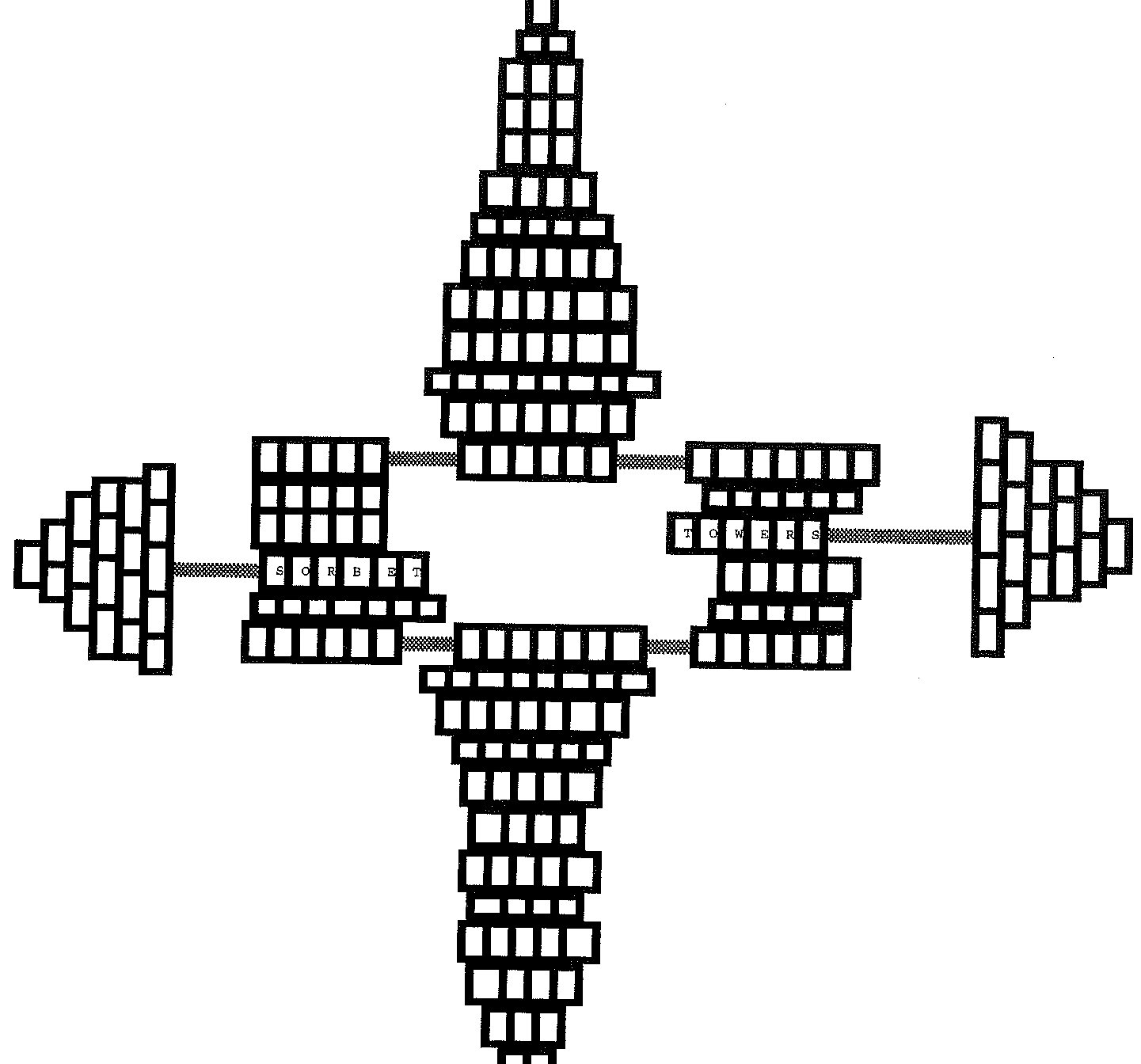
It clearly runs in the family. When first I found it, we thought it was a sketch-map of the inn, but then we found this second page explaining matters.” So saying, he handed another piece of paper to Liebnitz.
The second page said that the star-shaped diagram was an anagram chain. Each row of blocks contains a word, one letter per box reading from right to left (except for the clusters at the far right and left, where the words read down from the top of each row). To move from one row of blocks to the next, one of three methods is used. If the next row has one more letter than the one you are in, you add a letter and re-organize the letters to form a new word — like moving from TALE to LATER. Similarly, if the next row has one fewer letters than the one you are in, you drop a letter and re-organize the letters to form a new word — like moving from ALTER to LATE. If the next row has the same number of letters as the one you are in, then you change one of the letters to another letter (like moving from TALES to TAPES), but you cannot change the order of the letters. Rows connected by grey lines are treated as if they were next to each other.
The page also gave definitions for the words that fit into the boxes in the diagram (including SORBET and TOWERS already filled in to provide a start). These are divided into sections where all the words have the same number of letters. The definitions are arranged so that the words come out in alphabetic order within each section.
Two letters: half of a sunken fence; moon of Jupiter; northern Russian river; Heyerdahl’s boat (sun god).
Three letters: what is longa although vita is brevis; live by alms; marsh; possesses; organ of locomotion; fish egg or deer; French king.
Four letters: Arthur of tennis; statue in Piccadilly; theatre box; of sound mind; clear blood components; neither Bosnian nor Croat; Ollie’s buddy.
Five letters: puts in chips before drawing cards; tree-trunks; dullards or drill-holes; what a pugilist does; French naval port; medieval northern merchants’ guild; leers; slope; one who plants; Sharon or Oliver of the movies; emporium.
Six letters: makes amends; body joints; map orbs; diminishes; light frozen dessert; eagle claws; Pavarottis; soars up overhead.
Seven letters: Johnson’s Watson; cricket hurlers; inhabitants of Brittany; chows down; the ultimate (two words); Roman or US politico; vacillates.
Eight letters: Cockney chimers (two words); Texas state nickname (two words).
“Well,” said Liebnitz, intrigued despite himself, “That doesn’t seem too hard to do, assuming that the two-word answers get filled in as a single word with no spaces. But there must be more – how does this link to the Langerhans theft?”
“In handing this report over to my predecessor,” Tweedie replied, “Hassan said that the name of the thief was spelled out in the single boxes at the tip of the four arms of the star, starting at the top and going clockwise. He also left a further anagram clue, written in pencil on the back of the diagram: CHANGE PEON — TRIPARTITE NEON. He said that it gave in two words the successful approach to the problem.”
After a certain amount of work (not aided by the port), the ace logician managed to solve the 68 year old puzzle and determine the thief’s identity. After doing so, he mentioned with some sadness that it was probably too late for the cat. “Not so,” replied the archivist. “You are quite right about the thief’s identity, but he was in fact uncovered at the time, before Hassan could act. That’s why we never needed to solve the puzzle. The Langerhans participant from Germany, who was a colleague of Schrödinger’s and opposed to the majority view in any event, forced the thief to reveal where the cat and her box were hidden, and got him to open it. The cat was fine, by the way. She had had kittens while in the box, and took time only to shred the thief’s left trouser leg before returning to Schrödinger with her new family?”
Can you duplicate Liebnitz’s feat (with or without port) by filling in the diagram, deciphering Hassan’s two-word anagram and providing the real name of the thief? Not necessary to solve the puzzle, but can you also identify the other participants in the Langerhans meeting?
View the original scanned pages →
Originally published in bout de papier, Vol. 13, No. 2 (1996) — Summer 1996 // Été 1996, pp. 47–48. Read the rest of this issue →



