
bout de papier, Vol. 13, No. 2 (1996) — Summer 1996 // Été 1996, pp. 21–25
The nineties started on a wave of enthusiasm for the United Nations (UN) and its refurbished capacity to contain, and gradually quell, conflict. By the time Barbara McDougall, Canada’s Secretary of State for External Affairs (the position now titled Minister of Foreign Affairs) paid a visit to the former Yugoslavia and Somalia in May, 1993, events in those war-torn regions had conspired to raise the question of whether confidence in the UN had been misplaced. Nevertheless, there were still optimists to be found, heartened by the seeming stalemate in the Balkans conflict and prepared to write off the setbacks of the previous two years. Srebrenica was a new battle honour for the Canadians and not yet a tragedy gnawing at the Dutch, and reports from Belet Huen indicated that stability had returned to that region of Somalia and, across the country, a major tragedy had been averted.
Sunday, May 2, Toronto
From a CBC studio downtown, Wendy Mesley is recording an interview with Barbara McDougall, filmed sitting in the Canadian Forces Challenger that will take her to the Balkans. The Serbs have just agreed to the Vance-Owen Plan for the partition of Bosnia, pending ratification by the self-styled parliament of the Bosnian Serbs in Pale. Asked what course Canada should choose if the Plan fails, McDougall strikes a note of resolve, emphasizing “the strongest possible international action” and refusing to rule out “the possibility of some kind of military intervention.” She adds that one of her purposes on the trip is to satisfy herself as to contingency plans for the UN Force, which is neither equipped nor deployed for all-out battle.
The visit has been triggered by Major- General Lewis Mackenzie, the retired United Nations commander in Sarajevo, whose activities and public pronouncements have been grating on the ears of Ottawa policy-makers and officials. Their annoyance has recently reached a crescendo with Mackenzie’s intervention on behalf of 150 Canadians soldiers positioned between 7,500 Bosnian Serb regulars and government forces defending the eastern Bosnian town of Srebrenica. TV and radio news have carried reports of an agreement reached in Belgrade between the General and Radovan Karadzic, leader of the Bosnian Serbs, to allow another seventy Canadian peacekeepers to enter Srebrenica, permit independent monitors in the area and let in more humanitarian aid. Mackenzie’s private diplomacy has made it necessary to impress on the public that the government has primary responsibility for the safety of Canadian peacekeepers and is capable of fulfilling this responsibility.
McDougall’s intention to go to the former Yugoslavia does, however, date back many months. She has had to overcome military opposition, based on the argument that the presence of politicians could exacerbate an already dangerous situation. She believes that, since she worked hard to get 2,400 soldiers and nearly fifty Royal Canadian Mounted Police (RCMP) over there, she must show herself to the men and women in the field. She can point to other foreign leaders, such as François Mitterand, who have visited Sarajevo without any ill consequence. The trip is also a chance to correct the lack of media coverage of Canada’s peacekeepers in comparison with the extensive reporting of other contingents by the well-manned crews of CNN and the BBC. In line with the intention to reinforce peacekeeping and humanitarian initiatives, she will also be visiting Canada’s UN contingent in Somalia.
McDougall’s views of the Yugoslav crisis are hardening. In her view, the primary cause is the exploitation of historical and ethnic animosity by headstrong, maniacally stubborn leaders. She wants to keep the option of using force alive and is even hinting at the possibility of more forceful peacekeeping, meaning that peacekeepers should not flinch from standing up to one of the warring parties when thwarted in carrying out their mandate. She has become one of the chief proponents of an international court to try war criminals, because it could cause the combatants to think twice before they act. The Vance-Owen Plan that will carve up Bosnia-Herzegovina into homelands (“Ten little Northern Irelands,” as one UN officer describes them) does not appeal to her but she believes that negotiating the Plan is the best hope for peace. Binding these opinions together is her frustration with the failures of the European Community and the new Clinton Administration to make good on their rhetoric. There could be progress in getting the parties to the table, she thinks, if the West would just demonstrate a clear and consistent resolve. Thus, whenever the momentum behind applying pressure to the leaders flags, which it frequently does, her contributions to policy discussions become particularly assertive, not to say heated.
Monday, May 3, Zagreb
A strenuous overnight flight across the Atlantic ends in a motorcade careering through the suburbs of Zagreb, police sirens screaming. Riding in a car with other members of the Minister’s staff, I am relieved to arrive at the Hotel Esplanade, not only our temporary headquarters but also where Canada’s representative in Croatia both lives and works. For many months Sam Hanson has been manning the post by himself, transmitting daily a sheaf of telegrams on a myriad of subjects. Ironically, he has been doing this without Canada having established formal diplomatic relations with Croatia, which occurred just prior to our arrival.
The centre of Zagreb, an old outpost of the Habsburg Empire, should be attractive but a dingy pall hangs over it today. We have to start work in the early afternoon with briefings at the headquarters of the United Nations Protection Force (UNPROFOR). We meet first with the Canadian deputy commander, Major-General J.M.R. Gaudreau. He leaves us in no doubt that he does not share the meddlesome approach to the conflict exhibited by the UN commander in Bosnia, French Lieutenant-General Philippe Morillon. By making himself a virtual hostage in Srebrenica and by pushing the warring parties to agree that it should be regarded as a “safe area,” Morillon has stretched the UN mandate considerably. General Gaudreau comes from a different mould. A veteran of four tours in Cyprus, he is a trained practitioner of the classical principles of peacekeeping: consent of the parties, impartiality of the peacekeepers and the use of force only in self-defence. Already we are getting a sense of how the war in Bosnia is severely testing those principles. Croatia’s population is 4.7 million, with an additional 3.5 million Croats living abroad, including 250,000 in Canada. Since Croatia declared independence the government has been recruiting amateurs to its ranks, including expatriates. The previous occupation of the Minister of Defence, Gojko Susak, was running a pizza franchise in Ottawa.
Head of Information of the Foreign Ministry greets us with a broad Australian accent (and then tries to convince us that the tourist season on the Dalmatian Coast is going splendidly)! When the Foreign Minister arrives he volunteers that he is a medical researcher who has former pupils working in the Banting and Best Centre of the University of Toronto.
The Foreign Minister is the curtain raiser for a meeting with President Franjo Tudjman, who retains tight control of policy in this country. The President inhabits the Villa Zagorje, a modern structure in a leafy suburb which served as Marshall Tito’s residence in Zagreb. There is a bust of Tito in the lobby. Tudjman, a former academic and general in the Yugoslav army, actually served a prison term under Tito for his activities with “Croatian Spring,” a reform movement.
McDougall leads off by expressing appreciation for Tudjman’s recent visit to the opening of the Holocaust Museum in Washington, the kind of gesture that comes easily to her as an MP representing many Jewish constituents. In turn, the Croatian President offers his thanks for Canada’s recognition of Croatia and participation in UNPROFOR. Croatia has accepted extension of the UNPROFOR mandate, he says, and will agree to further extensions provided deadlines are set regarding implementation of the Vance y Plan (the basis of the shaky cease-fire nego-
• tiated by former US Secretary of State Cyrus i. Vance in early 1992, which stipulated the return of displaced residents to their homes). Preliminaries concluded, McDougall raises the issue of Croatia’s treatment of minorities. Here is where Croatia can set an example, she says. Tudjman is adamant that in Croatia Serbs and Croats live together amicably. The Serbian population of the areas of conflict is less than half the total of Serbs in Croatia. (The number of Serbs in Croatia is approximately 550,000.) Somewhat inconsistently he goes on, “We have problems with the Serbs because in the socialist system Serbia was the ruling nation. The Yugoslav army was predominantly Serbian and Serbs accounted for 70-80 percent of the police.” Then, in 1991-1992 the Serb-dominated army tried to restore communism. Worse, the behaviour of the army and the para-military Serbs was barbaric. Whereas two settlements were destroyed in World War Two (when, as Tudjman reminds the Minister, he fought against Germany and not with the Fascist Ustashe), 350 were destroyed in the recent war, together with 800 churches. “Nevertheless, we’ll grant them (the Serbs) all their civil and democratic rights.”
When her turn comes, McDougall observes that a long time has elapsed since Canada last experienced violence. She agrees that Serbia deserves a substantial share of the blame for the Balkans violence. “I was one of the first to call for sanctions on Serbia.” She keeps the pressure on Tudjman, this time with regard to Bosnia-Herzegovina and intelligence reports of arms being shipped to Bosnian Croats from Croatia. She also wants his opinion of the prospects for the Vance-Owen Plan. Meeting in Athens with leaders of the warring parties, UN and European Community mediators have just finalized an arrangement to permit corridors for movement between Serb-held areas in Bosnia, a last-minute concession to get Bosnian Serb agreement to the Plan. What are the chances of the Athens agreement succeeding? What role does the President think Canada can play?
McDougall’s initial remark has given Tudjman, who has been to Canada three times, an opening. He recalls the roadblocks that natives set up (at several Quebec locations in 1990), implying that even Canada has occasionally fallen down in its treatment of minorities. The Croats, he goes on pointedly, are one of the oldest people in Europe. Moreover, Croatia used to be much larger than it is today. He wants it understood that his government could never agree to separation of the United Nations Protected Areas (UNPAs), the zones of conflict in the 1991-1992 war, from Croatia.
As far as Bosnia is concerned, Tudjman appears keener to characterize the players than to explore the peacemaking process. He is sceptical that the Muslims, as he calls them, will negotiate seriously. The Muslim leadership has never given up the idea of Bosnia as a unitary state, with Muslims in the majority. He allows that the Bosnian Muslims are not fundamentalists, though they are bent on imposing Islamic rule.
At the same time, he tries to dispel the idea that his objective is a Greater Croatia. “Some of the Muslim leaders thought the Croats in Bosnia-Herzegovina wanted to annex areas to Croatia. We have prevented this. We have always been for cooperation between Muslims and Croats”
He reserves more serious condemnation for the Serbs. They are painted as ruthless ethnic cleansers, eager to annex the greater part of Bosnia to Serbia. He accuses Serbia of infiltrating its people into Croatia to continue an aggressive war. He did, however, talk to the presidents of the rump Yugoslavia and Serbia at last weekend’s meeting in Athens. Croatia is prepared to normalize relations with Serbia if the harassments cease. “We’ll hold you to it,” says McDougall, getting in the last word.
Tuesday, May 4, Western Slavonia and Zagreb
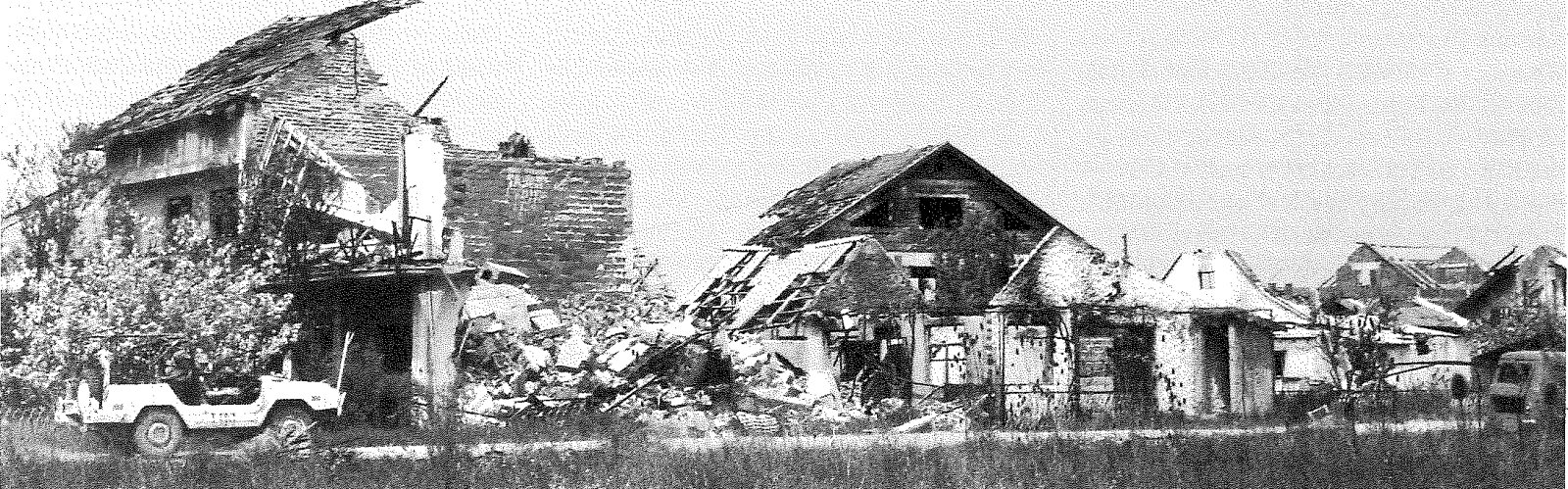
Realization that we are in a war zone dawns slowly as our convoy of automobiles traverses the flat land to the east of Zagreb. The first few wrecked houses, where Serbs undoubtedly lived, make little impression. Then their number becomes impossible Visoko, Bosnia to ignore. Gaping holes are punched in terra cotta roofs and only the sturdiest partitions stand erect amidst the rubble. The scene is more harrowing because the wrecked houses are interspersed with others still intact.
This is Western Slavonia or Sector West, one of the UNPAs the peacekeepers are supposed to secure and demilitarize. The Canadian contingent here is the Second Battalion of the Princess Patricia’s Light Infantry (PPCLI). There are Argentineans to the north, Jordanians and Nepalese to the south. The peacekeepers monitor movements in and out of the area and keep watch over the places where the Serbs were persuaded to deposit their heavy weapons. UNPROFOR is also charged with restoring civil authority in the UNPAs and enabling those who lost their homes to get them back. The peacekeepers are being told to keep their heads and try to cool tensions. “What I do not need in Croatia is a bunch of Rambos,” Lieutenant-Colonel Jim Calvin, the commanding officer and a native of Oshawa, has written in the first number of the soldiers’ newspaper, The Sandbag.
From Camp Polom near Daruvar we travel to a checkpoint in hilly, wooded country, where McDougall shakes hands all round. “I’m just a reservist, ma’am,” explains one young Seaforth Highlander apologetically, drawing a protest from Lieutenant-Colonel Calvin, nearly half of whose command come from reserve regiments such as the Seaforths. Then to Pakrac, scene of some of the bitterest fighting in the war, where there are eerie sights of gaunt, half destroyed buildings. The Canadians are experimenting with building peace from the ground up by resettling Serbs and Croats on the same street. The locals are apparently quite content to live in mixed communities, but the government of the self-styled “Republic of Serbian Krajina” in Knin will have none of it.
On to Lipic, another scene of massive destruction, once a spa much frequented by Austrians and the home of the famous Lippizaner stallions of the Vienna Riding School. Some of the horses were lost to a fire caused by the conflict. The soldiers have assembled a display of weapons taken from homes in the area. We are cautioned not to wander into the underbrush by the roadside for fear of landmines.
Throughout the afternoon the tensions crackling beneath the surface become more apparent. Calvin tells us that peacekeepers’ patrols have recently been fired upon and points out where locals have been ambushed Tensions in the communities reflect the struggle being waged between Zagreb and Knin. Possibly a quarter of a million Serbs left the UNPAs as a result of the war, and Croatians similarly were evicted from their homes and communities. Tudjman is determined to get Sector West back, as well as the other UNPAs. The rising temperature is evidenced by Croatia violating its agreement not to place artillery in forbidden zones adjacent to the UNPA boundary. A green Croatian spring may be gathering strength but the landscape is dry tinder.
On returning to Zagreb from the ruined homes of Sector West, we must look straight into the human face of war. Fourteen hundred Bosnian refugees, the majority women and children, crowd the Zaprude Camp. The Minister does the rounds of tiny rooms, asking the inhabitants to tell their stories and almost invariably having them break into tears. One room houses eight, a man, six women and a child. She hears how the daughter of one of the women accidentally came across her father’s body in the fields. Some of the women saw their husbands killed before their eyes. Even now the refugees’ circumstances are not easy and McDougall will be able to direct some Canadian aid funds to their benefit. Thanks to her intervention, the inhabitants of the Camp will have a special building for preparing their meals and will no longer have to cook in their rooms.
Wednesday, May 5, Sarajevo and Visoko
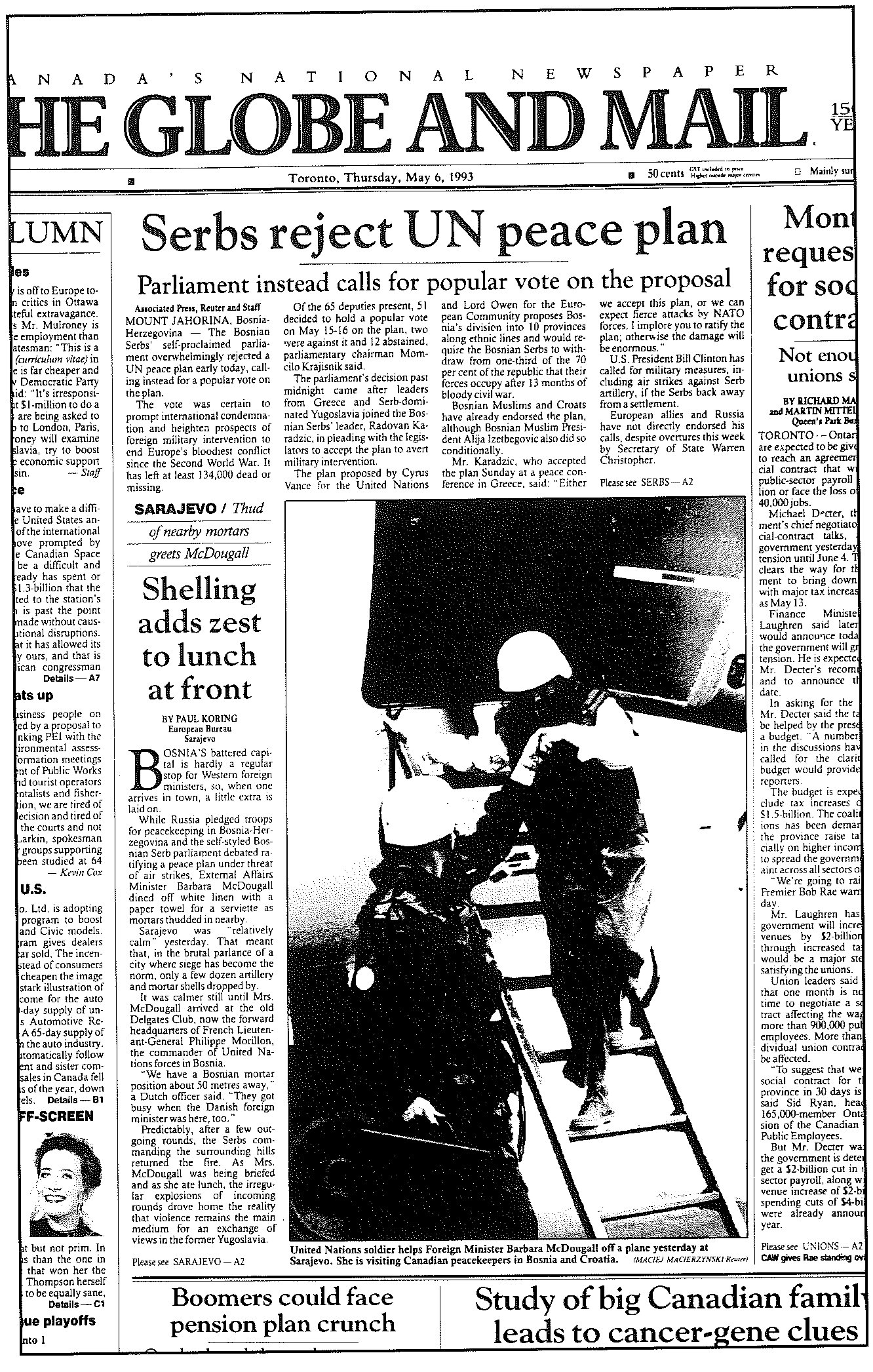
Descending into Sarajevo in a Russian Ilyushin, the pulse quickens. Paul Koring of The Globe and Mail hears bullets ricocheting off the aircraft and, when the door is open, there are dull thuds in the distance. Perhaps these are simply to impress a visiting dignitary, but there is no mistaking the photo opportunity. The Minister’s descent from the plane in helmet and flak jacket is tailor-made for tomorrow’s front pages. She strides across the tarmac in the eye of a retreating television camera and is at once engaged in an interview with Anna Maria Tremonti of the CBC. The message that McDougall most wanted to register with the home audience she now gets across in a matter of seconds: I came to Sarajevo.
The visit starts awkwardly. General Morillon, who should be the Minister’s host, sends his regrets. McDougall will later talk to him by telephone about the situation in Srebrenica. Sitting in his sandbagged headquarters, another former residence of Marshall Tito, we are briefed on the humanitarian relief operation. Of the total Bosnian population of four million, 2.3 million need to be provided with the basic necessities of life. The two biggest problems confronted by the United Nations High Commissioner for Refugees (UNHCR) and UNPROFOR are the lack of supplies in the pipeline and the proclivity of the Serbs to demand different credentials each time a convoy seeks freedom of passage.
The briefing over, we lunch at General Morillon’s table, our conversation punctuated by explosions near and far. “For every one of those explosions you can expect there will be casualties,” says Tony Land of the UNHCR, to dispel any thought that the adversaries are merely advertising their ardour. (Two people are later reported killed.) Colonel Valentin, the French chief of staff of the Sarajevo command, explains that there is a hospital, just down the road, in the centre of which the Bosnians have placed a mortar. The Serbs, it appears, have no monopoly on ruthlessness.
Down a broad avenue, hunched in our armoured personnel carriers (APCs). If the inside of a closed APC were not sufficiently oppressive an Egyptian soldier lights up a cigarette! We clamber out, shed our flak jackets and, joined by some shabbily dressed press photographers, charge up the staircase of the Bosnian Presidency and crowd into a boardroom where sombre paintings are superimposed on filthy walls. The Canadians who, owing to the rigours of travelling by APC and Ilyushin, by now resemble the crew of a carwash, range along one side of the table, the Bosnians along the other. I am opposite a weather-beaten General Jovan Divjak, deputy commander-in-chief of the Bosnian Army.
Prior to coming to power, President Alija Izetbegovic’s political activities, including work with Muslim youth, earned him two prison sentences amounting in total to over ten years. Today, his opening theme is the tragedy of a devastated country, villages destroyed, 1.5 million people expelled from their homes. He urges McDougall to visit a hospital, mentioning one in the centre of the city that has been shelled five hundred times. Then he adds ominously, “We’ll see what happens during the meeting.”
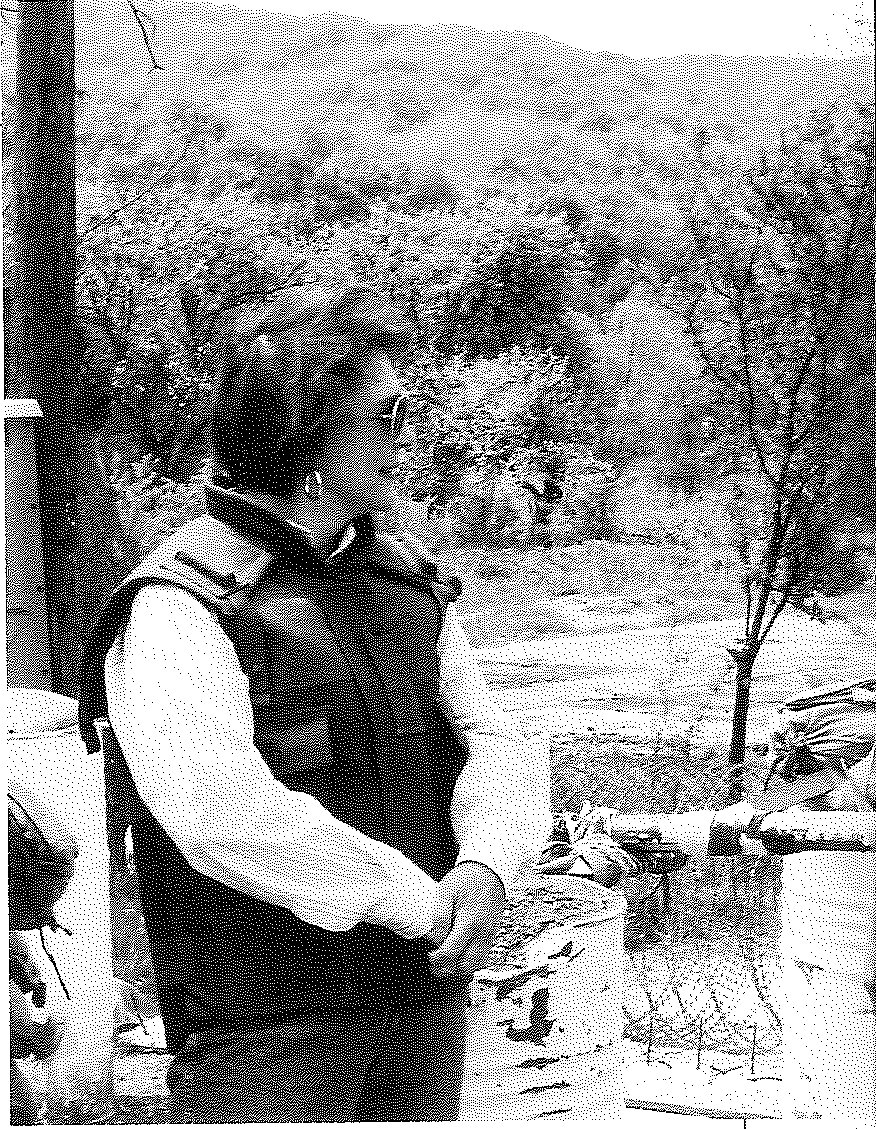
Boosting morale in Bosnia
McDougall gets straight to the Vance- Owen Plan, which she describes as not the optimum but a base on which to build. If peace is in prospect, Canada will assist. She asks Izetbegovic how he views the implementation of the Plan. At least 50,000 to 70,000 troops will be needed, he responds, and the first phase of the implementation should be run by NATO. But he wants to ease the conversation back to his theme, painting the picture of a Bosnia and Herzegovina where nationalities, religions and cultures mingled and lived peaceably and now desire to continue to do so. In Sarajevo, not five hundred yards from each other stand a Catholic church, an Orthodox church, a Jewish synagogue and a Moslem mosque. To illustrate his theme further, Izetbegovic turns to the Minister of Information, whom he identifies as a Croat, and then to the President of the Parliament who, we are told, is a Serb. (He misses Divjak, who is also of Serbian origin.)
McDougall’s response is to remind the President that there is nevertheless mistrust existing among the leadership of the successor states. “I will urge the international community to carry on with sanctions (on Serbia and Montenegro) until there is a demonstration of goodwill towards the peace plan, in its implementation,” she assures Izetbegovic, stressing the last three words.
The room lights flash on and off intermittently and from outside the window comes the cackle of small arms fire. The line separating the Bosnian forces from the Serbs is, after all, only a few hundred metres away. Izetbegovic sits impassively and McDougall, who experienced a shooting war in Haiti not long after becoming Minister, plunges ahead, trying to get him back to Vance-Owen. He sounds unconvinced that enough outside forces will be forthcoming to ensure peace but, if it can be achieved, prospects are encouraging. The refugees, he believes, will return and the country is rich in natural resources.
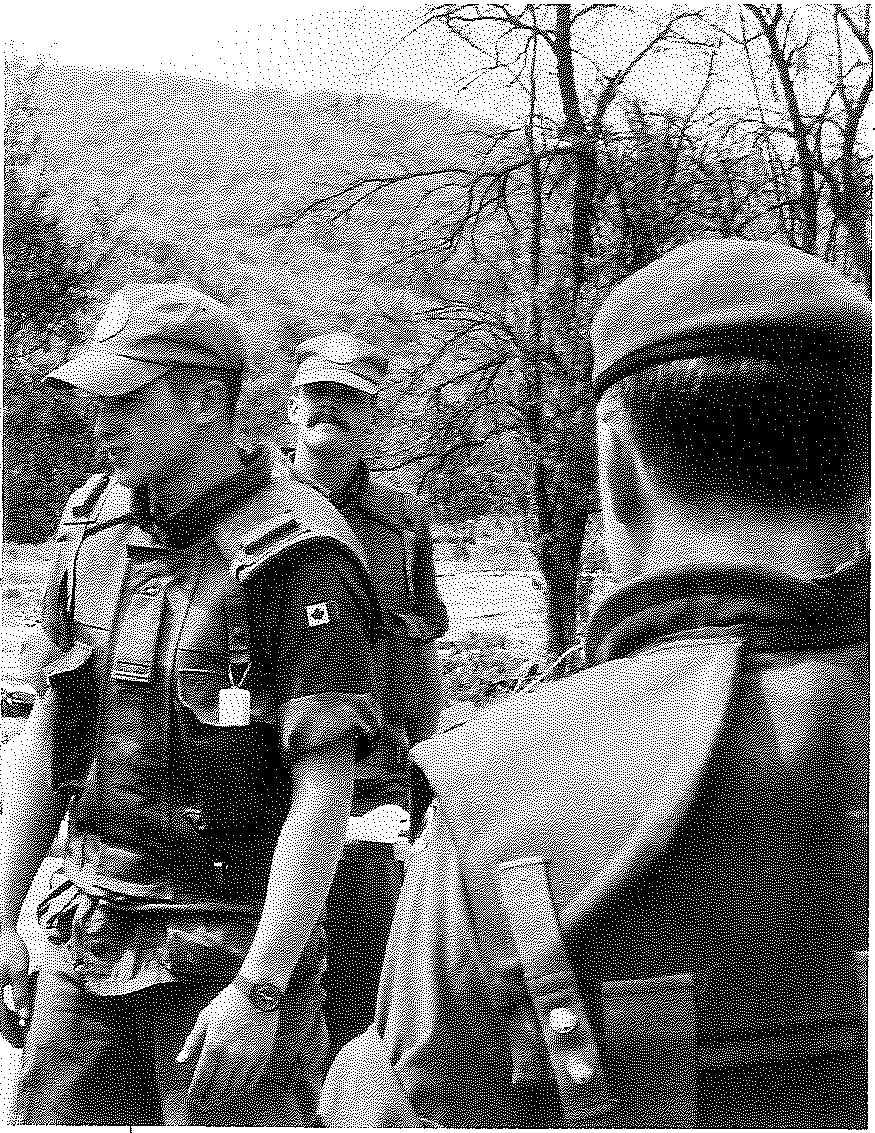
Before leaving, McDougall must register a complaint about reported incidents of Bosnian forces shelling their own people, apparently in or around Srebrenica. “Please look into this to ensure everyone in the region is respecting the safe area.” Izetbegovic is unexpectedly apologetic, possibly misunderstanding the nature of the complaint “I can assure you that our people look on the UN with sympathy, especially the Canadian and the French forces,” he says. Their expectations of what UNPROFOR could do for them have, however, been disappointed, which may account for the reported incidents. “They originally thought the peacekeepers came to defend them from the Chetniks.”
President Izetbegovic undoubtedly thinks a tour of Sarajevo will reinforce his arguments. The reaction that the besieged city does arouse is a mental struggle with startling contrasts, beginning with the sound of explosions that are incongruous in a superb natural setting like this one. The suburban homes that mount the nearby hills to the north, though they look benign, shelter Serb snipers. The dislocation of war is signalled more graphically by the sight of the installations for the 1984 Olympics with a sea of Christian and Muslim grave markers in the foreground. At the spot where, according to what we can grasp from our driver’s Serbo-Croatian, the Archduke Franz Ferdinand was assassinated by a Serb in 1914, a scar on a wall shows where a plaque must have rested. The driver hands me two letters to be mailed in Zagreb, pointing mutely to the wreckage of the post office. The streets are almost deserted, but from time to time little knots of hurrying people appear in the distance.
The tour concludes when we transfer to the aging M-113s that will transport us to the Canadian bases at Visoko and Kiseljak, a few miles northwest of Sarajevo. In an amazingly swift transition the scenery becomes almost bucolic as we clatter along country lanes and up winding mountain roads past neatly tilled plots and farming families, some of whom wave when they see the blue berets of the UN. Periodic checkpoints interrupt any pastoral reveries: three Serb checkpoints leaving Sarajevo, then a Croat checkpoint before entry into Kiseljak, finally across a bridge and we are waved through by Bosnian government soldiers. The guards, both men and women, cigarettes drooping from their lips, are the target of dark mutterings from inside the APCs about how much slivovitz they consume.
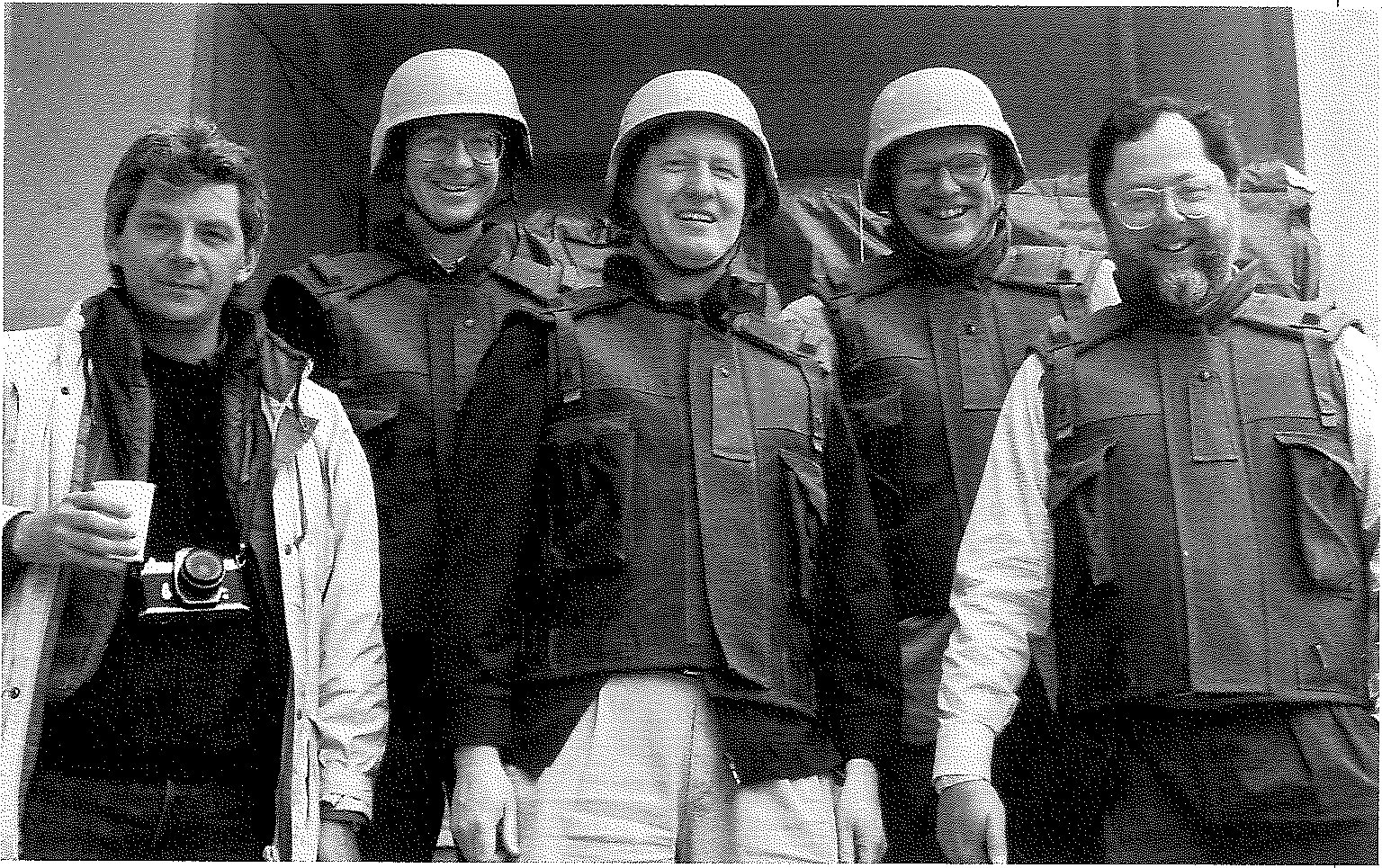
An infantry battalion group, drawn primarily from the Second Battalion, the Royal Canadian Regiment (RCR) and numbering just under one thousand, is near completion of its six-month tour in Bosnia. The main task of the peacekeepers, who are commanded by Lieutenant-Colonel Thomas Geburt, has been to escort humanitarian relief convoys in the Sarajevo region and in eastern and central Bosnia-Herzegovina. At Visoko, they are billeted in an abandoned factory in what appears to have been an industrial park. Sleeping accommodation is in tents pitched inside the cavernous building. If you want to visit the showers in a neighbouring structure you wear your helmet and flak jacket.
Dinner with the officers and noncommissioned officers climaxes with pears Hélène, in which the military cooks take an obvious pride. The mood belies the shabby, makeshift surroundings. There is that distinctively heady feeling that athletes get from being part of a team that has triumphed against all obstacles. It carries over into an evening that mixes socializing with work. An advance party from the replacement unit, the Second Battalion of the Royal 22nd Regiment (the “Van Doos”), is settling in. The young adjutant of the RCR unit, who will shortly be marrying a Croatian girl in Zagreb, is subjected to a good deal of banter. After filing their stories, the press repair to the “Hard Rock Café” where the buzz of conversation is mounting.
This is a chance to corner Colonel Geburt on the subject of Srebrenica. He is willing to talk. Srebrenica has given this unit a boost. Peacekeepers returning from there, on rotation, share a special élan. A few weeks ago they were sent to the town to assist with its evacuation. Thanks to the agreement that the redoubtable Morillon negotiated with the combatants, they wound up with responsibility for a “safe area” of twelve square kilometres, in addition to more routine jobs such as providing security to a hospital and enabling the restoration of the water supply. Thus far, the agreement is working. So well, indeed, that it has emboldened the UN Security Council to seize on the idea of safe areas as a means of halting the abhorrent practice of ethnic cleansing. Just after we leave Bosnia the Council will declare Sarajevo, Zepa, Gorazde, Bihac and Tuzla to be safe areas in addition to Srebrenica.
Nevertheless, should a handful of lightly armed Canadians have been saddled with the defence of an entire town, packed with refugees, against Serb regulars fifty times their number, to say nothing of irregulars allied to the Serbs? The Colonel’s matter-of-fact account makes it clear that the confidence-building role and impartial status of the small UN force were accepted by both sides. The Canadian commander was in fairly frequent communication with the warring parties and had no reason to think that he was about to be attacked by the Serbs. In the event of such an attack the peacekeepers would have tried to defend a core area, not the whole town. If the Canadians were “left in the lurch,” as some have feared, they were certainly unaware of it.
Thursday, May 6, Visoko and Zagreb
Breakfast with a young private on his way to Srebrenica. His adrenaline is visibly pumping. This morning CNN is carrying the news that the Bosnian Serb “parliament” in Pale has rejected the Vance-Owen Plan and soldiers crowd around the television set. Then we embark in M-113s for a bone rattling trip to Sarajevo airport and, aboard another Russian cargo plane, fly back to Zagreb. In the evening there is a long stuffy dinner, finishing with port and Irish coffee, at the Esplanade. We toast the memory of Sergeant Michael Ralph and Master Corporal John Ternapolski, the two Canadian peacekeepers who have died in the former Yugoslavia. In the morning the Challenger will take us to Nairobi, which will serve as our base for the visit to Canadian troops and UN officials in Somalia.
View the original scanned pages →
Originally published in bout de papier, Vol. 13, No. 2 (1996) — Summer 1996 // Été 1996, pp. 21–25. Read the rest of this issue →



