bout de papier, Vol. 13, No. 2 (1996) — Summer 1996 // Été 1996, pp. 18–20
For over a decade, officers in the political-economic stream of the department have been under silent pressure to change. This is because successive governments have been placing greater and greater emphasis on trade promotion in foreign policy. Last year’s foreign policy review confirmed that the trend will continue, as well it should given the connection between exports and jobs.
Trade Commissioners have been adapting well to this evolving departmental culture. Political officers have not. I say political officers because there is a growing bifurcation in the political-economic stream: some officers have been migrating to the other side of the hyphen — economic — to nest in specialist roles in trade and economic policy. Becoming known as economic officers, they too are adapting.
Where does that leave political officers? Are we to compete with journalists to report the news, pausing only long enough to meet demands for briefs and speeches? Or are we to be the messengers on narrow issues of foreign policy, disturbed from our routines only by the need to arrange occasional visits and conferences? The answer, of course, is that we must continue to do all of this. Unfortunately, if that is all we do, we will continue on our way toward a rendezvous with the dinosaurs.
It doesn’t have to be that way. Far from being marginalized, the political officer has a more important role than ever to play in support of Canada’s trade and other foreign policy objectives. The introduction of the country desk system offers a clue about what this role might be. Large corporations, with their government relations divisions, provide another. To put it simply, someone has to understand the political environment in which business operates. What’s more, someone has to use this information to devise precise and detailed strategies to advocate Canadian interests abroad. Both are crucial in an age of globalisation, where commerce and politics often intersect. Neither can be achieved without first harnessing the deluge of information that our new communications technology has brought upon us.
As some of our larger missions have already learned, the political officer can do this, but not without first being “retooled”.
Stopping the Information Rot…
The Japanese have pioneered a management approach called kaizen, which literally translated means improvement. Its meaning goes well beyond this. One of its main tenets is that improvements in the work of any organisation rely to a large extent on the sharing of information. In his seminal book named after the approach, author Masaaki Imai points out that, like any other raw materials, “information rots, too.”
We all know instinctively what this means. But his elaboration of the point holds up a clear mirror:
Information that is collected but not properly used rots rapidly. Any manager who does not forward information to the interested parties, and any management that does not have a system to use information, is doing a great disservice to the company….The trouble with many managers, however, is that they regard information as the source of their authority and try to control their subordinates by monopolizing it. Often they do this at the risk of sacrificing the organization’s effectiveness. Managers may be totally ignorant of the value of information and the contribution it can make in the hands of the right people at the right time.
In the department’s case, “managers” can be taken to mean anyone who controls information. That includes all of us.
For our purposes, the lesson taught by kaizen is clear. We need to make sure that relevant information gets to the right people quickly. More than that, it has to be converted into some form that assists in the pursuit of Canadian interests and improves the work of the department. Talking about it won’t make it happen. It requires a knowledge of the playing field, a good playbook, and a versatile quarterback.
Pointed Analysis…
Just as a large corporation needs to understand the political environment in which its business operates, an embassy or geographic division needs to understand the host country with which it is dealing. This is the starting point for the political officer, and always has been. There is, however, a way to put a “pointy end” on what can otherwise all too often become merely an academic pursuit.
Last year, a newly-arrived senior manager at the mission where I am currently assigned, asked the deceptively simple question: “Who’s running the country?” This sparked a long voyage of research that eventually arrived at the answer: “Nobody …..and everybody!”
Our analysis showed that the set of actors involved in decision-making varied greatly according to the issue. While these actors, presumably our target contacts, overlapped in some cases, there was no one set of people to whom we could turn to advocate Canadian interests when trade issues became political or when we wanted to promote other forms of cooperation.
Maybe we should have known this all along. Maybe it applies to every country. In any case, we now had to face the issue of what to do about it. If we were to go out and try to determine who the key players were on every conceivable issue, there would be no time for anything else. It seemed logical, therefore, to try to specify the issues that warranted Canadian government advocacy.
We quickly came up with a couple of pages of lists — not a helpful start when one is trying to narrow the field. But then we submitted each issue to a test: what was our actual objective in connection with that issue? For example, if the issue was deregulation then our objective might be identified as promoting deregulation of the building products sector. That would at least narrow the field and allow us to start to determine the players. But it was only the beginning.
Using the same example, we quickly realized that we would have to determine which regulations were keeping Canadian building products out. And after that we would have to find out who the people were around those regulations. Then we would have to know where those people were situated on the political map. And on and on, until it became woefully clear that our analytical conclusion would lead us into a very tangled web, ensnaring nearly every embassy program.
The issue then came back to this: “How do we manage this information?” We had long maintained a database of contact politicians and officials. It had proved useful and we wanted to keep it. The problem was that the database neither situated our contacts in any kind of useful political landscape, nor connected them to any specific Canadian interests.
Clearly, we needed new tools to do this, and a new approach to information management.
Map-making…
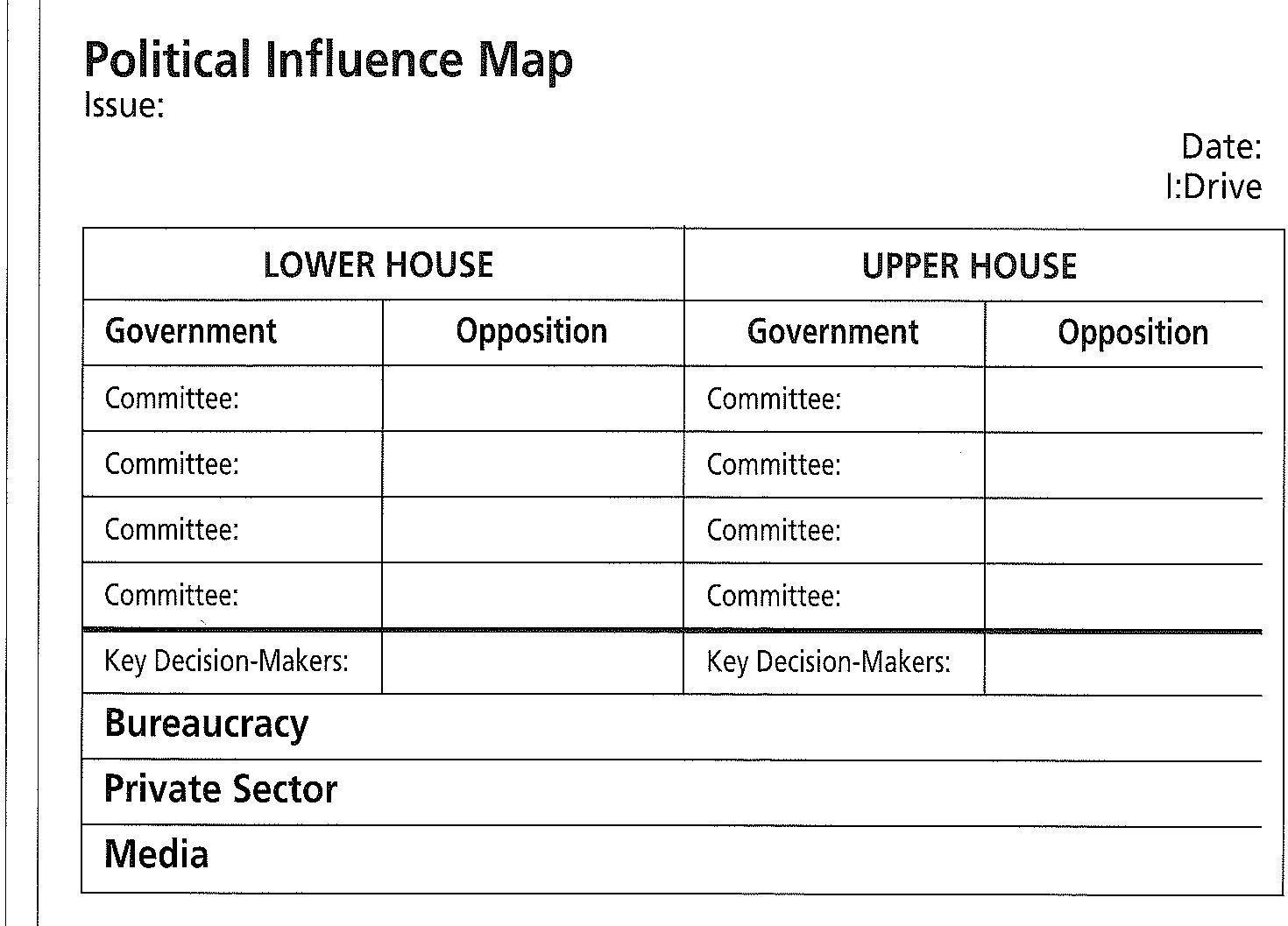
The first self-imposed rule was that any new tool had to be very simple to use. Judging from my own skills, anything requiring above average dexterity at the computer terminal would sound the death-knell for the idea. We also wanted something visually cogent. After some experimenting, we came up with what we called a political influence map, which is really a guide to the playing field on any given issue. When the names of the key actors are filled in, it also becomes a practical contact matrix. Here is the template we devised, which we now use with each priority issue on which we seek to promote Canadian interests (see left, at top).
Once we started to fill in the blanks, the matrix quickly grew to two or three pages. In the case of deregulation, we were able to identify between three and six government committees involved in one way or another. Inside each, there were anywhere from six to twenty members, all of whose names were listed. To this we also added the private sector players, officials, and journalists who seemed to exert some influence on the process of deregulation. As the players and loci of influence changed over time, we quickly learned that the matrix required regular updating.
In the end, we wondered how we had ever hoped to keep track of this complex network without a map.
Strategizing…
But, as our analysis had suggested, the map would be useless unless it could be connected with something that would define our objectives, list appropriate courses of action, and then record our actions and their results, so that we could learn and adjust our behaviour accordingly. To put it another way, in addition to a map of the playing field, we needed a playbook.
All too often, in cases where a trade issue becomes political, it is still approached with old think. A two or three page document is written which states the objectives and then lists possible steps to achieve them. Unfortunately, the very format of such a document makes it static and inflexible. It does not allow for the absorption and sharing of new information as the process unfolds. The available technology means we can do better.
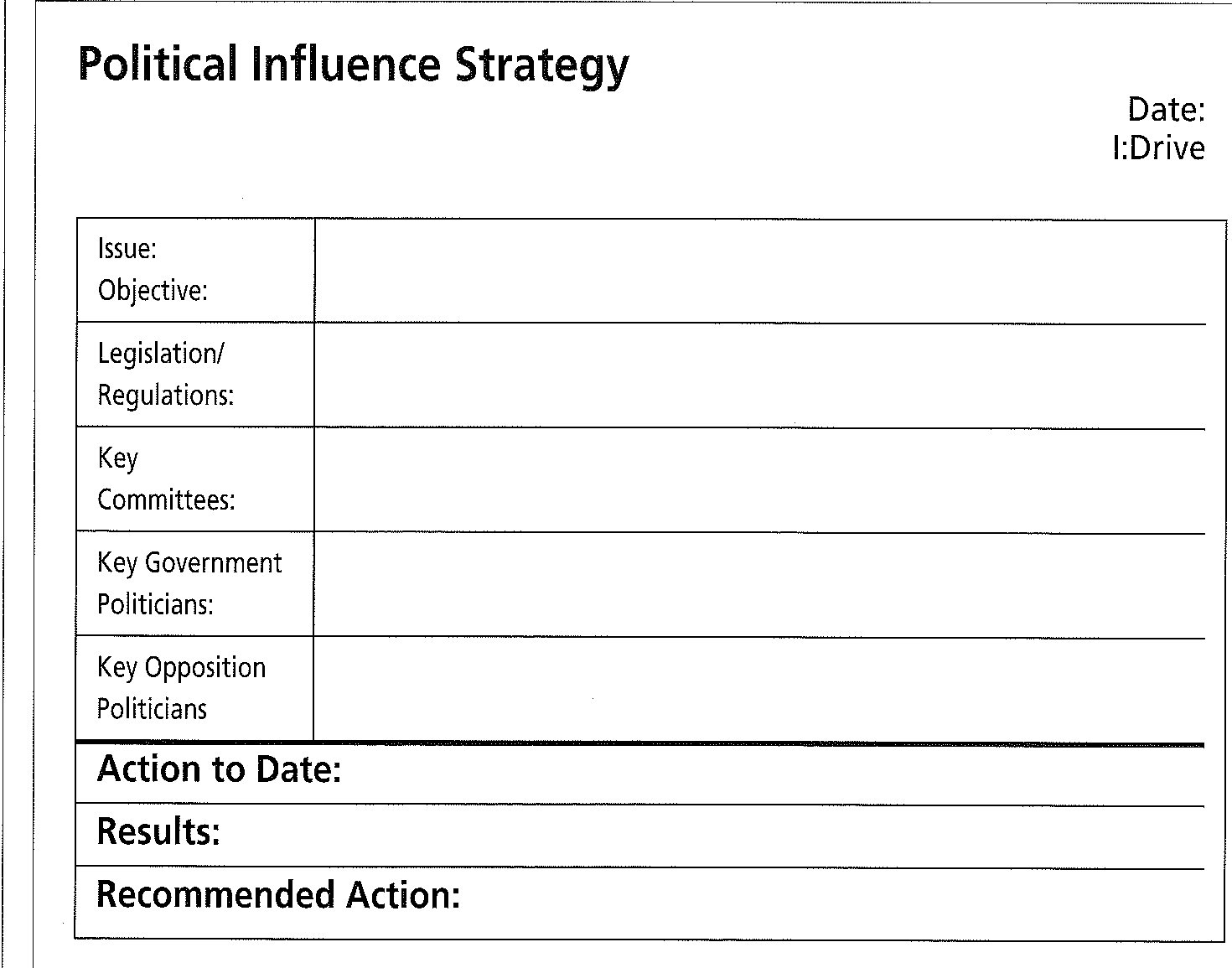
In short, we decided that we needed a second tool, a political influence strategy to serve as our playbook for moving the ball down the field. Here is the template that we came up with (see bottom left).
By filling in this matrix, and saving it in a numerical series as new information is added, it is possible to keep a record of developments, as well as actions taken and results achieved. This in turn allows for learning and strategic adjustment. In time, it becomes the definitive track record on the advocacy of any given Canadian interest in the host country. It tells you what works and what does not.
Virtual Teamwork…
As you might have guessed from the football metaphors, the key to making these tools work is teamwork. Task forces must be established around each issue. We were amazed at how much information we already had within the mission, but were simply not sharing with each other. You might think this means more dreary meetings. In fact, it means fewer.
How? The matrices are put on a shared computer file in the embassy. Task force members simply open the matrix, insert the information they have, and close it again. They can see exactly what information others have at any given time without the need to meet. In essence, they become a virtual working group.
The assumption is that no one individual can manage all of the information, but that all members need to know what the others are doing in order to learn and adjust their own behaviour.
Task forces need not be limited to embassy staff alone. Provincial or private sector representatives, headquarters officials, and anyone else who might happen to be pursuing the same interests can also be included. The result is that the country desk system is extended well beyond its original conception.
Of course, it’s easier said than done. In reality, people do not adjust readily to this kind of approach, partly for the reasons described by author Imai, partly because they are just too busy to deal with yet another task, and partly because it requires change. The political officer needs to quarterback the information flow. As the one who best understands the political environment, the political officer is in a critical position to advise the group on further actions that should or should not be taken as the strategy unfolds.
Results…
This technique has turned out to be effective on several levels. It forces us to identity our priorities and define our specific objectives. It provides a system for organizing relevant information in an accessible manner, staving off the dreaded information rot. It connects the political officer’s analysis and advocacy with the work of the other programs in the embassy, and with the government’s overall objectives. It promotes close cooperation and sharing of information. Finally, it provides a track record that can be indispensable in deciding when an issue needs to be added to the high-level bilateral agenda.
We have found that the approach works best in cases where we want to bring about changes in host country regulations that are unfavourable to Canada, or where we want to raise the profile of products that are in the running for government procurement contracts. It can also be used when the objective is to foster closer political cooperation, for example in such fields as peacekeeping or the environment.
Does it sell widgets? We didn’t think at the beginning that it would. That wasn’t the point. The purpose was to document our efforts and learn along the way. Win or lose, we would at least be satisfied that we had given it our best shot in each case and learned something in the process.
But the results, in the cases we have tackled so far, have exceeded our expectations. Simply by knowing precisely who to talk to, at what level, and at what stage in the process, we have already made breakthroughs with potential commercial benefits for Canada. It has been more than enough to encourage us that we are on the right track.
The approach has ancillary benefits as well. Some issues continue without resolution for many years. Despite this, on arrival at their new assignments officers often find a clean desk and an empty office, with little indication of what has gone on before. This can be avoided. Documented strategizing allows our successors to see precisely what we have been doing. Though to some that might sound a bit frightening, it at least provides some badly needed continuity.
Moreover, officers who base their actions on such systematic strategies arguably present a more professional image to their Canadian and foreign clients alike.
The approach might not work for everyone, everywhere. Missions and geographic divisions differ greatly. Clearly, the matrix categories would change to suit the local environment. But I can think of other assignments where I would have used the approach, had this tool been available.
Political officers cannot possibly hope to compete with journalists for the news. On the other hand, we cannot rely on CNN to advocate Canadian interests either. That is our job. It is real politics. With a bit of retooling, the political officer can approach it with the rigorous professionalism it deserves.
View the original scanned pages →
Originally published in bout de papier, Vol. 13, No. 2 (1996) — Summer 1996 // Été 1996, pp. 18–20. Read the rest of this issue →